A few years ago, I opened a Referral Notice and before I'd reached page three, I thought: this one's going to be trouble.
I hadn't read the witness statements. I hadn't looked at the programme. I hadn't even reached the quantum claim.
I just had a feeling.
Now, lawyers and adjudicators aren't supposed to admit things like that. We're supposed to weigh the evidence, analyse the facts and apply the law.
Feelings aren't invited.
Or are they?
The neuroscientist Antonio Damasio spent years studying how emotion and decision-making interact. His work challenged the idea that good reasoning requires emotion to be stripped away.
Damasio argued that emotion is not the opposite of reasoning.
It is one of the mechanisms through which reasoning and decision-making become possible.
He described somatic markers: bodily and emotional signals associated with possible outcomes, shaped by previous experience.
Think of them as rapid evaluative signals.
Imagine a project manager who has lived through three disastrous projects.
The emails become more defensive.
Meetings become more frequent but less productive.
Small issues take longer to resolve.
Nobody quite trusts the programme.
None of this proves the project is in trouble.
Yet experienced people may start feeling uneasy.
Their stomach sinks.
Their patience shortens.
Their attention sharpens.
According to Damasio, that feeling may not be irrational noise.
It may be experience expressing itself through emotion before conscious reasoning has fully caught up.
The brain has seen something like this before.
But how does that experience get translated into a judgment?
That question takes us from Antonio Damasio to Gary Klein.
Gary Klein found something similar when studying firefighters, military commanders and other experts making decisions under pressure.
He observed that experienced decision-makers rarely begin by systematically comparing a range of alternative solutions.
Instead, they recognise a familiar pattern, generate the first workable course of action, and mentally test whether it is likely to work.
Klein called this Recognition-Primed Decision Making.
The expert may not be guessing at random.
The expert may be matching today's clues to yesterday's experience.
The recognition comes first; the explanation often follows afterwards.
That uneasy feeling about the project, the claim or the witness may therefore be the mind recognising a familiar pattern before the person can fully explain why it feels familiar.
Not every environment rewards intuition. As Kahneman and Klein later agreed, intuition is most reliable where there are regular patterns and enough opportunities to learn from experience.
Construction projects, claims and disputes often contain recurring patterns, which is one reason experienced professionals can sometimes detect problems before they can fully articulate them.
But there is an important qualification.
Intuition is not automatically reliable.
A feeling can reflect genuine expertise.
It can also reflect bias, anxiety, overconfidence, fatigue or simple wishful thinking.
The existence of an intuition does not establish that it is correct.
Klein's work is most persuasive in environments where meaningful patterns actually exist and where the decision-maker has had enough valid experience to learn them.
That matters in disputes.
An experienced adjudicator may notice a pattern that deserves attention.
But the feeling is not the evidence.
It is a hypothesis to investigate.
That is the distinction.
Good judgement is not the absence of feeling.
It is knowing when experience may be trying to tell you something — and then testing that signal against the facts.
So the next time a project feels wrong before you can explain why, don't assume you're being irrational.
The feeling is not the conclusion.
It is the clue.
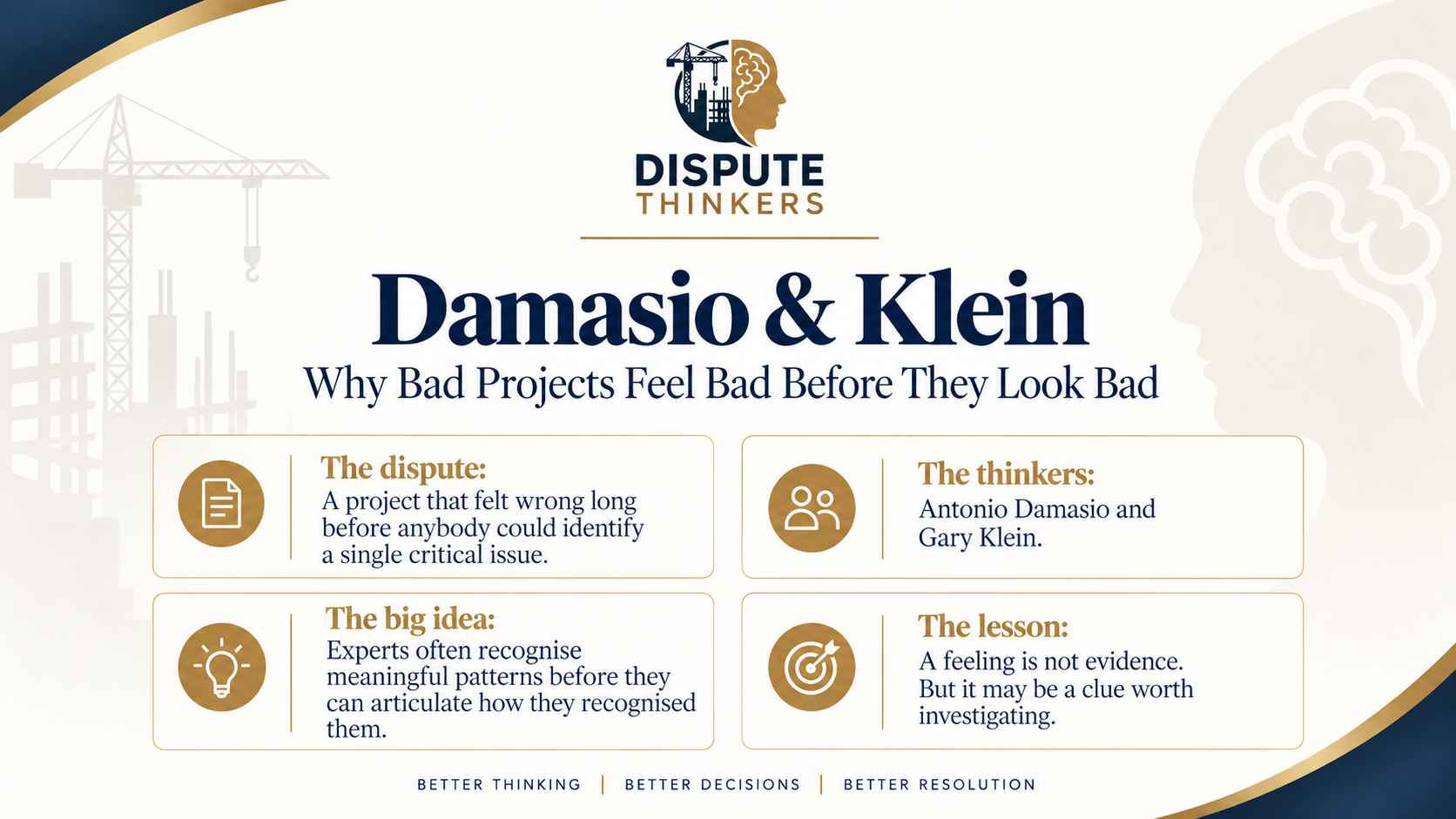
#DisputeThinkers #Psychology #DecisionMaking #HumanBehaviour #ConstructionLaw #Adjudication #Negotiation #BehaviouralScience #ProjectManagement #DecisionScience
Sources and additional information
- Damasio, A. R. (1994). Descartes' Error: Emotion, Reason and the Human Brain. New York: Putnam.
- Damasio, A. R. (1999). The Feeling of What Happens: Body and Emotion in the Making of Consciousness. New York: Harcourt Brace.
Core concept: Damasio's Somatic Marker Hypothesis challenges the idea that emotion and reason operate in simple opposition. Emotional and bodily signals can help guide decision-making by attaching evaluative significance to possible outcomes, often drawing on previous experience.
- Klein, G. (1998). Sources of Power: How People Make Decisions. Cambridge, MA: MIT Press.
- Klein, G. (2003). Intuition at Work. New York: Currency.
Core concept: Recognition-Primed Decision Making. Klein's research suggests that experienced decision-makers in familiar, time-pressured environments often recognise patterns, identify a plausible course of action and mentally simulate whether it will work rather than systematically comparing numerous alternatives.
- Klein, G. (2013). Seeing What Others Don't: The Remarkable Ways We Gain Insights.
Core concept: Klein examines how people detect connections, contradictions and anomalies that can produce sudden insights, and why expertise can sometimes enable people to notice significance that others overlook.
- Kahneman, D. (2011). Thinking, Fast and Slow. London: Allen Lane.
- Kahneman, D., & Klein, G. (2009). “Conditions for Intuitive Expertise: A Failure to Disagree.” American Psychologist, 64(6), 515–526.
Core concept: Intuition is most trustworthy where the environment contains sufficiently regular patterns and the decision-maker has had adequate opportunity to learn them. Confidence alone is not proof that an intuition is accurate.
Dispute Thinkers
Why Intelligent People Disagree
Better Thinking | Better Decisions | Better Resolution
© 2026 Nigel Davies
Back to Dispute Thinkers