McLean & Anor v Winchester Medical Aesthetics Ltd [2026]
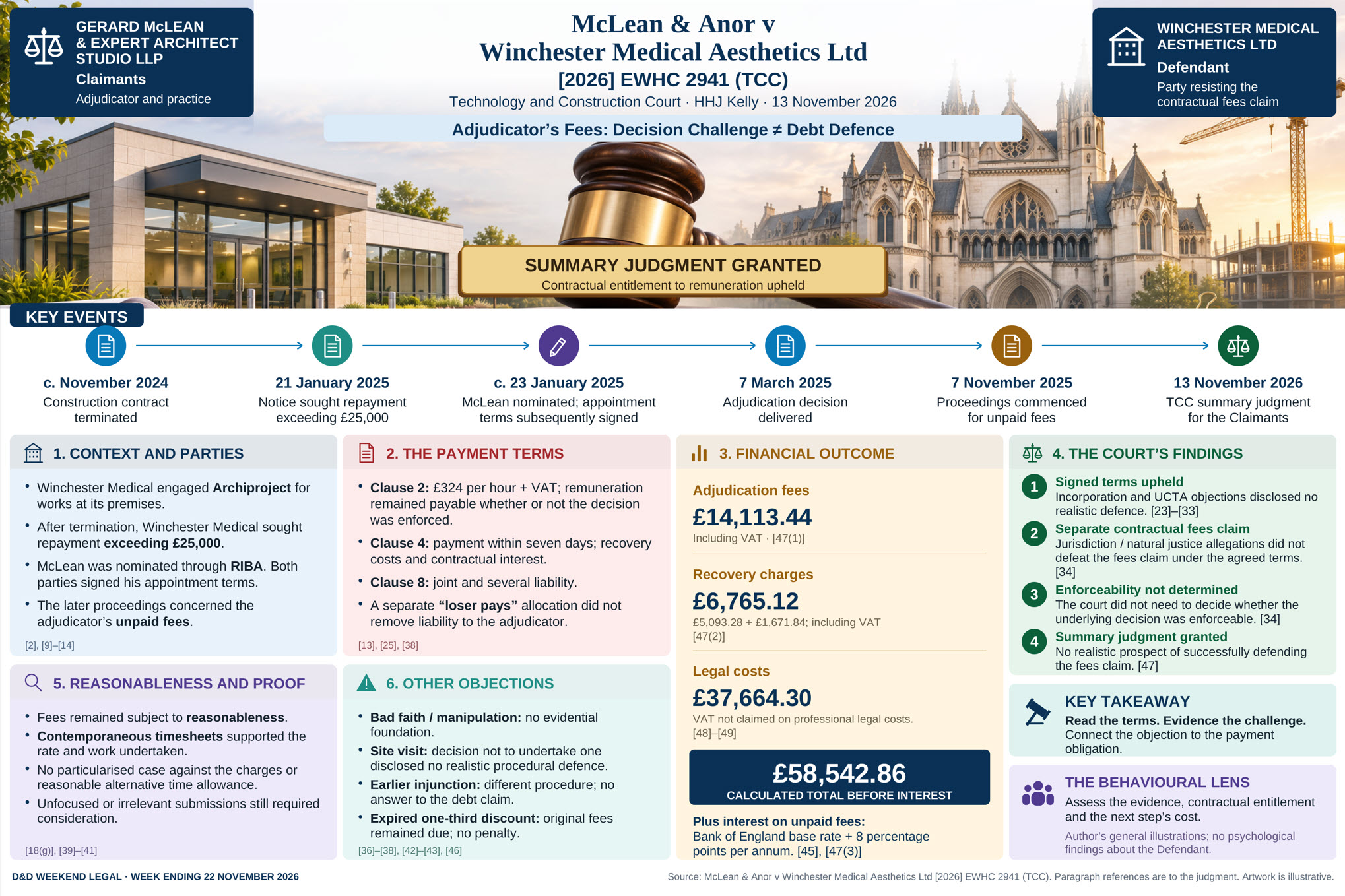
An adjudicator and his practice obtained summary judgment for unpaid fees, recovery charges, contractual interest and legal costs under expressly agreed appointment terms. Those terms preserved the adjudicator’s entitlement to remuneration irrespective of whether his decision was enforceable. Allegations concerning jurisdiction and natural justice therefore did not answer the separate contractual debt claim, while the remaining objections lacked the particularisation or evidence necessary to establish a realistic defence. The judgment emphasised the distinction between challenging an adjudication decision and establishing a defence to the adjudicator’s contractual entitlement to remuneration, while confirming that the charges themselves remained subject to scrutiny for reasonableness. [13], [18(f)–(g)], [23]–[49]
Key Words
Construction adjudication – Adjudicator remuneration – Appointment terms – Joint and several liability – Allocation of fees between parties – Unenforceable decision – Jurisdiction – Natural justice – Procedural discretion – Site visit – Bad faith – Reasonableness of fees – Contemporaneous timesheets – Recovery charges – Contractual interest – Unfair Contract Terms Act 1977 – Scheme for Construction Contracts – Penalty doctrine – Summary judgment – Costs.
- Headnote
- Mr Gerard McLean and Expert Architect Studio LLP, through which he provided adjudication services, sought payment following an adjudication between Winchester Medical Aesthetics Limited (Winchester Medical) and Archiproject Limited (Archiproject). Both parties had signed the adjudicator’s terms, which provided for remuneration at £324 per hour plus VAT, payment irrespective of whether his decision was enforced, joint and several liability, contractual interest and recovery of collection costs. The decision was delivered on 7 March 2025, but the fees remained unpaid. [1]–[3], [11]–[13]
- Winchester Medical resisted the claim by alleging excess of jurisdiction, breaches of natural justice, partiality, an unjustified refusal to inspect the site and excessive fees. It also challenged the incorporation and enforceability of the appointment terms, relied on an earlier injunction restraining presentation of a winding-up petition, and characterised the expiry of a temporary discount as an unenforceable penalty. [14]
- Held, granting summary judgment, that the signed appointment terms governed the adjudicator’s entitlement to remuneration. They were supplied clearly and accepted without objection, and the Defendant advanced no realistic defence based on incorporation or the Unfair Contract Terms Act 1977 (UCTA). The parties’ separate agreement that the losing party would bear the adjudicator’s fees did not displace their joint and several liability to the adjudicator under his appointment terms. [23]–[33], [38]
- The alleged jurisdictional and natural justice defects might have been relevant to enforcement of the adjudication decision between the disputing parties, but they did not defeat the adjudicator’s separate contractual claim where his agreed terms expressly preserved his entitlement to remuneration irrespective of enforceability. The allegations of bad faith and manipulation lacked evidential support, and the complaint concerning the absence of a site visit disclosed no realistic defence in the circumstances. [13], [34], [36]–[38], [42]
- The adjudicator’s hourly rate and recorded time were reasonable and supported by contemporaneous timesheets. The Defendant identified neither a reasonable alternative time allowance nor another particularised basis for disputing the charges. The additional recovery work and contractual interest were recoverable under the agreed terms, and the Claimants also recovered their legal costs of the proceedings. [39]-[45], [48]-[49]
- The temporary offer to reduce the fees by one third was an offer to accept less than the existing entitlement rather than a secondary contractual obligation imposing a detriment. Its expiry therefore did not engage the penalty doctrine. [20], [46].
- Material Facts
- Winchester Medical engaged Archiproject to undertake works at its premises. Their arrangements constituted a construction contract within section 104 of the Housing Grants, Construction and Regeneration Act 1996. Because the contract contained no dispute-resolution mechanism, the adjudication provisions of the Scheme for Construction Contracts applied under section 108(5). [2], [8]
- Following termination in or around November 2024, Winchester Medical complained about the adequacy of the works and, on 21 January 2025, served a notice seeking repayment of more than £25,000. It applied to the Royal Institute of British Architects the following day, and Mr McLean was nominated on or around 23 January 2025. [9]–[10]
- Mr McLean supplied his proposed appointment terms when accepting the nomination. Both parties signed and returned the terms. Winchester Medical raised no contemporaneous objection. The material provisions were as follows. [11]–[13]
- Clause 2 provided for remuneration at £324 per hour plus VAT for time spent on or in connection with the reference, including where the adjudicator was unable to make a decision, ceased to act or his decision was not enforced by the court.
- Clause 4 required payment within seven days and provided for interest at eight percentage points per annum above Bank of England base rate, together with the adjudicator’s administrative, legal and other costs of recovering unpaid invoices.
- Clause 8 made the parties jointly and severally liable for the adjudicator’s fees and expenses.
- The disputing parties separately agreed between themselves that the losing party would pay the adjudicator’s fees. That allocation did not alter the joint and several obligation which each undertook to the adjudicator. [25], [38]
- The adjudicator delivered his decision on 7 March 2025. Following non-payment, the Claimants commenced proceedings on 7 November 2025, and default judgment was entered on 16 January 2026 after the Defendant failed to file an Acknowledgment of Service or Defence. The Claimants subsequently indicated that they would not oppose the Defendant’s application to set aside the default judgment but would apply for summary judgment if a Defence were filed. [3], [5]–[7]
- The Defence disputed the claim in its entirety. It relied on alleged jurisdictional error, breach of natural justice, partiality, refusal to undertake a site visit, non-incorporation and unreasonableness of the contractual terms, unreasonable fees, an alleged penalty and the Defendant’s earlier success in restraining presentation of a winding-up petition. [14]
- Issues
- Whether the signed appointment terms were incorporated and enforceable, including against the challenge advanced under UCTA. [22]–[33]
- Whether allegations of excess of jurisdiction or breach of natural justice supplied a realistic defence to the adjudicator’s separate contractual claim for remuneration. [22], [34]–[35]
- Whether the allegations of partiality, bad faith and manipulation, and the complaint concerning the absence of a site visit, had sufficient evidential substance to resist summary judgment. [36]–[38], [42]
- Whether the adjudication fees and recovery charges were reasonable and contractually recoverable, together with interest and legal costs. [39]–[45], [48]–[49]
- Whether the earlier injunction restraining presentation of a winding-up petition assisted the Defendant in establishing a realistic defence to the debt claim. [43]
- Whether expiry of the temporary discount engaged the penalty doctrine. [20], [46]
- Decision
- The application for summary judgment succeeded because the Defendant had no realistic prospect of successfully defending the Claimants’ contractual claim. The court awarded the adjudication fees, recovery charges, contractual interest and legal costs claimed. [23]–[49]
- The court did not need to determine whether the substantive adjudication decision was enforceable between Winchester Medical and Archiproject, because the appointment terms preserved the adjudicator’s entitlement to remuneration irrespective of enforceability. Summary judgment disposed of the contractual fees claim without a trial. [13], [21], [34], [47]–[49]
- Reasoning
- The summary judgment threshold
- Under CPR Part 24, the court could grant summary judgment if the Defendant had no real prospect of successfully defending the claim and there was no other compelling reason for trial. A realistic prospect was distinguished from a fanciful one. Applying Easyair Ltd v Opal Telecom Ltd, the court was entitled to examine whether factual assertions had substance, particularly when tested against contemporaneous documents, while avoiding a mini-trial and taking account of evidence reasonably expected to become available at trial. [16]–[17]
- The relevant question was whether any of the Defendant’s objections provided a legally and evidentially sustainable answer to the contractual claim. [14], [21]–[22], [33]–[46]
- Acceptance and incorporation of the appointment terms
- There was no material dispute as to the terms which the Defendant signed and returned. They were agreed in their entirety, supplied promptly, expressed in uncomplicated language and accepted without objection. The court rejected the contention that the material provisions were not adequately drawn to the Defendant’s attention. [12], [23]–[26], [31]–[32]
- The Defendant’s size and lack of specialist construction or adjudication expertise did not establish unequal bargaining power on the evidence. The court accepted that it was free to refuse the proposed appointment, withdraw its notice and recommence the nomination process. [26]–[28]
- UCTA and the separate contractual arrangements
- The Defendant did not particularise how the remuneration, recovery-cost or joint-liability provisions were said to infringe UCTA. The court considered that the challenge appeared to depend on section 3(2)(b), because the provisions were not exclusion clauses. It relied on Steve Ward Services (UK) Ltd v Davies & Davies Associates Ltd [2022] EWCA Civ 153, in which a comparable remuneration provision was held not to fall within that section and, in any event, to be reasonable. [18(f)], [29]
- The judge held that, in this dispute, paragraph 25 of the Scheme formed part of the contract between the disputing parties and did not displace the separate appointment terms relied on in the adjudicator’s debt claim. [30]
- Similarly, the parties’ agreement that the losing party would bear the fees concerned the ultimate allocation of responsibility between themselves. It did not release either party from its joint and several liability to the adjudicator under clause 8. [13], [25], [38]
- Jurisdiction and natural justice
- The critical contractual provision expressly preserved the adjudicator’s entitlement to remuneration if his decision was not enforced. Accordingly, an allegation which might have supplied a ground for resisting enforcement of the adjudication decision did not, without more, answer the independent contractual claim for remuneration under the appointment terms. [13], [18(f)], [34]
- The alleged excess of jurisdiction and breaches of natural justice therefore afforded no realistic defence to this debt claim, even assuming that evidence might otherwise have established those defects. [34]
- The site visit and procedural discretion
- The adjudicator had broad procedural discretion, which extended to determining whether a site visit was required. The Defendant provided insufficient reasoning or evidence to establish that the decision not to undertake a site visit involved a relevant procedural defect or was inconsistent with the evidence. The complaint accordingly provided no realistic defence in the circumstances. [18(c)], [35], [42]
- Bad faith and alleged manipulation
- Allegations of fraud or bad faith required clear pleading, sufficient particulars and strong and cogent evidence capable of displacing the presumption of good faith. The Defendant alleged that the adjudicator manipulated the outcome so that it became the losing party and thereby secured payment of his fees, but the court found no evidential basis for that allegation. [19], [36]–[38]
- The adjudicator’s explanation of his decision-making process was consistent with his reasoned decision and its issue-by-issue examination of the matters before him. Moreover, the alleged financial motive was inconsistent with the agreed terms: clause 8 entitled the adjudicator to pursue either party under their joint and several liability irrespective of which succeeded in the adjudication. [13], [38]
- Reasonableness of the fees
- The adjudicator’s entitlement to remuneration remained subject to an implied requirement that the fees charged should be reasonable in all the circumstances, absent sufficiently clear words excluding that requirement. A bare allegation that the time or fees were excessive, or merely putting the adjudicator to proof of reasonableness, was insufficient. A positive and particularised basis for the challenge was required. [18(g)]
- The hourly rate of £324 and the recorded hours were reasonable and supported by contemporaneous timesheets. The Defendant produced no evidence that the fees were inflated, that the hourly rate was materially inconsistent with that charged by other adjudicators, or that the work could reasonably have been undertaken more quickly. [13], [39]
- Both parties supplied substantial quantities of material and raised procedural issues requiring consideration. Much of the material was unfocused, unclear, incoherently organised or irrelevant. Paragraph 17 of the Scheme nevertheless required the adjudicator to consider the parties’ submissions sufficiently to determine their relevance. The fact that material ultimately proved irrelevant did not mean that the time spent considering it was unnecessary. [40]–[41]
- The Defendant did not materially dispute that the recorded work was undertaken. It identified neither a reasonable alternative time allowance nor any other positive case challenging the reasonableness of the charges. [41]
- Recovery charges interest and legal costs
- Clause 4 entitled the adjudicator to recover his administrative, legal and other costs of recovering unpaid invoices. The further £1,671.84 claimed comprised four hours and eighteen minutes of recovery work at the agreed rate plus VAT, supported by a contemporaneous timesheet and an explanation of the work undertaken. The court held that work reasonable. [13], [44]
- The contractual interest rate of eight percentage points per annum above Bank of England base rate was held to be usual and reasonable. The judge observed that it corresponded with the default commercial rate under the Late Payment of Commercial Debts (Interest) Act 1998. The award rested on the agreed contractual provision. [13], [45]
- The court awarded legal costs of £37,664.30, holding that they were reasonably incurred and reasonable in amount, while observing that the Defendant’s wide-ranging submissions appeared to have increased the work required. VAT was not claimed on the professional legal costs. [48]–[49]
- The earlier winding-up injunction
- The earlier injunction restraining presentation of a winding-up petition did not determine whether the Defendant had a realistic prospect of successfully defending these proceedings, because the applicable procedure and legal considerations were different. The earlier procedural success therefore provided no answer to the contractual debt claim on the summary judgment application. [43]
- The temporary discount
- The penalty doctrine identified in Cavendish Square Holdings BV v Talal El Makdessi [2015] UKSC 67 concerned a secondary contractual obligation imposing a detriment upon breach which was out of all proportion to the innocent party’s legitimate interest in performance of the primary obligation. [20]
- The adjudicator’s offer to reduce his fees by one third if payment was made within a week was an offer to accept less than his existing entitlement and imposed no secondary liability on the Defendant. Its expiry left the original fees payable and did not engage the penalty doctrine. [46]
- Ratio Decidendi
- Where parties accept appointment terms expressly preserving an adjudicator’s entitlement to remuneration irrespective of whether his decision is enforceable, allegations of excess of jurisdiction or breach of natural justice which might affect enforcement of the adjudication decision do not, without more, provide a defence to the adjudicator’s separate contractual claim for remuneration. [13], [18(f)], [34]
- Where an adjudicator’s reasonable charges are supported by contemporaneous records and evidence of the work undertaken, a party resisting payment must identify a positive and sufficiently particularised basis for contending that the time or charges are unreasonable, rather than merely asserting excess or putting the adjudicator to proof. [18(g)], [39]–[41]
- On the terms and evidence before the court, the Defendant’s objections concerning incorporation and UCTA, bad faith, the absence of a site visit, the earlier winding-up injunction and the alleged penalty provided no realistic prospect of successfully defending the claim. [23]–[33], [36]–[38], [42]–[46]
- Disposition
Summary judgment was granted for the Claimants. [47]
Component | Amount | Reference |
|---|
Adjudication fees to the date of the decision, inclusive of VAT | £14,113.44 | [47(1)] |
Recovery work up to the application, inclusive of VAT | £5,093.28 | [47(2)(a)] |
Further recovery work, inclusive of VAT | £1,671.84 | [47(2)(b)] |
Subtotal of fees and recovery charges | £20,878.56 | Calculated |
Legal costs | £37,664.30 | [48]–[49] |
Total before interest | £58,542.86 | Calculated |
- The court additionally awarded interest on the unpaid fees at eight percentage points per annum above Bank of England base rate. The subtotal and total above are arithmetically derived from the individual awards and are not themselves figures stated in the judgment. [45], [47]–[49]
- Held:
- That the signed appointment terms governed the adjudicator’s entitlement to remuneration and that the Defendant had no realistic prospect of establishing its incorporation or UCTA defences. [23]–[33]
- That alleged excess of jurisdiction or breaches of natural justice did not defeat remuneration expressly payable irrespective of whether the adjudicator’s decision was enforceable. [13], [34]
- That the allegations of bad faith and manipulation lacked the necessary evidential foundation and that the complaint concerning the absence of a site visit afforded no realistic defence in the circumstances. [36]–[38], [42]
- That the adjudicator’s hourly rate and recorded time were reasonable and adequately evidenced, while the Defendant failed to advance a positive and sufficiently particularised challenge to the charges. [18(g)], [39]–[41]
- That the contractual provisions entitled the adjudicator to recover reasonable debt-recovery charges and contractual interest, and that the Claimants were entitled to their legal costs. [13], [44]–[45], [48]–[49]
- That the earlier winding-up injunction did not determine whether the Defendant had a realistic defence to the debt proceedings and that expiry of the temporary discount did not constitute a penalty. [43], [46]
- That the Defendant had no realistic prospect of successfully defending the claim and that summary judgment would therefore be entered for the Claimants. [47]
Comment
The £14,113.44 Invoice That Led to £58,542.86 in Fees and Costs
How does an unpaid £14,113.44 adjudicator’s invoice become a £58,542.86 liability before interest?
The answer begins with an important distinction between an expectation about an adjudication and the contractual obligations which govern the adjudicator’s remuneration.
In McLean, the judge referred to the Defendant’s apparent expectations concerning the likely duration and outcome of the adjudication. The Defendant subsequently alleged that the adjudicator had manipulated the outcome, but the court found no evidence to support that allegation. [36]-[38]
That sequence provides an opportunity to consider a broader decision-making question, without attributing any particular psychological process to the Defendant: how can expectations about an outcome influence the way evidence and explanations are evaluated after the event?
Ziva Kunda’s account of motivated reasoning described how motivation could influence the cognitive processes used to access, construct and evaluate beliefs, while recognising that desired conclusions remained constrained by the need to construct apparently reasonable justifications.
Linda Babcock and colleagues identified a related phenomenon in experimental legal bargaining, where participants with the same information could reach systematically different assessments of fairness depending upon the side they represented.
Neither body of research establishes how Winchester Medical, its representatives or any other participant in McLean reasoned. The comparison is illustrative only.
What the judgment did establish was legal and evidential: an unfavourable adjudication decision, an allegedly defective procedure and an allegedly excessive invoice were distinct propositions requiring separate analysis and evidence. [34], [36]-[42]
The contract has its own question
The question in McLean concerned the adjudicator’s contractual entitlement to payment.
Both parties had signed his appointment terms. Clause 2 preserved his entitlement to remuneration even where his decision was not enforced. Clause 8 imposed joint and several liability for his fees. Those terms were upheld against the challenges advanced. [12–13], [23–33]
The payment obligation had not acquired a satisfaction guarantee.
The court accepted that jurisdictional or natural justice objections might matter when one construction party sought to enforce the adjudication decision against the other. But this was the adjudicator’s separate debt claim. The agreed terms expressly addressed the possibility that his decision might be unenforceable. The objections therefore did not supply a realistic defence to that contractual entitlement. [34]
The separate agreement that the losing party would bear the fees did not change matters. That arrangement allocated responsibility between Winchester Medical and Archiproject. It did not remove the adjudicator’s right to pursue either party under the joint and several liability they had accepted. Both arrangements could operate at the same time, however inconvenient that might prove for the party receiving the invoice. [25], [38]
The useful question was therefore precise:
If this criticism of the adjudication were proved, what would it do to the payment obligation now being enforced?
That question deserves an answer before the next witness statement.
“Excessive” needs particulars
The appointment terms did not make the amount charged untouchable. The judgment recognised the requirement for reasonable remuneration and examined the evidence supporting the charges. [18(g)], [39–44]
The adjudicator had contemporaneous timesheets and an explanation of the work undertaken. The Defendant did not identify a reasonable alternative time allowance or another sufficiently particularised basis for saying that the charges were unreasonable. [39–41]
An adjective cannot cross-examine a timesheet.
“Excessive” is a conclusion. The useful work lies underneath it: identify the disputed entry, explain what should have been done differently and produce the evidence. A duplicated task, an unnecessary exercise or an implausible allowance of time might provide the beginnings of a specific challenge. Those are illustrations of the analysis required, not findings made in this case.
The paperwork point is particularly uncomfortable for anyone who has ever mistaken the size of a submission for the strength of an argument.
Both parties supplied substantial quantities of material. Some of it was unfocused, unclear, poorly organised or irrelevant. The adjudicator still had to examine submissions sufficiently to determine their relevance. That required time. [40–41] Irrelevant material rarely announces itself on the first page.
A party may regard an email as obvious nonsense. The adjudicator must still establish what it says, why it has been submitted and whether it bears on an issue. The fact that the answer eventually proves to be “nothing useful” does not mean that reaching it took no work.
For adjudicators, the practical discipline is contemporaneous recording. For parties, it is disciplined presentation: identify the issue, explain the document’s purpose and remove duplication. Organisation is part of cost control, not merely a courtesy to whoever has been asked to read the bundle. [39–41]
The discount changes the reference point
The discount argument exposes another gap between legal entitlement and human expectation.
The adjudicator offered to accept one third less if payment was made within a week. Payment was not made within that period. The Defendant characterised the return to the original figure as a penalty. The court rejected that argument: the offer was a temporary concession against an existing entitlement, and its expiry left the original fees payable. [20], [46]
Tversky and Kahneman’s work on reference-dependent choice helps explain why the general situation can feel different. People may assess an outcome against a salient reference point, rather than solely by its absolute value. A favourable figure can become the benchmark against which the next figure is judged.
Where a discounted amount becomes a salient reference point, restoration of the original amount may be experienced as an increase. Psychologically, something appears to have been taken away.
That is a possible way of understanding reactions to an expired concession. It does not establish how the Defendant reasoned here. Nor does it answer the contractual question.
In McLean, the original invoice had survived the offer’s expiry. It had not applied for promotion.
The distinction matters when making concessions as well as responding to them. An offer can change expectations more quickly than it changes an underlying legal obligation.
The next pound deserves a fresh decision
Then comes the most dangerous sentence in a prolonged dispute: “We have come too far to stop now.”
Arkes and Blumer’s research on sunk costs examined the tendency to continue an undertaking because money, time or effort has already been invested. Their work also identified the wish to avoid appearing wasteful as one explanation for that persistence. Past expenditure can become a reason to approve further expenditure, even when the next decision deserves an assessment of its own.
There was no finding that sunk-cost reasoning explained Winchester Medical’s conduct, and the research is used here only to illuminate a general risk in decisions about whether to continue contested proceedings.
In litigation, the practical question is what the next step is likely to achieve and what fresh exposure it creates. That assessment can include a realistic prospect of recovering earlier costs. The mere fact that those costs have been incurred does not supply the answer.
Earlier procedural success also needs careful handling. Winchester Medical had obtained an injunction restraining presentation of a winding-up petition. The court held that the relevant procedure and considerations were different from the question whether the Defendant had a realistic prospect of defending this contractual debt claim. [43]
A successful application does not come with transferable merits.
The injunction had resolved the question presented on that application. The fees proceedings required a defence to the obligation asserted in those proceedings. Carrying the confidence from one into the other could not supply the missing legal analysis.
A properly evidenced challenge to unreasonable fees remains worth examining. The discipline is to keep asking what the evidence now establishes, what the contract requires and whether the next stage is justified. Conviction is useful. It should occasionally be asked to produce its working.
The answer was in the second bill
The opening arithmetic can now be completed.
The adjudication fees were £14,113.44. Recovery work added £6,765.12. Legal costs added £37,664.30. Together, those awards produced £58,542.86 before contractual interest. The aggregate is calculated from the individual sums awarded. [47–49]
The court regarded the costs as reasonably incurred and reasonable in amount. It also observed that the Defendant’s wide-ranging submissions appeared to have increased the work required. [49]
The original adjudication fee had not multiplied. The agreed payment terms supported recovery of the adjudicator’s reasonable collection work and contractual interest, while the Claimants also recovered £37,664.30 in legal costs of the proceedings. [13], [44], [47–49]
That is the answer to the opening puzzle. The expense lay in the work required to pursue payment of an obligation that the objections advanced did not defeat.
For an argument about an invoice, the appointment terms turned out to be remarkably useful reading.
#ConstructionLaw #Adjudication #AdjudicatorFees #TCC #ConstructionDisputes #DisputeResolution #ContractLaw #SummaryJudgment #CaseLaw #DDAlegal
Authorities and Materials
The descriptions and classifications below are editorial. Paragraph references identify where each authority or material is discussed in McLean, unless another judgment is expressly identified.
Case Law:
The ordering below reflects the significance of each theme and authority to the reasoning in the judgment. Unless otherwise stated, the summaries identify the propositions for which the authorities were cited by the court.
- Contractual entitlement to adjudicators’ fees and enforceability of the appointment terms
- Steve Ward Services (UK) Ltd v Davies & Davies Associates Ltd [2022] EWCA Civ 153 — [18(f)], [29].
- An adjudicator may agree terms entitling him to remuneration even where his decision is unenforceable. Those terms may also provide for payment for time spent securing recovery of his fees, including time spent at court, associated costs, expenses and disbursements, and may impose joint and several liability on the parties. At [29], the court also relies on this authority for the conclusion that section 3(2)(b) of the Unfair Contract Terms Act 1977 did not apply to a similar provision imposing joint and several liability irrespective of the enforceability of the adjudicator’s decision, and that the provision was reasonable in any event.
- Application: This authority supports the central distinction between enforcing an adjudication decision and enforcing the adjudicator’s separate contractual entitlement to payment. It informs the rejection of the challenge to the appointment terms, the conclusion that alleged jurisdictional or natural justice defects did not defeat this contractual fees claim, and the recovery of reasonable collection costs. [29], [34], [38], [44]
- Reasonableness of adjudicators’ fees and the need for a particularised challenge
- The following two authorities are cited together at [18(g)] for a composite statement of principle. The judgment does not attribute separate propositions to each case.
- The Vinden Partnership Ltd v ORCA LGS Solutions Ltd & Stourport on Severn Care Ltd [2017] EWHC B24 (TCC) — [18(g)].
- Cited jointly with Fenice Investments for the implied obligation that an adjudicator’s fees must be reasonable in all the circumstances, which may be excluded only by very clear contractual wording. A party disputing the charges must advance a positive and particularised case explaining why the time or fees are unreasonable. A bare assertion of excess, or merely requiring the adjudicator to prove reasonableness, is insufficient.
- Application: The court accepted the contemporaneous timesheets and the explanation of the work undertaken, while finding that the Defendant failed to identify a reasonable alternative time allowance or any other positive basis for challenging the fees. [39–41]
- Fenice Investments Inc v Jerram Falkus Construction Ltd [2011] EWHC 1678 — [18(g)].
- Cited jointly with The Vinden Partnership in support of the same principles: remuneration is subject to an implied requirement of reasonableness unless clearly excluded, and a challenge must explain positively and with sufficient particulars why the recorded time or resulting charges are unreasonable. The judgment presents the two authorities together, rather than distinguishing their respective contributions to that statement of principle.
- Application: Those principles underpin the rejection of the Defendant’s general complaint about the amount of time spent reviewing the parties’ submissions and documents. [39–41]
- Summary judgment and the requirement for a realistic defence
- Easyair Ltd v Opal Telecom Ltd [2009] EWHC 339 (Ch) — [17].
- Relied on for the framework governing summary judgment. The court must assess whether the defence has a realistic prospect of success without conducting a mini-trial. It need not accept factual assertions uncritically, particularly where contemporaneous documents contradict them. It must consider both the evidence before it and evidence reasonably expected to be available at trial, and should be cautious about final determination where a fuller investigation could materially affect the outcome. Conversely, a short point of law or contractual construction should be determined where the necessary evidence is available and the parties have had an opportunity to address it.
- Application: This framework governs the court’s assessment of whether the pleaded objections provide a realistic defence to the contractual claim and its ultimate decision to grant summary judgment. [21], [23–47]
- Swain v Hillman [1999] EWCA Civ 3053; [2001] 2 All ER 91 — [17(a)].
- Cited within the principles drawn from Easyair for the distinction between a realistic prospect of success and a fanciful one. The assessment requires a defence with a realistic prospect of succeeding.
- ED&F Man Liquid Products v Patel [2003] EWCA Civ 472 — [17(b)].
- Cited within the principles drawn from Easyair for the requirement that a realistic defence must carry some degree of conviction and be more than merely arguable.
- Adjudicators’ procedural discretion and the limits of objections to enforcement
- Wycombe Demolition Ltd v Topevent Ltd [2015] EWHC 2692 (TCC) — [18(c)].
- Relied on for the adjudicator’s responsibility for determining the procedure, process and steps required before issuing the decision. Whether to undertake a site visit forms part of that procedural discretion. The judgment cites the authority when addressing the proposition that failure to conduct a site visit provides a basis for objection.
- Application: The court rejected the site-visit complaint because the decision was a procedural matter for the adjudicator and the Defendant supplied insufficient reasoning or evidence to establish that it was procedurally flawed or inconsistent with the evidence. [35], [42]
- Bouygues UK Ltd v Dahl-Jensen UK Ltd [2001] 1 All ER (Comm) 1041; [2001] CLC 927 — [18(b)].
- Relied on for the distinction between an adjudicator answering the correct question incorrectly and answering a question outside the proper scope of the reference. An error of fact or law does not itself prevent enforcement where the adjudicator has addressed the right question; answering the wrong question raises a different issue concerning the validity of the decision.
- Application: This provides the background to the treatment of jurisdictional objections. The court subsequently distinguishes those objections to enforcement of an adjudication decision from the present claim for fees under appointment terms expressly preserving remuneration irrespective of enforceability. [34]
- Pleading and proving allegations of fraud or bad faith
- The following two authorities are cited together at [19]. The judgment relies on them collectively for the pleading and evidential requirements stated there.
- Fiona Trust v Privalov [2010] EWHC 3199 — [19].
- Cited jointly with Hotel Cipriani for the requirement that allegations of fraud or bad faith be pleaded clearly and supported by particulars sufficient to enable a response. Such allegations require strong and cogent evidence. The starting point is a presumption of good faith unless the allegations are distinctly proved.
- Application: The court found no evidential foundation for the allegation that the adjudicator manipulated the outcome to secure payment. His explanation of his reasoning was consistent with the decision and the consideration of the evidence recorded within it. [36–38]
- Hotel Cipriani Srl v Cipriani (Grosvenor Street) Ltd [2008] EWHC 3032 — [19].
- Cited jointly with Fiona Trust for the same composite proposition: fraud or bad faith must be clearly particularised and supported by strong and cogent evidence sufficient to displace the presumption of good faith. The judgment does not distinguish the particular propositions derived from each authority.
- Application: These requirements support the rejection of the unsupported allegations of partiality, bad faith and manipulation. [36–38]
- The penalty doctrine and the expiry of an offer to discount fees
- Cavendish Square Holdings BV v Talal El Makdessi [2015] UKSC 67 — [20].
- Relied on for the test of whether a contractual provision imposes a secondary obligation carrying a detriment out of all proportion to the innocent party’s legitimate interest in enforcing the primary obligation.
- Application: The court rejected the contention that the expiry of the offer to reduce the fees by one third constituted a penalty. The offer permitted payment of less than the fees otherwise due; its expiry did not impose an additional contractual detriment. [46]
Legislation, Procedural Rules and Regulatory Framework
The themes and materials below are arranged by their significance to the judgment’s reasoning. Paragraph references immediately following each entry identify where the legislation or rule is expressly cited, including references by its defined abbreviation. References labelled “Application” identify the court’s subsequent discussion or application. Titles and rule numbers follow the judgment’s own references.
- Enforceability of the adjudicator’s appointment terms
- Unfair Contract Terms Act 1977 (“UCTA”), particularly section 3(2)(b) — [14(4)], [22(2)], [29].
- The Defendant invoked UCTA in challenging the adjudicator’s appointment terms as unreasonable and unenforceable. The challenge concerned the provisions preserving remuneration irrespective of whether the adjudication decision was enforceable, permitting recovery of interest and collection costs, and imposing joint and several liability for the fees.
- Section 3(2)(b) is specifically identified at [29]. Because the relevant provisions were not exclusion clauses, the court proceeded on the basis that the Defendant’s challenge relied on that subsection. The Defendant supplied no particulars explaining how the terms infringed UCTA. The court also relied on Steve Ward as authority that the subsection did not apply to a comparable provision imposing joint and several liability irrespective of the enforceability of the adjudication decision, and that the provision was reasonable in any event.
- Application: The UCTA challenge formed part of the broader attack on the incorporation and enforceability of the appointment terms. The court concluded that this attack disclosed no realistic prospect of successfully defending the claim. [24–33]
- The statutory adjudication framework and the relevance of the Scheme
- Scheme for Construction Contracts (England and Wales) Regulations 1998 (Amendment) (England) Regulations 2011 (updated 2016) (“the Scheme”), as identified in the judgment — [8], [14(4)], [18(e)], [30], [40], [42].
- The judgment identifies the Scheme by this composite title at [8] and states that its terms were implied into the construction contract because that contract contained no dispute-resolution mechanism. The Scheme was relevant both to the Defendant’s challenge to the appointment terms and to the assessment of the work reasonably undertaken by the adjudicator.
- Paragraph 25 — [14(4)], [30]. The Defendant alleged that the appointment terms were inconsistent with this provision. The court rejected that argument in the circumstances of this case: paragraph 25 was implied into the construction contract between Winchester Medical and Archiproject, and the Defendant had not established its relevance to the separate contract governing the adjudicator’s entitlement to payment. The court therefore treated it as irrelevant to this contractual fees dispute.
- Paragraph 17 — [40]. The adjudicator was required to consider the parties’ submissions sufficiently to ascertain their relevance and could not simply ignore a submission. This supported the court’s assessment that time spent examining material could be reasonable even where that material ultimately proved irrelevant.
- Single-dispute limitation — [18(e)]. The judgment states that, where the contract incorporates the Scheme, a party may refer only a single dispute to adjudication unless the parties agree otherwise. No particular numbered provision is identified for this proposition.
- Enforcement policy — [42]. The court refers to the policy of the Act and the Scheme favouring enforcement of adjudicators’ decisions notwithstanding errors of fact or law.
- Application: The Scheme informed the rejection of the paragraph 25 argument and the assessment of the time reasonably spent reviewing extensive, poorly organised or irrelevant submissions. [30], [40–42]
- Housing Grants, Construction and Regeneration Act 1996, as amended, particularly sections 104 and 108(5) — [8], [42].
- Section 104 — [8]. The agreements between Winchester Medical and Archiproject amounted to a construction contract within the meaning of this provision. This supplied the statutory foundation for the adjudication framework described in the judgment.
- Section 108(5) — [8]. Because the construction contract contained no dispute-resolution mechanism, the court stated that the Scheme’s terms were implied pursuant to this subsection.
- Enforcement policy — [42]. The court later refers to the Act, together with the Scheme, when explaining the policy favouring enforcement despite factual or legal error. That observation forms part of its rejection of the Defendant’s procedural and public-policy objections. The judgment separately recognises the distinction between objections to enforcement of an adjudication decision and the adjudicator’s contractual claim for fees. [34], [42]
- Summary judgment and the pleading of defences
- The following are the procedural rules expressly cited in the judgment. They are identified separately from the Acts and the Scheme regulations.
- Civil Procedure Rules, CPR 24.2, as identified in the judgment — [16].
- The judgment identifies this rule as governing the court’s power to grant summary judgment. The relevant grounds were that the Defendant had no real prospect of successfully defending the claim and that there was no other compelling reason for the claim to await determination at trial.
- Application: The court assessed whether the Defendant’s objections disclosed a realistic defence to the contractual claim and ultimately granted summary judgment. The accompanying approach to that assessment is explained through the authorities discussed at [17]. [21], [23–47]
- Civil Procedure Rules, CPR 16.5 — [19].
- This rule is cited alongside Fiona Trust and Hotel Cipriani in the discussion of allegations of fraud or bad faith advanced in a defence. The judgment states that such allegations must be set out clearly and supported by particulars sufficient to enable a response.
- The same paragraph addresses the need for strong and cogent evidence and the presumption of good faith. Those propositions are presented with the cited case authorities; the judgment does not attribute the entire evidential test exclusively to CPR 16.5.
- Application: The court rejected the allegations that the adjudicator acted in bad faith or manipulated the outcome because they lacked evidential support. [36–38]
- Interest on unpaid adjudication fees
- Late Payment of Commercial Debts (Interest) Act 1998 — [45].
- The Act is cited when assessing the reasonableness of the agreed interest rate of eight per cent above base rate. The judge accepted that the contractual rate was consistent with the commercial default rate under the Act and regarded the term as usual and reasonable. No particular section of the Act is identified.
- Application: The interest award rested on the agreed contractual provision, which appears in clause 4(b) of the appointment terms. The Act supplied a reference point for assessing that provision; interest on the unpaid fees was awarded under the contract. [13], [45], [47(3)]
Source note: The Scheme is retained as one composite regulatory entry because the judgment does not separately analyse the 1998 Regulations and the 2011 amending regulations. The words “updated 2016” do not identify a separate instrument. The judgment’s references to VAT, a statutory demand and winding-up proceedings do not name any additional legislation.
Legal Texts and Commentary:
- Adjudicators’ jurisdiction, natural justice and the enforceability of decisions
- Coulson on Construction Adjudication, 4th edition, paragraphs 13.01–13.04 — [18(b)], [18(d)].
- Errors within jurisdiction and their effect on enforceability. At [18(b)], the textbook is cited alongside Bouygues UK Ltd v Dahl-Jensen UK Ltd for the distinction between an adjudicator answering the correct question incorrectly and answering the wrong question. An adjudicator’s decision is not to be refused enforcement merely because it contains an error of fact or law, provided the adjudicator has addressed the question properly referred. This principle distinguishes an error made within jurisdiction from a decision exceeding the proper scope of the reference. The judgment relies on the textbook and the cited case together for this proposition. [18(b)]
- The sources and scope of the adjudicator’s jurisdiction. At [18(d)], the judgment identifies the construction contract and the Notice of Adjudication as the principal sources of the adjudicator’s jurisdiction. The Notice defines the dispute referred, making its wording significant. The textbook is expressly cited following the explanation that the scope of the reference may also be widened by the nature of the defence or defences advanced by the responding party. [18(d)]
- Natural justice and materiality. The paragraph in which the textbook is cited also states that the assessment requires consideration of whether the principles of natural justice have been breached and, if so, whether that breach was material. This supplies the framework within which procedural objections to an adjudication decision are considered. [18(d)]
- Relevance to the court’s reasoning. These principles provide the background to the Defendant’s jurisdictional and natural justice objections. The court subsequently explains that such objections concern the enforceability of the adjudication decision between the disputing parties. In this case, the adjudicator’s separate contractual entitlement to remuneration was expressly preserved irrespective of whether his decision was enforceable. The objections therefore disclosed no realistic defence to the fees claim. [34]
Source note: The textbook’s paragraphs 13.01–13.04 are the passages identified by the judgment. The references [18(b)] and [18(d)] identify where the textbook is expressly cited; [34] identifies the subsequent reasoning explaining the relevance of those principles to the claim.
Psychological references for the Comment
These are additional research references for the commentary, separate from the authorities cited in the judgment.
- Kunda, Z. (1990). “The Case for Motivated Reasoning.” Psychological Bulletin, 108(3), 480–498. A review and theoretical account of how desired conclusions can influence the selection and evaluation of reasons.
- Babcock, L., Loewenstein, G., Issacharoff, S. and Camerer, C. (1995). “Biased Judgments of Fairness in Bargaining.” American Economic Review, 85(5), 1337–1343. Experimental evidence connecting knowledge of one’s bargaining role with self-serving assessments and reduced settlement.
- Tversky, A. and Kahneman, D. (1991). “Loss Aversion in Riskless Choice: A Reference-Dependent Model.” The Quarterly Journal of Economics, 106(4), 1039–1061. The reference-point framework used to illuminate reactions to the withdrawal or expiry of a concession.
- Arkes, H. R. and Blumer, C. (1985). “The Psychology of Sunk Cost.” Organizational Behavior and Human Decision Processes, 35(1), 124–140. Research on how prior expenditure of money, effort or time can encourage continued commitment.
Nigel Davies BSc(Hons) (Q.Surv), PGCert.Psych, GDipLaw, PGDipLP, DipArb, MSc (Built Environment), LLM (Construction Law & Practice), MSc (Mechanical & Electrical), MSc (Psychology), FRICS, FICE, FCIOB, FCInstCES, FCIArb, CArb, GMBPsS, Panel Registered Adjudicator, Mediator, Mediation Advocate, Chartered Builder, Chartered Construction Manager, Chartered Surveyor, Chartered Civil Engineering Surveyor, Chartered Arbitrator, Author, Solicitor-Advocateand PhD Candidate in Experimental Psychology (UCL)
Adjudicator Assessor and Re-Assessor for the ICE
ICE DRC Member
ICE DRC CPD Committee Chairman
Adjudicator Exam Question Setter for the ICE
CIArb Adjudication Panel Member since 2006
CIArb Arbitration Panel Member since 2006
CIC Adjudication Panel Member since 2010
FIDIC Adjudication Panel Member since 2021
ICE Adjudication Panel Member since 2021
Law Society Panel Arbitrator
RIBA Adjudication Panel Member since 2018
RICS Adjudication Panel Member since 2006
RICS Dispute Board Registered since 2013
TECSA Adjudication Panel Member since 2012
The information & opinions expressed in this article are not necessarily comprehensive, nor do they represent the trenchant view of the author; in any event, this article does not purport to offer professional advice. This article has been prepared as a summary and is intended for general guidance only. In the case of a specific problem, it is recommended that professional advice be sought.
© 2026 Davies & Davies Associates Ltd
Back to Legal Updates