Avanton Capital CC Ltd v LUC Construction Ltd
Technology and Construction Court, King’s Bench Division
Mr Justice Constable, 15 October 2026
Key Words
Adjudication enforcement – Summary judgment – CPR 83.7(4) – Wimbledon v Vago – Probable inability to repay – SPV – Group funding – Shareholder support – Judgment debtor impecuniosity – Manifest injustice – Stifling of arbitration – Evidential burden – Pay now, argue later.
- Headnote
- The Claimant, Avanton Capital CC Limited (“Avanton”), applied for summary judgment to enforce an adjudicator’s decision dated 9 July 2026, under which the Defendant, LUC Construction Limited (“LUC”), had been directed to pay Avanton £1,877,640.25 plus interest and £11,460 plus VAT in respect of the Adjudicator’s fees and expenses. [1], [4]
- LUC had initially resisted enforcement on the basis of alleged breaches of natural justice but abandoned those grounds before the hearing, with the result that summary judgment was no longer opposed, save for Avanton’s concession that account should be taken of £184,140 owing to LUC under a separate adjudication decision. [1]
- The remaining issue was LUC’s cross-application for a stay of execution pursuant to CPR 83.7(4). [2]
- LUC contended that Avanton would probably have been unable to repay the judgment sum if the Adjudicator’s decision were reversed in the arbitration, that Avanton’s financial position had substantially deteriorated since the Contract had been entered into, and that immediate enforcement would have been manifestly unjust because LUC was likely to cease trading and would have been unable to pursue the final determination of the account. [5]
- The Court held that LUC had not established that Avanton would probably have been unable to repay the judgment sum following the arbitration, notwithstanding Avanton’s negligible cash position, substantial secured borrowing, negative historical net assets and reliance upon discretionary group funding. [38]–[40]
- The Court further held that, although Avanton’s accounting position had deteriorated numerically, LUC had not established that the deterioration represented a materially different repayment risk from the risk inherent in the SPV structure which LUC had knowingly accepted when entering into the Contract. [42]–[48]
- The Court accepted that a judgment debtor’s inability to pay could, in exceptional circumstances, be relevant to the discretion to stay execution where enforcement would have created a risk of manifest injustice or deprived the debtor of a realistic opportunity to pursue a final determination. [12]–[26]
- A judgment debtor relying upon its own inability to pay or an assertion that enforcement would stifle its claim had, however, been required to establish that no realistic funding was available from its owners, shareholders, associated persons or, where appropriate, external funders. [14]–[15], [26(3)]
- LUC had not addressed whether funds could have been raised from Toma Holdings AG, its other shareholder or shareholders, or any other source, and that evidential omission had been fatal to its application. [50]–[53]
- The stay was refused and summary judgment was entered for Avanton in the sum of £1,603,500.25 plus interest, together with £13,742 in respect of the Adjudicator’s fees. [55]
- Material Facts
- Avanton and LUC had entered into a design and build contract on or about 15 November 2023 under which LUC had been engaged to construct three industrial units at Culvert Court, London. [3]
- Practical completion had been certified on 10 April 2025, after which disputes had arisen concerning the value of the final account. [3]
- Avanton had been an SPV established for the purpose of developing Culvert Court and had been indirectly controlled by Avanton Capital through an intermediate holding company. [27]
- Mr Ben Spencer’s evidence had recorded his understanding that Avanton had been incorporated solely to undertake the Culvert Court development, had held £1 share capital, had employed no employees and had had no commercial purpose beyond the development and subsequent management or disposal of the property. [44]
- Mr Spencer’s evidence had therefore demonstrated that LUC had understood Avanton’s nature and commercial structure when it entered into the Contract. [44]–[47]
- On 22 May 2026, LUC had commenced seven adjudications concerning different aspects of the final account dispute. [4]
- On 13 June 2026, Avanton had commenced a separate adjudication alleging that LUC had failed to serve a valid payment notice or pay less notice in respect of a notified sum of £1,877,640.25 and had consequently become liable to pay that sum in full. [4]
- Between 24 June and 10 July 2026, LUC had obtained three adjudication decisions which had determined that contra-charges applied by Avanton in the final account had been overstated by an aggregate of £710,264. [4]
- On 9 July 2026, the Adjudicator in Avanton’s adjudication had decided that LUC was to pay Avanton £1,877,640.25 plus interest and £11,460 plus VAT in respect of the Adjudicator’s fees and expenses. [4]
- Following that decision, the adjudicators dealing with LUC’s remaining adjudications had resigned, with the result that those adjudications had not been completed. [4]
- LUC had commenced arbitration to determine the final account and maintained that it was likely ultimately to have been the net payee. [5(c)]
- LUC had relied upon the three adjudication decisions concerning Avanton’s contra-charges and contemporaneous messages sent by or on behalf of Avanton’s chief executive in support of its position on the underlying account. [5(b)]–[5(c)]
- Issues
- The first issue was whether LUC had established that Avanton would probably have been unable to repay the judgment sum if the Adjudicator’s decision were subsequently reversed in the arbitration. [5(1)], [8]–[11], [27]–[40]
- The second issue was whether Avanton’s financial position had substantially deteriorated since the Contract had been entered into and, if so, whether that deterioration represented a materially different repayment risk from that which LUC had accepted when contracting with Avanton as an SPV. [5(2)], [41]–[48]
- The third issue was whether LUC had established that it was unable to pay the judgment or fund the arbitration and that enforcement would therefore have caused manifest injustice or stifled its pursuit of a final determination. [5(3)(a)], [12]–[26], [50]–[53]
- The fourth issue was whether the three adjudication decisions obtained by LUC concerning Avanton’s contra-charges provided a sufficient basis for staying execution of Avanton’s judgment. [5(3)(b)]–[5(3)(c)], [54]
- Decision
- LUC had not established that Avanton would probably have been unable to repay the judgment sum following final determination in the arbitration. [38]–[40]
- Although Avanton’s financial position had deteriorated in absolute numerical terms, LUC had not established that the deterioration represented a materially different repayment risk from the risk inherent in the SPV structure which LUC had knowingly accepted at the time of contracting. [42]–[48]
- LUC had not established that it was unable to raise the funds required to satisfy the judgment or to continue with the arbitration. [50]–[53]
- LUC’s failure to adduce evidence concerning the availability of financial support from Toma Holdings AG, its other shareholder or shareholders, or other sources had been fatal to its reliance upon inability to pay and stifling. [52]–[53]
- In the absence of sufficient evidence of inability to pay or stifling, the Court had been unable to conclude that refusal of a stay would have resulted in manifest injustice. [53]
- The Court did not determine the jurisdictional status or discretionary weight of the three adjudication decisions concerning the true value of elements of the final account because their relevance had depended upon LUC first establishing inability to pay or stifling. [54]
- LUC’s application for a stay of execution was refused. [55]
- Summary judgment was entered for Avanton in the sum of £1,603,500.25 plus interest, together with £13,742, comprising £11,460 plus VAT, in respect of the Adjudicator’s fees. [55]
- Reasoning
- Avanton’s probable ability to repay
- The governing principles had been those stated in Wimbledon Construction Company 2000 Ltd v Vago, which required the Court to balance the policy favouring summary enforcement of adjudication decisions, the successful party’s right not to be kept out of its money, and the potential prejudice arising from a serious risk that the judgment sum could not subsequently be recovered. [8]–[9]
- The probable inability of a successful adjudication party to repay the judgment sum following trial or arbitration could have constituted special circumstances justifying a stay of execution. [9(d)]
- The applicant for a stay had borne the burden of establishing the factual matters upon which the application depended. [10]
- The relevant threshold had been probable inability to repay, and evidence that there might have been an inability to repay had not been sufficient. [11]
- Avanton’s management accounts had required material correction because a shareholder loan of approximately £1.423 million had been included in the calculation as an asset, whereas it had properly been treated as a liability. [28]–[33]
- Once the adjudication sum had been excluded, the shareholder loan had been treated as a liability and the formal CBRE valuation of £20.5 million had been substituted for the value attributed to the development in the management accounts, the resulting figure for equity and capital reserves had been approximately negative £2.488 million. [31]–[33]
- Avanton’s financial evidence had therefore demonstrated a negligible cash position, substantial secured borrowing, negative historical net assets and reliance upon discretionary third-party funding which could have been withdrawn. [38]
- Those matters had supported the conclusion that Avanton might not have been able to repay the judgment sum if the Adjudicator’s decision were reversed in the arbitration. [38]
- The absence of present cash had not, however, determined whether Avanton would probably have lacked access to sufficient resources from the development, refinancing, asset realisation or group support at the time when any repayment liability arose. [39]
- Avanton Capital’s July 2026 management accounts had recorded a positive net asset value of approximately £8.9 million, while its filed accounts at 31 July 2025 had recorded net assets of £9,427,350. [34]
- Avanton Capital had historically provided Avanton with financial support amounting to approximately £4.157 million. [34]–[35]
- Although the evidence did not establish a binding commitment requiring Avanton Capital to meet a future repayment liability and elements of the accounting evidence had remained unsatisfactory, substantial group funding had historically been made available and there had been direct evidence that such support was intended to continue. [34]–[39]
- The evidence had supported the conclusion that Avanton might not have been able to repay the judgment sum, but LUC had not established probable inability to repay on the balance of probabilities. [38]–[40]
- Deterioration in Avanton’s financial position
- The Wimbledon v Vago principles had provided that a claimant’s probable inability to repay would not ordinarily have justified a stay where the claimant’s financial position had been the same as, or similar to, its position when the contract had been entered into. [9(f)(i)]
- The Court had referred to Herschell Engineering Ltd v Breen Property Ltd for the proposition that a party which entered into a contract with a company whose financial status was or might have been uncertain would ordinarily have accepted the commercial consequences of that decision. [43]
- The evidence had demonstrated deterioration in Avanton’s financial position in absolute numerical terms because Avanton had moved from limited negative equity to negative equity exceeding £2 million. [42]
- The Court had nevertheless considered that the balance sheet of an SPV such as Avanton would necessarily have been affected by development costs, borrowing charged against the property and movements in the value of the development. [43]
- Whether the development ultimately produced a positive or negative outcome had been uncertain both when the Contract had been entered into and at the time of the enforcement proceedings. [43]
- Mr Spencer’s evidence had demonstrated that LUC had known that Avanton was an SPV established solely for the Culvert Court development and that its financial position depended upon the development and the subsequent management or disposal of the property. [44]–[45]
- The Court had regarded the circumstances as comparable to those in LXB RP (Crown Road) Ltd v Squibb Group Ltd, in which the successful adjudication party had been an SPV with limited assets. [46]
- The material distinction had been that, in the present case, LUC’s knowledge of Avanton’s SPV status and commercial structure had not been uncertain but had been established by Mr Spencer’s own evidence. [46]–[47]
- The numerical deterioration had therefore not established a materially different repayment risk from the risk inherent in the structure which LUC had knowingly accepted when entering into the Contract. [48]
- LUC’s inability to pay and the alleged stifling of the arbitration
- A defendant’s reliance upon its own inability to pay had been unusual because it would ordinarily have been rare and exceptional for an impecunious commercial defendant to obtain a stay merely because it could not satisfy the judgment. [12]–[13]
- The burden had rested upon the defendant to establish an inability to pay, including that no funds would have been made available by its owners or other closely associated persons. [14]–[15]
- The Court had derived that principle by analogy from Goldtrail Travel Ltd v Onur Air Tasimacilik AS, under which the absence of assets in the company itself did not establish that capital could not be raised from owners, business associates, relatives or other available sources. [14]–[15]
- The Court had nevertheless accepted that a judgment debtor’s inability to pay could form part of the assessment of prejudice and could, exceptionally, have supported a stay where enforcement created a risk of manifest injustice. [16]–[26]
- The discretion had not been confined to an inflexible application of the factors identified in Wimbledon v Vago but had required an evaluation of all relevant circumstances and the different forms of prejudice which enforcement or a stay might have produced. [24]–[26]
- Where enforcement was said to have stifled a claim seeking final reversal of an adjudication award, the Court would ordinarily have required evidence that no realistic funding source existed, whether from owners, associated persons or, where appropriate, external funders. [26(2)]–[26(3)]
- Once inability to pay or fund the final proceedings had been established, the relevant discretionary considerations could have included the realistic prospect that the adjudication award would ultimately be repaid, the prejudice to the successful party if a stay merely delayed satisfaction of a substantial judgment, the judgment creditor’s contribution to the debtor’s financial position and the parties’ conduct generally. [26(4)]
- Where the competing risks of injustice arising from the claimant’s possible inability to repay and the defendant’s possible inability to pay had been finely balanced, the ordinary course of enforcing the adjudication judgment had been preferred. [25]
- LUC had been an established trading company whose most recent accounts had disclosed turnover exceeding £14 million and profit after tax of £453,121. [51]
- Dividends of £491,883 had been declared and paid for the year ending 31 January 2026. [51]
- Avanton had accepted that LUC could not have paid the judgment without raising funds, but LUC’s evidence had not addressed what funding might have been available from other sources. [52]
- There had been no direct evidence concerning the financial position of Toma Holdings AG, which had held 50 per cent of LUC, or whether Toma Holdings AG or LUC’s other shareholder or shareholders could have funded payment of the judgment or the continuation of the arbitration. [52]
- That omission had been material because Mr Spencer had described himself as a director and shareholder of Toma Holdings AG and had therefore been in a position to address whether financial support had been sought or might realistically have been available. [52]
- LUC’s evidence had consequently fallen substantially short of establishing either an inability to pay or that enforcement would have stifled its pursuit of the arbitration. [53]
- Without such a finding, refusal of a stay could not have been characterised as producing manifest injustice. [53]
- The competing adjudication decisions
- LUC had obtained three adjudication decisions which had determined that elements of Avanton’s contra-charges had been overstated by an aggregate of £710,264. [4]
- LUC had not contended that the existence of those decisions, without a prior finding of inability to pay or stifling, had independently justified a stay of execution. [54]
- The Court had therefore not been required to determine Avanton’s contention that the other adjudicators lacked jurisdiction to determine true-value disputes before LUC had discharged its notified-sum liability. [54]
- The Court had likewise not been required to determine the weight which the three decisions might otherwise have carried in the discretionary assessment because their potential relevance had depended upon LUC first establishing inability to pay or stifling. [54]
- Ratio Decidendi
- A party seeking a stay of execution on the basis that the successful adjudication party would be unable to repay the judgment sum had been required to establish probable inability to repay following final determination, rather than merely a possibility or material risk of non-payment. [8]–[11], [38]–[40]
- The absence of present cash, negative net assets, substantial secured borrowing and dependence upon discretionary group support had not, without more, established probable inability to repay where the evidence demonstrated a history of substantial group funding, significant positive net assets and a stated intention that support would continue. [34]–[40]
- Where the successful adjudication party was an SPV, numerical deterioration in its accounting position had not in this case justified a stay because LUC had not established that the deterioration represented a materially different repayment risk from that inherent in the structure which it had knowingly accepted when entering into the Contract. [41]–[48]
- A judgment debtor’s inability to pay could, exceptionally, have been relevant to a stay of execution where enforcement would have created a risk of manifest injustice or deprived the debtor of a realistic opportunity to pursue a final determination capable of reversing the adjudication award. [12]–[26]
- A judgment debtor relying upon inability to pay or stifling had been required to establish that no realistic funding was available from its owners, shareholders, associated persons or, where appropriate, external funders. [14]–[15], [26(3)]
- A failure to adduce evidence addressing available shareholder or associated-party funding had prevented the Court from finding that the judgment debtor was unable to pay or that enforcement would have stifled the final proceedings. [50]–[53]
- Where competing risks of injustice arising from the financial positions of the judgment creditor and judgment debtor had been finely balanced, the Court had favoured the ordinary course of enforcing the adjudication judgment. [25]
- Disposition
- Avanton succeeded in its application for summary judgment. [55]
- LUC failed in its cross-application for a stay of execution under CPR 83.7(4). [55]
- Summary judgment was entered for Avanton in the sum of £1,603,500.25 plus interest. [55]
- LUC was also liable to pay £13,742, comprising £11,460 plus VAT, in respect of the Adjudicator’s fees. [55]
- The Court made no determination concerning the jurisdiction of the three adjudicators who had considered aspects of the true value of the final account. [54]
- The Court also made no determination concerning the weight which those decisions might otherwise have carried in the exercise of its discretion. [54]
- Held
- Held, that LUC had not established on the balance of probabilities that Avanton would have been unable to repay the judgment sum if the Adjudicator’s decision were subsequently reversed in the arbitration. [38]–[40]
- Held, that Avanton’s negligible cash position, secured borrowing, negative net assets and reliance upon discretionary group funding had established a possibility of non-payment but had not established probable inability to repay. [38]–[40]
- Held, that the historic provision of substantial group funding, Avanton Capital's significant positive net assets and the evidence that support was intended to continue had prevented LUC from satisfying the required evidential burden. [34]–[40]
- Held, that Avanton’s financial position had deteriorated numerically since the Contract had been entered into but that the deterioration had not represented a materially different repayment risk from that inherent in the SPV structure which LUC had knowingly accepted. [42]–[48]
- Held, that a judgment debtor’s inability to pay could exceptionally have been relevant to the discretion to stay execution where enforcement would have caused manifest injustice or stifled a realistic claim for final determination. [12]–[26]
- Held, that a judgment debtor relying upon inability to pay or stifling had been required to adduce evidence addressing whether funds could have been raised from owners, shareholders, associated persons or other realistic sources. [14]–[15], [26(3)]
- Held, that LUC had failed to establish its inability to pay or that enforcement would have stifled the arbitration because it had not adduced evidence concerning the availability of financial support from Toma Holdings AG, its other shareholder or shareholders, or other sources. [50]–[53]
- Held, that the absence of that evidence had been fatal to LUC’s application and had prevented a finding that refusal of the stay would have resulted in manifest injustice. [52]–[53]
- Held, that it had been unnecessary to determine whether the three adjudicators who had considered aspects of the true value of the final account had possessed jurisdiction because LUC had not first established inability to pay or stifling. [54]
- Held, that LUC’s application for a stay of execution was refused. [55]
- Held, that summary judgment was entered for Avanton in the sum of £1,603,500.25 plus interest, together with £13,742 in respect of the Adjudicator’s fees. [55]
- Comment
How can a company show nearly £2.5 million in adjusted negative equity, have negligible cash and rely on discretionary group support, yet defeat an argument that it probably cannot repay a £1.6 million judgment?
And how can the company raising that concern fail to prove its own inability to pay?
There is the puzzle at the heart of Avanton Capital CC Ltd v LUC Construction Ltd [2026] EWHC 2630 (TCC). It is also a rather good illustration of why a worrying set of accounts and an evidentially established probability are not the same thing.
LUC had commenced seven adjudications concerning the final account for three industrial units. Avanton commenced its own and obtained a decision for £1,877,640.25, plus interest and adjudicator's fees. LUC initially resisted enforcement on natural justice grounds, but abandoned those objections. What remained was its application for a stay: Avanton might be unable to repay following arbitration, and immediate payment might force LUC to cease trading and prevent it from pursuing that arbitration. [1]–[5]
A potentially serious predicament. There was only one problem: the evidence had to establish it.
And this is where the psychology becomes interesting.
The seductive arithmetic of being right
People can become remarkably good at collecting information that supports a proposition they already favour. In psychology this is commonly discussed as confirmation bias. Peter Wason's research into hypothesis testing famously illustrated the difficulty of testing cherished explanations against possible disconfirming evidence. Ziva Kunda's work on motivated reasoning similarly examines how desired conclusions can shape the evaluation of available information.
These concepts are analytical lenses on decision-making under uncertainty. They are not findings about the motives, mental processes or conduct of Avanton or LUC. Constable J made no such findings. Psychology may help explain why an argument feels compelling; only the evidence can establish whether it succeeds.
In financial litigation, the danger is straightforward. Once a proposition such as 'this company cannot repay' becomes the focus, dramatic indicators may assume disproportionate importance. A risk in disputes of this kind is that countervailing evidence receives less attention. Courts, rather inconveniently for neat narratives, must assess the whole picture.
Avanton's picture was certainly not attractive. Its cash position was negligible, it had substantial secured borrowing, and its management accounts needed correction. A shareholder loan of approximately £1.423 million had been treated in the overall calculation as an asset rather than a liability. Excluding the adjudication sum, correcting that treatment and substituting CBRE's formal £20.5 million property valuation produced adjusted negative equity of approximately £2.488 million. That was a judicially adjusted analytical figure, not simply the deficit reported on the face of the accounts. [31]–[33], [38]
Not exactly a balance sheet designed to inspire spontaneous applause.
But the legal question was not whether the accounts looked alarming. It was whether LUC had established that Avanton would probably be unable to repay if the adjudicator's decision were reversed following arbitration. [9]–[11], [39]
The Court considered the other side of the ledger, in a broader sense. Avanton had historically received approximately £4.157 million in group support. Avanton Capital's accounts showed significant positive net assets. There was evidence of an intention to continue funding, although no binding undertaking to meet a future repayment liability. The accounting explanations were not uniformly satisfactory; the support was discretionary. Yet the combined evidence did not establish probable inability to repay. [34]–[40]
The distinction is deceptively simple. A possibility may be substantial without becoming a probability. An alarming balance sheet is not a crystal ball, however enthusiastically it is consulted.
The risk accepted at the beginning can look different at the end
Avanton was a special purpose vehicle formed for the Culvert Court development. It had £1 share capital, no employees and a commercial purpose tied to developing, managing or disposing of that property. LUC knew the essential structure when it contracted. Indeed, its own witness described it. [43]–[47]
Constable J accepted that Avanton's financial position had probably deteriorated in absolute numerical terms. But he was not satisfied that LUC had shown a materially different repayment risk from the one inherent in the development structure it knowingly accepted. [42]–[48]
Prospect theory, developed by Daniel Kahneman and Amos Tversky, offers a useful general perspective on risk perception: people evaluate gains and losses relative to reference points, and potential losses commonly attract particular weight. Applied cautiously as commentary, the insight is that an exposure accepted when a contract is formed may take on quite different significance when it crystallises into an immediate payment obligation.
The underlying structure may remain substantially the same even though the perceived significance of its risk changes.
That is not a reason to dismiss genuine deterioration. It is a reason to identify what actually changed. An SPV does not become an astonishing new discovery merely because an adjudication award has arrived.
The Court was not deciding whether LUC should have liked the risk. It was deciding whether LUC had proved a materially different one.
The evidential gap: where else could the money come from?
LUC's own financial circumstances raised the judgment's more unusual point. A judgment debtor's inability to pay can, exceptionally, matter when immediate enforcement risks manifest injustice or would stifle a realistic opportunity to pursue final determination. The policy of pay now, argue later was not intended, in an exceptional case, to become pay now and lose any realistic opportunity to argue later. [12]–[26]
But exceptionality is not a substitute for proof.
LUC was an established trading company. Its recent accounts showed turnover exceeding £14 million, profit after tax of £453,121 and dividends declared and paid of £491,883. Avanton accepted that LUC could not satisfy the judgment without raising funds. The central evidential deficiency was that LUC's material did not address what funds might be raised from other sources. [51]–[53]
Toma Holdings AG held 50% of LUC. There was no direct evidence of its financial position and no evidence as to whether Toma Holdings AG or LUC's other shareholder or shareholders would have been able to fund payment of the judgment or pursuit of the arbitration. The omission was significant because Mr Spencer was himself a director and shareholder of Toma Holdings AG. [52]
The proposition was that LUC could not pay without raising funds. The evidential difficulty was that the material before the Court did not address what funds might be raised from other sources, including shareholders.
Could shareholder assistance be obtained? Was associated-party support realistic? Could external funding be raised? There may have been cogent negative answers. But they had not been established by the evidence before the Court.
The Court requires evidence of the answers, not confidence that the answers must be no.
That is not a demand for miracles. It is a demand to test the proposition being advanced. A claim of inability to pay does not become stronger by stopping the inquiry at the company's own available cash.
Three other decisions, but no shortcut around the missing evidence
LUC had also secured three adjudication decisions finding that Avanton's contra-charges had been overstated by an aggregate of £710,264. It relied on those decisions, together with contemporaneous messages, in support of its position that it was likely ultimately to be the net payee following arbitration. [4]–[5]
Those were matters with potential significance. The Court did not decide that they were worthless. Nor did it decide Avanton's jurisdictional argument that the other adjudicators could not determine true-value disputes before discharge of the notified-sum liability. [54]
The point was narrower, and more consequential. In the way LUC advanced its case, those decisions mattered to the stay application only if it first established inability to pay or stifling. It did not. The Court therefore had no reason to determine their jurisdictional status or what discretionary weight they might otherwise carry. [54]
Adjudication creates a temporarily binding obligation. The prospect of a different ultimate account does not, by itself, switch that obligation off. The result of a later arbitration is a matter to be determined, not an advance permission slip to withhold a presently enforceable sum.
The answer to the mystery
Constable J refused the stay and entered judgment for £1,603,500.25 plus interest, together with £13,742 in adjudicator's fees. [55]
The judgment does not say that negative equity is harmless, that SPVs are always good for the money, or that shareholders must finance a judgment debtor. It says something more exacting: the evidential threshold and the relevant comparison must be proved, not assumed.
For lawyers, adjudicators, arbitrators, expert witnesses and commercial decision-makers, the psychological lesson is equally useful. When an explanation feels obvious, test it hardest. What contrary evidence exists? What realistic alternatives have not been examined? Is the risk truly new, or has its significance simply become more immediate?
That is the discipline which separates a persuasive narrative from a sustainable application.
So how could Avanton's sharply negative adjusted equity coexist with a refusal to stay enforcement, while LUC's own inability-to-pay case failed?
Because the Court was deciding probable future inability, not awarding a prize for the most unsettling financial statement. And it required evidence about alternative funding rather than an unsupported conclusion that no money could be found.
A balance sheet is not a prophecy, and a belief is not proof.
The most expensive mistake in litigation is sometimes not getting the law wrong.
It is becoming so convinced of the answer that you forget to prove it.
#ConstructionLaw #ConstructionAdjudication #AdjudicationEnforcement #Arbitration #TechnologyAndConstructionCourt #TCC #SummaryJudgment #StayOfExecution #CPR83 #WimbledonVago #ManifestInjustice #InsolvencyRisk #FinancialStanding #SpecialPurposeVehicle #SPV #ShareholderFunding #EvidentialBurden #NaturalJustice #FinalAccountDisputes #PaymentNotices #PayLessNotices #NotifiedSum #TrueValueAdjudication #ConstructionDisputes #DisputeResolution #PayNowArgueLater #UKConstructionLaw #CaseLaw #LegalUpdate #AvantonVLuc #DDAlegal
Authorities and Materials
The thematic classifications below are editorial and are included to identify the principal purpose for which each authority or material was referred to in the judgment. The summaries describe the use made of those authorities by the Court and should not be treated as exhaustive statements of the propositions for which they may stand.
Stay of Execution: Principal Framework
- Wimbledon Construction Company 2000 Ltd v Vago [2005] EWHC 1086 (TCC) — The principal authority governing stays of execution in adjudication enforcement proceedings. The Court referred to the established principles that adjudication decisions should ordinarily be enforced summarily; that the successful party should not ordinarily be prejudiced by being kept out of its money; that probable inability to repay following final determination may amount to special circumstances justifying a stay; and that a stay will not usually be justified where the claimant's financial position is the same as or similar to that which existed when the contract was entered into, or where that position has been caused wholly or materially by the defendant's failure to pay the adjudication award. [8]–[9]
- AWG Construction Services v Rockingham Motor Speedway [2004] EWHC 888 — Cited within the discussion in Wimbledon v Vago for the balancing exercise between the statutory policy favouring summary enforcement, the successful party's entitlement not to be kept out of its money, and the potential prejudice to a judgment debtor facing a serious risk that monies paid pursuant to the adjudication decision may not subsequently be recoverable. [8]
Stay of Execution: Burden and Evidential Threshold
- WRW Construction Ltd v Datblygau Davies Developments Ltd [2020] EWHC 1965 (TCC); [2020] Bus LR 2336 (TCC) — Authority for the proposition that the burden rested upon the applicant for a stay to establish the elements upon which the application depended. [10]
- Bewley Homes plc v CNM Estates (Surbiton) Ltd [2010] EWHC 2619 (TCC); [2011] BLR 67 — Authority for the requirement to establish probable, rather than merely possible, inability to repay. The Court also relied upon Bewley Homes when considering the unusual and exceptional circumstances required before a commercial defendant's own inability to pay could justify staying execution of a judgment against it. [11], [13]
Funding, Impecuniosity and Stifling of Final Determination
- Goldtrail Travel Ltd (in liquidation) v Onur Air Tasimacilik AS [2017] UKSC 57, [2017] 1 WLR 3014 — Applied by analogy to the evidential burden upon a judgment debtor asserting that payment would stifle its ability to pursue final determination. The relevant inquiry extended beyond the company's immediately realisable assets to whether the necessary funds could be made available by its owner or another closely associated person. Constable J incorporated that approach into the requirement that a party alleging stifling should ordinarily demonstrate the absence of any realistic funding source, including, where appropriate, owners, associated persons or external funders. [14]–[15], [26(3)]
Manifest Injustice and Exceptional Stays
- Hillview Industrial Developments (UK) Ltd v Botes Building Ltd [2006] EWHC 1365 (TCC) — Cited for the proposition that the jurisdiction to stay execution in adjudication enforcement proceedings should be confined to cases in which there was a risk of manifest injustice, consistently with the statutory purpose of adjudication. [18]
- Galliford Try Building Ltd v Estura Ltd [2015] EWHC 412 (TCC) — An example of the exceptional circumstances in which the judgment debtor's financial position contributed to a partial stay. The Court noted that payment of the adjudication award had been found probably impossible and that the unusual circumstances created wider considerations concerning final resolution of the account; a partial stay was granted in respect of the judgment above £1.5 million. [17]–[20]
- JRT Developments Ltd v TW Dixon (Developments) Ltd [2020] 10 WLUK 106 (TCC) — An exceptional case in which a stay was granted where the successful party was found very highly likely to be unable to repay following trial, its financial circumstances had materially changed, and the defendant's inability to pay and the likelihood of a significant repayment following final determination also formed part of the Court's assessment. [21]
- J&B Hopkins Ltd v A&V Building Solution Ltd [2023] EWHC 2475 (TCC) — An example of an exceptional stay where the judgment debtor's inability to pay had been established after consideration of funding available from those standing behind the company, including evidence that previous sources of finance from family and friends had been exhausted. The Court in that case had also considered the conduct of the judgment creditor and concerns concerning the decision being enforced. [22]
Flexible Balancing of Competing Prejudice
- Gosvenor London Ltd v Aygun Aluminium UK Ltd [2018] EWCA Civ 2695 — Authority confirming that the factors identified in Wimbledon v Vago were not intended to constitute an inflexible list. Constable J relied upon that principle when considering the potential prejudice arising from inability to pay from the perspectives of both the judgment creditor and the judgment debtor. [24]–[25]
- Kersfield Developments (Bridge Road) Ltd v Bray and Slaughter Ltd [2017] EWHC 15 (TCC) — Cited in support of the approach that, where competing considerations were finely balanced, the Court should lean towards the ordinary course of enforcing the judgment. Constable J applied that approach to competing risks arising from a claimant's inability to repay and a defendant's inability to pay. [25]
Financial Disclosure in Enforcement Proceedings
- Farrelly (M&E) Building Services Ltd v Byrne Bros (Formwork) Ltd [2013] Bus LR 1413 — Cited for the proposition that there was no general obligation upon a party seeking enforcement to disclose confidential information concerning its financial or business position merely to enable the opposing party to investigate whether grounds existed for seeking a stay of execution. [35]
SPVs and Financial Risk at the Date of Contracting
- Herschell Engineering Ltd v Breen Property Ltd (unreported, 28 July 2000) — Cited, through Wimbledon v Vago, for the principle that where a party knowingly contracted with a company whose financial position was or might have been uncertain, the resulting repayment risk could represent a consequence of the commercial arrangement which that party had accepted rather than a sufficient reason to avoid the consequences of an adjudication award. [43]
- LXB RP (Crown Road) Ltd v Squibb Group Ltd [2016] EWHC 2669 (TCC) — Applied by analogy when considering Avanton's status as an SPV with limited assets. Constable J regarded the present circumstances as comparable, subject to the important distinction that LUC's knowledge of Avanton's nature and corporate structure at the outset had been established by Mr Spencer's own evidence. [44]–[48]
True-Value Adjudications: Jurisdictional Issue Not Determined
- Henry Construction Projects Ltd v Alu-Fix (UK) Ltd [2023] EWHC 2010 (TCC); Bexheat Ltd v Essex Services Group Ltd [2022] EWHC 936 (TCC) — Relied upon by Avanton in support of its submission that the adjudicators determining the true-value disputes lacked jurisdiction before LUC had discharged its notified-sum liability. The Court did not determine that submission, or the weight which the three decisions might otherwise have carried in the exercise of its discretion, because their potential relevance depended upon LUC first establishing inability to pay or stifling, which it had failed to do. [54]
Procedural Rules
Civil Procedure Rules, CPR 83.7(4) — The procedural provision under which LUC advanced its application for a stay of execution. The Court considered the application by reference to the principles applicable to stays of adjudication enforcement judgments and ultimately refused the stay. [2], [8]–[26], [55]
Legal Commentary
Construction Adjudication (4th edn), para 17.35 (Coulson LJ) — Cited in relation to the unusual nature of a judgment debtor relying upon its own inability to pay as a reason for staying execution of a judgment entered against it. [13]
Editorial Verification Note
The judgment recorded an adjudicated principal sum of £1,877,640.25 at [4], referred to a separate adjudication award of £184,140 owing to LUC at [1], and entered summary judgment for £1,603,500.25 at [55]. Those figures did not arithmetically reconcile on the face of the judgment. The judgment sum was therefore reproduced above exactly as stated at [55], without attempting to reconcile the figures. [1], [4], [55]
No order as to costs was stated in the supplied judgment. [55]
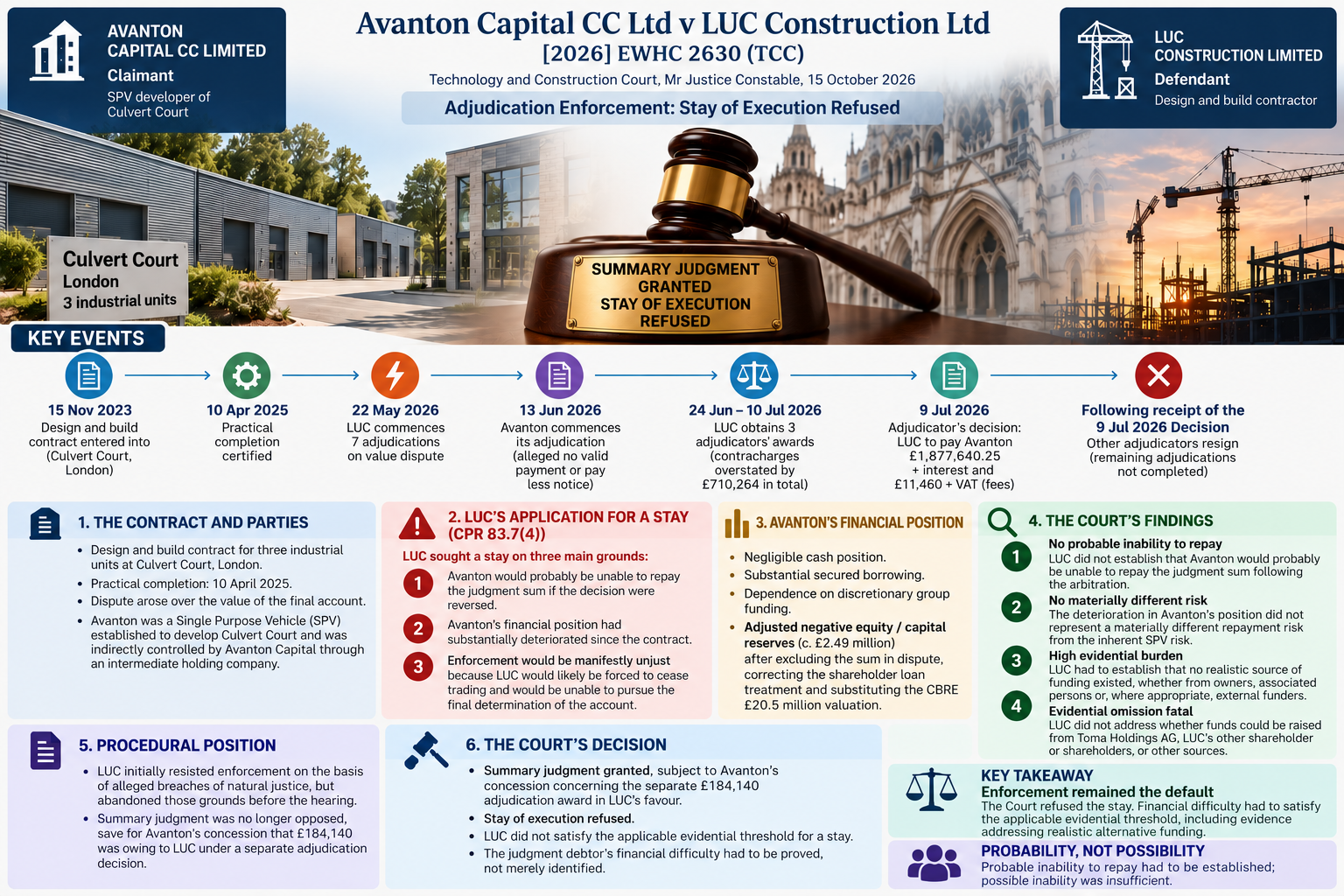
🏗️ Avanton Capital CC Ltd v LUC Construction Ltd [2026] EWHC 2630 (TCC) — £2.5m in Adjusted Negative Equity, £1.6m to Pay: When Financial Risk Meets the Burden of Proof
💷 Can a company with nearly £2.5m in adjusted negative equity, negligible cash and discretionary group funding still enforce an adjudicator’s award?
In Avanton v LUC, Mr Justice Constable refused a stay of execution, reinforcing a crucial distinction: probable inability to repay must be established; identifying a material risk of non-payment is not enough.
The dispute concerned three industrial units in London. Following seven adjudications commenced by LUC, Avanton obtained an award of £1,877,640.25 plus interest and fees, arising from an alleged failure to serve valid payment or pay less notices.
LUC abandoned its natural justice objections but sought a stay under CPR 83.7(4), arguing that Avanton might not repay following arbitration and that enforcement could force LUC to cease trading.
📌 The Technology and Construction Court held:
🔹 Probability, Not Possibility: Under Wimbledon v Vago, probable inability to repay must be established. A possibility of non-payment is insufficient. [8–11], [38–40]
🔹 £2.49m Adjusted Negative Equity: Correcting a £1.423m shareholder loan, excluding the disputed sum and applying CBRE’s £20.5m valuation produced adjusted negative equity/capital reserves of £2,488,161. Alarming figures did not establish probable future inability to repay. [31–33], [39]
🔹 Group Funding: Avanton had historically received approximately £4.157m in group support. Although discretionary, that history of support, together with Avanton Capital's significant positive net assets and evidence that support was intended to continue, meant that LUC did not establish probable inability to repay. [34–40]
🔹 Known SPV Risk: LUC knew Avanton was a development SPV. Numerical deterioration did not establish a materially different repayment risk from that knowingly accepted when contracting. [41–48]
🔹 Fatal Evidential Gap: A debtor’s inability to pay may exceptionally justify a stay where manifest injustice or stifling arises. But LUC failed to address realistic funding from Toma Holdings AG, its other shareholder(s) or other sources. [25–26], [50–53]
⚖️ Outcome: Stay refused. Summary judgment entered for £1,603,500.25 plus interest and adjudicator’s fees. [55]
🧠 The Psychology of Proof
Confirmation bias and motivated reasoning offer useful perspectives on why adverse financial indicators can seem conclusive while countervailing evidence receives less attention.
These are analytical perspectives, not findings about either party.
💬 A balance sheet is not a prophecy, and a belief is not proof.
For lawyers, adjudicators, arbitrators and construction professionals, the lesson is simple: an apparently compelling financial narrative cannot replace evidence satisfying the legal test.
The most expensive litigation mistake may be becoming so convinced of the answer that you forget to prove it.
🔗 Full judgment: https://www.bailii.org/ew/cases/EWHC/TCC/2026/2630.html
#ConstructionLaw #Adjudication #StayOfExecution #WimbledonVago #Arbitration #EvidentialBurden #LegalPsychology #TCC #DDAlegal
Nigel Davies BSc(Hons) (Q.Surv), PGCert.Psych, GDipLaw, PGDipLP, DipArb, MSc (Built Environment), LLM (Construction Law & Practice), MSc (Mechanical & Electrical), MSc (Psychology), FRICS, FICE, FCIOB, FCInstCES, FCIArb, CArb, GMBPsS, Panel Registered Adjudicator, Mediator, Mediation Advocate, Chartered Builder, Chartered Construction Manager, Chartered Surveyor, Chartered Civil Engineering Surveyor, Chartered Arbitrator, Author, Solicitor-Advocateand PhD Candidate in Experimental Psychology (UCL)
Adjudicator Assessor and Re-Assessor for the ICE
ICE DRC Member
ICE DRC CPD Committee Chairman
Adjudicator Exam Question Setter for the ICE
CIArb Adjudication Panel Member since 2006
CIArb Arbitration Panel Member since 2006
CIC Adjudication Panel Member since 2010
FIDIC Adjudication Panel Member since 2021
ICE Adjudication Panel Member since 2021
Law Society Panel Arbitrator
RIBA Adjudication Panel Member since 2018
RICS Adjudication Panel Member since 2006
RICS Dispute Board Registered since 2013
TECSA Adjudication Panel Member since 2012
The information & opinions expressed in this article are not necessarily comprehensive, nor do they represent the trenchant view of the author; in any event, this article does not purport to offer professional advice. This article has been prepared as a summary and is intended for general guidance only. In the case of a specific problem, it is recommended that professional advice be sought.
© 2026 Davies & Davies Associates Ltd
Back to Legal Updates