BDP Construction Ltd v Cygnet Behavioural Health Ltd [2026] EWHC 1796 (TCC)
The Honourable Mr Justice Constable, 16 July 2026
Premier Modular Ltd v Maidstone And Tunbridge Wells NHS Trust [2026] EWHC 1404 (TCC)
Adrian Williamson KC sitting as a Deputy Judge of the High Court, 10 June 2026
Key Words
Adjudication – Summary Judgment – Liquidated Damages – Jurisdiction – Natural Justice – Construction Law – Evidential Burden – Dispute Resolution – JCT Contract – Technology and Construction Court.
- Headnote
- These cases concerned the limits of adjudicator decision-making and the circumstances in which allegations of jurisdictional excess or breach of natural justice prevented, or failed to prevent, enforcement of adjudicators’ decisions. [B20]-[B22], [B23]-[B40]; [P42], [P48]-[P50]
- In BDP Construction Ltd v Cygnet Behavioural Health Ltd, the Court enforced an adjudicator’s decision where the adjudicator concluded that neither party had established the contractual basis for its competing liquidated damages case. [B18]-[B19], [B27]-[B30], [B40]
- The Court held that an adjudicator did not exceed jurisdiction, nor breach natural justice, merely by concluding that neither party had discharged the evidential burden in relation to the competing cases advanced. [B27]-[B30], [B34], [B40]
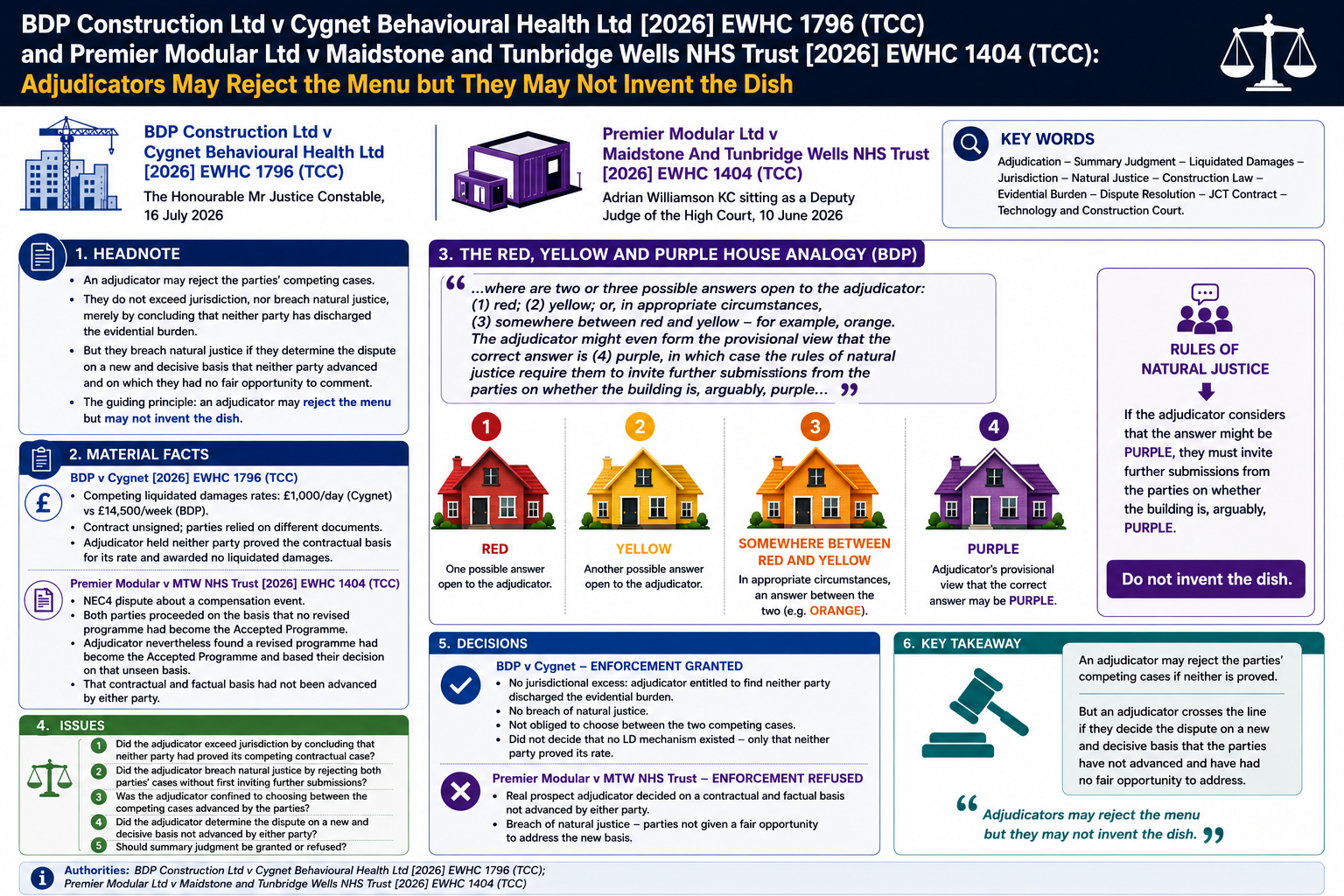
- A notable feature of the judgment was the Court’s adoption of the “red, yellow and purple house” analogy when addressing the jurisdiction challenge. [B23]-[B24]
- The Court rejected the submission that the adjudicator had effectively determined that no liquidated damages mechanism existed. The Court held that the adjudicator had merely concluded that neither party had persuaded him that the applicable liquidated damages rate was the rate for which that party contended. [B24], [B30]
- The Court further held that the existence of only two competing contractual cases did not oblige the adjudicator to select one of them. The adjudicator remained entitled to conclude that neither side had proved its case. [B25]-[B30]
- In Premier Modular Ltd v Maidstone and Tunbridge Wells NHS Trust, the Court refused summary enforcement because the Trust had a real prospect of establishing that the adjudicator had determined the dispute upon a contractual and factual basis that neither party had advanced and which had not been fairly canvassed. [P35], [P39(ii)]-[P39(iv)], [P42], [P48]-[P51]
- The combined effect of the judgments was that an adjudicator remained entitled to reject the parties’ competing cases but risked a material breach of natural justice if the dispute was determined upon a new and decisive basis which neither party had advanced and upon which the parties had not been given a fair opportunity to comment. [B30], [B34]; [P35], [P39(iv)], [P42]
- Material Facts
- In BDP Construction Ltd v Cygnet Behavioural Health Ltd, BDP was engaged by Cygnet under an amended JCT Design and Build Contract 2016 for the construction of a hospital development. [B1], [B4]
- Practical completion was achieved on 18 July 2024. [B4]
- Cygnet subsequently claimed £141,000 in liquidated damages calculated by reference to a completion date of 29 February 2024 and a liquidated damages rate of £1,000 per day. [B5]
- BDP disputed that claim and contended that the applicable contractual amendments provided for a completion date of 26 April 2024 and liquidated damages at the rate of £14,500 per week. [B8], [B12]-[B14]
- The contract had not been executed and the parties relied on different contractual documentation and different contemporaneous evidence to support their respective positions. [B8], [B12]-[B14], [B17]-[B18]
- The adjudicator concluded that neither party had established the contractual basis of its asserted liquidated damages rate and consequently determined that Cygnet was not entitled to recover liquidated damages. [B18]-[B19]
- BDP then sought summary judgment to enforce the adjudicator’s decision. [B1]-[B3]
- In Premier Modular Ltd v Maidstone and Tunbridge Wells NHS Trust, the claimant sought enforcement of an adjudicator’s award arising from an NEC4 compensation event dispute concerning the provision of a permanent mains water supply. [P11], [P13]
- Both parties had proceeded on the basis that no revised programme had become the Accepted Programme. [P14], [P25]
- The adjudicator nevertheless concluded that a revised programme had become the Accepted Programme and relied upon that conclusion to determine that a compensation event existed under clause 60.1(3). [P30]-[P31]
- That contractual and factual basis had not been advanced by either party. [P35], [P39(iv)], [P42]
- Issues
- Whether an adjudicator exceeded jurisdiction by concluding that neither party had proved its competing contractual case. [B23]-[B31]
- Whether an adjudicator breached natural justice by rejecting both parties’ cases without first inviting further submissions. [B32]-[B39]
- Whether an adjudicator was confined to choosing between two competing positions merely because the parties had framed the dispute as a binary dispute. [B25]-[B30]
- Whether a shared dispute concerning contractual rights was equivalent to a shared contractual premise restricting the adjudicator’s jurisdiction. [B21(2)], [B28]-[B30]
- Whether an adjudicator breached natural justice by determining a dispute on a contractual and factual basis not advanced by either party and not fairly canvassed during the adjudication. [P35], [P39(ii)]-[P39(iv)], [P42]
- Whether such conduct justified refusal of summary enforcement notwithstanding the court’s established policy of robust adjudication enforcement. [B20]; [P48]-[P50]
- Decision
- The Court enforced the adjudicator’s decision in BDP Construction Ltd v Cygnet Behavioural Health Ltd. [B40]
- The Court held that the adjudicator had acted within jurisdiction by determining that neither party had established its asserted liquidated damages regime. [B27]-[B30], [B40]
- The Court further held that the adjudicator had not breached natural justice because he had merely rejected evidence that had already been canvassed between the parties. [B34], [B40]
- The Court refused summary enforcement in Premier Modular Ltd v Maidstone and Tunbridge Wells NHS Trust. [P48]-[P51]
- The Court held that the Trust had a real prospect of establishing that the adjudicator had determined the dispute upon a contractual and factual basis which neither party had advanced and which had not been fairly canvassed. [P35], [P39(ii)]-[P39(iv)], [P42]
- The Court held that the defendant had a real prospect of establishing a material breach of natural justice. [P42], [P48]-[P50]
- Reasoning
- The Court in BDP reaffirmed that adjudicators’ decisions would ordinarily be enforced notwithstanding errors of fact or law unless the adjudicator exceeded jurisdiction or committed a material breach of natural justice. [B20]
- The Court rejected the submission that the adjudicator was confined to choosing between the two liquidated damages rates advanced by the parties. [B25]-[B30]
- The Court held that no agreement existed which restricted the adjudicator to a binary choice between £1,000 per day and £14,500 per week. [B25]-[B29]
- A significant feature of the judgment was the “red, yellow and purple house” analogy. Counsel submitted that where an adjudicator was asked to determine whether a building was red or yellow, the adjudicator might conclude that the building was red, yellow, orange, or even purple after inviting submissions, but could not conclude that the building itself did not exist. [B23]
- The Court rejected the submission that the adjudicator’s reasoning was equivalent to deciding that the building did not exist. [B24]
- The Court held that the adjudicator had not decided that no liquidated damages mechanism existed. The adjudicator had merely concluded that neither party had persuaded him that the applicable liquidated damages rate was the rate for which that party contended. [B24], [B30]
- The Court characterised the dispute as concerning the applicable completion date and applicable liquidated damages rate rather than the existence of a liquidated damages mechanism. [B24]
- The Court held that the existence of only two competing positions did not itself create a jurisdictional limitation requiring the adjudicator to choose one of them. [B25]-[B27]
- The Court held that BDP bore the burden of proving that its asserted rate of £14,500 per week formed part of the contract and that Cygnet bore an evidential burden in relation to its contention that the applicable rate was £1,000 per day. [B27]
- The Court further held that the failure of BDP to establish its case did not require a finding that Cygnet had successfully proved its own case. [B27]
- The Court reiterated that an adjudicator was ordinarily entitled to conclude that a party had failed to prove what it asserted. [B28]
- The Court reviewed authorities including Shimizu Europe Ltd v LBJ Fabrications Ltd and Primus Build Ltd v Pompey Centre Ltd concerning agreed factual or contractual premises. [B21(2)], [B28]
- The Court held that those authorities did not assist Cygnet because there was no agreed contractual premise in the present case. Neither party accepted the contractual case advanced by the other, even in the alternative. [B29]-[B30]
- The judgment therefore drew a clear distinction between a shared dispute and a shared premise. The parties shared a dispute concerning the applicable liquidated damages regime but did not share any agreed contractual basis upon which that dispute was to be determined. [B25]-[B30]
- The Court also gave detailed consideration to the natural justice challenge. [B32]-[B39]
- The Court held that an adjudicator did not breach natural justice merely by rejecting evidence that had already been placed before the adjudicator and debated by the parties. [B34]
- The Court distinguished between rejecting evidence already canvassed and deciding a dispute upon a new positive basis not advanced by either party. [B34]
- The former was permissible. The latter might require the adjudicator to invite further submissions before reaching a determination. [B23], [B34]
- Perhaps the most important practical observation appeared in paragraph 30. The Court observed that the adjudicator had effectively accepted BDP’s criticisms of Cygnet’s contractual case whilst simultaneously accepting Cygnet’s criticisms of BDP’s contractual case. [B30]
- The consequence was that both parties failed to establish the contractual foundation required for their respective positions. [B30]
- The Court therefore treated the adjudicator’s conclusion as an orthodox application of evidential burden and proof rather than a departure from the issues referred for determination. [B27]-[B30]
- Conversely, the Court in Premier Modular concluded that the adjudicator’s reasoning depended upon propositions not advanced by either party. [P35], [P42]
- The adjudicator’s conclusion that a revised programme had become the Accepted Programme formed the foundation of the compensation event finding notwithstanding that both parties had proceeded on the opposite basis. [P30]-[P35], [P42]
- The Court held that the adjudicator had effectively gone off on a “frolic” by deciding the dispute on an unargued basis not properly put to the parties. [P36], [P42]
- The Court therefore distinguished permissible independent reasoning from impermissible reliance upon a new and determinative contractual theory that had never formed part of either party’s case. [P35], [P39(iv)], [P42]
- Applicable Principles
- An adjudicator did not exceed jurisdiction merely because the adjudicator concluded that neither party had established the contractual or factual basis of its competing case. [B27]-[B30]
- An adjudicator was entitled to reject both parties’ submissions where the relevant evidence had been fully canvassed and the adjudicator was merely assessing whether the evidential burden had been discharged. [B28]-[B30], [B34]
- The existence of only two competing contractual cases did not require an adjudicator to select one of them. An adjudicator remained entitled to conclude that neither case had been established on the evidence. [B25]-[B30]
- A jurisdictional restriction arose only where the parties shared an agreed factual or contractual premise upon which the adjudicator was required to proceed. A shared dispute did not constitute a shared premise. [B21(2)], [B28]-[B30]
- An adjudicator did not breach natural justice merely by rejecting competing evidence already advanced and debated within the adjudication process. [B34]
- A material breach of natural justice may arise where an adjudicator decides the dispute upon a decisive contractual or factual basis not advanced by either party and not fairly canvassed, without first giving the parties an opportunity to comment. [P35], [P39(iv)], [P42]
- The distinction between rejecting the parties’ cases and creating a new case constituted the critical boundary between lawful adjudicator reasoning and material procedural unfairness. [B30], [B34]; [P35], [P39(iv)], [P42]
- Disposition
- In BDP Construction Ltd v Cygnet Behavioural Health Ltd, summary judgment was granted in favour of BDP in the sum of £136,769 together with £4,779 in adjudicator’s costs and interest. [B40]
- In Premier Modular Ltd v Maidstone and Tunbridge Wells NHS Trust, the claimant’s application for summary judgment was dismissed and the adjudicator’s decision was not summarily enforced. [P51]
- Summary of Holdings and Conclusions
- Held, that an adjudicator was not restricted to selecting one of two competing cases merely because the parties had framed the dispute in binary terms. [B25]-[B30]
- Held, that an adjudicator remained entitled to conclude that neither party had proved its case and that such a conclusion did not constitute either a jurisdictional excess or a breach of natural justice. [B27]-[B30], [B34], [B40]
- Held, that the adjudicator had not concluded that no liquidated damages mechanism existed, but had merely concluded that neither party had established the contractual rate of liquidated damages for which it contended. [B24], [B30]
- Held, that a shared dispute concerning contractual rights was not equivalent to a shared contractual premise restricting the adjudicator’s jurisdiction. [B28]-[B30]
- Held, that an adjudicator was entitled to accept each party’s criticisms of the other party’s contractual case and conclude that neither party had discharged the burden of proving its asserted position. [B30]
- Held, that an adjudicator did not breach natural justice by rejecting competing evidence already before the adjudicator, provided that the adjudicator did not determine the dispute on an unargued positive basis which had not been fairly canvassed. [B34]
- The Court concluded, for the purposes of the summary judgment application in Premier Modular, that the Trust had a real prospect of establishing a material breach of natural justice because the adjudicator had adopted a determinative contractual and factual basis which neither party had advanced or had a fair opportunity to address. [P35], [P39(ii)]-[P39(iv)], [P42]
- The different outcomes in BDP Construction Ltd v Cygnet Behavioural Health Ltd and Premier Modular Ltd v Maidstone and Tunbridge Wells NHS Trust were explained by the distinction between rejecting the parties’ competing cases and constructing a new determinative case. [B30], [B34], [B40]; [P35], [P39(iv)], [P42], [P48]-[P51]
Comment
Taken together, these judgments drew a clear distinction between permissible independent adjudicator reasoning and material procedural unfairness. An adjudicator was not required to choose between competing positions simply because those were the only positions advanced by the parties. Where neither party discharged the evidential burden, the adjudicator was entitled to conclude that neither case had been established. The existence of competing answers did not require the conclusion that one of them must be correct. [B27]-[B30], [B34]
In BDP Construction Ltd v Cygnet Behavioural Health Ltd, the Court held that the adjudicator remained within jurisdiction by concluding that neither party had established its asserted liquidated damages regime. The existence of two competing positions did not create a binary obligation requiring the adjudicator to select one of them. The failure of one party’s case did not automatically amount to proof of the other party’s case. [B25]-[B30]
The judgment also provided important guidance concerning burden of proof. The Court observed that the adjudicator had effectively accepted BDP’s criticisms of Cygnet’s contractual case whilst simultaneously accepting Cygnet’s criticisms of BDP’s contractual case. The result was that neither party established the contractual foundation necessary to support its position. The decision therefore reflected an assessment of evidential sufficiency rather than the introduction of a new factual or contractual basis. [B30]
The Court further distinguished between rejecting evidence already canvassed during the adjudication and determining a dispute on a new positive basis which neither party had advanced. The former was an ordinary exercise of adjudicative judgment. The latter might require the parties to be given an opportunity to make further submissions. [B34]
The position in Premier Modular Ltd v Maidstone and Tunbridge Wells NHS Trust was materially different. There, the Court concluded that the Trust had a real prospect of establishing that the adjudicator’s determination depended upon a contractual and factual basis which neither party had advanced and which had not been fairly canvassed. [P35], [P39(iv)], [P42]
The adjudicator’s conclusion that a revised programme had become the Accepted Programme formed the foundation of the compensation event finding notwithstanding that both parties had proceeded on the opposite basis. In those circumstances, the Trust had a properly arguable case that it had not been afforded a fair opportunity to address the determinative reasoning adopted by the adjudicator. [P30]-[P35], [P39(iv)], [P42]
The judgments therefore illustrated two sides of the same principle. An adjudicator may draw independent conclusions from the evidence, reject competing submissions and conclude that neither party had proved its case. An adjudicator may not, however, determine the dispute on a new and decisive contractual or factual basis which the parties had not been given a fair opportunity to address. [B27]-[B30], [B34]; [P35], [P39(iv)], [P42]
For practitioners, the practical lesson is clear. A shared dispute did not necessarily create a shared premise. Nor did the existence of two competing cases mean that one of them must succeed. The adjudicator’s task remained to determine the dispute referred on the basis of the evidence and arguments properly before the tribunal. The distinction between rejecting the parties’ competing cases and constructing a new determinative case ultimately explained the different outcomes in BDP and Premier Modular. [B25]-[B30], [B34], [B40]; [P42], [P48]-[P51]
#ConstructionLaw #Adjudication #SummaryJudgment #TCC #LiquidatedDamages #NaturalJustice #Jurisdiction #DisputeResolution #JCTContract #UKLaw #LegalUpdate #CaseLaw #DDAlegal
Authorities BDP Construction Ltd v Cygnet Behavioural Health Ltd [2026] EWHC 1796 (TCC)
Editorial note: The thematic classifications and prioritisation below are editorial and are not labels used by the Court.
Case Law:
Adjudication Enforcement, Jurisdiction and Natural Justice — Primary Theme
- Carillion Construction Ltd v Devonport Royal Dockyard Ltd [2005] EWCA Civ 1358 – The Court cited Carillion as a leading authority on adjudication enforcement. It confirms that an adjudicator’s decision should ordinarily be enforced unless it is plain that the adjudicator decided a question not referred or adopted an obviously unfair procedure. Judicial interference with adjudicators’ decisions should occur only in rare circumstances. [20(2)]
- Bexheat Ltd v Essex Services Group Ltd [2022] EWHC 936 (TCC) – The Court cited Bexheat for the modern summary of adjudication enforcement principles. Adjudicators’ decisions will generally be enforced notwithstanding alleged errors of procedure, fact or law, unless the adjudicator has acted in excess of jurisdiction or there has been a serious breach of natural justice. [20(1)]
- Pilon Ltd v Breyer Group Plc [2010] EWHC 837 (TCC) – The Court cited Pilon for the proposition that the starting point in determining an adjudicator’s jurisdiction is the Notice of Adjudication, while any defence falling within the scope of the dispute is also included within that jurisdiction. [21(1)]
Jurisdiction by Agreement and Agreed Premises — Secondary Theme
- Shimizu Europe Ltd v LBJ Fabrications Ltd [2003] BLR 381 – The Court cited Shimizu for the principle that, where parties agree a particular factual or contractual premise upon which the dispute is to be determined, an adjudicator exceeds jurisdiction if the dispute is decided on a contrary basis. The Court treated Shimizu as an example of jurisdiction being restricted by an agreed premise expressly advanced by one party and accepted by the other. [21(2)], [28]
- Primus Build Ltd v Pompey Centre Ltd [2009] EWHC 1487 (TCC) – The Court cited Primus Build alongside Shimizu for the principle that an adjudicator may exceed jurisdiction where the adjudicator determines the dispute contrary to an agreed factual or contractual basis adopted by the parties. [21(2)]
Natural Justice and Procedural Fairness — Tertiary Theme
- Roe Brickwork Ltd v Wates Construction Ltd [2013] EWHC 3417 (TCC) – The Court cited Roe Brickwork for the proposition that there is no rule requiring an adjudicator to accept either party’s case. An adjudicator may reach a conclusion on a point of importance on a basis advanced by neither party, provided that the parties were aware of the relevant material and the issue had already been canvassed between them. [22(2)] This authority supported the Court’s conclusion that rejecting both parties’ evidential cases did not require the adjudicator to invite further submissions, provided that no new positive case or uncanvassed material was introduced. [30], [34]
- Stellite Construction Ltd v Vascroft Contractors Ltd [2016] EWHC 792 (TCC) – The Court cited Stellite for the principle that a breach of natural justice may arise where an adjudicator strays significantly outside the ambit of the materials and matters advanced without giving the parties an opportunity to comment. [22(1)]
- Cantillon Ltd v Urvasco Ltd [2008] EWHC 282 – The Court cited Cantillon for the principle that any breach of natural justice must be significant or causative of potential prejudice and therefore material. A breach may be material where a party has been deprived of the opportunity to address a point which is decisive, or of considerable potential importance, to the outcome and is not merely peripheral or irrelevant. [22(3)]
Materiality and the Consequences of Procedural Error — Further Theme
- Corebuild Ltd v Cleaver [2019] 186 Con LR 203 – The Court cited Corebuild when considering materiality. A failure to permit submissions may be immaterial where the adjudicator’s answer was so obviously correct that further submissions could not have changed the outcome. Generally, however, the resisting party need only show that the point it was prevented from addressing was properly arguable, in the sense that it had reasonable prospects of success. [22(4)] The authority was applied when the Court considered whether any alleged procedural unfairness could realistically have affected the outcome of the adjudication." [35]-[39] The Court held that Cygnet’s proposed argument under clause 2.29.2 had no reasonable prospect of success because, absent proof of the contractually agreed rate, there could be no conceptually or numerically identifiable “lesser” rate. [38]–[39]
Prioritisation Summary — Case Law
- Adjudication Enforcement, Jurisdiction and Natural Justice – This was the dominant theme because the judgment concerned enforcement of an adjudicator’s decision and the limits of jurisdictional and natural justice challenges. The Court reaffirmed the robust approach to adjudication enforcement and the rarity of judicial intervention. [20]–[22], [40]
- Jurisdiction by Agreement and Agreed Premises – This was central to Cygnet’s argument that the adjudicator was restricted to choosing between two competing liquidated damages rates and therefore exceeded jurisdiction by finding that neither case had been proved. The Court rejected that argument because there was no agreed premise confining the adjudicator to a binary outcome. [21(2)], [25]–[30]
- Natural Justice and Procedural Fairness – This was important because the Court was required to determine whether the adjudicator could reject both parties’ evidential cases without inviting further submissions. The Court held that the adjudicator had merely rejected evidence already canvassed and had not introduced a new positive case or relied on uncanvassed material. [22], [32]–[34]
- Materiality and the Consequences of Procedural Error – This was a fallback issue considered by the Court when analysing whether any alleged breach of natural justice could realistically have affected the outcome. The Court concluded that the alternative argument Cygnet said it would have advanced had no reasonable prospect of success. [35]–[39]
Overall Position
The Court held that the adjudicator had jurisdiction to resolve the dispute in the manner adopted, that there had been no material breach of natural justice, and that the adjudicator’s decision should be enforced. Summary judgment was entered for £136,769, together with £4,779 for the adjudicator’s costs and interest. [40]
Contractual Provisions and Framework:
Contractual Liquidated Damages Machinery and Notice Requirements — Primary Theme
- JCT Design and Build Contract 2016, clause 2.29.2 and clause 2.29.2.1 – The Court considered clause 2.29.2.1 when determining whether Cygnet could establish materiality for the purposes of its natural justice challenge. The clause entitled the Employer to claim liquidated damages at the rate stated in the Contract Particulars or at a lesser rate stated in the notice. Cygnet argued that the adjudicator could have relied upon the provision to uphold the validity of the notice even if the contractually agreed rate differed from the rate stated. The Court rejected that submission, holding that once the adjudicator had concluded that neither party had established the contractually agreed liquidated-damages rate, there could be no conceptually or numerically ascertainable “lesser” rate for the purposes of the clause. Accordingly, the provision could not have altered the outcome. [8], [11], [38]-[39]
- JCT Design and Build Contract 2016, clause 2.29 – The clause formed part of BDP's challenge to the validity of the liquidated damages notice. The Referral relied upon clause 2.29 when asserting that a party seeking liquidated damages must demonstrate compliance with the contractual machinery governing recovery and deduction of liquidated damages. [11]
- JCT Design and Build Contract 2016, clause 2.35 – Mentioned as the contractual basis upon which Cygnet required BDP to remedy alleged defects. The Court noted the existence of the defects claim but did not place substantive reliance upon clause 2.35 because the defects dispute was not material to the issues before the Court. [5]
Contract Formation and Contractual Framework — Secondary Theme
- JCT Design and Build Contract 2016 (General Contract Form) – The Court identified an amended JCT Design and Build Contract 2016 as the contractual framework within which the dispute arose. The parties agreed that an amended JCT Design and Build Contract 2016 applied, but disputed which amendments had been incorporated and, consequently, the applicable completion date and liquidated-damages rate. The dispute concerning the competing contractual amendments lay at the heart of the adjudication. [1], [7], [12]-[14]
Prioritisation Summary — Contractual Provisions and Framework
- Contractual Liquidated Damages Machinery and Notice Requirements – This was the dominant contractual theme because the dispute concerned the validity of the liquidated damages notice, the applicable liquidated damages rate, and whether the adjudicator was entitled to conclude that neither party had established its contractual case. The Court’s analysis of clause 2.29.2.1 was central to its rejection of Cygnet’s fallback argument on materiality. [11], [27]-[30], [38]-[39]
- Contract Formation and Contractual Framework – This was important because the central dispute concerned which contractual amendments formed part of the JCT Design and Build Contract 2016 and whether either party had proved the contractual basis for its asserted completion date and liquidated damages regime. [7]-[18], [25]-[30]
Overall Position
The judgment did not cite or turn upon any particular statutory provision, statutory instrument or external regulatory scheme. The Court’s reasoning was grounded principally in common-law principles governing adjudication enforcement, jurisdiction and natural justice, applied to the amended JCT Design and Build Contract 2016 and the parties’ competing contractual documents. The principal contractual provision analysed in substantive detail was clause 2.29.2.1. The Court held that the clause could not assist Cygnet once the adjudicator had concluded that neither party had established the contractually agreed liquidated-damages rate, because no “lesser” rate could then be identified either conceptually or numerically. [20]-[40]
Two recent TCC decisions draw a useful line between independent reasoning and procedural unfairness.
In BDP, the adjudicator faced competing cases on the applicable completion date and liquidated-damages rate under an amended JCT Design and Build Contract 2016. BDP said £14,500 per week. Cygnet said £1,000 per day. The adjudicator found that neither party had proved its contractual case. The Court enforced the decision.
In Premier Modular, the adjudicator relied on a revised programme as the Accepted Programme even though neither party had advanced that case and both had proceeded on the opposite basis. The Court refused summary enforcement because the Trust had a real prospect of establishing a material breach of natural justice.
📌 The TCC’s message:
🔹 Two competing cases do not create a compulsory binary choice. An adjudicator may conclude that neither party has discharged the evidential burden.
🔹 A shared dispute is not a shared premise. Jurisdiction may be restricted where the parties agree the factual or contractual basis on which the dispute is to be decided. In BDP, there was no such agreement.
🔹 Rejecting evidence is not inventing a new case. The adjudicator in BDP merely rejected evidence already canvassed. No further round of submissions was required.
🔹 A new decisive basis may require further submissions. An adjudicator risks a material breach of natural justice where the decision rests on a basis neither party advanced or had a fair opportunity to address.
🔹 Materiality still matters. Cygnet argued that JCT clause 2.29.2.1 might preserve its notice by permitting a “lesser” rate. The Court rejected that argument: where no contractual rate had been proved, no “lesser” rate could be identified.
🧠 Authorities included Carillion, Bexheat, Pilon, Shimizu, Primus Build, Roe Brickwork, Stellite, Cantillon, and Corebuild.
💬 The practical lesson is simple. An adjudicator may reject both parties’ cases. What the adjudicator should not do is construct a new determinative case and reveal it only after the decision is complete.
⚖️ BDP was enforced for £136,769, plus £4,779 in adjudicator’s costs and interest. Premier Modular was not summarily enforced.
Nigel Davies BSc(Hons) (Q.Surv), PGCert.Psych, GDipLaw, PGDipLP, DipArb, MSc (Built Environment), LLM (Construction Law & Practice), MSc (Mechanical & Electrical), MSc (Psychology), FRICS, FCIOB, FCInstCES, FCIArb, CArb, GMBPsS, Panel Registered Adjudicator, Mediator, Mediation Advocate, Chartered Builder & Chartered Construction Manager, Chartered Surveyor & Civil Engineering Surveyor, Chartered Arbitrator, Author, and Solicitor-Advocate
Adjudicator Assessor and Re-Assessor for the ICE
ICE DRC Member
ICE DRC CPD Committee Chairman
Adjudicator Exam Question Setter for the ICE
CIArb Adjudication Panel Member since 2006
CIArb Arbitration Panel Member since 2006
CIC Adjudication Panel Member since 2010
FIDIC Adjudication Panel Member since 2021
ICE Adjudication Panel Member since 2021
Law Society Panel Arbitrator
RIBA Adjudication Panel Member since 2018
RICS Adjudication Panel Member since 2006
RICS Dispute Board Registered since 2013
TECSA Adjudication Panel Member since 2012
The information & opinions expressed in this article are not necessarily comprehensive, nor do they represent the trenchant view of the author; in any event, this article does not purport to offer professional advice. This article has been prepared as a summary and is intended for general guidance only. In the case of a specific problem, it is recommended that professional advice be sought.
© 2026 Davies & Davies Associates Ltd
Back to Legal Updates