Craigard (Dartford) Ltd & Anor v Westbury Homes (Holdings) Ltd & Anor
Technology and Construction Court, King’s Bench Division
HHJ Keyser KC, 29 September 2026
Key Words
Terminal dilapidations – Repairing covenant – Good and substantial repair and condition – HVAC system – Mechanical and electrical services – Repair or replacement – Least onerous performance – Betterment – Supersession – Landlord’s refurbishment intentions – ESG refurbishment – Consequential loss – Loss of rent – Section 18(1) Landlord and Tenant Act 1927 – Diminution in value – Proudfoot standard – Ultraworth – Sunlife – Reversionary loss – Valuation evidence.
- Headnote
- The Claimants, as freehold owners of Cotton Lake House, Dartford, brought a terminal dilapidations claim against the former tenant and its surety following expiry of a 20-year commercial lease on 8 July 2023. [1]-[4] The pleaded claim was £1,609,125.53, comprising £1,335,980.15 for remedial works, £218,145.38 for loss of rental income and £55,000 for professional fees. [6]
- The principal dispute concerned the building’s ageing HVAC system. [8], [103]-[115] Although the system had been out of repair at lease expiry, the critical question was whether the tenant’s covenant required wholesale replacement or whether the system could have been restored to the contractual standard by repair. [112]-[115]
- Following expiry of the Lease, the Claimants replaced the existing HVAC installation with a new VRF system and MVHR system at a cost of £566,089.15 as part of a wider refurbishment and ESG-led repositioning of the Premises. [57]-[59], [68]-[70]
- The Court found that the Defendants had not properly maintained the HVAC system and that the system had been out of repair when the Lease expired. [112] The Claimants nevertheless bore the burden of proving that complete replacement had been necessary to satisfy the repairing covenant. [112]
- The Claimants failed to discharge that burden. [113] Applying Ultraworth Ltd v General Accident Fire & Life Assurance Corp Plc and Sunlife Europe Properties Ltd v Tiger Aspect Holdings Ltd, the Court held that, if either repair or replacement could reasonably have been recommended as a means of achieving covenant compliance, damages fell to be assessed on the less onerous repair basis. [17], [20]-[21], [113]-[115]
- The Court rejected the Defendants’ submission that the Claimants’ intention to replace the HVAC system and undertake a wider refurbishment extinguished the primary common-law claim for the proper cost of repair. [124]-[130] Subject to s.18(1), the common-law measure remained the cost necessary to place the Premises into the condition required by the covenant. [18]-[21], [127]-[130]
- A different analysis applied to consequential losses. [130] The claim for loss of rent and alternative accommodation failed because the same interruption and expenditure would have occurred in any event as a consequence of the Claimants’ independent refurbishment intentions. [131]-[137]
- Following application of the common-law measure and the statutory diminution-in-value exercise under s.18(1) of the Landlord and Tenant Act 1927, the damages payable by the Defendants were £648,141.47. [139]-[148]
- Material Facts
- The Premises comprised a purpose-built two-storey office building formerly known as Persimmon House and subsequently known as Cotton Lake House at Crossways Business Park, Dartford. [1] They provided approximately 14,916 sq ft of office accommodation and parking for 83 cars. [1]
- The Claimants acquired the freehold in March 2021 for £3.1 million as a property syndicate investment. [2], [39]
- The First Defendant held the Premises under a lease dated 9 July 2003, and the Second Defendant was the surety under that Lease. [3] The Lease expired by effluxion of time on 8 July 2023. [4]
- Clause 3.7.1 required the tenant to keep the Premises, including plant, machinery and heating, cooling and air-conditioning apparatus, in “good and substantial repair and condition”. [13] Clause 3.12.1 required the Premises to be yielded up in a condition consistent with due performance of the tenant’s covenants. [13]
- Problems with the HVAC system had been known for many years. [30]-[33], [35] The chillers were ageing, operated with R22 refrigerant and were technically obsolete. [30]-[33], [35] There had also been frequent complaints of excessive summer temperatures, while the tenant’s managing agent had recognised that significant works would eventually be required. [30]-[33], [45]
- In April 2020 the managing agent recorded an objective of keeping the system functioning until July 2023 so that substantial expenditure might be avoided and the landlord might have difficulty requiring renewal through a dilapidations claim. [33]
- From at least 2022 the Claimants had been planning substantial investment in the Premises, including complete replacement of the heating and cooling system. [46]-[50] Communications with investors and occupiers contemplated a new system providing improved efficiency and localised temperature control. [46]-[50]
- The Claimants also wished to reposition the Premises as a higher-quality, energy-efficient and ESG-conscious office asset, including obtaining improved environmental credentials and enhancing marketability to tenants and investors. [57]-[60], [126]
- The Lease expired without the First Defendant having undertaken works sufficient to place the HVAC system into the condition required by the repairing covenant. [60]-[66], [112] The Claimants thereafter carried out a wider refurbishment and replaced the existing HVAC installation with a VRF/MVHR system costing £566,089.15. [68]-[70]
- A Schedule of Dilapidations dated 1 February 2024 was served shortly afterwards. [5], [71]-[72] Proceedings were commenced in November 2024. [6]-[7]
- Issues
- Whether the HVAC system had been out of repair at the expiry of the Lease. [103]-[112]
- Whether compliance with the repairing covenant had required wholesale replacement of the HVAC installation, or whether repair of the existing installation could have achieved the contractual standard. [103]-[115]
- What remedial costs had been recoverable in respect of the building fabric, including gutters, roof underfelt, fascias and soffits, carpets and ceilings. [76]-[102]
- What sums had been recoverable in respect of ancillary electrical and lighting works. [116]-[123]
- Whether the Claimants’ intention independently to refurbish the Premises and replace the HVAC system had defeated or reduced the primary common-law measure of damages. [124]-[130]
- Whether consequential losses, including loss of rent and alternative accommodation costs, had been caused by the Defendants’ breaches. [131]-[137]
- To what extent recoverable common-law damages had been limited by the diminution in value of the reversion under s.18(1) of the Landlord and Tenant Act 1927. [23]-[25], [139]-[147]
- Decision
- The HVAC system had not been properly maintained and had been out of repair at lease expiry. [112]
- The Claimants failed to prove that wholesale replacement had been required to comply with the repairing covenant. [113]-[115] Damages in respect of the HVAC system therefore fell to be assessed by reference to repair rather than the cost of the replacement system actually installed. [110], [113]-[115]
- The Court allowed £59,601.44 in respect of gutters, £144,383 in respect of roof underfelt and £19,500 in respect of fascias and soffits. [76]-[91] It also allowed £34,247 for replacement of the first-floor carpets and £43,000 for ceiling works on the repair-based HVAC hypothesis. [95]-[102]
- The Court rejected or substantially reduced a number of electrical and improvement-related items where the Claimants had failed to demonstrate that the expenditure had been attributable to a breach of covenant. [116]-[121] In respect of office lighting, only £5,000 was allowed. [122]
- The Claimants’ independent intention to undertake a wider refurbishment had not extinguished the primary common-law claim for the reasonable cost of remedying proven breaches. [124]-[130]
- The Court assessed a 10-week period of disruption as producing a prima facie loss of £44,130.38 in respect of the ground-floor offices. [133]-[135] The consequential claim nevertheless failed because that loss would have arisen in any event from the Claimants’ intended improvement works and had therefore not been caused by the Defendants’ breaches. [136]-[137]
- The claims considered at paragraph 138 comprised £55,000 for Mr Everington’s professional fees, £2,950 for preparation of the Schedule of Dilapidations and Quantified Demand, and £3,541 for solicitors’ fees. [138] The Court held that the First Defendant’s breaches had been a material cause of those fees and that they had been recoverable under clause 3.31 of the Lease. [138]
- The damages payable were ultimately assessed at £648,141.47. [148]
- Reasoning
- The applicable standard of repair was the familiar Proudfoot v Hart standard: having regard to the age, character and locality of the Premises, they were required to be reasonably fit for occupation by a reasonably minded tenant of the relevant class. [15]-[16] The standard was not one of perfection. [15]-[16]
- Ultraworth established that an ageing mechanical system did not require replacement merely because it had originally been new or had become old. [17] Compliance required that the system should have been in good working order and should have worked substantially as well as the original system did, or ought to have done, when new. [17] A greater maintenance requirement did not itself establish non-compliance. [17]
- Sunlife further established that the tenant was entitled to perform its covenants in the manner least onerous to it. [20]-[21] The tenant was not required to deliver new equipment or equipment having any particular remaining life expectancy. [21] Where plant was beyond economic repair, replacement was required on a like-for-like or nearest-equivalent basis rather than by upgrading it to current standards unless legislation or regulation required otherwise. [21]
- The relevant question was not whether the Claimants had acted reasonably from a commercial perspective in installing a modern VRF/MVHR system. [20]-[21], [113] It was whether replacement had gone further than was necessary to remedy the tenant’s breach. [20]-[21], [113]-[115]
- The burden of proving that replacement had been necessary rested on the Claimants. [112] The Court found that they had not discharged that burden. [113] The Claimants’ commercial preference for a new system, including future-proofing and marketing the Premises as high-quality and environmentally friendly offices, did not establish that replacement had been necessary to satisfy the repairing covenant. [113]-[115]
- The Court regarded the BWB report as providing the most reliable evidence both of the condition of the HVAC system at lease expiry and of the available remedial measures. [114(6)] Although BWB regarded replacement as the most economic long-term solution, its identification and costing of remedial works to the existing system indicated that repair remained a viable option. [114(6)]
- The Claimants had not intended to undertake remedial works and had not given them serious consideration. [114(7)] The resulting absence of evidence could not reverse the burden of proof or simply be turned against the Defendants. [114(3), 114(6)]
- The Court distinguished between the primary measure of damages and consequential losses. [129]-[130] For the primary measure, the Defendants’ argument that the Claimants would have stripped out compliant repairs anyway was contrary to established common law. [124]-[129] Subject to s.18(1), the landlord’s future intentions did not extinguish the common-law measure of damages for breach of a repairing covenant. [127]-[130]
- Ordinary causation principles applied to consequential loss. [130], [136] The Claimants’ proposed refurbishment would have required the same decanting and interruption even if the tenant had fully complied with its covenants. [126], [136] The claimed rental and accommodation losses would therefore have arisen in any event. [131]-[137]
- Section 18(1) did not alter the method by which common-law damages were initially assessed; it imposed an upper limit by reference to diminution in the value of the reversion. [23] The statutory cap applied to the entire damages claim, including the cost of repairs and any recoverable loss of rent. [24]
- In the valuation exercise, the Court preferred the evidence that a hypothetical purchaser would have been satisfied with an HVAC system which was functioning and in proper repair and would not have considered the cost and disruption of installing an entirely new system worthwhile. [146]
- The diminution analysis therefore proceeded on the basis that the existing HVAC installation had been capable of being put into repair rather than on an assumption that a hypothetical purchaser would necessarily have replaced it. [147] That finding also affected the treatment of supersession in the statutory valuation exercise. [147]
- Ratio Decidendi
- Where mechanical plant was subject to a covenant requiring good and substantial repair and condition, its age, obsolescence or commercial unattractiveness did not of itself entitle the landlord to recover the cost of wholesale replacement. [15]-[21], [103]-[115] If repair was reasonably capable of achieving the contractual standard, damages were to be assessed by reference to that less onerous means of compliance. [17], [20]-[21], [113]-[115]
- The tenant was entitled to perform its repairing obligations in the least onerous manner permitted by the covenant. [20]-[21], [113] Where the landlord chose to undertake wider replacement, modernisation or improvement works, it could recover the reasonable cost that would have been necessary to remedy the breach but not the additional cost attributable only to the preferred upgrade. [20]-[21], [113]-[115]
- The landlord’s independent intention to replace compliant repairs or undertake a wider refurbishment did not, without more, extinguish the primary common-law measure of damages for breach of a repairing covenant. [124]-[130] Any statutory restriction arising from demolition, structural alteration or diminution in value fell to be considered under s.18(1). [23]-[25], [127]-[130]
- Consequential damages required proof of causation. [130], [136] Loss of rent, decanting expenditure or similar losses were not recoverable where the same loss would have been incurred in any event as a consequence of works the landlord independently intended to undertake. [131]-[137]
- Under s.18(1), recoverable terminal dilapidations damages could not exceed the diminution in the value of the reversion caused by the breaches. [23]-[25] The statutory valuation exercise therefore depended upon the treatment of the building that the hypothetical purchaser would have adopted, rather than simply upon the actual landlord’s refurbishment intentions. [139]-[147]
- Disposition
- The Claimants succeeded in establishing substantial breaches of the repairing covenants in respect of the building fabric and the HVAC installation. [76]-[115]
- Damages for that item were assessed by reference to repair costs, the available repair-cost evidence being £163,504, rather than by reference to the cost of the replacement system actually installed. [113]-[115] Damages for that item were assessed by reference to the available repair-cost evidence of £163,504 rather than the cost of the replacement system actually installed. [110], [115]
- The Claimants recovered appropriate sums for proven building-fabric defects, repair-based HVAC works and recoverable professional and related fees. [76]-[123], [138]
- No damages were awarded for loss of rental income. [136]-[137]
- The damages payable by the Defendants were £648,141.47. [148] The Court invited the parties to agree the appropriate orders for interest and costs, failing which those matters would be determined at a short further hearing or by written submissions. [148]
- Held
- Held, that the HVAC system had been out of repair at expiry of the Lease and that the tenant had failed properly to perform its repairing obligations. [112]
- Held, that the Claimants had not proved that wholesale replacement of the HVAC system had been necessary to achieve compliance with the repairing covenant. [112]-[115]
- Held, that where repair could reasonably have achieved the contractual standard, the tenant was entitled to the less onerous method of performance and damages were to be assessed on the repair basis. [17], [20]-[21], [113]-[115]
- Held, that the Claimants’ intention independently to replace the HVAC installation and refurbish the Premises had not extinguished the primary common-law claim for the reasonable cost of remedying proven disrepair. [124]-[130]
- Held, that the claimed consequential loss of rent was not recoverable because the relevant interruption and expenditure would have been incurred irrespective of the Defendants’ breaches as a consequence of the Claimants’ intended refurbishment. [131]-[137]
- Held, that, following assessment of the common-law damages and the statutory diminution-in-value position under s.18(1) of the Landlord and Tenant Act 1927, the damages payable were £648,141.47. [139]-[148]
Comment
How does a £566,089 HVAC system become a £163,504 problem?
That is the small mystery sitting inside Craigard. The answer is not really about air-conditioning. It is about what happens when commercial decisions, litigation positions and evidence begin travelling in the same direction — but not necessarily for the same reason.
The tenant had spent years nursing an ageing system towards lease expiry. In April 2020 its managing agent recorded that, if the system could be kept going until July 2023 and could “appear functional” at lease end, the landlord might struggle to impose renewal through a dilapidations claim. One admires the clarity, if not necessarily the maintenance philosophy.
The Claimants, meanwhile, were travelling in the opposite direction. By 2022 they were telling investors and occupiers that the building was going to receive a complete overhaul of its heating and cooling system, with improved efficiency and local temperature control. The refurbishment strategy later expanded into the full ESG wardrobe: BREEAM, solar panels, improved marketability and a building intended to “stand out from the crowd”.
By paragraph 59 of the judgment, Keyser KC’s conclusion was emphatic: “there was no question for the claimants but that the system would be replaced”.
So by the time the dispute crystallised, the parties were approaching the same mechanical plant from very different legal positions.
The tenant’s position depended on the proposition that the existing system remained capable of repair. The landlord’s position depended on the proposition that replacement was required.
And the law, irritatingly, wanted evidence.
That is where the case becomes psychologically interesting.
Ziva Kunda’s work on motivated reasoning examined the tendency for reasoning to become goal-directed: people do not always begin by asking, “What does the evidence show?” Sometimes the practical question becomes, consciously or otherwise, “What evidence supports the conclusion I already have reason to prefer?” Raymond Nickerson’s work on confirmation bias described the neighbouring tendency to give greater weight to information consistent with an existing hypothesis while subjecting awkward material to rather more vigorous inspection.
Those are general psychological phenomena, not findings made about anyone in Craigard. But the case provides a useful practical illustration of why lawyers, experts and commercial decision-makers need to guard against them.
The Court found that the Claimants had “decided to replace the HVAC system and were not interested in the possibility of repairing the existing system”. Yet the burden still rested on them to prove that replacement was necessary to satisfy the repairing covenant. They did not discharge it. The legal proposition was distinctly unromantic: if either repair or replacement could reasonably have been recommended by a specialist, damages fell to be assessed on the less onerous repair basis. [112]-[115]
Then came the BWB report.
BWB regarded replacement as the most economic long-term solution. Commercially, that made perfect sense. But the same report also identified and costed remedial works to the existing installation. The Court regarded it as the most reliable evidence both of condition and remedy, and the fact that BWB had bothered to identify and cost repairs mattered: doing so made sense only if repair remained a viable option. [114(6)]
This is an important distinction. A modern replacement system may be the best investment. It may be more efficient, more attractive to tenants, cheaper to operate and considerably less likely to inspire lengthy correspondence between surveyors. None of that necessarily means the outgoing tenant has to pay for it.
There was another revealing feature.
An earlier version of the BWB report apparently referred to components having reached the “end of economic life”. Mr Everington asked for that wording to be changed to “‘not in repair’ or similar”. Keyser KC observed that this indicated that the report had been obtained not really to determine the best course of action but to support a dilapidations claim.
That is not a finding of psychological bias. It is, however, a useful illustration of how different descriptions of the same condition can carry different legal consequences.
“Old and uneconomic” describes an asset-management problem.
“Not in repair” sounds rather more like an invoice for somebody else.
Language matters because framing matters. The description chosen for a problem can influence the category into which we place it, the evidence we consider relevant and, ultimately, the remedy that appears natural. This is one reason expert evidence is most valuable when it begins with the engineering question rather than the desired legal conclusion.
The Court was equally unwilling to allow uncertainty to do the work of evidence. Unknown compatibility, unknown component condition and uncertainty over replacement parts could not simply be assembled into proof that repair was impossible. An evidential gap does not become stronger merely because several people stare into it.
There is also a useful analogy with escalation of commitment. Barry Staw’s classic work examined the tendency for prior commitment to a course of action to influence later decisions about whether to continue with it. Again, this is not a psychological diagnosis of the parties. It is a broader warning about decision architecture.
Once a course has been announced to investors, discussed with tenants, incorporated into specifications and embedded within a wider refurbishment strategy, changing direction naturally becomes more difficult. Each earlier decision becomes part of the context in which the next one is made.
That matters in dilapidations because commercial reasonableness and legal recoverability are not the same thing.
The Claimants may have been entirely sensible to install a modern VRF/MVHR system. The Court accepted that, from their perspective, investment in a new system for future-proofing and marketing the Premises as high-quality, environmentally friendly offices was reasonable. But that did not establish that replacement had been necessary to satisfy the covenant. [113]
The numbers make the point rather efficiently.
The only repair-cost evidence before the Court was £163,504; the replacement system installed by the Claimants cost £566,089.15. The judgment records the replacement cost expressly.
The difference between those figures is where commercial ambition met contractual measurement.
The same distinction also disposed of the consequential loss claim. The Court calculated a prima facie period of disruption but the loss was not recoverable because the Claimants’ intended refurbishment would have caused the same interruption anyway. Causation has the tiresome habit of asking what would actually have happened, rather than what produces the more satisfying spreadsheet.
The hypothetical purchaser then entered the story and proved noticeably calmer than everybody else. The Court concluded that such a purchaser would have been satisfied with a functioning HVAC system in proper repair and would not have considered the cost and disruption of installing an entirely new system worthwhile. The final damages award was £648,141.47. [146]-[148]
And that is the punchline.
The most expensive component in a dilapidations dispute may not be the roof, the chiller, the controls or even the lawyers.
It may be the conclusion reached before the evidence has finished arriving.
Once a party becomes committed to replacement, repair can begin to look inadequate. Once it becomes committed to repair, replacement can begin to look extravagant. And once either position has become part of the story told to a client, board, investor or court, the risk of interpreting later evidence through the lens of earlier commitments becomes increasingly difficult to avoid.
The law’s response in Craigard was considerably less psychological.
Prove it.
#Dilapidations #TerminalDilapidations #CommercialProperty #PropertyLaw #LandlordAndTenant #RepairingCovenant #HVAC #MechanicalAndElectrical #Section18 #LandlordAndTenantAct1927 #DiminutionInValue #Supersession #ConsequentialLoss #LossOfRent #ESG #TCC #CaseLaw #UKLaw #LegalUpdate #DDAlegal
Authorities and Materials
The thematic classifications, descriptions and prioritisation below are editorial. They are not labels or rankings adopted by the Court, and the summaries are paraphrases rather than quotations unless expressly indicated. The list is confined to authorities and materials referred to in the judgment.
Case Law:
Standard of Repair — Primary Theme
- Proudfoot v Hart (1890) 25 QBD 42 — The Court adopted the Proudfoot formulation as the governing standard of repair: having regard to the age, character and locality of the premises, they were required to be reasonably fit for occupation by a reasonably minded tenant of the relevant class. The judgment emphasised that the contractual standard was not one of perfection and applied the same approach to the covenant requiring the Premises to be kept in “good and substantial repair and condition”. [15]-[16]
- Simmons v Dresden [2004] EWHC 993 (TCC), 97 Con LR 81 — Cited in support of the proposition that the standard imposed by a repairing covenant was not perfection and that whether the relevant standard had been achieved was a question of fact and degree. [15]
- Pullman Foods Limited v The Welsh Ministers [2020] EWHC 2521 (TCC) — Keyser KC referred to his own earlier observations in Pullman Foods as supporting the application of the Proudfoot factors when determining the content of an obligation to keep premises in good or substantial repair and condition. [16]
Repair v Replacement, Betterment and Supersession — Central Analytical Theme
- Sunlife Europe Properties Limited v Tiger Aspect Holdings Limited [2013] EWHC 463 (TCC); [2013] 2 P&CR 4 — The Court relied extensively upon Sunlife for the principles that the tenant was entitled to perform its covenants in the manner least onerous to it; that it was not required to provide new equipment or equipment with any particular remaining life expectancy; and that plant beyond economic repair was ordinarily to be replaced on a like-for-like or nearest-equivalent basis unless legislation or regulation required otherwise. Sunlife also supplied the principles governing mitigation, proportionality, betterment, wider remedial works and supersession, and established that the relevant question was not whether the landlord’s chosen works were commercially reasonable but whether they went further than was necessary to remedy the breach. The Court also relied upon Sunlife in relation to the interaction between the common-law measure of loss and the statutory cap imposed by s.18(1). More than any other authority, Sunlife supplied the analytical framework through which Keyser KC approached the HVAC dispute and the interaction between repair, replacement, betterment and supersession. [20]-[21], [24], [113]
- Ultraworth Ltd v General Accident Fire & Life Assurance Corp Plc [2000] EWHC 172 (TCC), [2000] 2 EGLR 115 — The Court relied upon Ultraworth for the proposition that a landlord was not entitled to a new mechanical system merely because the system had been new at the commencement of the term. Compliance required the system to be in good working order, in repair and working substantially as well as the original system did, or ought to have done, when new; it did not have to require as little maintenance as a new system. Whether the covenant had been complied with remained a question of fact and degree. The authority reinforced the distinction between restoring functionality and providing a new system, a distinction that proved central to the Court’s resolution of the HVAC dispute. [17], [113]
- Carmel Southend Ltd v Strachan & Henshaw Ltd [2007] EWHC 1289 (TCC) — Referred to within the passages from Sunlife for the proposition that the existence of betterment, or the landlord’s decision to carry out works more extensive than those strictly required, did not enable the tenant to escape liability for the reasonable cost of works that would have been necessary to remedy the breach. [21]
- Ruxley Electronics & Construction Ltd v Forsyth [1996] AC 344 — Referred to within the principles adopted from Sunlife for the rule that a claimant could not recover remedial expenditure that was disproportionate to the benefit conferred by the proposed repair. [20]
- Phethean-Hubble v Coles [2012] EWCA Civ 349 — Referred to within the Sunlife principles for the proposition that, where breach of the repairing covenant had been established, the Court was entitled in the absence of contrary evidence to infer that remedial work was necessary unless the tenant demonstrated otherwise. [21]
Measure of Damages — Primary Common-Law Measure
- Ebbetts v Conquest [1895] 2 Ch 377 — The Court cited Ebbetts for the primary common-law measure of damages following expiry of a lease: the sum required to put the premises into the state of repair in which the tenant ought to have left them under the covenant. [18]
- Joyner v Weeks [1891] 2 QB 31 — The Court relied upon Joyner as affirming that the common-law measure stated in Ebbetts represented a rule of law. Where a covenant to leave premises in repair had been broken, the tenant was required to pay the reasonable and proper amount proved by the landlord for placing the premises into the state of repair in which they ought to have been left. [18]
Landlord Intentions and Section 18 — Statutory Interaction
- Marquess of Salisbury v Gilmore [1942] 2 KB 38 — The Court relied upon Lord Greene MR’s explanation of the purpose of the second limb of s.18(1) of the Landlord and Tenant Act 1927. Before statutory intervention, a landlord could recover damages for failure to yield up in repair even where the premises were to be demolished or structurally altered so that the repairs would have been valueless. The second limb was enacted to prevent the resulting unjust enrichment. [128]
Henderson v Thorn [1893] 2 QB 164 — Cited as an illustration of the pre-statutory common-law rule. Even where a landlord intended to demolish the premises and was economically indifferent to their actual condition, breach of the repairing covenant entitled the landlord to recover the amount necessary to place them into repair. [128]
Editorial observation: Together, Marquess of Salisbury and Henderson illustrated why the Defendants’ causation argument could not defeat the primary common-law repair measure: absent statutory intervention, landlord intentions alone did not extinguish damages for breach of a repairing covenant. [127]-[129]
- Tiger Aspect Holdings Ltd v Sunlife Europe Properties Ltd [2013] EWCA Civ 1656 — Referenced in the valuation analysis when discussing the residual method and the importance of accurate assumptions concerning remedial costs and rental void periods. The judgment referred to Lewison LJ at [24] in that context, rather than adopting the decision as a separate substantive rule governing the outcome. [141]
Particular Findings on Disrepair — Applied Theme
- Blue Manchester Limited v North West Ground Rents Limited [2019] EWHC 142 (TCC) — Applied when determining whether deterioration of the roof underfelt constituted disrepair despite the absence of reported water ingress. The Court relied upon the proposition that disrepair did not need to be so serious as to make the property currently non-functional before the covenant could be breached. The authority assisted the Court in concluding that latent deterioration of the roof underfelt could constitute actionable disrepair even though no actual water ingress had yet occurred and the defect had been discovered fortuitously during later works. [86]
Legislation:
Statutory Cap on Terminal Dilapidations Damages — Primary Theme
- Landlord and Tenant Act 1927, s.18(1) — This was the principal statutory provision in the judgment. The first limb capped damages for breach of a repairing covenant at the amount by which the value of the landlord’s reversion had been diminished by the breach; it did not alter the common-law method of assessment but imposed an upper limit upon recoverable damages. The Court held that the cap applied to the entire damages claim, including the primary repair measure and any recoverable loss of rent. The second limb provided that no damages were recoverable where the premises would at or shortly after termination have been demolished or structurally altered so as to render the covenant repairs valueless. The parties agreed that the second limb did not apply. Its existence was nevertheless important to the Court’s rejection of the argument that the Claimants’ actual refurbishment intentions independently extinguished the common-law repair measure. The statutory diminution exercise subsequently required consideration of which remedial works would survive the hypothetical purchaser’s likely treatment of the building. [7], [23]-[25], [127]-[130], [139]-[147]
Statutory and Regulatory Compliance of the Premises — Secondary Theme
- Workplace (Health, Safety and Welfare) Regulations 1992, regulation 5 — The Claimants’ M&E expert relied upon regulation 5 as part of the contention that works relocating an electrical distribution board were required. The Court rejected that proposition, finding that regulation 5 did not require the distribution board to be moved and consequently did not establish that the claimed works were required by reason of a breach of covenant. [120]
- Fire Precautions Act 1971 — The Act was expressly identified within clause 3.11.1 of the Lease as an example of an enactment with whose provisions and requirements the tenant had covenanted to comply insofar as they affected the Premises or their use. No separate issue concerning the application or interpretation of the Act arose for determination. [13]
Security of Tenure — Background Theme
- Landlord and Tenant Act 1954, Part II — The judgment recorded that the First Defendant’s three sub-leases had been contracted out of the security of tenure provisions in Part II of the 1954 Act. The provision formed part of the factual background and was not material to the Court’s determination of the dilapidations issues. [3]
- Clause 3.11.1.2 of the Lease also referred generically to “any regulation of the European Community”. [13] No particular European Community regulation was identified in the judgment and therefore there is no separately identifiable regulation to list.
Legal Texts & Commentary:
Repairing Covenants, the Standard of Repair and Consequential Loss — Primary Theme
- Dowding & Reynolds, Dilapidations: The Modern Law and Practice, 8th edition — The Court relied upon para 9:05 for the general Proudfoot formulation of the standard imposed by a repairing covenant: having regard to the age, character and locality of the premises, they were required to be reasonably fit for occupation by a reasonably minded tenant of the relevant class. Para 9:34 was relied upon for the proposition that a covenant requiring premises to be kept in good or tenantable condition might extend beyond works ordinarily described as “repairs” but that the standard was nevertheless judged by substantially the same Proudfoot factors. Para 32-04 was cited for the proposition that consequential loss of rent was recoverable only where evidence showed that the need to carry out repairs had prevented the premises from being let in circumstances where they otherwise could have been let. [15]-[16], [22]
Common-Law Damages and Diminution — Secondary Theme
- Woodfall: Landlord and Tenant, para 13:119 — Cited for the common-law rule that the cost-of-repair measure was not reduced merely because the landlord had decided or arranged to demolish the premises, had re-let them on full repairing terms, or because the breach had not affected rental value, subject to the statutory intervention considered separately under s.18(1). [19]
- Dowding & Reynolds, Dilapidations: The Modern Law and Practice, 7th edition, para 30-32 — Cited in relation to the statutory diminution exercise. Where the former landlord had reasonably carried out works going no further than was required to remedy the tenant’s breach, the starting point was that the actual cost of those works represented the diminution in the value of the reversion, with the burden resting on the former tenant to prove otherwise. [25]
For completeness, BS7671 was also referred to at [120] but it was a technical standard rather than a legal text or commentary. The Court expressly recorded that it had not been referred to the text of BS7671 and concluded that section 462 did not appear to require relocation of the relevant distribution board. It has therefore not been categorised as a legal text or commentary.
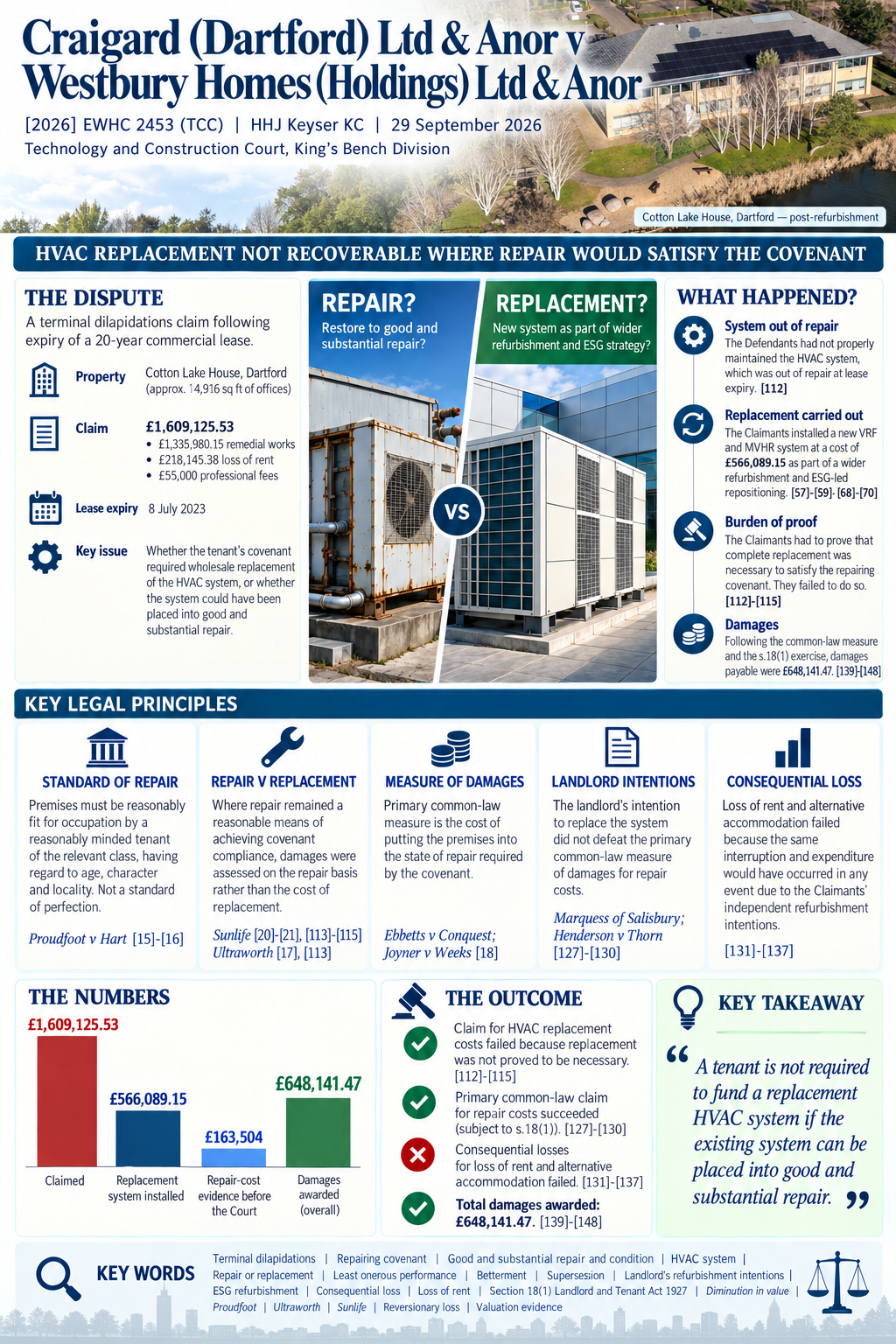
🏢 Craigard (Dartford) Ltd & Anor v Westbury Homes (Holdings) Ltd & Anor [2026] EWHC 2453 (TCC) — Repair v Replacement in Terminal Dilapidations
How does a £566,089 HVAC replacement become a £163,504 repair-cost issue?
That was the central question before HHJ Keyser KC in this terminal dilapidations dispute concerning Cotton Lake House, Dartford.
The HVAC system was out of repair at lease expiry. But that did not automatically entitle the landlord to recover the cost of wholesale replacement.
📌 The TCC held:
🔹 Repair v Replacement — Where repair remained a reasonable means of achieving covenant compliance, damages were assessed on the repair basis rather than by reference to replacement. [113]-[115]
🔹 No Automatic Upgrade — The tenant was not required to provide a new system merely because the existing one was ageing, obsolete or commercially unattractive. Ultraworth and Sunlife were central. [17], [20]-[21]
🔹 Landlord Intentions — The landlord’s intention to replace the system as part of a wider refurbishment did not defeat the primary common-law measure of damages for repair costs. [127]-[130]
🔹 Consequential Loss — Loss of rent and alternative accommodation failed because the same interruption would have occurred anyway as part of the planned refurbishment. [131]-[137]
🔹 Section 18 — The statutory cap depended on diminution in the value of the reversion and the treatment a hypothetical purchaser would have adopted. [139]-[147]
💷 Key figures:
Claim: £1.609m
Replacement HVAC: £566,089
Repair-cost evidence: £163,504
Damages awarded: £648,141.47
💬 The practical lesson?
A commercially sensible replacement is not automatically a recoverable dilapidations cost.
The outgoing tenant pays for compliance with the covenant — not necessarily the landlord’s preferred upgrade.
Replacement may be sensible. That does not make it necessary.
🔗 Full judgment: https://www.bailii.org/ew/cases/EWHC/TCC/2026/2453.html
#Dilapidations #CommercialProperty #PropertyLaw #LandlordAndTenant #HVAC #Section18 #TCC #CaseLaw #LegalUpdate #DDAlegal
Nigel Davies BSc(Hons) (Q.Surv), PGCert.Psych, GDipLaw, PGDipLP, DipArb, MSc (Built Environment), LLM (Construction Law & Practice), MSc (Mechanical & Electrical), MSc (Psychology), FRICS, FICE, FCIOB, FCInstCES, FCIArb, CArb, GMBPsS, Panel Registered Adjudicator, Mediator, Mediation Advocate, Chartered Builder, Chartered Construction Manager, Chartered Surveyor, Chartered Civil Engineering Surveyor, Chartered Arbitrator, Author, Solicitor-Advocate and PhD Candidate in Experimental Psychology (UCL)
RSPH/RICS Level 5 Certificate in Adjudication in the Construction Industry Unit 4 Director (Production of an Enforceable Decision)
Adjudicator Assessor and Re-Assessor for the ICE
ICE DRC Member
ICE DRC CPD Committee Chairman
Adjudicator Exam Question Setter for the ICE
CIArb Adjudication Panel Member since 2006
CIArb Arbitration Panel Member since 2006
CIC Adjudication Panel Member since 2010
FIDIC Adjudication Panel Member since 2021
ICE Adjudication Panel Member since 2021
Law Society Panel Arbitrator
RIBA Adjudication Panel Member since 2018
RICS Adjudication Panel Member since 2006
RICS Dispute Board Registered since 2013
TECSA Adjudication Panel Member since 2012
The information & opinions expressed in this article are not necessarily comprehensive, nor do they represent the trenchant view of the author; in any event, this article does not purport to offer professional advice. This article has been prepared as a summary and is intended for general guidance only. In the case of a specific problem, it is recommended that professional advice be sought.
© 2026 Davies & Davies Associates Ltd
Back to Legal Updates