Durkan Estates Ltd v Wallace Estates Ltd
Technology and Construction Court, King’s Bench Division
Mr Justice Constable, 30 July 2026
Key Words
Building Safety Act 2022 – Remediation Agreement – Remediation Order – Technology and Construction Court – Reverse Summary Judgment – CPR Part 24 – Common-Law Repudiatory Breach – Anticipatory Breach – Building Safety Regulator – Gateway 2 Approval – Time at Large – Estoppel by Convention – Affirmation and Waiver – Contractual Delay.
- Headnote
- The proceedings concerned a Remediation Agreement dated 1 July 2024 under which Durkan Estates Ltd agreed to remedy relevant building-safety defects at Centrillion Point, Croydon, at its own cost following the making of a Remediation Order under the Building Safety Act 2022. [1]-[3]
- Wallace Estates Ltd terminated the Agreement on 26 June 2025, alleging both contractual and common-law rights of termination arising from alleged repudiatory and anticipatory breaches by Durkan. [5], [8]-[10]
- Wallace sought reverse summary judgment under CPR Part 24 against Durkan’s claim and summary judgment on its own counterclaim. The application was confined to whether Durkan had committed a repudiatory or anticipatory repudiatory breach at common law. It did not concern Wallace’s alleged contractual right to terminate for “Substantive Breach” under clause 3 of the Agreement. [8]
- Durkan contended that the dispute involved contested issues of delay, causation, estoppel by convention, remediability, waiver and affirmation which required disclosure and determination at trial. [37]-[44], [45]-[56], [57]-[68]
- Mr Justice Constable held that Durkan’s claim had a real prospect of success and that the issues were too fact-sensitive for summary determination. Wallace’s applications were dismissed. [69]
- Material Facts
- Durkan had developed Centrillion Point into residential accommodation during the late 2000s. Wallace became the freeholder in May 2014. [1]
- On 4 January 2024, the First-tier Tribunal made a Remediation Order requiring Wallace to remedy specified defects by 31 May 2025. [2]
- The parties subsequently entered into the Remediation Agreement on 1 July 2024. Under that Agreement, Durkan undertook to design and carry out the remedial works. The Agreement specified a Completion Date of 19 September 2025, or such other date as might be agreed through the contractual machinery. [3], Annex 1 paragraphs 1, 4 and 10
- By June 2025, no Gateway 2 application had been submitted to the Building Safety Regulator. On 24 June 2025, the First-tier Tribunal refused Wallace’s application to extend the Remediation Order compliance date. [4]
- At that hearing, Wallace advanced evidence and submissions indicating that continuation with Durkan remained preferable to termination and that appointing a replacement contractor could cause further delay. Two days later, Wallace served a notice purporting to terminate the Agreement. [60]-[63]
- Wallace subsequently pursued a Remediation Contribution Order against Durkan and its parent company for more than £13.5 million. Durkan commenced High Court proceedings seeking, among other relief, a declaration that Wallace’s termination was unlawful and damages. [6]-[7]
- Issues
- The principal question on the application was whether Durkan had no real prospect of resisting Wallace’s allegation that it was in repudiatory or anticipatory repudiatory breach at common law. [8]-[10], [13]-[16]
- That question required consideration of several connected matters:
- whether the contractual Completion Date retained operative significance; [38]-[44]
- whether the parties had proceeded on a shared assumption that dates could not sensibly be fixed before Gateway 2 approval; [40]-[44]
- whether Wallace was estopped from relying upon the original Completion Date; [36], [38]-[44]
- what had caused the delay; [50]-[54]
- whether Durkan was continuing to make efforts to perform; [52]-[54]
- whether any breach was remediable; [24], [55]
- whether Wallace had affirmed the Agreement; [34]-[35], [57]-[68]
- and whether disclosure and further evidence might materially affect the outcome. [14]-[16], [44], [64]-[68]
- Decision
- The Court dismissed Wallace’s application for reverse summary judgment on Durkan’s claim and its application for summary judgment on the counterclaim. [69]
- The Court did not determine that Wallace’s termination was unlawful. It held that Durkan had a real prospect of establishing that proposition and that the disputed issues remained to be determined at trial. [69]
- Reasoning
- CPR Part 24
- The Court applied the established summary judgment principles. A claim must have a realistic rather than fanciful prospect of success, but the Court must not conduct a mini-trial. It must also consider evidence that may reasonably become available at trial, particularly where disclosure could materially alter the evidential picture. [13]-[16]
- The application therefore did not turn on which party appeared to have the stronger preliminary argument. The question was whether Durkan’s case was realistic and whether trial remained necessary. [13]-[16]
- The Completion Date and Estoppel
- Wallace argued that the contractual machinery for changing the Completion Date had not been followed. The Court expressly recognised that this contractual analysis was potentially powerful. [42]-[43]
- However, that analysis did not provide a complete answer to Durkan’s alternative case based on estoppel by convention. [43]
- Durkan relied on evidence that both parties had proceeded on the basis that meaningful dates could not be fixed before the design and Gateway 2 process had advanced sufficiently. It argued that no one genuinely expected completion by 19 September 2025 and that the construction period was understood to run from a later regulatory milestone. [40]-[41]
- The Court did not find that the Completion Date had been varied, that time was at large or that an estoppel had been established. It held only that Durkan’s estoppel case was plainly arguable and could not properly be rejected without disclosure and factual investigation. [43]-[44]
- Time Was Not of the Essence
- A central difficulty for Wallace was that time was not of the essence. Nor had Wallace served a notice requiring performance within a reasonable period. Although such a notice would not itself vary the Agreement or automatically make any subsequent failure repudiatory, its absence formed part of the circumstances relevant to whether the delay justified termination. [28]-[32], [45]
- That did not make repudiation legally impossible. It did, however, mean that Wallace had to establish far more than ordinary delay. [31]-[33], [46]
- The relevant test was whether the alleged breaches deprived Wallace of substantially the whole benefit of the Agreement. The authorities treat that as a high threshold. [19]-[21], [32]-[33], [46]
- The Court held that this enquiry was acutely fact-sensitive. It required examination of:
- the causes of delay;
- the extent of progress actually made;
- whether Durkan was continuing to make efforts to perform;
- whether any breach was remediable;
- whether Wallace had itself contributed to delay;
- the consequences of delay;
- and whether damages could provide an adequate remedy. [47]-[56]
- Those matters could not be resolved simply by construing the Agreement in isolation. The evidence was disputed, expert material had been produced and further disclosure might materially affect the outcome. [48]-[56]
- The Building Safety Act Context
- The Court accepted that the Building Safety Act context and the existence of the Remediation Order materially increased the importance of timely performance. [49]
- However, those matters did not displace ordinary contractual principles. They did not automatically convert a non-essential time obligation into a condition, nor did they alter the common-law test for repudiatory breach. [49]
- The Court held that, although the Building Safety Act context materially increased the importance of timely performance, it did not alter the test for repudiation or convert a non-essential time stipulation into a condition. [49]
- Causation and Remediability
- The causes of delay remained disputed. [50]-[54]
- Durkan alleged that Wallace’s own conduct had contributed to the lack of progress. Wallace denied this and relied on the contractual allocation of responsibility. [50]-[52]
- The Court held that those matters required proper pleading and factual investigation. The character and consequences of an alleged repudiatory breach could not sensibly be assessed while responsibility for delay remained unresolved. [51]-[54]
- Durkan also relied upon expert evidence suggesting that the Gateway 2 submission could have been completed within eight to ten weeks of termination. Wallace’s replacement contractor apparently took considerably longer. [55]
- The Court did not determine that this comparison established Durkan’s case. It held that it could be relevant to whether Durkan’s delay was remediable and whether Wallace had truly been deprived of substantially the whole benefit of the Agreement. [55]
- Affirmation
- The affirmation issue was particularly striking.
- On 24 June 2025, Wallace told the First-tier Tribunal that termination was not a panacea, that replacing Durkan could cause further delay and that continuing with Durkan was, at that stage, the reasonable course. [60]-[62]
- Two days later, Wallace terminated the Agreement. [63]
- Durkan argued that Wallace had thereby affirmed the Agreement and lost any right to terminate on the basis of existing breaches. Wallace relied on a contractual clause stating that affirmation would not be effective unless made in writing. [57], [64]-[65]
- The Court did not determine that affirmation had occurred. It held that Durkan had a real prospect of establishing it. [66]-[68]
- Written evidence and submissions placed before the Tribunal, in Durkan’s presence and to its knowledge, might arguably satisfy the contractual requirement for affirmation in writing. The precise legal and factual effect of Wallace’s conduct required disclosure and determination at trial. [66]-[68]
- The absence of any pleaded explanation for the change of position between 24 and 26 June reinforced the need for further factual investigation. [64]
- The short interval between the First-tier Tribunal hearing and the service of the Termination Notice was one of the circumstances which, in the Court’s view, warranted further factual investigation and disclosure. [64]-[68]
- Basis of the Decision
- The application was dismissed because Durkan’s case was realistic and because the dispute could not properly be resolved without trial. [69]
- In particular:
- Wallace’s contractual analysis did not dispose of Durkan’s estoppel case; [43]-[44]
- time was not of the essence; [28]-[32], [45]
- the common-law test for repudiation therefore set a high threshold; [32]-[33], [46]
- causation, progress, remediability and the consequences of delay were disputed; [47]-[56]
- Wallace’s own conduct could be relevant to whether it had been deprived of substantially the whole benefit of the Agreement; [56]
- the affirmation issue required disclosure and factual determination; [57]-[68]
- and further witness, documentary and expert evidence could materially affect the outcome. [14]-[16], [44], [64]-[68]
- Disposition
- Wallace’s application for reverse summary judgment against Durkan was dismissed. [69]
- Wallace’s application for summary judgment on its counterclaim was also dismissed. [69]
- The disputed factual and legal issues remained to be determined at trial. [69]
- Summary of Determinations
- Durkan’s contention that the termination notice was unlawful had a real prospect of success and could not be summarily dismissed. [69]
- Durkan’s estoppel by convention case was reasonably arguable and required determination at trial. [43]-[44]
- Where time was not of the essence, the question whether delay amounted to repudiatory breach required a fact-sensitive assessment of all relevant circumstances. [45]-[56]
- Durkan’s affirmation case had a real prospect of success notwithstanding the contractual non-waiver provision. [65]-[67]
- Disclosure, witness evidence and factual investigation might materially affect the outcome and supported the need for determination at trial. [14]-[16], [44], [64]-[68]
- Wallace was not entitled to reverse summary judgment or summary judgment on its counterclaim. [69]
Comment
The decision illustrates the care with which the Technology and Construction Court approaches summary disposal where the governing legal principles depend upon disputed facts. [13]-[16], [48]-[56]
Wallace advanced contractual arguments which the Court expressly described as potentially powerful. The application nevertheless failed because those arguments did not eliminate the factual disputes concerning delay, causation, estoppel, remediability and affirmation. [43], [48]-[56], [66]-[69]
The judgment is also a useful reminder that CPR Part 24 is not concerned with identifying which party currently appears to have the stronger argument. The question is whether the opposing party has a realistic prospect of success and whether a trial remains necessary. [13]-[16]
Here, the Court considered that disclosure, witness evidence and expert evidence could materially affect the outcome. That was not procedural overcaution. It reflected the fact that many of the legally significant issues depended upon facts that had not yet been determined. [44], [48]-[56], [64]-[68]
Particular significance attached to the fact that time was not of the essence. Wallace therefore had to establish much more than delay. It had to show that the alleged breach deprived it of substantially the whole benefit of the Agreement. [28]-[33], [45]-[47]
The judgment further demonstrates the potential importance of the factual context surrounding contractual dates. Durkan’s case was not simply that the Completion Date had been formally varied. It was that the parties had proceeded on a shared understanding that meaningful dates could not be fixed until Gateway 2 approval had been obtained. [38]-[44]
Whether that contention ultimately succeeds remains a matter for trial. The Court held only that it was sufficiently arguable to defeat summary judgment. [43]-[44]
The affirmation issue was equally unsuitable for summary determination. Wallace had advanced evidence and submissions before the First-tier Tribunal on 24 June 2025 indicating that continuation of the Remediation Agreement remained preferable and that termination could cause further delay. Two days later, the Agreement was terminated. [60]-[63]
The Court did not decide the legal effect of those events. It held that they raised issues requiring disclosure and factual investigation at trial. [64]-[68]
Perhaps the most significant practical lesson is that the Building Safety Act context did not displace ordinary principles of contract law. Compliance with remediation obligations was plainly important. But the existence of a Remediation Order and the risk of regulatory consequences did not automatically convert a non-essential time obligation into a condition or reduce the common-law threshold for repudiatory breach. [49]
The decision was therefore not a finding that Wallace’s termination was unlawful. It was a finding that Durkan had a real prospect of establishing that proposition at trial. [69]
In a dispute where responsibility for delay, the significance of contractual deadlines, the existence of estoppel and the effect of alleged affirmatory conduct all remained contested, the Court concluded that the proper forum was a trial rather than a compressed rehearsal with the inconvenient evidence removed. [43]-[56], [64]-[69]
That may be less dramatic than announcing a fundamental breach. It is also rather more useful.
#BuildingSafetyAct2022 #ConstructionLaw #PropertyLaw #TCC #RemediationAgreement #RepudiatoryBreach #SummaryJudgment #BuildingSafetyRegulator #EstoppelByConvention #DurkanVWallace #DisputeResolution #LegalUpdate #CaseLaw #DDAlegal
Authorities
The thematic classifications, descriptions and prioritisation below are editorial. They are not labels or rankings adopted by the Court, and the summaries are paraphrases rather than quotations unless expressly indicated. The list is confined to authorities referred to in the judgment and is not intended to be exhaustive of the relevant law.
Case Law:
Summary Judgment and CPR Part 24 Principles (Primary Theme)
- Easyair Ltd (t/a Openair) v Opal Telecom Ltd [2009] EWHC 339 (Ch) – The judgment set out and applied Lewison J’s formulation of the summary judgment principles, including the requirement that a claim must have a realistic rather than fanciful prospect of success, the prohibition on conducting a mini-trial, and the need to consider evidence reasonably expected to be available at trial. [14]
- AC Ward & Sons Ltd v Catlin (Five) Ltd [2009] EWCA Civ 1098; [2010] Lloyd's Rep IR 301 – Cited as Court of Appeal approval of the Easyair summary judgment principles. [14]
- Swain v Hillman [1999] EWCA Civ 3053; [2001] 2 All ER 91 – Cited for the distinction between a realistic prospect of success and a fanciful one, and for the principle that summary judgment must not become a mini-trial. [14]
- ED & F Man Liquid Products Ltd v Patel [2003] EWCA Civ 472 – Cited for the proposition that a realistic claim must carry some degree of conviction and that the Court is not required to accept factual assertions uncritically where they lack substance or are contradicted by contemporaneous documents. [14]
- Royal Brompton Hospital NHS Trust v Hammond (No 5) [2001] EWCA Civ 550 – Cited for the principle that the Court must take into account evidence that can reasonably be expected to become available at trial when considering summary judgment. [14]
- Doncaster Pharmaceuticals Group Ltd v Bolton Pharmaceutical Co 100 Ltd [2007] FSR 63 – Cited for the proposition that the Court should be slow to dispose of claims summarily where fuller factual investigation may alter the evidential picture and affect the outcome. [14]
- ICI Chemicals & Polymers Ltd v TTE Training Ltd [2007] EWCA Civ 725 – Cited for the principle that a party cannot resist summary judgment merely by suggesting that something may turn up at trial. [14]
- Korea National Insurance Corp v Allianz Global Corporate & Specialty AG [2007] EWCA Civ 1066 – Cited for the requirement that a party asserting that further evidence will emerge at trial must identify, at least in general terms, the nature, source and relevance of that evidence. [15]
- Okpabi v Royal Dutch Shell Plc [2021] UKSC 3 – Cited for the principle that the Court should ask whether there are reasonable grounds for believing that disclosure may materially add to or alter the evidence relevant to the claim. [16]
Repudiatory Breach, Renunciatory (Anticipatory) Breach and Common-Law Termination (Secondary Theme)
- Ampurius Nu Homes Holdings Ltd v Telford Homes (Creekside) Ltd [2013] EWCA Civ 577; [2013] 4 All ER 377 – The principal authority relied upon by the Court in its analysis of repudiatory delay. Cited for the analysis of repudiatory breach, the need to assess the benefit intended to be obtained under the contract, the effect of the breach, remediability, future performance and whether the injured party has been deprived of substantially the whole benefit of the contract. Also cited for the observation that the test sets a high bar. [20]-[21], [33], [47]
- Hongkong Fir Shipping Co Ltd v Kawasaki Kisen Kaisha Ltd (The Hongkong Fir) [1962] 2 QB 26 – Cited for Diplock LJ’s classic formulation that the question is whether the breach deprives the innocent party of substantially the whole benefit of the contract. [19]
- Spar Shipping AS v Grand China Logistics Holding (Group) Co Ltd (The Spar Capella, The Spar Vega, The Spar Draco) [2016] EWCA Civ 982; [2017] 4 All ER 124 – Cited for the classification of breaches into breaches of condition, repudiatory breaches and renunciatory (anticipatory) breaches. [17]
- Universal Cargo Carriers Corp v Citati [1957] 2 QB 401 – Cited for the proposition that anticipatory breach occurs from the point at which the future actual breach becomes inevitable. [18]
- Federal Commerce & Navigation Co Ltd v Molena Alpha Inc (The Nanfri) [1979] AC 757 – Cited for Lord Wilberforce’s statement that a repudiatory breach must go to the root of the contract. [20]
- Koompahtoo Local Aboriginal Land Council v Sanpine Pty Ltd [2007] HCA 61; (2007) 233 CLR 115 – Referred to within the passage from Ampurius for the observation that describing a breach as “going to the root of the contract” is a conclusory formulation requiring consideration of the nature of the contract, the term, the degree of breach and its consequences. [20]
- Eminence Property Developments Ltd v Heaney [2010] EWCA Civ 1168 – Cited for the principle that all surrounding circumstances must be considered when determining objectively whether conduct evinces an intention no longer to be bound by the contract. [22]
- BSkyB Ltd v HP Enterprise Services UK Ltd (formerly Electronic Data Systems Ltd) [2010] EWHC 86 (TCC) – Cited for the proposition that contractual termination provisions may be relevant when assessing whether a breach is repudiatory and whether conduct evidences an intention no longer to be bound by the contract. [24]
Time Stipulations, Delay and Time of the Essence (Third Theme)
- Shawton Engineering Ltd v DGP International Ltd (t/a Design Group Partnership) & Anor [2005] EWCA Civ 1359; [2006] BLR 1 – One of the principal authorities concerning delay. Cited for the proposition that, where time is not of the essence, termination for delay may be justified either following reasonable notice requiring performance or where the delay itself amounts to a fundamental breach depriving the innocent party of substantially the whole benefit of the contract. The judgment also cited the observation that, where the defaulting party remains engaged in efforts to perform, establishing a fundamental breach is intrinsically difficult. [32]-[33], [53]
- Dalkia Utilities Services Plc v Celtech International Ltd [2006] EWHC 63 (Comm); [2006] 1 Lloyd’s Rep 559 – Cited for the principle that a notice requiring performance within a reasonable time does not unilaterally vary the contract, automatically make time of the essence or render subsequent non-performance repudiatory. The breach must still go to the root of the contract. [31]
- Spar Shipping AS v Grand China Logistics Holding (Group) Co Ltd [2015] EWHC 718 (Comm); [2015] 1 All ER (Comm) 879 – Cited through Popplewell J's discussion of Dalkia concerning notices making time of the essence and repudiatory breach arising from delay. [31]
Affirmation, Election and Waiver (Fourth Theme)
- Bentsen v Taylor & Sons & Co [1893] 2 QB 274 – Cited for the principle that, once an innocent party has elected to affirm a contract and communicated that election, it cannot later rely upon the same antecedent breach to terminate. The judgment also recognised the separate possibility that a continuing repudiation or subsequent breach may give rise to a renewed right of termination. [35], [68]
Estoppel by Convention (Fifth Theme)
- Tinkler v Commissioners for HM Revenue and Customs [2021] UKSC 39; [2022] AC 886 – The principal authority cited in the judgment on estoppel by convention. Cited for the modern statement of its constituent elements, including an expressly shared assumption, responsibility for communicating that assumption, reliance, subsequent mutual dealing and sufficient detriment or benefit. [36]
- HMRC v Benchdollar Ltd [2009] EWHC 1310 (Ch) – Cited because its summary of estoppel by convention principles, formulated by Briggs J, was approved by the Supreme Court in Tinkler. [36]
Summary of Prioritisation
- Summary Judgment and CPR Part 24 Principles were central because the application before the Court was a summary judgment application and the judgment repeatedly applied those principles to determine whether trial was required. [13]-[16], [69]
- Repudiatory Breach, Renunciatory (Anticipatory) Breach and Common-Law Termination formed the substantive legal framework within which Wallace's asserted right to terminate had to be assessed. [17]-[24], [46]-[56]
- Time Stipulations and Delay were critical because the alleged repudiatory breaches consisted primarily of failures to perform obligations within specified periods. [25]-[33], [45]-[56]
- Affirmation and Election became important because Durkan alleged that Wallace had affirmed the Agreement shortly before serving the Termination Notice. [34]-[35], [57]-[68]
- Estoppel by Convention was an important alternative route by which Durkan contended that Wallace was precluded from relying upon the stated Completion Date. [36], [41]-[44]
Legislation, Procedural Rules and Regulatory Framework
The thematic classifications, descriptions and prioritisation below are editorial. They are not labels or rankings adopted by the Court, and the summaries are paraphrases rather than quotations unless expressly indicated. The list is confined to statutory provisions, procedural rules and regulatory or contractual frameworks expressly identified in the judgment and is not intended to be exhaustive of the relevant legal framework.
Building Safety Act 2022 and Building Safety Remediation Regime (Primary Theme)
- Building Safety Act 2022 (“BSA”) – The principal statutory context for the dispute. The judgment identified the defects as “relevant defects”, the property as a “relevant building”, and the statutory provisions governing Remediation Orders and Remediation Contribution Orders. The Remediation Agreement was entered into against that building-safety background. The Court held that, although the BSA context and the Remediation Order materially increased the importance of timely performance, they did not of themselves alter the common-law test for repudiation or convert a non-essential time stipulation into a condition. [1]-[6], [49]
- Building Safety Act 2022, section 123 – Cited as the statutory provision under which the First-tier Tribunal made the Remediation Order requiring Wallace to remedy the identified defects. The Remediation Order formed the statutory background against which the contractual and common-law issues arose. [2]
- Building Safety Act 2022, section 124 – Cited as the provision enabling applications for a Remediation Contribution Order. The judgment referred both to Wallace’s ability to seek such an order against Durkan and to the subsequent application made by Wallace for more than £13.5 million. [3], [6]
- Building Safety Act 2022, section 120 – Cited because the defects forming the subject matter of the Remediation Agreement were described as “relevant defects” within the meaning of that provision. [1]
- Building Safety Act 2022, sections 117 and 124(1) – The judgment stated that Centrillion Point was a “relevant building” within the meaning of sections 117 and 124(1) of the BSA. That status formed part of the statutory background to the remediation regime. [2]
- The judgment therefore treated the BSA as the statutory setting for the dispute, while making clear that regulatory seriousness did not displace the orthodox contractual test for repudiatory breach.
Contractual References to the Regulatory Framework (Secondary Theme)
- “Building Safety Legislation” and “Statutory Requirements” – Contractual expressions reproduced in Annex 1 rather than separately identified enactments. They appeared in the definitions of Building Control Approval and the Building Control Approval Application and formed part of the contractual requirements governing the regulatory approval process. Annex 1 [10]-[11], [17]
- Building control approval process administered by the Building Safety Regulator (“BSR”) – Although the judgment did not identify the process by reference to a particular statutory provision, it repeatedly referred to the need for Building Control Approval and to the absence of a Gateway 2 application before the remedial works could commence. The absence of a submission, and the uncertainty surrounding the timing of approval, featured prominently in the factual and contractual arguments concerning delay, progress and the Completion Date. [4], [40]-[43], [55], Annex 1 [10]-[11], [17]
- The Agreement provided that the works could not commence before Building Control Approval had been given by the BSR and received by the freeholder.
Civil Procedure Rules and Summary Judgment Framework (Third Theme)
- Civil Procedure Rules, Part 24 (“CPR Pt 24”) – The procedural framework governing Wallace’s application for reverse summary judgment on Durkan’s claim and summary judgment on its own counterclaim. The judgment centred upon whether Durkan’s claim had a real prospect of success and whether there was any other compelling reason for trial. [8], [13]-[16], [69]
- CPR rule 24.3 – The procedural rule setting out the test for summary judgment: whether a party has no real prospect of succeeding on the relevant claim, defence or issue, and whether there is no other compelling reason why the matter should be disposed of at trial. [13]
- CPR rule 16.5 – Referred to in connection with Wallace’s submission that Durkan should be treated as having made a deemed admission concerning the absence of an updated and finalised set of plans and specifications. The Court held that the relevant allegations had been satisfactorily traversed and that no deemed admission arose. [54]
- The Court quoted CPR rule 24.3 directly and applied it as the governing procedural test.
Remediation Order and First-tier Tribunal Proceedings (Fourth Theme)
- Remediation Order and variation proceedings before the First-tier Tribunal – The judgment referred to Wallace’s obligations under the Remediation Order and to its unsuccessful application to vary the compliance date. The order and the variation proceedings supplied important factual and regulatory context, but the Court held that they did not alter the common-law principles governing repudiatory breach. [2], [4], [49], [60]-[63]
Summary of Prioritisation
- The Building Safety Act 2022 and the building-safety remediation regime were central because the dispute arose from a Remediation Agreement entered into within the statutory framework created by the Act, including the Remediation Order and Remediation Contribution Order regime. [1]-[6], [49]
- The Building Safety Regulator and building control approval process were heavily emphasised because no Gateway 2 application had been submitted by the relevant time, approval was required before the works could commence, and uncertainty surrounding that process formed a major part of the dispute concerning delay, progress and the Completion Date. [4], [40]-[43], [55], Annex 1 [17]
- The Civil Procedure Rules and summary judgment framework were fundamental because the judgment concerned an application under CPR Part 24 and the Court’s task was to decide whether Durkan’s case had a real prospect of success and whether trial remained necessary. [8], [13]-[16], [69]
- The Remediation Order and First-tier Tribunal proceedings remained important because the parties’ contractual arrangements, the urgency of the remedial works and Wallace’s arguments concerning delay all arose against the backdrop of the existing Remediation Order and Wallace’s unsuccessful attempt to vary it. [2], [4], [49], [60]-[63]
Legal Texts & Commentary:
The thematic classifications, descriptions and prioritisation below are editorial. They are not labels or rankings adopted by the Court, and the summaries are paraphrases rather than quotations unless expressly indicated. The list is confined to legal texts and commentary expressly cited or referred to in the judgment and is not intended to be exhaustive of the relevant literature.
Repudiatory Breach, Delay and Termination at Common Law (Primary Theme)
- Chitty on Contracts (36th Edition), paragraph 28-011 – The Court cited Chitty for the proposition that entitlement to terminate for breach depends upon a range of factors, including the nature of the contract, the nature of the term breached, the nature of the breach and its consequences. The text was relied upon as a summary of the fact-sensitive nature of repudiatory breach and was referred to both in the general discussion of common-law termination and in relation to breaches of time stipulations. [23], [26]
- A Restatement of the English Law of Contract (2016), Andrew Burrows – Referred to indirectly within the passage quoted from Spar Shipping concerning the classification of renunciatory or anticipatory breach and the innocent party’s entitlement to accept that breach before the contractual date for performance. The Court did not separately analyse or apply the text. [17]
- The judgment principally relied upon Chitty as a concise statement of the legal principles governing repudiatory breach, termination and the evaluation of contractual consequences, while Burrows appeared only through the Court of Appeal’s discussion in Spar Shipping.
Affirmation, Election and Continuing Breach (Secondary Theme)
- Chitty on Contracts (36th Edition), paragraphs 28-056 and 28-057 – Relied upon in the Court’s analysis of affirmation and election. Paragraph 28-056 was cited for the requirements of knowledge, unequivocal conduct and communicated election, and for the principle that affirmation may be express or implied. Paragraph 28-057 was cited for the distinction between terminating on the basis of an affirmed breach and terminating later in response to a continuing repudiation or subsequent breach. [34]-[35]
- The Court relied upon these passages as concise summaries of the principles governing affirmation, election and the consequences of continuing or subsequent breaches. [34]-[35]
Construction Law and Time Obligations (Third Theme)
- Chitty on Contracts (36th Edition), paragraph 28-030 – Cited for the principles governing notices requiring performance where time was not originally of the essence. The text explained that a party affected by delay may give notice requiring performance within a reasonable period and that the reasonableness of that period depends upon all the circumstances. The Court subsequently emphasised that such a notice does not unilaterally vary the contract or automatically render later non-performance repudiatory. [30]-[31]
- Keating on Construction Contracts (12th Edition), paragraph 8-008 – Cited for the general proposition that time is not ordinarily of the essence in construction contracts unless the contract expressly provides otherwise. The text supported the Court’s treatment of the relevant time obligations, although Wallace had in any event expressly admitted that time was not of the essence. [28]-[29]
- The Court referred to these texts when considering the significance of time stipulations in construction contracts and the principles governing notices requiring performance. The more detailed analysis of whether delay was repudiatory was developed through the cited authorities. [27]-[33]
Summary of Prioritisation
- Chitty on Contracts (36th Edition) was the most significant legal text because it was relied upon repeatedly across several substantive issues, including repudiatory breach, time stipulations, affirmation, election and continuing breach. Its principles informed multiple stages of the Court’s reasoning. [23], [26], [30], [34]-[35]
- A Restatement of the English Law of Contract (2016) was referred to indirectly through the Court of Appeal’s formulation in Spar Shipping. Its role was limited to the classification of renunciatory or anticipatory breach and the innocent party’s entitlement to accept that breach before the due date for performance. [17]
- Keating on Construction Contracts (12th Edition) supported the general proposition applied by the Court that time is not ordinarily of the essence in construction contracts unless expressly provided. That proposition formed part of the Court’s subsequent analysis of whether delay could amount to repudiatory breach. [28]-[29], [45]-[46]
Overall, the judgment drew most heavily on Chitty on Contracts as a source of general contractual principle, with Keating on Construction Contracts providing construction-specific guidance on time obligations, and Burrows’ Restatement appearing only indirectly through the cited case law.
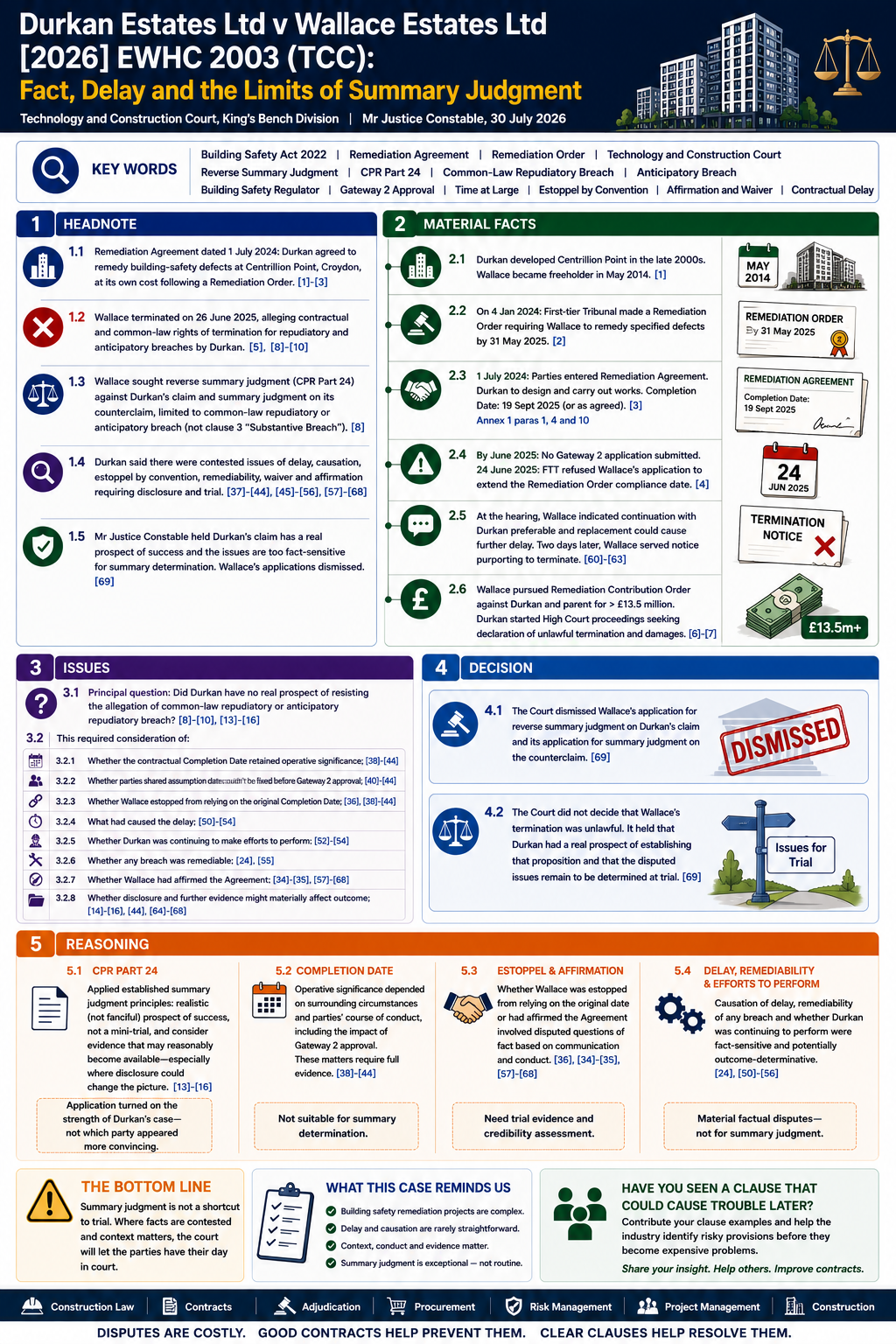
Mr Justice Constable dismissed an application for reverse summary judgment arising from the termination of a Remediation Agreement at Centrillion Point, Croydon.
Durkan had agreed to carry out remedial works following a Remediation Order under the Building Safety Act 2022. Wallace terminated the Agreement on 26 June 2025, alleging repudiatory and anticipatory breach. [1]–[10]
📌 The TCC held:
🔹 No mini-trial: CPR Part 24 was not suitable for resolving disputed issues of causation, progress, remediability, estoppel and affirmation without disclosure and factual investigation. [13]–[16], [48]–[56]
🔹 Time was not of the essence: Delay alone was insufficient. Wallace had to show that it had been deprived of substantially the whole benefit of the Agreement—a high threshold. [28]–[33], [45]–[47]
🔹 Completion Date and estoppel: Wallace’s contractual argument was potentially powerful but it did not dispose of Durkan’s case that the parties had proceeded on a shared understanding that meaningful dates depended on the Gateway 2 process. [40]–[44]
🔹 Causation and remediability: Responsibility for delay, the extent of progress and whether the alleged breach could have been remedied all required determination at trial. [50]–[56]
🔹 Affirmation: Wallace told the First-tier Tribunal on 24 June 2025 that continuing with Durkan remained preferable and that termination could cause delay. Two days later, it terminated. Durkan’s affirmation case had a real prospect of success. [60]–[68]
🔹 Building Safety Act context: Regulatory urgency increased the importance of timely performance, but did not alter the common-law test for repudiatory breach or convert a non-essential time obligation into a condition. [49]
💬 The Court did not decide that Wallace’s termination was unlawful. It held that Durkan had a real prospect of proving that case at trial. [69]
⚖️ Urgency does not abolish evidence, and a fundamental breach still has to be proved.
Nigel Davies BSc(Hons) (Q.Surv), PGCert.Psych, GDipLaw, PGDipLP, DipArb, MSc (Built Environment), LLM (Construction Law & Practice), MSc (Mechanical & Electrical), MSc (Psychology), FRICS, FCIOB, FCInstCES, FCIArb, CArb, GMBPsS, Panel Registered Adjudicator, Mediator, Mediation Advocate, Chartered Builder & Chartered Construction Manager, Chartered Surveyor & Civil Engineering Surveyor, Chartered Arbitrator, Author, and Solicitor-Advocate
Adjudicator Assessor and Re-Assessor for the ICE
ICE DRC Member
ICE DRC CPD Committee Chairman
Adjudicator Exam Question Setter for the ICE
CIArb Adjudication Panel Member since 2006
CIArb Arbitration Panel Member since 2006
CIC Adjudication Panel Member since 2010
FIDIC Adjudication Panel Member since 2021
ICE Adjudication Panel Member since 2021
Law Society Panel Arbitrator
RIBA Adjudication Panel Member since 2018
RICS Adjudication Panel Member since 2006
RICS Dispute Board Registered since 2013
TECSA Adjudication Panel Member since 2012
The information & opinions expressed in this article are not necessarily comprehensive, nor do they represent the trenchant view of the author; in any event, this article does not purport to offer professional advice. This article has been prepared as a summary and is intended for general guidance only. In the case of a specific problem, it is recommended that professional advice be sought.
© 2026 Davies & Davies Associates Ltd
Back to Legal Updates