Murnells London Ltd v Beale
Technology and Construction Court, King’s Bench Division
District Judge Baldwin, 4 September 2025
Key Words
Construction contract — Adjudication enforcement — Summary judgment — Jurisdiction — Contracting entity — Crystallisation of dispute — Waiver — Reservation of rights — Letter of Intent — JCT Intermediate Building Contract — Objective contract construction — Rectification — Extension of time — Housing Grants, Construction and Regeneration Act 1996 — "Pay now, argue later" — Bresco Electrical Services Ltd v Michael J Lonsdale (Electrical) Ltd.
- Headnote
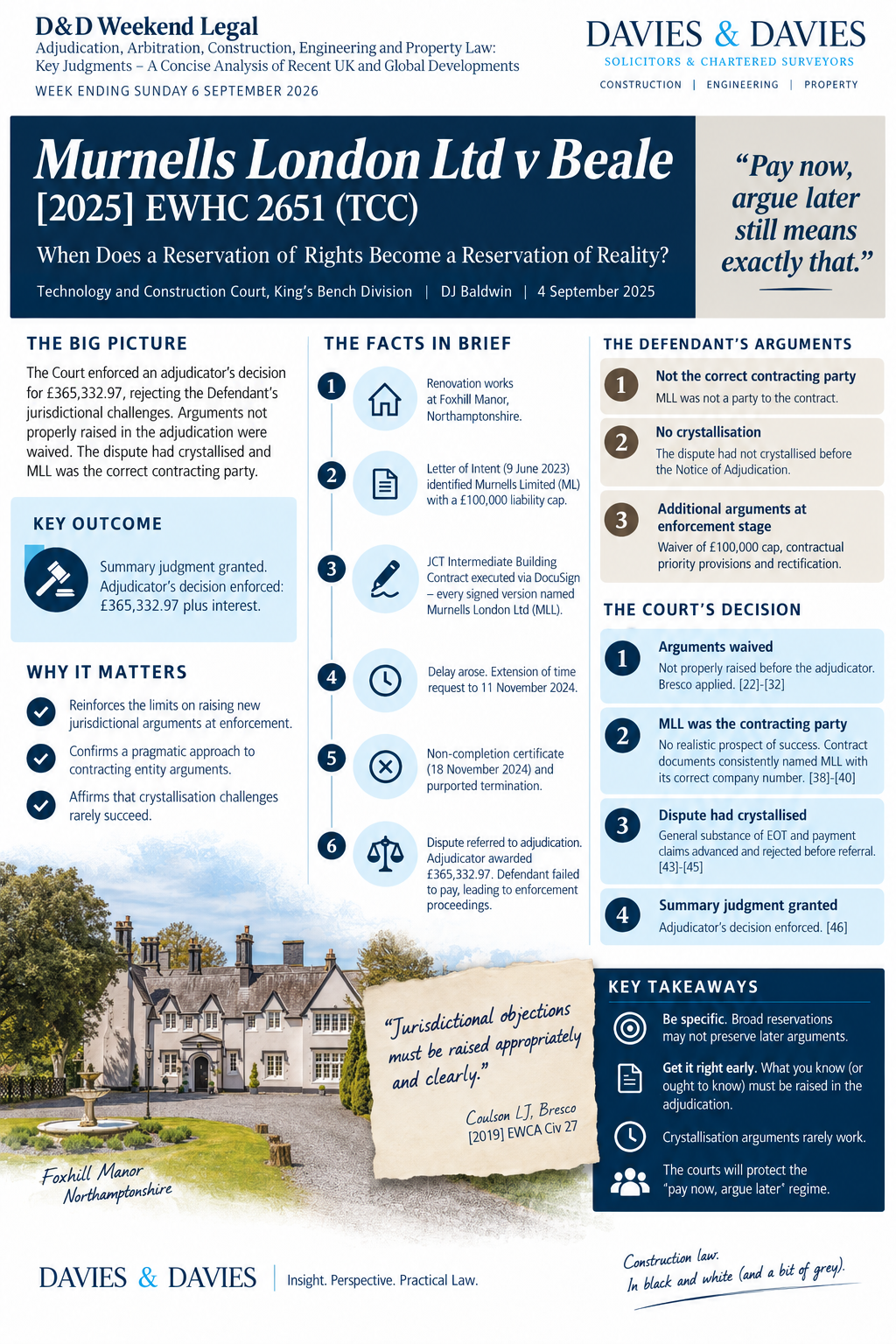
- The Claimant, Murnells London Limited (“MLL”), sought summary judgment to enforce the decision of an adjudicator requiring the Defendant, Christopher Beale, to pay £365,332.97 plus interest arising out of renovation works at Foxhill Manor, Northamptonshire. [1], [3]
- The Defendant resisted enforcement on two jurisdictional grounds, namely that MLL was not the correct contracting party and that the dispute referred to adjudication had not crystallised before service of the Notice of Adjudication. [8]-[15], [41]-[45]
- The Defendant also sought to advance additional supporting arguments at the enforcement stage concerning waiver of the £100,000 liability cap under the Letter of Intent, contractual priority provisions, and rectification of the contract. [16]-[20]
- District Judge Baldwin held that those arguments had not been properly raised before the adjudicator and had therefore been waived applying the principles identified by Lord Justice Coulson in Bresco Electrical Services Ltd v Michael J Lonsdale (Electrical) Ltd [2019] EWCA Civ 27. [22]-[32]
- The court further held that the Defendant had no realistic prospect of establishing that MLL was not a party to the contract, the contractual documentation consistently identifying MLL as contractor and containing its correct company registration number. [38]-[40]
- The court also held that the dispute had crystallised before commencement of the adjudication because the general substance of the extension of time and payment claims had already been advanced and rejected prior to referral. [43]-[45]
- Summary judgment was therefore entered in favour of MLL and the adjudicator's decision was enforced. [46]
- Material Facts
- The Defendant engaged Ascot Design as contract administrator and White & Lloyd as quantity surveyors in connection with extensive renovation works at Foxhill Manor. [3]
- A Letter of Intent dated 9 June 2023 identified Murnells Limited (“ML”) as contractor and contained a maximum liability provision of £100,000. [3], [17]
- Subsequent attempts were made to execute a formal JCT Intermediate Building Contract through the DocuSign platform. [4]
- Every signed iteration of that contract identified the contractor as MLL rather than ML. [4], [38(vi)]-[38(ix)]
- Delay arose during the project and an extension of time request was submitted seeking an extension to 11 November 2024. [5]
- A non-completion certificate was issued on 18 November 2024 and the Defendant subsequently purported to terminate the contract for repudiatory breach. [6]
- MLL asserted that the termination constituted a repudiatory breach by the Defendant and thereafter referred a dispute to adjudication. [6]-[9]
- The adjudicator rejected the Defendant's jurisdictional challenges and awarded MLL £365,332.97 plus interest. [1], [15]
- The Defendant failed to comply with the adjudicator's decision, leading to enforcement proceedings. [1]
- Issues
- Whether the Defendant was entitled to rely upon new supporting jurisdictional arguments that had not been advanced before the adjudicator. [16]-[33]
- Whether MLL was the contracting party entitled to refer the dispute to adjudication. [33]-[40]
- Whether the dispute referred to adjudication had crystallised before service of the Notice of Adjudication. [41]-[45]
- Whether the Defendant had demonstrated a real prospect of successfully resisting summary judgment. [33]-[46]
- Decision
- The Defendant had waived reliance upon the newly advanced arguments concerning waiver of the Letter of Intent cap, contractual priority provisions and rectification because those matters had not been raised before the adjudicator. [22]-[32]
- The Defendant had no realistic prospect of establishing that MLL was not the contracting party. [39]-[40]
- The dispute had sufficiently crystallised before service of the Notice of Adjudication. [44]-[45]
- Neither jurisdictional challenge disclosed a realistic prospect of defeating enforcement of the adjudicator's decision. [39]-[46]
- Summary judgment was accordingly granted in favour of MLL. [46]
- Reasoning
- The court applied the waiver principles articulated by Lord Justice Coulson in Bresco Electrical Services Ltd v Michael J Lonsdale (Electrical) Ltd [2019] EWCA Civ 27, namely that jurisdictional objections must be raised appropriately, clearly and preferably, specifically during the adjudication itself. [23]-[28], [92]
- The broad reservation of rights relied upon by the Defendant was insufficient to preserve detailed jurisdictional objections that were known or should reasonably have been known at the time. [27]-[29], [92(iv)]
- The court considered that allowing parties to develop new jurisdictional grounds at the enforcement stage would undermine the statutory "pay now, argue later" philosophy that underpins construction adjudication. [25], [28]
- The court further observed that the Defendant's additional arguments had not been presented either to the adjudicator or to the Claimant during the adjudication process and therefore could not properly be entertained at enforcement. [27]-[32]
- In relation to the contracting entity issue, the court accepted that certain contemporaneous documents referred to ML. [35]
- However, the draft contract had been produced by the Defendant's own quantity surveyor and repeatedly identified MLL as the contractor using its correct Companies House registration number. [38(i)]-[38(ix)]
- The explanation advanced for the alleged mistake was vague, unsupported and internally inconsistent. [38(iv)], [39]
- The absence of any contemporaneous challenge to the identity of the contractor until March 2025 further weakened the Defendant's position. [38(xi)]
- The Defendant's contention that MLL was not the contracting party therefore possessed only fanciful prospects of success. [39]
- On crystallisation, the court applied the guidance in St Austell Printing Company Ltd v Dawnus Construction Holdings Ltd that every element of a dispute need not have been particularised before adjudication. [43]
- The Notice of Adjudication concerned MLL's aggregate entitlement to payment and was not confined to a specific extension of time date. [44(i)]-[44(iii)]
- The court regarded the Defendant's approach as seeking an impermissible level of particularisation inconsistent with established adjudication principles. [45]
- Ratio Decidendi
- A party seeking to challenge an adjudicator's jurisdiction must articulate specific jurisdictional objections during the adjudication process and cannot ordinarily rely upon broad reservations of rights to advance new jurisdictional grounds at enforcement. [23]-[32], [92]
- Where formal contractual documentation consistently identifies a contracting party and bears that party's correct corporate details, a subsequent assertion of administrative mistake will not ordinarily disclose a realistic defence to enforcement absent cogent supporting evidence. [38]-[40]
- A dispute will be treated as crystallised where the essential nature and general substance of the claim have been advanced and rejected before adjudication, even if further evidence or additional particulars emerge later. [43]-[45]
- The court will adopt a cautious approach to enforcement-stage attempts to expand the scope of jurisdictional objections because such attempts undermine the statutory purpose of adjudication. [25], [28]-[29]
- Disposition
- The Defendant's new jurisdictional arguments were treated as waived. [29], [32]-[33]
- The contracting entity challenge failed. [40]
- The crystallisation challenge failed. [45]
- Summary judgment was entered in favour of MLL for £365,332.97 plus interest. [46]
- Held
- Held, that the Defendant had waived reliance upon additional jurisdictional arguments not raised before the adjudicator. [22]-[32]
- Held, that broad reservations of rights could not operate as a vehicle for preserving unidentified jurisdictional objections for later deployment at the enforcement stage. [25]-[29], [92(iv)]
- Held, that MLL was the contracting party and therefore possessed the right to refer the dispute to adjudication. [38]-[40]
- Held, that the dispute had crystallised before commencement of the adjudication. [44]-[45]
- Held, that neither jurisdictional challenge disclosed a realistic prospect of defeating enforcement. [39]-[46]
- Held, that summary judgment should be granted enforcing the adjudicator's decision in full. [46]
Comment
How do you lose an adjudication, reserve your rights, discover some rather better arguments afterwards, and still end up with precisely nowhere to go?
That, stripped of several thousand pages of documents and the ceremonial plumage of construction law, is the interesting question in Murnells London Ltd v Beale.
The Defendant resisted enforcement on jurisdictional grounds: wrong contracting entity, no properly crystallised dispute and, by the enforcement hearing, some additional arguments concerning the Letter of Intent, its £100,000 cap, contractual priority and rectification. The procedural difficulty was relatively simple. Several of those additional arguments had not actually been put to the adjudicator.
District Judge Baldwin held that they had therefore been waived. A broad reservation of rights was not treated as a legal storage locker for unidentified jurisdictional arguments awaiting later deployment. The TCC, unsurprisingly, prefers its jurisdictional objections labelled before they reach the carousel.
That is precisely the sort of difficulty the waiver doctrine is designed to prevent. Hindsight may be wonderfully articulate, but it is not generally permitted to enter the adjudication after the doors have closed.
The contracting-party argument fared little better.
Some documents undoubtedly referred to Murnells Limited. But the formal contract repeatedly identified Murnells London Limited, used its correct company number and circulated among the relevant participants without objection to the contractor’s identity before March 2025.
The court was therefore faced with contemporaneous contractual documentation on one side and later explanations of an alleged mistake on the other.
Contemporaneous documents have an irritating habit in litigation: they cannot remember things differently.
Here, they proved decisive. The court concluded that the contracting-entity challenge had only “fanciful” prospects of success.
And here the case becomes more interesting than adjudication law.
Psychologists have been warning us for decades that human reasoning is not quite the dispassionate internal tribunal we like to imagine. Motivated reasoning describes our impressive ability to scrutinise unwelcome evidence with microscopic rigour while greeting congenial evidence like an old friend at the pub. Hindsight bias makes alternatives appear far more obvious once we know that the original strategy failed. Cognitive dissonance then provides the finishing service: when outcome and self-belief collide, the mind becomes extraordinarily inventive in explaining why the outcome does not really count.
None of that means the Defendant, his advisers or his advocates were influenced by any such process. The judgment makes no such finding, and it would be neither necessary nor appropriate to suggest otherwise. The point is structural, not diagnostic.
Sophisticated reasoning does not necessarily eliminate cognitive bias. In some circumstances, it may simply provide more sophisticated resources with which to defend an existing conclusion. That is why procedural rules about waiver matter. They require the objection to be identified before knowledge of the outcome can influence its subsequent formulation or evaluation.
In that limited sense, the waiver doctrine freezes the argument before hindsight gets the opportunity to improve it.
The same procedural discipline appears in the court’s rejection of the crystallisation challenge. The law did not require “every last particular of every last element” to have been articulated beforehand. The essential dispute existed; later detail did not magically turn it into a different dispute.
So the real lesson of Murnells is not merely “reserve jurisdiction properly”. It is more uncomfortable than that.
When a dispute is live, say what the objection actually is. Test it. Commit to it. Do not assume that a beautifully comprehensive reservation will preserve arguments nobody has yet formulated. The TCC’s “pay now, argue later” policy deliberately tolerates what Baldwin DJ called “temporary rough justice”; it does not tolerate forensic archaeology after defeat.
And there is the punchline.
The most dangerous argument in a dispute may be the one that appears obvious only after the dispute has been lost.
By then, it may represent genuine insight.
Or it may simply be hindsight, now expressed with considerably better drafting.
#ConstructionAdjudication #TCC #UKConstructionLaw #BrescoWaiver #MurnellsVBeale #ContractEnforcement #SummaryJudgment #PayNowArgueLater #DisputeResolution #LegalUpdate #CaseLaw #DDAlegal
Authorities and Materials
The ordering and thematic prioritisation below are editorial, based upon the prominence and function of the authorities and materials within the judgment. The summaries are paraphrases rather than quotations unless expressly indicated. The list is confined to authorities and materials referred to in the judgment and is not intended to be exhaustive of the relevant law.
Case Law:
Waiver, Reservations of Rights and Adjudication Jurisdiction — Primary Theme
- Bresco Electrical Services v Michael J Lonsdale [2019] EWCA Civ 27 — The principles articulated by Coulson LJ in Bresco were central to the Court's analysis of waiver and reservations of jurisdiction. District Judge Baldwin reproduced and applied Coulson LJ's formulation of the relevant principles.
Those principles included that:
- a party wishing to challenge an adjudicator's jurisdiction must do so “appropriately and clearly”;
- a reservation based upon specific objections is preferable because it enables the adjudicator to investigate the objection and the referring party to assess its merits;
- where specific jurisdictional objections are rejected, the objecting party may subsequently be precluded from advancing other jurisdictional grounds which might otherwise have been available; and
- although a general reservation may sometimes be effective, its effectiveness will depend upon its wording and it may fail where the objecting party knew, or ought to have known, of a specific jurisdictional ground but did not articulate it.
The Court also relied upon the policy underlying Bresco: the statutory “pay now, argue later” regime should not be undermined by permitting an unsuccessful party routinely to expand its jurisdictional objections at the enforcement stage. [23]-[29]
Bresco therefore supplied the analytical framework through which the court determined whether the Defendant had waived reliance upon the newly advanced jurisdictional arguments." [22]-[29]
The following authorities were referred to through Coulson LJ's synthesis in Bresco and were not independently analysed by District Judge Baldwin in the judgment.
- Allied P & L Limited v Paradigm Housing Group Limited [2009] EWHC 2890 (TCC); [2010] BLR 59 — Identified within Coulson LJ's formulation in Bresco in support of the proposition that a party which participates in an adjudication without effectively reserving its jurisdictional position may waive the objection and thereafter be unable to resist enforcement upon that jurisdictional ground. [23(i)]
- GPS Marine Contractors v Ringway Infrastructure Services [2010] EWHC 283 (TCC) — Identified within Bresco in support of the propositions that jurisdictional reservations should preferably be specific; that a specific objection allows both the adjudicator and the referring party properly to address it; and that, where specific objections are rejected, different jurisdictional grounds which might otherwise have been available may be precluded at the enforcement stage. [23(ii)]-[23(iv)]
- Aedifice Partnership Limited v Ashwin Shah [2010] EWHC 2106 (TCC) — Identified within Bresco in support of the proposition that a general reservation may sometimes be effective, but may not preserve a jurisdictional objection where the specific ground was known, or ought to have been known, and was not articulated. [23(iv)]
- CN Associates (a firm) v Holbeton Limited [2011] EWHC 43 (TCC); [2011] BLR 261 — Identified within Bresco in support of the proposition that a general reservation may be ineffective where the objecting party knew, or ought to have known, of the specific jurisdictional ground but failed to identify it at the appropriate stage. [23(iv)]
- Equitix ESI CHP (Wrexham) Limited v Bester Generacion UK Limited [2018] EWHC 177 (TCC) — Identified within Bresco in support of the proposition that a broadly worded reservation designed simply to preserve all possible jurisdictional arguments — including those not yet identified — may be ineffective. [23(iv)]
Contract Formation, Contracting Entity and Existence of Contract — Secondary Theme
- Pegram Shopfitters Ltd. v Tally Weijl (UK) Ltd [2003] EWCA Civ 1750; [2004] 1 WLR 2082 — Relied upon by the Defendant in support of the proposition that arguments concerning the nature and existence of a contract should not be peremptorily dismissed. The Court acknowledged that approach but concluded that, on the evidence before it, the Defendant's contracting-entity challenge nevertheless had only “fanciful” prospects of success. The alleged mistake was either unexplained or founded upon vague recollection; the relevant evidence was capable of being viewed as contradictory; and none of the material participants had identified the asserted mistake before the Defendant ultimately signed contractual documentation naming MLL as contractor. [39]
Crystallisation of Disputes in Adjudication — Tertiary Theme
- St Austell Printing Company Limited v Dawnus Construction Holdings Limited [2015] EWHC 96 (TCC) — The Court drew upon the observations in St Austell concerning crystallisation, including that arguments of this kind very rarely succeed; that a claim which is not accepted, in whole or in part, within a reasonable period after it has formally been advanced may be treated as disputed; that “every last particular of every last element” need not have been articulated before adjudication; and that absence of particularisation is not, without more, a proper ground for resisting enforcement. Applying that approach, the Court concluded that the dispute between the parties had sufficiently crystallised before the Notice of Adjudication. [43]-[45]
- MW High Tech Projects UK Limited v Balfour Beatty Kilpatrick Limited [2020] EWHC 1413 (TCC) — Cited by the Defendant in support of an argument concerning the effect of a later expert report upon the scope of the dispute referred to adjudication. The Defendant sought to distinguish the permissible use of expert material considered in MW High Tech from the position in the present case, where the Ellis Report had not been supplied to the Defendant until after the Notice of Adjudication and was said materially to have enlarged the period of delay relied upon. The Court recorded that argument but ultimately rejected the crystallisation challenge on the broader facts and scope of the dispute before it. [42]
Prioritisation Summary — Case Law
- Waiver, reservations of rights and adjudication jurisdiction form the principal theme of the judgment because the Court's first substantial analysis concerned whether the Defendant could rely at enforcement upon jurisdictional arguments or supporting grounds which had not been articulated before the adjudicator. Bresco provided the central framework for that analysis. [22]-[33]
- Contract formation and contracting entity form the second major theme because the first substantive jurisdictional challenge depended upon whether MLL was a party to the relevant contract and therefore entitled to refer the dispute to adjudication. [33]-[40]
- Crystallisation of disputes forms the third principal theme because the Defendant separately contended that the dispute referred to adjudication had not sufficiently crystallised before service of the Notice. [41]-[45]
Legislation:
Statutory Right to Adjudicate and Jurisdiction — Primary Theme
- Housing Grants, Construction and Regeneration Act 1996, section 108(1) — Section 108(1) confers the statutory right to refer a dispute to adjudication upon a party to a construction contract. The Defendant's jurisdictional argument was that MLL was not a party to the relevant contract and therefore did not possess the statutory right to adjudicate. The contracting-entity issue consequently engaged the question whether MLL was properly a contractual party for the purposes of the statutory adjudication regime. [12], [33]-[40] The judgment records the Defendant's correspondence as referring to the “Housing Grants, Construction and Regeneration Act 1999 (sic)”; the applicable statute is the Housing Grants, Construction and Regeneration Act 1996.
Civil Procedure and Enforcement Procedure — Secondary Theme
- Civil Procedure Rules, rule 24.4(4) — Referred to by the Court when considering the procedural position created by the Defendant's acknowledgment of service but absence of a Defence. District Judge Baldwin observed that, unless the Defendant was seeking declaratory relief of the type contemplated by section 9.4 of the TCC Guide within the same proceedings, a defendant in this particular enforcement context was not obliged to file a Defence, having acknowledged service so as to avoid default judgment. The Defendant was instead entitled to rely upon witness evidence in opposition to the summary judgment application. [2]
Technology and Construction Court Procedure — Tertiary Theme
- Technology and Construction Court Guide, section 9.4 — Referred to in conjunction with CPR r.24.4(4) when the Court considered the circumstances in which a defendant might seek declaratory relief within adjudication enforcement proceedings. Its role in the judgment was procedural and contextual rather than substantive. [2] (Note! There is a New 2026 TCC Guide: Technology and Construction Court (TCC) Guide 2026 - Courts and Tribunals Judiciary)
Prioritisation Summary — Legislation
- Section 108(1) of the Housing Grants, Construction and Regeneration Act 1996 is the most significant statutory provision referred to because the Defendant's contracting-entity challenge depended upon the proposition that MLL was not a party to the relevant construction contract and therefore had no statutory right to adjudicate. [12], [33]-[40]
- CPR r.24.4(4) is procedurally relevant because it informed the Court's conclusion that, in the circumstances identified in paragraph [2] of the judgment, the Defendant was not required to file a Defence merely in order to oppose the summary judgment application.
- Section 9.4 of the TCC Guide provided procedural context concerning declaratory relief within adjudication enforcement proceedings and did not play a substantive role in the Court's determination of the jurisdictional issues. [2]
Legal Texts & Commentary:
No Legal Texts or Commentary Cited — Primary Observation
- No legal textbooks, practitioner texts, academic commentaries, journal articles or other secondary sources were cited or relied upon within the judgment. The Court's reasoning proceeded from the authorities referred to above, the applicable statutory and procedural provisions, and the contractual and factual evidence before it. [1]-[46]
Prioritisation Summary — Legal Texts & Commentary
- No legal texts or commentaries played any part in the court's reasoning. The judgment was founded entirely upon adjudication authorities, procedural authorities and the contemporaneous contractual and factual evidence. [22]-[45]
Murnells London Ltd v Beale [2025] EWHC 2651 (TCC)
A judgment from last year worth revisiting.
A General Reservation of Rights Is Not a Warehouse for Jurisdictional Arguments You Discover Later
District Judge Baldwin enforced an adjudicator’s decision for £365,332.97 plus interest arising from works at Foxhill Manor.
The Defendant resisted enforcement on two grounds: that Murnells London Limited was not the correct contracting party, and that the dispute had not crystallised before adjudication.
Further arguments later emerged concerning the Letter of Intent, its £100,000 cap, contractual priority and rectification.
The problem was simple.
Several had not been put to the adjudicator.
📌 Key points
🔹 Jurisdictional objections must be clear
Applying Bresco Electrical Services Ltd v Michael J Lonsdale (Electrical) Ltd [2019] EWCA Civ 27, the Court stressed that jurisdictional challenges should be raised “appropriately and clearly”.
A general reservation may sometimes work, but it will not necessarily preserve points known, or which ought to have been known, but never articulated.
🔹 Broad reservations have limits
The Defendant reserved the right to raise future jurisdictional arguments “of any nature”.
That did not save the later arguments. They were treated as waived.
🔹 The contracting-entity challenge failed
Some documents referred to Murnells Limited, but the formal contract repeatedly identified Murnells London Limited and used its correct company number.
The Court regarded the challenge as having only “fanciful” prospects of success.
🔹 The dispute had crystallised
The Court rejected the Defendant’s approach as too narrow. The essential dispute already existed; later evidence and particulars did not create a different dispute.
🔹 Pay now, argue later still means exactly that
The Court warned against allowing jurisdictional challenges to expand at enforcement.
Temporary rough justice may sometimes be the price of speed.
That is not a defect in adjudication. It is the point.
🧠 The psychological angle is interesting too.
Once an outcome is known, arguments can appear clearer and more persuasive.
That is the territory of hindsight bias, motivated reasoning and cognitive dissonance.
The judgment makes no finding that the Defendant or his advisers were influenced by any such process. The point is structural: waiver rules force objections to be identified before the outcome can reshape how they are formulated.
💬 The practical lesson is simple:
If you have a jurisdictional objection, identify it early and say what it actually is.
A reservation of rights is not a substitute for an argument never articulated.
The most dangerous argument may be the one that only becomes obvious after you have lost.
By then, it may be insight.
Or merely hindsight with better drafting.
Nigel Davies BSc(Hons) (Q.Surv), PGCert.Psych, GDipLaw, PGDipLP, DipArb, MSc (Built Environment), LLM (Construction Law & Practice), MSc (Mechanical & Electrical), MSc (Psychology), FRICS, FCIOB, FCInstCES, FCIArb, CArb, GMBPsS, Panel Registered Adjudicator, Mediator, Mediation Advocate, Chartered Builder & Chartered Construction Manager, Chartered Surveyor & Civil Engineering Surveyor, Chartered Arbitrator, Author, and Solicitor-Advocate
Adjudicator Assessor and Re-Assessor for the ICE
ICE DRC Member
ICE DRC CPD Committee Chairman
Adjudicator Exam Question Setter for the ICE
CIArb Adjudication Panel Member since 2006
CIArb Arbitration Panel Member since 2006
CIC Adjudication Panel Member since 2010
FIDIC Adjudication Panel Member since 2021
ICE Adjudication Panel Member since 2021
Law Society Panel Arbitrator
RIBA Adjudication Panel Member since 2018
RICS Adjudication Panel Member since 2006
RICS Dispute Board Registered since 2013
TECSA Adjudication Panel Member since 2012
The information & opinions expressed in this article are not necessarily comprehensive, nor do they represent the trenchant view of the author; in any event, this article does not purport to offer professional advice. This article has been prepared as a summary and is intended for general guidance only. In the case of a specific problem, it is recommended that professional advice be sought.
© 2026 Davies & Davies Associates Ltd
Back to Legal Updates