United Living (South) Ltd v Dovista UK Ltd & Ors [2026] EWHC 2676 (TCC) | Eyre J, 3 November 2026
A settlement of identified construction-defect claims does not necessarily extinguish other claims arising from the same project. The scope of the release turns on the agreed words; and the fact that a claimant could have investigated or advanced a claim earlier does not, without more, make later proceedings an abuse of process. [69]–[89], [101]–[118], [141]–[145]
Key Words
Construction defects – Architect’s professional duties – Sequential defect claims – Settlement agreement – Scope of contractual compromise – Defined dispute – Abandoned claims – General release – Entire agreement clause – Estoppel by representation – Abuse of process – Henderson v Henderson – Johnson v Gore Wood – Broad merits-based assessment – Could have and should have – Distinct causes of action – Separate building elements – Unjust harassment – Oppression – Aldi Stores guidance – Connected proceedings – Inchoate claim – Strike-out – Summary judgment.
- Headnote
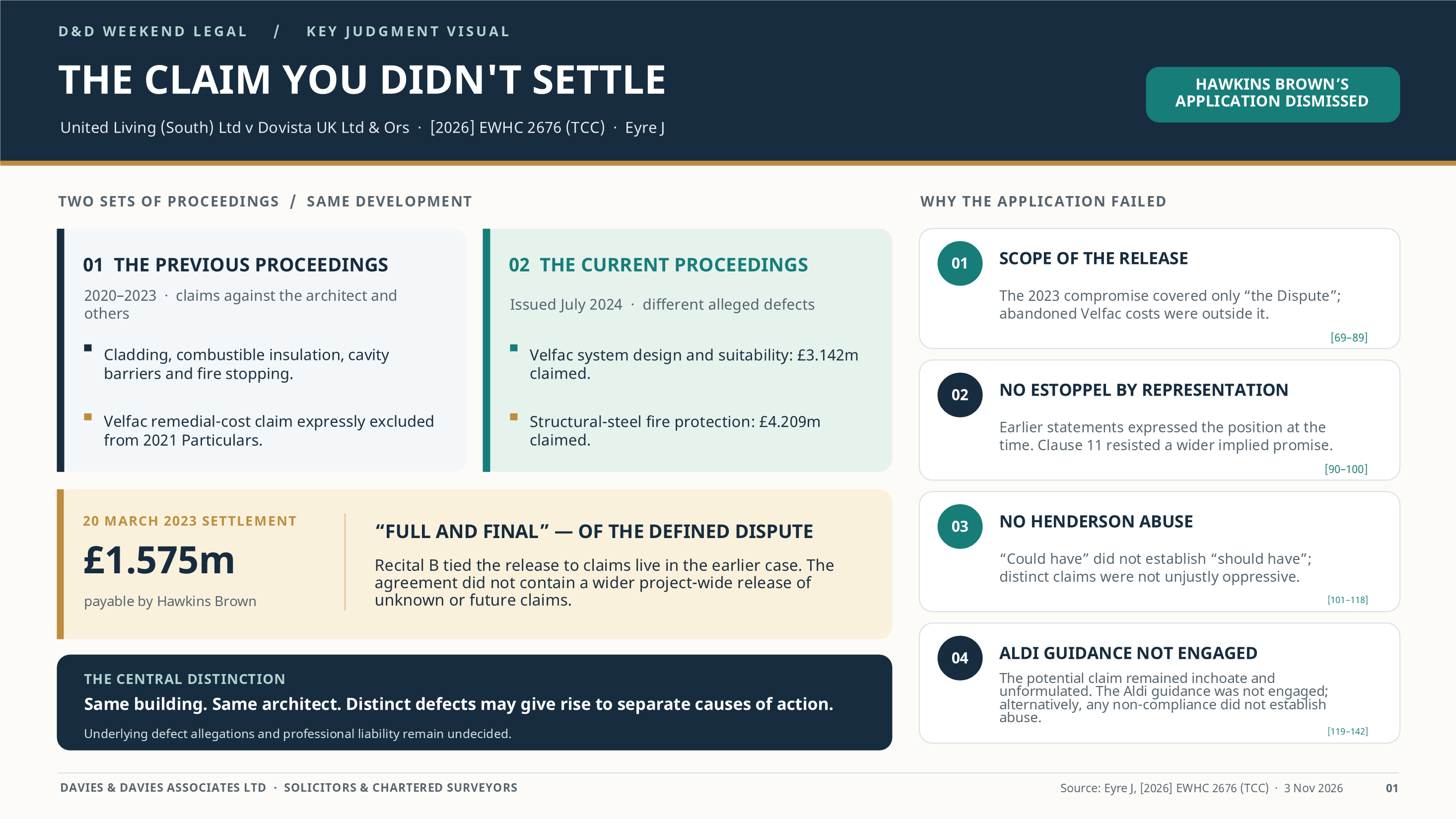
- The Claimant, United Living (South) Limited (“United Living”), brought proceedings against the Third Defendant, Hawkins Brown Limited (“Hawkins Brown”), and others for damages arising from alleged defects in the Velfac curtain walling system and the fire protection of structural steelwork at the Wenlock Building in London. [1, 48–54]
- United Living had previously brought proceedings against Hawkins Brown and others to recover sums for which it had become liable to Workspace 14 Limited (“Workspace”), which had acquired the benefit of United Living's contractual obligations through a collateral warranty and subsequent assignment. [1, 9–23]
- The claim against Hawkins Brown in those earlier proceedings had been compromised by a Settlement Agreement dated 20 March 2023 and a Tomlin Order sealed on 28 March 2023, under which Hawkins Brown had agreed to pay United Living £1.575 million. [1, 38–47]
- Hawkins Brown applied to strike out the Current Proceedings as an abuse of process under the principle derived from Henderson v Henderson, contending that United Living could and should have advanced the Velfac and structural steel claims in the Previous Proceedings. [2–4]
- Hawkins Brown further contended that United Living’s failure to disclose the potential further claim during the settlement of the Previous Proceedings contravened the guidance in Aldi Stores Ltd v WSP Group plc and rendered the Current Proceedings abusive. [2, 4, 119–142]
- Alternatively, Hawkins Brown sought summary judgment declaring that the Current Proceedings had been compromised by the Settlement Agreement or were barred by estoppel by representation. [2, 4, 69, 90–100]
- Held, dismissing the application, that the Settlement Agreement had compromised only the claims which were live in the Previous Proceedings when the agreement was concluded. [69, 78–89]
- The Velfac claim had been abandoned before the Settlement Agreement was made and therefore had not formed part of “the Dispute” as defined by the agreement. [18, 68, 77–80, 89]
- The agreement contained no language releasing all claims, whether known or unknown, arising from Hawkins Brown’s appointment, the works or the development, and the Court would not construe a release confined to a defined dispute as though it contained such wider language. [72–89]
- The estoppel case also failed because United Living’s statements in the Previous Proceedings had represented only its position and intention at the time and had not amounted to a representation that it would never bring a further claim. [94–95]
- Entry into the Settlement Agreement could not constitute an implied representation that claims outside its properly construed scope had been compromised, particularly where clause 11 contained an entire agreement and non-reliance provision. [96–100]
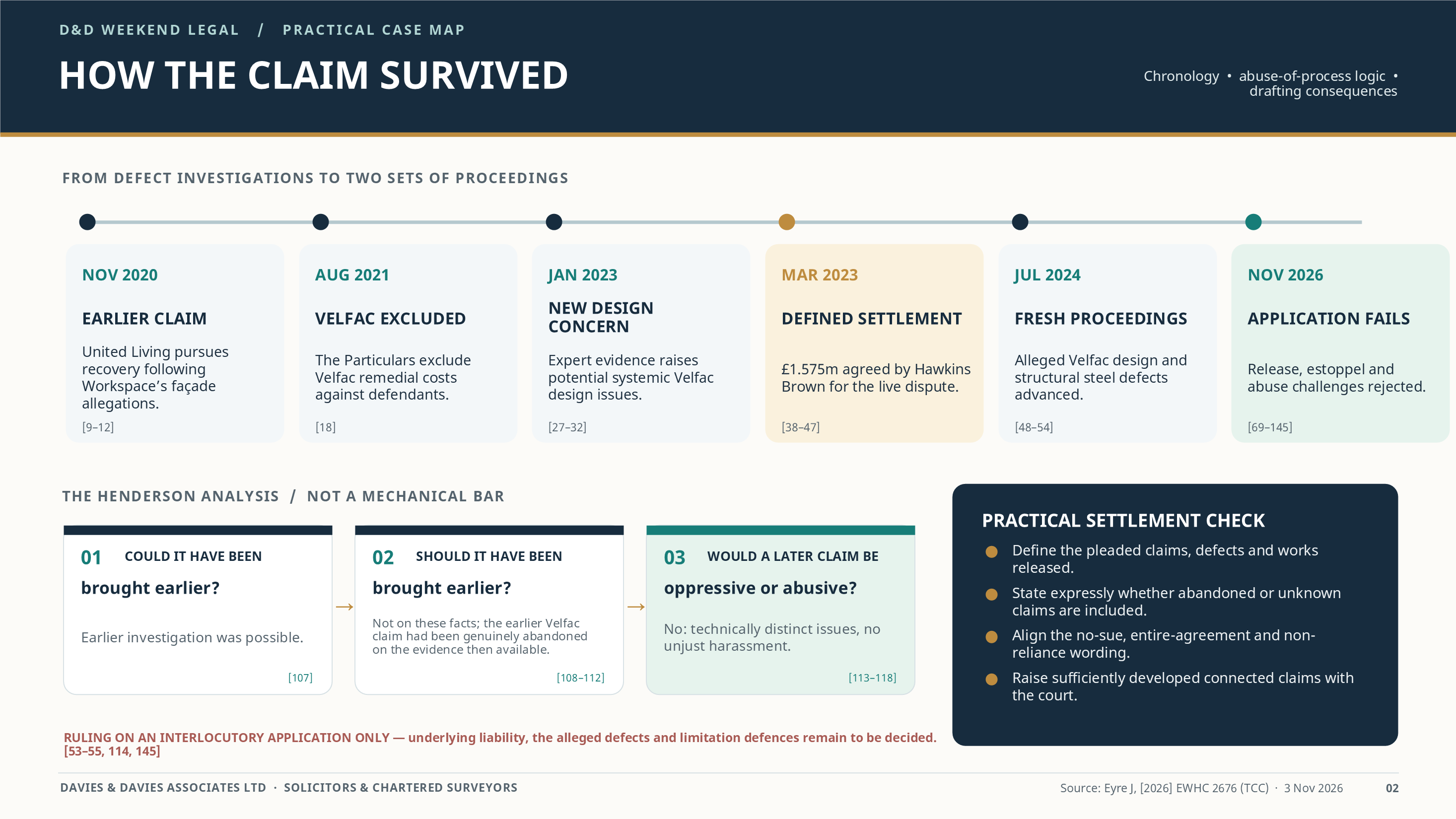
- Although United Living could have undertaken investigations which would have revealed the later claims earlier, it did not follow that it should have advanced those claims in the Previous Proceedings. [56–59, 102–112]
- United Living had genuinely abandoned the earlier Velfac claim because it considered that the defects resulted from workmanship for which Hawkins Brown was not responsible, an assessment which Hawkins Brown’s own solicitors had themselves advanced. [14–18, 57–59, 68, 108–109]
- The Current Proceedings concerned distinct design issues and different elements of the building from those in the Previous Proceedings, and the commencement of separate proceedings in respect of those matters did not amount to unjust harassment or oppression. [113–118]
- By the February 2023 mediation, United Living knew that the Velfac system required replacement and that there were potential grounds for a claim against Hawkins Brown. However, the claim remained inchoate and unformulated, requiring substantial further factual, expert and legal investigation before United Living could determine whether proceedings should be commenced. [29–32, 120–125]
- The Aldi Stores guidance had not required United Living to seek case-management directions in respect of that speculative and unformulated claim, and any failure to disclose it had not rendered the Current Proceedings abusive. [133–142]
- The application for strike-out and summary judgment was therefore dismissed. [145]
- Material Facts
- United Living had entered into a design and build contract dated 24 July 2007 for the conversion of 50–56 and 60 Wharf Road, London N1 into the Wenlock Building. [1, 7]
- Hawkins Brown had been appointed as architect under an agreement dated 12 November 2007, and practical completion of the development had been certified in stages between September 2008 and March 2009. [7]
- The building had extended to nine storeys and had incorporated brickwork, timber rainscreen cladding and, at the upper levels, a curtain wall arrangement comprising window frames and Velfac rainscreen panels. [8]
- Workspace commenced proceedings against United Living in September 2020, alleging defects that included combustible insulation, untreated timber cladding, missing cavity barriers and deficiencies in fire stopping. [9]
- United Living commenced the Previous Proceedings against Hawkins Brown and others in November 2020, seeking to recover the sums for which it might become liable to Workspace. [10–12]
- United Living initially alleged that Hawkins Brown was responsible for all relevant remedial costs, including costs associated with the Velfac system. [10–14]
- After considering the First Wintech Report, United Living concluded that the main cause of the proposed Velfac remedial works was poor workmanship for which Hawkins Brown would not be responsible. [13–14]
- Hawkins Brown’s solicitors had themselves contended in February 2021 that the relevant defects resulted from workmanship and that the First Wintech Report supported that conclusion. [15–16]
- United Living’s Particulars of Claim dated 26 August 2021 expressly stated that no claim was made against the defendants for the costs of remedial works to the Velfac curtain walling system. [18]
- The Workspace Proceedings were settled in July 2022, and the settlement arrangements contemplated remedial works to the Velfac system rather than its complete replacement. [21]
- A report from PS Fixing Limited dated 15 November 2022 identified rotten frames, corroded fixings, missing insulation and deficiencies in fire barriers within the Velfac system. [24]
- On 20 December 2022, Velfac informed United Living that the system was beyond viable remediation. [26]
- A report from Taylor Hammond of Status A Limited dated 6 January 2023 concluded that the fundamental defect was that the Velfac system had not been designed or intended for the situation in which it had been used and that complete removal and replacement represented the only viable solution. [27–29]
- HKA Global subsequently expressed the preliminary view that there were grounds for a claim against Hawkins Brown arising from an alleged failure to review Velfac’s designs competently and to identify defects in the fabrication drawings. [30]
- United Living understood that substantial further investigation would be required before it could determine whether the facts supported claims against Hawkins Brown and the other potential defendants and whether any cause of action remained within the applicable limitation periods. [31–32]
- The parties reached an agreement in principle at a mediation on 20 February 2023, and the Settlement Agreement was executed on 20 March 2023. [33–38]
- Recital B defined “the Dispute” by reference to the claims brought in the Previous Proceedings concerning liability for the costs of elements of the remedial works, while clause 5.1 provided for the full and final settlement of that defined dispute. [39–45]
- Clause 11 provided that the Settlement Agreement constituted the parties’ entire agreement concerning its subject matter and that neither party had relied upon any representation or warranty not expressly contained in the agreement. [47]
- An inspection undertaken in April 2024 revealed alleged deficiencies in the fire protection provided to structural steel beams and columns. [48]
- United Living issued the Current Proceedings on 18 July 2024 and claimed approximately £3.142 million for replacement of the Velfac system and £4.209 million for remediation of the alleged structural steel defects. [49–54]
- Issues
- Whether the Settlement Agreement had compromised only those claims which remained live in the Previous Proceedings or had operated as a general release of all potential claims against Hawkins Brown arising from its engagement on the development. [4, 69–89]
- Whether United Living’s pleadings, correspondence, conduct of the Previous Proceedings or entry into the Settlement Agreement had given rise to an estoppel by representation preventing it from pursuing the Current Proceedings. [4, 90–100]
- Whether United Living could and should have brought the Velfac and structural steel claims in the Previous Proceedings. [2–4, 56–59, 101–118]
- Whether the Current Proceedings, assessed in accordance with the broad merits-based approach in Johnson v Gore Wood, amounted to unjust harassment, oppression or an abuse of the Court’s process. [101–119]
- Whether United Living’s failure to disclose the potential further claim during the February 2023 mediation or to seek directions from the Court contravened the Aldi Stores guidance and rendered the Current Proceedings abusive. [119–142]
- Whether, if abuse were established, strike-out followed automatically or remained subject to a discretionary assessment of proportionality. [4, 103–104, 143–144]
- Decision
- Hawkins Brown’s application was dismissed. [145]
- The Settlement Agreement had compromised only those claims which remained live in the Previous Proceedings at the time of the agreement. [69, 78–89]
- The claims advanced in the Current Proceedings had not formed part of that defined dispute and had not been released or compromised. [78–89]
- The pleaded representations were insufficient to establish an estoppel by representation, and Hawkins Brown had not shown that it was entitled to summary judgment on that ground. [90–100]
- The Current Proceedings did not constitute an abuse of process under the Henderson v Henderson principle. [101–142]
- United Living had not been required to bring the current claims in the Previous Proceedings merely because earlier investigations could have revealed them. [107–112]
- The claims involved separate defects and substantially distinct factual and design issues which had not been litigated in the Previous Proceedings. [113–118]
- United Living’s failure to disclose the potential claim during the 2023 settlement process had not rendered the subsequent proceedings abusive. [119–142]
- The Aldi Stores guidance had not been engaged by a claim which remained speculative, inchoate and unformulated, or alternatively any departure from that guidance had not been sufficiently serious to alter the overall merits-based assessment. [133–142]
- Reasoning
- Scope of the Settlement Agreement
- The Court applied the ordinary objective principles of contractual construction and sought to identify the parties’ intention from the language of the Settlement Agreement read in its documentary, factual and commercial context. [70–71]
- Although parties could agree releases extending to unknown or future claims, the Court required sufficiently clear language before concluding that claims outside the immediate subject matter of the settlement had been surrendered. [72–77]
- The definition of “the Dispute” in recital B referred to the claims and defences in the Previous Proceedings and to liability concerning the costs of “elements of the Works”. [41, 78–80]
- That wording indicated that the Previous Proceedings and the resulting compromise concerned particular elements of the remedial works rather than every possible liability arising from Hawkins Brown’s involvement in the development. [78–81]
- Clause 5.1 released the claims comprising “the Dispute”, and clause 6.1 prevented further proceedings only in respect of those defined Released Claims. [44–45, 80–81]
- The parties could have expressed a wider intention by referring to all claims arising out of or in connection with Hawkins Brown’s appointment, the contract, the works or the development, but they had not done so. [74–75, 84]
- The Court therefore declined to transform an agreement settling identified proceedings into a general release which the parties had not expressed. [78–89]
- A claim which had been abandoned before a settlement agreement was concluded did not form part of the claims then in issue unless the agreement expressly brought it within the compromise. [77, 89]
- United Living had expressly abandoned the Velfac claim in its 2021 Particulars of Claim, and the claim was therefore outside the scope of “the Dispute” settled in March 2023. [18, 68, 77–80, 89]
- Estoppel by Representation
- The correspondence and pleadings relied upon by Hawkins Brown indicated that United Living was not pursuing a Velfac claim at the relevant time. [94–95]
- Those statements had not amounted to representations that United Living’s understanding or intentions would never change in response to later information. [94–95]
- Entry into a settlement agreement which compromised particular claims could not itself amount to a representation that different claims lying outside the agreement had also been released. [96–99]
- The availability of standard language capable of creating a general release, coupled with the parties’ failure to use it, weighed against the alleged implication. [99]
- The entire agreement and non-reliance provisions in clause 11 were also inconsistent with reliance upon an unwritten representation that the Settlement Agreement had a wider effect than its terms disclosed. [47, 99]
- The Court considered that the asserted estoppel would have been untenable upon a final determination, but held for the purposes of the application that United Living had at least a real prospect of successfully resisting it. [98–100]
- Abuse of Process
- The applicable principle required the Court to undertake a broad merits-based assessment rather than apply a rigid rule that any matter which could have been raised in earlier proceedings must have been raised there. [101–105]
- The questions whether a claim could have been brought earlier and whether it should have been brought earlier were separate, and satisfaction of both questions would not necessarily establish abuse. [102–105]
- A finding of abuse ordinarily required circumstances showing that the later proceedings amounted to unjust harassment or oppression and that the defendant was being vexed twice in relation to the same matter. [102–105]
- United Living accepted that the First Wintech Report had provided sufficient notice to permit further investigations which could have identified the Velfac claim at an earlier stage. [56–58, 107]
- The Court also considered that such investigations probably would have revealed the environmental and structural steel defects earlier. [58, 107]
- However, the Court was not persuaded that United Living should have brought those claims in the Previous Proceedings. [108–112]
- United Living had genuinely considered that the Velfac problems resulted from poor workmanship for which Hawkins Brown was not responsible, and Hawkins Brown’s solicitors had advanced the same assessment. [15–18, 59, 68, 109]
- The Court considered that parties should be encouraged to narrow the issues in dispute and that it would be inappropriate readily to penalise a claimant which had abandoned a claim in good faith because it regarded that claim as untenable. [109]
- United Living and Workspace had also acted legitimately in initially pursuing remediation of the Velfac system rather than proceeding directly to complete replacement. [110]
- Even if United Living both could and should have advanced the claims earlier, the broad merits-based assessment did not establish abuse. [113–118]
- The authorities recognised that different defects affecting different elements of the same building could constitute separate causes of action notwithstanding that the claims arose under the same contract or professional engagement. [115]
- The Previous Proceedings had concerned combustible insulation, cavity barriers, fire stopping and other identified external wall defects, whereas the Current Proceedings concerned the alleged systemic unsuitability of the Velfac system and deficiencies in the fire protection of structural steelwork. [9, 51–54, 115–117]
- The common professional appointment and similarity of the duties pleaded did not remove the factual and technical distinction between the two groups of claims. [67, 115–117]
- Hawkins Brown had not faced liability for the current allegations in the Previous Proceedings and was not being required to defend for a second time issues which had already been litigated or decided. [116–118]
- The practical and financial burdens identified by Hawkins Brown arose principally from the passage of time and the operation of the applicable limitation regime, rather than from the commencement of separate proceedings concerning distinct defects. [61–65, 118]
- Those burdens did not make the Current Proceedings oppressive or an unjust harassment. [117–118]
- Settlement Conduct and the Aldi Stores Guidance
- By the time of the February 2023 mediation, United Living knew that the Velfac system required replacement and that there might be a claim against Hawkins Brown arising from its design review. [29–36, 120]
- United Living did not disclose that possibility to Hawkins Brown or to the Court before the Settlement Agreement was concluded. [36–38, 68, 120]
- However, the evidence did not establish that disclosure would probably have produced a materially different outcome to the settlement negotiations. [121–123]
- United Living would not realistically have surrendered the potential further claim without additional payment, while Hawkins Brown had not suggested that it would have paid a greater sum to obtain a general release. [122]
- While recognising the danger of speculation, the Court considered it hard to see how disclosure would have produced an outcome other than settlement of the existing claims, albeit with Hawkins Brown aware that United Living was considering a further claim. [122–123]
- The potential further claim remained inchoate because substantial investigation was required into breach, causation, the position of other potential defendants, limitation and the application of the Defective Premises Act 1972. [31–32, 125]
- United Living had not possessed draft Particulars of Claim or a draft letter of claim and had not made a final decision to commence further proceedings. [31–32, 36, 125]
- Its position was therefore materially different from that of a party holding a formulated claim in reserve with the intention of issuing it immediately after completing a settlement. [125–132]
- The Aldi Stores guidance required connected claims to be brought before the court where appropriate, but breach of that guidance did not automatically make subsequent proceedings abusive. [133–140]
- Compliance with the guidance formed part of the broad merits-based evaluation and ordinarily required consideration of any resulting harassment, oppression, unfairness or prejudice. [102, 133–140]
- The circumstances differed materially from Aldi Stores because United Living’s potential claim remained speculative and unformulated and because the Current Proceedings included defendants who had not been parties to the Previous Proceedings. [136–141]
- United Living had not been required to seek directions concerning what remained an uninvestigated possibility, and the Aldi Stores guidance had not been engaged. [141]
- Alternatively, any failure to follow the guidance had not been sufficient to make the Current Proceedings abusive when all the circumstances were considered together. [141–142]
- Consequences of a Hypothetical Finding of Abuse
- The Court did not determine whether a finding of abuse automatically required strike-out or whether the Court retained a discretion to impose a proportionate alternative sanction. [143]
- The issue did not arise because the Current Proceedings had not been found abusive. [142–143]
- The Court nevertheless observed that, had it accepted Hawkins Brown’s contention that United Living’s conduct during the mediation and settlement amounted to the illegitimate keeping of a “card up its sleeve”, causing Hawkins Brown to settle the Previous Proceedings on a false basis and rendering the Current Proceedings oppressive, the claim would have been struck out. [144]
- That conclusion would have followed whether strike-out were treated as the inevitable legal consequence of abuse or as the proper exercise of a judicial discretion. [144]
- Principles and Ratio
- A settlement agreement which expressly compromised a defined dispute arising in identified proceedings released only the claims falling within that definition, unless its language objectively demonstrated an intention to release a wider class of claims. [69–89]
- Where a claim had been abandoned before the settlement agreement was concluded and did not form part of the live dispute at that time, settlement of the existing proceedings did not compromise that abandoned claim in the absence of express wording bringing it within the release. [77–80, 89]
- Entry into a settlement agreement compromising particular claims did not, without more, constitute a representation that claims outside the agreement had also been surrendered. [96–100]
- An entire agreement and non-reliance clause was inconsistent with an estoppel founded upon an alleged implied representation that the agreement possessed a wider scope than its express terms. [47, 99–100]
- For the purposes of Henderson v Henderson abuse, the fact that a claimant could have brought a claim in earlier proceedings did not establish that it should have done so, and neither conclusion automatically established abuse. [102–105, 107–113]
- The Court was required to undertake a broad merits-based assessment of all the circumstances, including whether the later proceedings amounted to unjust harassment or oppression and whether the defendant was being vexed twice in respect of the same matter. [101–105, 113–119]
- A claimant which had abandoned an earlier claim in good faith because the available evidence indicated that the claim was untenable was not necessarily precluded from advancing a later claim after materially different information emerged. [59, 108–112]
- Claims concerning distinct defects in different elements of a building could constitute separate causes of action and could be advanced in sequential proceedings without those later proceedings being inherently abusive. [115–117]
- A failure to disclose an inchoate and unformulated potential claim during the settlement of existing proceedings did not, in the circumstances of this case, amount to abuse where the settlement contained no general release, no representation of global finality had been made, and the later proceedings concerned distinct issues. [119–132]
- The Aldi Stores guidance did not impose an absolute obligation to seek directions concerning every speculative possibility of a later claim, and any failure to follow that guidance remained one factor within the broad merits-based assessment rather than an automatic bar to subsequent proceedings. [133–142]
- Disposition
- Hawkins Brown’s application to strike out the Current Proceedings as an abuse of process was dismissed. [145]
- Hawkins Brown’s application for summary judgment on the basis that the claims had been compromised by the Settlement Agreement was dismissed. [69, 78–89, 145]
- Hawkins Brown’s application for summary judgment on the basis of estoppel by representation was dismissed. [98–100, 145]
- The Court declined to direct the trial of the estoppel issue as a preliminary issue. [98]
- United Living was permitted to continue the Current Proceedings concerning the alleged Velfac and structural steel defects. [50–55, 145]
- The substantive merits of those defect claims, including Hawkins Brown’s liability and any limitation defences, remained to be determined. [53–55, 114, 118]
- Held that:
- The Settlement Agreement dated 20 March 2023 compromised only the claims which remained live in the Previous Proceedings and did not operate as a general release of all claims arising from Hawkins Brown’s involvement in the Wenlock Building. [69, 78–89]
- The abandoned Velfac claim had not formed part of “the Dispute” as defined by the Settlement Agreement and had not been released by that agreement. [18, 68, 77–80, 89]
- United Living’s earlier pleadings and correspondence had represented only its then-existing position and intention and had not represented that no further claim would ever be brought. [94–95]
- Entry into the Settlement Agreement did not give rise to an estoppel preventing claims outside its proper scope, particularly in light of the entire agreement and non-reliance provisions contained in clause 11. [96–100]
- United Living could have commissioned investigations which would have revealed the later claims earlier, but that fact did not establish that it should have advanced those claims in the Previous Proceedings. [56–59, 107–112]
- United Living had genuinely abandoned the earlier Velfac claim because it considered that the relevant defects resulted from workmanship for which Hawkins Brown was not responsible, a position which Hawkins Brown’s solicitors had themselves advanced. [14–18, 59, 68, 108–109]
- The Current Proceedings concerned distinct defects and design issues which had not been litigated in the Previous Proceedings and did not amount to unjust harassment or oppression of Hawkins Brown. [113–118]
- United Living’s knowledge during the 2023 settlement process concerned an inchoate and unformulated potential claim requiring substantial further investigation rather than a formulated claim which it had decided to pursue. [30–32, 36, 120–132]
- United Living’s failure to disclose that potential claim to Hawkins Brown or to the Court did not render the Current Proceedings abusive. [119–142]
- The Aldi Stores guidance had not required United Living to seek directions concerning the speculative potential claim, or alternatively that any non-compliance had not been sufficient to alter the broad merits-based conclusion that no abuse had occurred. [133–142]
- Hawkins Brown’s application for strike-out and summary judgment was dismissed. [145]
Comment: The Claim You Didn’t Settle
What does “full and final settlement” finally settle? In Eyre J’s judgment, the answer depended not upon an abstract expectation of finality, but upon the scope of the dispute the parties had actually agreed to compromise. The £1.575 million settlement resolved that defined dispute. It did not extinguish every potential claim arising from an architect’s involvement in the same development. [41]–[47], [78]–[89]
That distinction has particular significance in construction disputes. A single development may produce technically distinct defects, discovered at different times, engaging different duties and potentially different defendants. The same appointment, the same professional and the same building may therefore appear in successive proceedings without the second action necessarily being a replay of the first. [67]–[68], [113]–[118]
The agreement released claims in “the Dispute”, a term tied to claims and defences in the Previous Proceedings. The express exclusion of Velfac remedial costs from the 2021 Particulars of Claim was therefore significant. Had the parties intended a global discharge of all known and unknown claims connected with the development, they could have used language achieving that result. They did not. [18], [41]–[47], [78]–[89]
The procedural dimension is just as important. United Living had information from which further investigation could have been undertaken. But Eyre J separated three questions often compressed into one: could the claim have been brought earlier; should it have been brought earlier; and, looking at matters in the round, is bringing it now oppressive or an unjust harassment? An affirmative answer to the first does not automatically supply the other two. [101]–[118]
There was also an uncomfortable twist in the evidence. The earlier decision not to claim against the architect for the Velfac remedial works was genuine, and Hawkins Brown’s own solicitors had advanced the workmanship explanation on which that decision rested. As the judge recognised, parties should be encouraged to narrow the issues rather than be incentivised to maintain claims they genuinely regard as unsustainable simply to guard against a later allegation of procedural abuse. [14]–[16], [59], [108]–[110]
One might ask whether silence at a settlement mediation should be treated differently. By February 2023 United Living recognised a real possibility of a further claim, but substantial investigation remained: expert assessment, breach, causation, potential defendants, limitation and possible statutory avenues. The judge treated that claim as inchoate, not a carefully prepared claim being held in reserve for immediate deployment after settlement. [30]–[38], [120]–[132]
This is not a licence to conceal mature claims. Aldi Stores remains an important case-management discipline, and the judgment recognises that serious failures to raise connected proceedings may lead to abuse findings. But Eyre J held that directions were not required for this speculative, unformulated possibility; alternatively, any departure from the guidance did not change the holistic result. [133]–[142]
There is also a behavioural dimension, although it formed no part of the Court’s reasoning. A substantial settlement can create a natural expectation of finality. Commercially understandable though that expectation may be, it cannot enlarge the contractual scope of a release. Equally, later-discovered defects can make earlier warning signs appear more significant with hindsight. Those are general features of decision-making, not findings about the parties or their witnesses.
For those drafting settlements, the questions are practical. Is the release tied to pleaded claims, specified defects or a broader project-wide relationship? Are abandoned claims included? Are unknown claims expressly addressed? Do the no-sue and entire-agreement provisions match the intended bargain? And where connected claims are sufficiently developed, has the case-management position been raised with the court? The answers should be made clear before the Tomlin Order is sealed.
Eyre J did not decide whether Hawkins Brown was professionally negligent or whether the new allegations would succeed. He decided that the procedural and contractual objections did not prevent those claims from proceeding. The difference is central. [53]–[55], [145]
Editorial qualifications: The behavioural observations above are editorial and were not findings made by Eyre J. The hypothetical observations concerning strike-out at [143]–[144] do not form part of the dispositive ratio: no abuse was established. This report concerns an interlocutory application and not a determination of the underlying defect allegations.
#ConstructionLaw #ConstructionDisputes #SettlementAgreements #AbuseOfProcess #ProfessionalNegligence #TCC #DDAlegal
Authorities and Materials
The thematic classifications, descriptions and prioritisation below are editorial. They are not labels or rankings adopted by the Court, and the summaries are paraphrases rather than quotations unless expressly indicated. The list is confined to authorities and materials referred to in the judgment and is not intended to be exhaustive of the relevant law.
Case Law:
- Abuse of process, successive proceedings and the Henderson principle
- Henderson v Henderson (1843) 3 Hare 100 — The originating principle against abusive successive litigation. The question in the present case was whether United Living could and should have pursued the later claims in the previous action and whether the new proceedings were oppressive when the circumstances were viewed as a whole. [2], [101]–[105], [142]
- Johnson v Gore Wood & Co [2002] 2 AC 1 — The controlling broad, merits-based approach, rejecting an automatic bar merely because an issue could have been raised earlier. Also cited for protecting the integrity of settlements and for the public interest in avoiding unjust harassment. [4], [76], [101]–[104], [127], [142]–[143]
- Skatteforvaltningen v MCML Ltd [2024] EWHC 148 (Comm) — Eyre J adopted Bright J’s synthesis of the abuse authorities at [51]–[63], except that he reserved the question whether strike-out is compulsory after a finding of abuse. The analysis distinguishes could have from should have and requires a holistic assessment, including the significance of prejudice and oppression. [102]–[105], [139]
- Dexter Ltd v Vlieland-Boddy [2003] EWCA Civ 14 — Clarke LJ’s six propositions: the burden lies on the party alleging abuse; possible earlier joinder is insufficient; the merits-based inquiry governs; and a finding of abuse without unjust harassment or oppression will be rare. Quoted within Skatteforvaltningen. [102]
- Orji v Nagra [2023] EWCA Civ 1289 — Endorsed the Dexter approach and the high hurdle before denying a claimant a trial. Bright J also cited it in relation to potential alternatives to strike-out, although Eyre J expressly reserved the mandatory-versus-discretionary sanction question. [102]–[104]
- Michael Wilson & Partners Ltd v Sinclair [2017] EWCA Civ 3 — No prima facie presumption that a later action is abusive merely because connected issues were previously litigated; a case-specific assessment remains necessary. Quoted within Skatteforvaltningen. [102]
- Stuart v Goldberg Linde [2008] EWCA Civ 2, [2008] 1 WLR 823 — Courts do not lightly bar a genuine claim, but parties should disclose potential connected proceedings rather than keep material future claims concealed. Discussed in Skatteforvaltningen and again through MW High Tech. [102], [130]
- Clutterbuck v Cleghorn [2017] EWCA Civ 137 — Requires a scrupulous assessment of all the circumstances. Bright J distinguished oppressive relitigation and collateral attacks from a claim affected only by failure to comply with the Aldi guidance. [102]
- Connected claims, disclosure to the court and the Aldi guidance
- Aldi Stores Ltd v WSP Group plc [2007] EWCA Civ 1260, [2008] 1 WLR 748 — Guidance that a potential connected claim arising in ongoing complex litigation should, when appropriate, be raised with the court already seised of proceedings. Non-compliance is relevant to abuse but does not itself create an automatic prohibition on subsequent proceedings. Eyre J found the guidance inapplicable to an insufficiently formed potential claim, or alternatively insufficient to establish abuse on these facts. [2], [4], [102], [133]–[142]
- MW High Tech Projects UK Ltd v Outotec (USA) Inc [2024] EWCA Civ 844, [2024] 4 WLR 85 — Reiterated the serious risk of an abuse finding where connected claims are withheld, while explaining that an Aldi breach is a factor in the broad merits-based inquiry, not an automatic ground for strike-out. [130], [138]
- Ocorian Private Trustees (Jersey) Ltd v McGeoch [2026] EWHC 1575 (Ch) — A serious failure to present the full position to the Jersey court was held to constitute abuse in subsequent English proceedings. Eyre J distinguished the particular misconduct and false basis for subsequent litigation from United Living’s speculative, unformulated claim. [140]–[142]
- Gladman Commercial Properties v Fisher Hargreaves Proctor [2013] EWCA Civ 1466 — Within Bright J’s survey, identified as a case in which the conduct was expressly characterised as oppressive; thus it did not establish that a mere Aldi breach without oppression or other prejudice mandates strike-out. [102]
- Otkritie Capital International Ltd v Threadneedle Asset Management Ltd [2017] EWCA Civ 274 — Illustrates a failure to follow the Aldi guidance for which the consequence was reflected in costs rather than striking out the claim. [102], [138]
- Re Lehman Brothers Holdings Plc — Hildyard J cautioned that the Aldi guidance must not become an inflexible rule overriding the Johnson analysis. The guidance was found not to be engaged and the claim was not struck out. The supplied judgment gives no neutral citation or report reference; none is supplied here. [102]
- Scope and construction of settlement releases
- BCCI v Ali [2001] UKHL 8, [2002] 1 AC 251 — A release can encompass unknown claims if sufficiently clear, but its language and subject-matter context govern. The judgment also discussed the materially different situation of one party knowingly taking the benefit of a broad release while the other party is unaware of a claim. [72], [128]–[129]
- Bin Obaid & others v Al-Hezaimi & others [2024] EWCA Civ 612 — Settlement of identified proceedings ordinarily settles the disputes then being litigated; a broader compromise should normally be clearly signalled. Claims abandoned before settlement are not necessarily included within the claims then in issue. [74], [77]–[80], [89]
- Dawnvale Cafe Components Ltd v Hylgar Properties Ltd [2024] EWHC 1199 (TCC) — Legally advised commercial parties intending a release of all potentially related claims could have used language encompassing claims arising from the contract, works or disputes, rather than wording tied to identified proceedings. [75], [84], [99]
- Re Electrical Control Installations Ltd [2021] EWHC 2661 (Ch), [2022] BCC 199 — Where a claim is genuinely within the scope of a release, a court looks to the substance of the bargain rather than allowing the same claim to be revived in another form. [76]
- Distinct construction defects and separate causes of action
- Steamship Mutual Underwriting Association Ltd & another v Trollope & Colls (City) Ltd & others (1986) 33 BLR 81 — Separate damage to different elements of the same building may give rise to separate causes of action despite a common contractual relationship; separate proceedings are not inherently abusive. [115]
- Secretary of State for Transport v Pell Frischmann Consultants Ltd [2006] EWHC 2909 (TCC) — A new duty, a materially different breach, or damage to a different building element may constitute a new claim, subject to a fact-sensitive assessment. [115]
- Co-operative Group Ltd v Birse Development Ltd [2013] EWCA Civ 474 — Approved Pell Frischmann and noted that an allegation founded upon facts not the same or substantially the same as those already pleaded is likely to be a new cause of action. Contrasted disparate repairable defects with a subsequently alleged systemic defect. [115]
- Conquer v Boot — Cited within Lloyd LJ’s passage quoted from Steamship Mutual for the proposition that a claimant must bring forward its entire case on one and the same cause of action. The judgment does not provide a report citation, and this is a secondary mention rather than an independent application by Eyre J. [115]
- Objective interpretation and commercial common sense
- ABC Electrification Ltd v National Rail Infrastructure Ltd [2020] EWCA Civ 1645, [2021] BLR 97 — Sets out the agreed objective method of interpreting contractual language in documentary, factual and commercial context, without substituting hindsight or subjective intention for the words used. [70], [88]
- Lukoil Asia Pacific Ptd Ltd v Ocean Tankers (Pte) Ltd [2018] EWHC 163 (Comm) — Commercial common sense may tip the balance between linguistically possible interpretations but cannot itself defeat the natural meaning of a clause. [71]
- Wood v Capita Insurance Services Ltd [2017] UKSC 24; [2017] AC 1173; [2017] 2 WLR 1095; [2017] 4 All ER 615; 171 Con LR 1 — Cited within the ABC Electrification quotation as one of the principal authorities informing the integrated language-and-context approach. Not independently analysed by Eyre J. [70]
- Arnold v Britton [2015] UKSC 36; [2015] AC 1619; [2015] 2 WLR 1593; [2016] 1 All ER 1 — Cited within ABC Electrification in support of the centrality of the wording chosen and caution against using commercial common sense to rewrite the contract. [70]
- Rainy Sky SA v Kookmin Bank [2011] UKSC 50; [2012] BLR 132; [2012] 1 Lloyd's Rep 34; [2011] 1 WLR 2900; [2012] 1 All ER 1137; 138 Con LR 1 — Cited within ABC Electrification among the recognised authorities governing objective contract interpretation. Not separately applied. [70]
- Triple Point Technology Inc v PTT Public Company Ltd [2021] UKSC 29, [2021] AC 1148 — Relied on in submissions concerning exclusion clauses, but Eyre J expressly held that the cited guidance did not assist in construing this Settlement Agreement. [72]
- Consequences of abuse and proportionality (question left open)
- FII Group Test Claimants v HMRC [2020] UKSC 47, [2022] AC 1 — Hawkins Brown relied upon observations concerning the consequence of a finding of abuse; Eyre J noted the accompanying reminder that a later claim is not abusive merely because it could and should have been raised earlier unless it is oppressive. The judge did not decide whether strike-out is mandatory upon proof of abuse, because abuse was not established. [103]–[104], [143]–[144]
Legislation, Procedural Rules and Regulatory Materials:
- Procedural framework and limitation
- Civil Procedure Rules (CPR) — The overriding objective and the judicial management of related proceedings form part of the background to the abuse analysis. The judgment refers to the CPR in the quoted discussion and to an application for summary judgment, but does not expressly identify CPR Part 24 by number. The Aldi guidance is case law, not a freestanding numbered CPR rule. [2], [102], [130], [133]–[142]
- Limitation Act 1980, sections 4B(4) and/or 10 — Hawkins Brown accepted that claims benefiting from these extended limitation provisions were in time. The Court did not finally decide which individual substantive claims satisfied the provisions; the point arose in assessing whether the burdens of old claims rendered the second proceedings oppressive. [118]
- Building and fire safety duties in the underlying allegations
- Building Regulations applicable to the development — The alleged absent cavity barriers and fire stopping and the alleged inadequacy of protection to upper-floor structural steelwork were advanced by reference to regulatory requirements, including functional requirement B3(1). The application did not decide whether the alleged regulatory failures were established. [9], [52], [92]
- Defective Premises Act 1972 — Mentioned in connection with investigation of whether defects rendered apartments unfit for habitation and whether there was a viable statutory cause of action. The Court made no determination of substantive liability under the Act. [32], [92], [125]
- Building Safety Act 2022 — Identified as part of the post-Grenfell background in which inadequacies of the façade arrangements came to light. No specific provision of that Act was applied in deciding the interlocutory application. [8]
- Associated technical guidance (not legislation)
- Approved Document B (ADB) — Cited in the pleaded allegations concerning 90-minute fire resistance for structural steelwork and functional requirement B3(1). ADB is guidance associated with the Building Regulations, not itself an Act or statutory instrument; its substantive application was not decided. [52], [92]
Contractual and Procedural Materials:
- Settlement Agreement dated 20 March 2023, particularly recital B and clauses 5.1, 6.1 and 11 — Defined “the Dispute”, released the relevant claims, limited the agreement not to sue to those released claims, and included entire-agreement and non-reliance terms. The wording was central to rejecting the alleged broad compromise and estoppel. [39]–[47], [69]–[100]
- Tomlin Order sealed 28 March 2023 — The mechanism by which the Previous Proceedings against Hawkins Brown were compromised; it did not independently enlarge the Settlement Agreement’s defined release. [1], [38]–[47]
- Earlier pleadings and correspondence, including the Particulars of Claim of 26 August 2021 — The express exclusion of Velfac remedial costs from the earlier claim was material to the finding that the Velfac claim was not live when settlement occurred. [18], [68], [77]–[89]
- Workspace Settlement Agreement and Tomlin Order dated July 2022 — Provided the context for the remedial obligations which United Living had sought to recover in the Previous Proceedings, including a plan for Velfac remediation rather than wholesale replacement. [1], [21], [39]–[47]
Legal Texts & Commentary:
- Procedural finality and proportionate sanctions
- Zuckerman, Civil Procedure, 4th ed. (2021), §§26.122–26.128 — Referred to within Bright J’s analysis quoted in Skatteforvaltningen. The commentary criticised the outcomes in Aldi Stores and Otkritie as insufficiently stringent. Bright J declined to accept that mere non-compliance with Aldi should generally require striking out a potentially sound claim; Eyre J adopted the summary of abuse principles but expressly reserved the distinct issue of mandatory strike-out after abuse has been found. [102]–[104], [143]
Editorial qualification: The descriptions above are confined to the judgment. References to cases embedded in quotations are distinguished from authorities independently reasoned through by Eyre J. The decision disposed of applications concerning release, estoppel and abuse; it did not decide underlying professional negligence, defects, limitation defences or whether strike-out is necessarily mandatory after an established abuse. [98]–[100], [142]–[145]
Nigel Davies BSc(Hons) (Q.Surv), PGCert.Psych, GDipLaw, PGDipLP, DipArb, MSc (Built Environment), LLM (Construction Law & Practice), MSc (Mechanical & Electrical), MSc (Psychology), FRICS, FICE, FCIOB, FCInstCES, FCIArb, CArb, GMBPsS, Panel Registered Adjudicator, Mediator, Mediation Advocate, Chartered Builder, Chartered Construction Manager, Chartered Surveyor, Chartered Civil Engineering Surveyor, Chartered Arbitrator, Author, Solicitor-Advocate and PhD Candidate in Experimental Psychology (UCL)
Adjudicator Assessor and Re-Assessor for the ICE
ICE DRC Member
ICE DRC CPD Committee Chairman
Adjudicator Exam Question Setter for the ICE
CIArb Adjudication Panel Member since 2006
CIArb Arbitration Panel Member since 2006
CIC Adjudication Panel Member since 2010
FIDIC Adjudication Panel Member since 2021
ICE Adjudication Panel Member since 2021
Law Society Panel Arbitrator
RIBA Adjudication Panel Member since 2018
RICS Adjudication Panel Member since 2006
RICS Dispute Board Registered since 2013
TECSA Adjudication Panel Member since 2012
The information & opinions expressed in this article are not necessarily comprehensive, nor do they represent the trenchant view of the author; in any event, this article does not purport to offer professional advice. This article has been prepared as a summary and is intended for general guidance only. In the case of a specific problem, it is recommended that professional advice be sought.
© 2026 Davies & Davies Associates Ltd
Back to Legal Updates