E & TL Jones (Civils) Ltd v Vale of Glamorgan Council
Technology and Construction Court, King’s Bench Division
HHJ Keyser KC, 4 August 2026
Key Words
Construction contract – Project Bank Account – NEC4 Option Y(UK)1 – Contracts (Rights of Third Parties) Act 1999 – Named Supplier – Joining Deed – direct payments – main contractor insolvency – prevention principle – contractual interpretation – causation – waiver – third-party defences.
- Headnote
- The Claimant, a civil-engineering and groundworks subcontractor, brought proceedings against the Defendant local authority under the Contracts (Rights of Third Parties) Act 1999 following the insolvency of ISG Construction Ltd, the main contractor. [1], [24]–[28]
- The Claimant sought damages of £486,017.67, being the amount certified under its fourth subcontract payment application and included within ISG’s seventh application for payment under the Main Contract. [1], [21]–[23]
- The Main Contract incorporated NEC4 secondary Option Y(UK)1 and provided for the establishment of a Project Bank Account (“PBA”) for the protection of suppliers who acquired the contractual status of “Named Suppliers”. [3]–[9], [30]–[32]
- Although the Defendant and ISG executed a PBA Trust Deed, the PBA was never opened, the schedule of Named Suppliers remained incomplete, and the Claimant never executed a Joining Deed. [11]–[12], [18]
- While the PBA remained unopened, the Defendant made direct payments to ISG, including a payment comprising sums attributable to work undertaken by the Claimant. [19]–[23]
- ISG entered administration on 20 September 2024 without having paid the Claimant and before the Claimant had become a Named Supplier. [17]–[18], [23]
- The Claimant contended that clause Y1.8 conferred an enforceable benefit upon it as a Supplier, that the Defendant breached that clause by paying ISG directly, and that the direct payments prevented or materially reduced the prospect of the PBA being established. [24]–[28], [36], [68]
- The Court held that the relevant class of third parties identified by clause Y1.8 comprised Named Suppliers, not Suppliers or subcontractors generally. [30]–[35]
- The Claimant had never become a Named Supplier because the prescribed proposal, acceptance and joinder process had not been completed and no Joining Deed had been executed. [18], [32]–[34]
- The Claimant therefore failed to satisfy sections 1(1)(b) and 1(3) of the 1999 Act and had no right to enforce clause Y1.8. [34]–[37], [49]
- The Court rejected the Claimant’s reliance upon the prevention principle. An alleged breach of the contractual provision sought to be enforced could not itself confer a statutory right of enforcement upon a non-party that did not satisfy section 1 of the 1999 Act. [36]–[37], [50]
- The Court further held that clause Y1.8 imposed a positive obligation to make payment into an existing PBA. It did not impose a separate negative obligation prohibiting direct payments to ISG while no PBA existed. [52], [56]–[65]
- The Defendant’s direct payments did not therefore constitute breaches of the Main Contract. [52], [56]–[66]
- On the alternative assumption that the Claimant possessed an enforceable right and that the direct payments constituted breaches, the Court found that causation was not established. The evidence showed that the failure to open the PBA resulted from Santander’s administrative processes and KYC requirements, rather than any lack of incentive on ISG’s part. [67]–[71]
- The Court further considered that, had the Claimant otherwise been entitled to enforce clause Y1.8, the Defendant would in any event have been entitled under section 3(2) of the 1999 Act to rely upon ISG’s request for and acceptance of direct payment as a defence. [58], [72]
- The claim was dismissed. [73]
- Material facts
- In September 2021, the Defendant issued an Invitation to Tender for the construction of an extension to a school in Penarth. [3]
- The tender documentation required the successful contractor to use a PBA as the principal mechanism for protecting payments due to some or all works-package subcontractors. [3]–[5]
- On 23 August 2023, the Defendant entered into the Main Contract with ISG for £20,897,221.77. [6]
- The Main Contract incorporated NEC4 secondary Option Y(UK)1 and identified Santander as the project bank. [7]–[9]
- The contractual machinery distinguished between a “Supplier” and a “Named Supplier”. [9], [32]–[33]
- A Supplier became a Named Supplier after the Contractor proposed its addition, the Project Manager accepted that proposal, and the Client, Contractor and Supplier executed the prescribed Joining Deed. [9], [32]
- The Defendant and ISG executed a PBA Trust Deed dated 2 April 2024, but the schedule of Named Suppliers recorded only: “To be confirmed”. [11]
- On 15 May 2024, the Claimant entered into a groundworks subcontract with ISG for £2,950,574.69. [14]
- The Claimant was neither identified in the Trust Deed as a Named Supplier nor subsequently admitted to it by a Joining Deed. [11], [18]
- Between November 2023 and September 2024, the Defendant made seven payments directly to ISG while the PBA remained unopened. [19]
- The process of establishing the PBA was delayed by administrative difficulties at Santander, including misplaced documentation and unresolved KYC requirements arising in the context of ISG’s proposed corporate sale. [13], [15]–[17]
- The evidence did not establish that ISG deliberately delayed the opening of the PBA because it continued to receive direct payments. [15]–[16], [69]–[70]
- ISG’s seventh Main Contract application included £486,017.67 attributable to the amount certified under the Claimant’s fourth subcontract payment application. [21], [23]
- On 5 September 2024, the Defendant paid ISG £1,121,427.30 in respect of that application. [19], [23]
- ISG entered administration on 20 September 2024 without paying the Claimant and before the PBA had been opened. [17]–[18], [23]
- The Claimant had no realistic prospect of recovering the amount through ISG’s administration. [1], [23]
- Issues
- Whether clause Y1.8 conferred an enforceable benefit upon the Claimant within sections 1(1)(b) and 1(3) of the 1999 Act. [26], [28]–[29]
- Whether the relevant contractual class comprised all Suppliers or only those Suppliers who had acquired the defined status of Named Suppliers. [29]–[35]
- Whether the prevention principle could overcome the Claimant’s failure to become a Named Supplier on the basis that the Defendant’s alleged breach impeded completion of the PBA arrangements. [36]–[37]
- Whether clause Y1.8 prohibited the Defendant from making direct payments to ISG while the PBA remained unopened. [28], [51]
- Whether clause Y1.8 imposed only a positive obligation to pay into an existing PBA or also contained an implied negative obligation not to pay ISG by any other method. [51], [56]–[65]
- Whether any breach of clause Y1.8 caused the Claimant’s loss. [28], [67]–[71]
- Whether section 3(2) of the 1999 Act permitted the Defendant to rely upon ISG’s request for and acceptance of direct payments as a defence. [28], [58], [72]
- Decision
- The Main Contract did not confer upon the Claimant a right to enforce clause Y1.8 under the 1999 Act. [34]–[37], [49]
- The class of third parties upon whom clause Y1.8 purported to confer a benefit was limited to Named Suppliers. [30]–[35]
- The Claimant never became a Named Supplier because the contractual approval and joinder process was not completed and no Joining Deed was executed. [18], [32]–[34]
- The Claimant therefore failed to satisfy the identification requirement in section 1(3) of the 1999 Act. [34]–[37]
- The prevention principle did not permit the Claimant to circumvent the statutory conditions governing third-party enforcement. [36]–[37], [50]
- The Defendant did not breach clause Y1.8 by making direct payments to ISG while no PBA existed. [52], [56]–[66]
- Clause Y1.8 imposed a positive obligation to pay into an operational PBA. It did not impose an independent negative obligation prohibiting payment by another method. [56], [59]
- The Claimant’s proposed construction would have prevented certified payments from being made while the banking arrangements remained incomplete. [60]–[64]
- That construction was inconsistent with the Main Contract’s payment provisions and did not accord with commercial common sense. [60]–[64]
- On the alternative assumptions considered by the Court, the Claimant failed to prove that the direct payments caused either the non-establishment of the PBA or its loss. [67]–[71]
- On that alternative basis, the operative causes of delay were Santander’s administrative handling and KYC requirements. [69]–[71]
- The Court found that the PBA would not have been opened before ISG entered administration, irrespective of whether the Defendant had made direct payments. [69]–[71]
- The Court further considered that, had the Claimant otherwise been entitled to enforce clause Y1.8, ISG’s request for and acceptance of direct payments would have afforded the Defendant a defence under section 3(2) of the 1999 Act. [58], [72]
- The claim was dismissed. [73]
- Reasoning
- Standing under the 1999 Act
- Sections 1(1)(b) and 1(3) required the relevant contractual term to confer a benefit upon the third party and to identify that party by name, as a member of a class, or as answering a particular description. [25]–[26], [29]
- The relevant question was not whether the PBA arrangements were intended, in a broad commercial sense, to benefit subcontractors. It was whether clause Y1.8 identified a class of which the Claimant was a member. [30]–[31]
- The contractual language distinguished Suppliers generally from the narrower category of Named Suppliers. [9], [32]–[35]
- A Supplier became a Named Supplier through proposal, acceptance and execution of the Joining Deed. [9], [32]
- Those steps defined membership of the relevant class; they were not merely procedural requirements governing the exercise of a pre-existing right. [32]–[35]
- The Claimant did not acquire Named Supplier status merely because it was a subcontractor or because the PBA arrangements were intended to protect subcontractor payments. [30]–[35]
- It had not executed a Joining Deed and was not identified in the schedule to the Trust Deed. [11], [18], [33]
- It was therefore outside the class identified by clause Y1.8 and could not enforce that clause under section 1 of the 1999 Act. [34]–[37], [49]
- Prevention principle
- The Claimant argued that the Defendant’s direct payments removed ISG’s incentive to complete the PBA arrangements and thereby prevented the Claimant from becoming a Named Supplier. [27], [36], [68]
- The Court held that the argument failed to address the anterior statutory question: whether the Claimant possessed a right of enforcement under section 1. [36]
- As a non-party to the Main Contract, the Claimant could sue upon it only if the statutory requirements were satisfied. [36]
- An alleged breach of the term sought to be enforced could not itself confer standing upon a third party that did not satisfy those requirements. [36]–[37], [50]
- To hold otherwise would permit the Claimant to enforce the clause without first satisfying the statutory conditions governing third-party rights. [36]
- Construction of clause Y1.8
- The Claimant submitted that clause Y1.8 required every Main Contract payment to be made into the PBA and that any direct payment to ISG was necessarily a breach. [24], [27], [51]
- The Court construed clause Y1.8 as imposing a positive obligation whose performance presupposed the existence of an operational PBA. [56]
- The PBA never came into existence, so the stipulated payment mechanism was unavailable. [18], [56]
- The failure to pay into an account that did not exist did not, without more, amount to a breach of the positive obligation. [56]
- The Court rejected the argument that clause Y1.8 also contained an implied negative obligation prohibiting payment to ISG by any other means. [56]–[59]
- No such prohibition was expressed, nor did it arise by necessary implication from the positive obligation to pay into the PBA. [56], [59], [61]–[64]
- The proposed implication would have conflicted with the NEC4 core payment provisions and prevented payment altogether while Santander’s processes remained incomplete. [60]–[64]
- It would also have prohibited payments attributable solely to ISG’s own work. [64]
- The Court considered that outcome commercially unrealistic and unsupported by the contractual language. [61]–[64]
- In the absence of Named Suppliers, no third party possessed enforceable contractual or proprietary rights in relation to the proposed PBA arrangements. [52]–[53]
- The Defendant and ISG were therefore free to agree upon or accept an alternative method of payment. [52], [58], [62]–[63]
- Causation: alternative finding
- The Court addressed causation only on the alternative assumption that the Claimant possessed an enforceable right and that the direct payments constituted breaches. [67]
- The Claimant contended that, had the Defendant refused to make direct payments, ISG would have been compelled to procure the opening of the PBA. [68]
- The Court held that this counterfactual case was unsupported by the evidence. [69]–[71]
- The contemporaneous material did not show that ISG had deliberately delayed the PBA because direct payments continued. [69]–[70]
- It instead showed continuing attempts to progress the banking arrangements. [15]–[16], [69]–[70]
- The delays arose from Santander’s administrative handling, misplaced documentation, personnel changes and unresolved KYC requirements connected with ISG’s proposed sale. [15]–[17], [69]–[70]
- Santander would not open the PBA until its KYC requirements had been satisfied following the proposed sale. [16], [69]
- The proposed sale failed and ISG entered administration before the process could be completed. [17], [69]
- Withholding direct payments would not, on the balance of probabilities, have resulted in the PBA being opened before ISG’s administration. [69]–[71]
- On that alternative basis, the alleged breach did not cause the Claimant’s loss. [69]–[71]
- Defence under section 3: alternative finding
- Section 3(2) of the 1999 Act preserved the promisor’s entitlement to rely upon any defence or set-off that would have been available had proceedings been brought by the promisee. [26]
- The Court addressed this issue only after observing that the analysis otherwise depended upon too many hypothetical assumptions. [72]
- ISG requested and accepted the payments made directly by the Defendant. [19], [58], [72]
- The Court considered that ISG thereby waived any entitlement to complain that those payments contravened clause Y1.8. [72]
- Had the Claimant otherwise been entitled to enforce clause Y1.8, that waiver would have afforded the Defendant a defence under section 3(2). [72]
- Ratio decidendi and alternative findings
- Ratio decidendi
- A third party does not acquire a right to enforce a contractual term under section 1(1)(b) of the 1999 Act merely because the term was intended, in a general or commercial sense, to operate for its benefit. [30]–[35]
- Where the contract confers a benefit upon members of a defined class, the third party must establish that it falls within that class for the purposes of section 1(3). [26], [29]–[35]
- Under NEC4 Option Y(UK)1, where the relevant class comprises Named Suppliers, a subcontractor that has not completed the prescribed proposal, approval and joinder process and has not executed a Joining Deed is not a member of that class. [32]–[35]
- A third party that does not satisfy section 1 cannot rely upon an alleged breach of the term sought to be enforced as a means of circumventing the statutory requirements for third-party enforcement. [36]–[37], [50]
- A contractual obligation to make payment into a PBA presupposes the existence of an account into which payment can be made. [56]
- Where no PBA has been established, a positive obligation to pay into that account does not, without express wording or necessary implication, create a separate negative obligation prohibiting payment by another method. [56]–[59]
- A prohibition upon direct payment will not be implied where it would conflict with the contractual payment machinery and prevent payment altogether while the banking arrangements remain incomplete. [60]–[64]
- Alternative findings
- On the alternative assumption that the Claimant possessed an enforceable right and that the direct payments constituted breaches, the Claimant remained required to prove that the alleged breach caused its loss by reference to the appropriate counterfactual and the available evidence. [67]–[71]
- The Court found that causation was not established because the evidence showed that the PBA would not have been opened before ISG’s administration, irrespective of whether direct payments had been made. [69]–[71]
- The Court further expressed the view that ISG’s request for and acceptance of direct payments constituted waiver and would have afforded the Defendant a defence under section 3(2) of the 1999 Act. [72]
- Disposition
- The Claimant failed to establish a right to enforce clause Y1.8 under section 1 of the 1999 Act. [34]–[37], [49]
- The Claimant failed to establish that the Defendant breached clause Y1.8 by making direct payments to ISG. [52], [56]–[66]
- On the alternative assumptions considered by the Court, the Claimant also failed to establish that the direct payments caused its loss. [67]–[71]
- The Court further considered that, had the Claimant otherwise been entitled to enforce clause Y1.8, the Defendant would have been entitled to rely upon the defence preserved by section 3(2) of the 1999 Act. [72]
- The claim was dismissed. [73]
- Held
- Clause Y1.8 identified Named Suppliers, rather than Suppliers or subcontractors generally, as the class of third parties upon whom the Main Contract purported to confer an enforceable benefit. [30]–[35]
- The Claimant never became a Named Supplier because the contractual approval and joinder process was not completed and it did not execute a Joining Deed. [18], [32]–[34]
- The Claimant did not satisfy sections 1(1)(b) and 1(3) of the 1999 Act and was not entitled to enforce clause Y1.8. [34]–[37], [49]
- The prevention principle did not permit a third party to circumvent the statutory requirements for enforcement by relying upon an alleged breach of the term it sought to enforce. [36]–[37], [50]
- The obligation to make payment into the PBA presupposed the existence of an operational account. [56]
- Clause Y1.8 did not impose an independent negative obligation prohibiting direct payments to ISG while no PBA existed. [56]–[59]
- The Defendant did not breach the Main Contract by making direct payments to ISG. [52], [56]–[66]
- The Court further found, on the alternative assumptions considered, that the Claimant failed to prove that the direct payments caused either the failure to establish the PBA or the loss claimed. [67]–[71]
- On that alternative basis, the evidence demonstrated that the PBA was delayed by Santander’s administrative and KYC requirements and would not have been opened before ISG entered administration, irrespective of the payment method adopted by the Defendant. [69]–[71]
- The Court further expressed the view that ISG’s request for and acceptance of direct payments would, had the Claimant otherwise been entitled to enforce clause Y1.8, have afforded the Defendant a defence under section 3(2) of the 1999 Act. [72]
- The claim was dismissed. [73]
Comment
At first instance, this was a case in which a substantial commercial grievance did not translate into an enforceable legal right. E & TL Jones had carried out the works. ISG had received a payment under the Main Contract that included the amount certified in respect of Jones’ Subcontract Application No. 4. ISG subsequently entered administration without remitting that amount to Jones, leaving a loss of £486,017.67 for which no recovery was expected through the administration process. [1], [23]
The central issue was the distinction between a Supplier and a Named Supplier. Jones was unquestionably a Supplier from the date of its subcontract. However, it never became a Named Supplier. Under NEC4 Option Y(UK)1, Named Supplier status arose only after the Contractor proposed the Supplier, the Project Manager accepted the proposal, and the Client, Contractor and Supplier executed the Joining Deed. [9], [18], [32]–[33]
Those requirements were not procedural niceties. They defined the contractual class entitled to the protections afforded by the Project Bank Account arrangements. [32]–[35]
The Court therefore distinguished between the broad purpose of the PBA regime and the narrower statutory requirements imposed by the Contracts (Rights of Third Parties) Act 1999. The contractual arrangements were plainly designed to protect subcontractor payments from the consequences of main-contractor insolvency. However, section 1 of the 1999 Act required more than the existence of a generally beneficial contractual scheme. It required the claimant to establish that it fell within the class identified by the relevant contractual provision. The Court held that the relevant class under clause Y1.8 comprised Named Suppliers and not Suppliers generally. [30]–[37]
The prevention argument could not overcome that difficulty. Jones contended that the Defendant’s direct payments removed ISG’s incentive to establish the PBA and thereby prevented Jones from becoming a Named Supplier. The Court regarded the argument as circular because it sought to rely upon the alleged breach of clause Y1.8 in order to establish the standing necessary to enforce clause Y1.8. The claimant could not circumvent the statutory requirements of section 1 of the 1999 Act by alleging a breach of the very clause it sought to enforce. [36]–[37], [50]
The alleged breach also failed as a matter of contractual construction. Jones argued that clause Y1.8 prohibited any payment other than through the PBA and that every direct payment to ISG therefore constituted a breach of contract. The Court rejected that interpretation. Clause Y1.8 imposed a positive obligation to make payment into a Project Bank Account. That obligation necessarily presupposed the existence of a Project Bank Account into which payment could be made. [51]–[56]
Because no PBA had ever been established, the contractual obligation to pay into it could not be performed. The Court held that clause Y1.8 did not contain a separate implied prohibition against making payment by another route while no PBA existed. No such prohibition was expressed in the contractual language and the Court found no justification for implying one. [56]–[59]
The wider NEC4 payment regime reinforced that conclusion. The Claimant’s construction would have prevented certified payments from being made while the banking arrangements remained incomplete. It would even have prevented payments attributable solely to ISG’s own work. The Court regarded that outcome as inconsistent with the payment machinery established by clause 51 of the NEC4 contract and contrary to commercial common sense. [60]–[64]
The claim therefore failed on enforceability and contractual construction. [34]–[37], [49], [56]–[66]
The Court also considered the position on alternative assumptions. Jones argued that, had the Defendant refused to make direct payments, ISG would have been forced to establish the PBA and Jones would have received payment before the administration. The Court held that this counterfactual case was unsupported by the evidence. [67]–[71]
The contemporaneous material did not demonstrate deliberate delay by ISG. Instead, it showed continuing attempts to establish the account. The delays arose principally from Santander’s administrative processes, misplaced documentation, personnel changes and unresolved Know Your Customer requirements connected with ISG’s proposed corporate sale. [15]–[17], [69]–[70]
The evidence therefore indicated that the failure to establish the PBA was attributable to Santander’s processes rather than to any lack of incentive on ISG’s part. The Court concluded that the PBA would not have been established before ISG entered administration irrespective of whether the Defendant had continued making direct payments. Accordingly, on the alternative basis considered, the alleged breach did not cause the loss claimed. [69]–[71]
The Court also expressed the view that, had Jones otherwise been entitled to enforce clause Y1.8, ISG’s request for and acceptance of direct payments would have constituted waiver and afforded the Defendant a defence under section 3(2) of the 1999 Act. [58], [72]
The broader lesson for subcontractors and project participants is practical and significant. Project Bank Accounts do not protect subcontractors merely because policy documents, tender requirements or contractual aspirations contemplate that they should. Enforceable protection depends upon the relevant contractual machinery being implemented. The subcontractor must be proposed and accepted as a Named Supplier, and the Joining Deed must be executed. The PBA must then be established and operated if the intended payment and trust protections are to function in practice. Those stages are related, but they are not identical: the joinder process did not require the PBA to have been opened first. [3]–[5], [11]–[18], [32]–[35], [55]
In this case, the machinery was designed, documented and partially implemented, but it was never brought fully into effect. The claim failed because the legal status necessary to invoke the protection was never acquired. [18], [34]–[37], [73]
The claim was dismissed. [73]
#ConstructionLaw #ThirdPartyRights #ProjectBankAccounts #NEC4 #ContractLaw #TCC #SubcontractorProtection #Insolvency #CommercialLaw #UKLaw #DisputeResolution #LegalUpdate #CaseLaw #DDAlegal
Authorities and Materials
The thematic classifications, descriptions and prioritisation below are editorial. They are not labels or rankings adopted by the Court, and the summaries are paraphrases rather than quotations unless expressly indicated. The list is confined to authorities and materials referred to in the judgment and is not intended to be exhaustive of the relevant law.
Case Law
Third-Party Rights under the Contracts (Rights of Third Parties) Act 1999
- Prudential Assurance Co Ltd v Ayres [2007] EWHC 775 (Ch), reversed on other grounds [2008] EWCA Civ 52) — The Court quoted Lindsay J’s statement that section 1(1)(b) is satisfied where, on the true construction of the relevant term, the term has the effect of conferring a benefit upon the third party. The benefit need not be the predominant purpose of the provision, and section 1(1)(b) is not excluded merely because the term also benefits another person. The proposition was not in dispute between the parties. [30]
- Public and Commercial Services Union v Secretary of State for the Department for Environment, Food and Rural Affairs [2024] UKSC 41, [2025] AC 1392 (“PCSU v DEFRA”) — The Court referred to this Supreme Court authority principally in relation to section 1(2) of the Contracts (Rights of Third Parties) Act 1999. Once the requirements of sections 1(1)(b) and 1(3) are satisfied, a strong rebuttable presumption arises that the relevant term is enforceable by the identified third party. Rebuttal requires it to appear, on the proper objective construction of the contract, that the parties positively intended that the term should not be enforceable by that third party. Such an intention may be demonstrated by an express provision, inconsistent contractual terms, or the necessary implication of a contrary term. The Court also considered the Supreme Court’s treatment of contractual chains and whether the existence of rights elsewhere in a contractual structure is sufficient to rebut the statutory presumption. [39]–[47]
- Laemthong International Lines Co Ltd v Abdullah Mohammed Fahem & Co [2005] EWCA Civ 519 — This Court of Appeal authority was cited within the passage from Prudential Assurance v Ayres as illustrating that section 1(1)(b) does not require the benefit conferred upon the third party to be the predominant purpose or intention of the contractual term. The judgment did not otherwise analyse Laemthong independently. [30]
- Chudley v Clydesdale Bank plc [2019] EWCA Civ 344 — The Claimant relied upon Chudley as an analogous case involving a contractual obligation to establish a segregated account and enforceable rights under the 1999 Act. HHJ Keyser KC considered that the authority provided no assistance on the decisive question, which was the proper construction of NEC4 Option Y(UK)1 and the identification of the class upon whom clause Y1.8 purported to confer a benefit. The Court also distinguished Flaux LJ’s observation that a party could not rely upon one breach to negate causation arising from another. That observation concerned causation where the claimant had already established an enforceable contractual right; it did not permit Jones to avoid the anterior requirement of satisfying section 1 of the 1999 Act. [50]
Construction-Industry Contractual Structures and Privity
- PCSU v DEFRA [2024] UKSC 41, [2025] AC 1392 — In addition to its significance under section 1(2), the Court considered the Supreme Court’s discussion of contractual chains. The Supreme Court had left open whether the mere existence of a contractual chain, under which the third party possessed rights against another contracting party, was sufficient to rebut the presumption of third-party enforceability. HHJ Keyser KC concluded that the existence of direct rights under the PBA Trust Deed would not, without more, demonstrate a positive intention that the relevant provisions of the Main Contract should not be enforceable by an identified third party. [41]–[47]
Causation and Reliance upon Prior Breach
- Chudley v Clydesdale Bank plc [2019] EWCA Civ 344 — The Claimant relied upon Flaux LJ’s observation that a contracting party could not take advantage of one breach of contract to negate causation arising from another breach. The Court held that the principle did not assist Jones because it applied in circumstances where the claimant had already been held entitled to enforce the relevant contractual obligation. Jones first had to establish that it qualified under section 1 of the 1999 Act, which it could not do. [50]
Contractual Interpretation and Implied Terms
- PCSU v DEFRA [2024] UKSC 41, [2025] AC 1392 — The Court considered the Supreme Court’s analysis of the relationship between contractual construction and the implication of terms when applying section 1(2). HHJ Keyser KC observed that the reasoning in PCSU v DEFRA, particularly at [96], appeared to equate the exercises of interpretation and implication: absent an express term or an inconsistent provision, rebuttal of the statutory presumption would generally require the implication of a contrary term. The judge noted that this appeared to differ from the prevalent view that interpretation and implication are distinct exercises. [46]
Prioritisation Summary — Case Law
- The judgment was determined principally by the construction of NEC4 Option Y(UK)1 and the contractual distinction between a Supplier and a Named Supplier. The authorities provided the legal framework governing third-party rights under the 1999 Act but did not dictate the outcome. [29]–[37]
- Prudential Assurance v Ayres was significant to the agreed proposition that clause Y1.8 was capable, in principle, of conferring a benefit upon third parties under section 1(1)(b). It was not, however, determinative of whether Jones belonged to the contractually identified class for the purposes of section 1(3). [30]–[35]
- PCSU v DEFRA was the principal authority considered in the Court's discussion of section 1(2), including the strength of the statutory presumption and the circumstances in which it may be rebutted. That issue did not ultimately require determination because the Claimant had already failed to satisfy section 1(3). [38]–[49]
- The Court gave materially less weight to Chudley v Clydesdale Bank plc, expressly stating that it gained no assistance from the authority on the proper construction of NEC4 Option Y(UK)1 or on the Claimant’s attempt to avoid the statutory requirements of section 1. [50]
Legislation
- Contracts (Rights of Third Parties) Act 1999, section 1(1)(b) — The Claimant relied upon section 1(1)(b), rather than section 1(1)(a), and was therefore required to establish that clause Y1.8 purported to confer a benefit upon it. The Court accepted that clause Y1.8 was capable, in broad terms, of conferring a benefit upon members of an identified class. [25]–[26], [29]–[31]
- Contracts (Rights of Third Parties) Act 1999, section 1(2) — Section 1(2) permits the presumption of third-party enforceability to be rebutted where, on the proper construction of the contract, it appears that the contracting parties did not intend the relevant term to be enforceable by the third party. The Court discussed the provision at length but held that it did not arise for determination because the Claimant had failed to satisfy section 1(3). [26], [38]–[49]
- Contracts (Rights of Third Parties) Act 1999, section 1(3) — The third party was required to be expressly identified by name, as a member of a class, or as answering a particular description. This provision was central to the outcome. The relevant contractual class was Named Suppliers, and the Claimant was not a member of that class because it had not completed the proposal, acceptance and joinder process or executed a Joining Deed. [25]–[26], [29]–[37]
- Contracts (Rights of Third Parties) Act 1999, section 1(4) — The Court noted that any right of third-party enforcement would remain subject to, and exercisable in accordance with, the other relevant terms of the Main Contract. [25]–[26]
- Contracts (Rights of Third Parties) Act 1999, section 3(2) — Section 3(2) preserves any defence or set-off arising from or connected with the contract that would have been available to the promisor had proceedings been brought by the promisee. On the alternative assumptions considered, the Court expressed the view that ISG’s request for and acceptance of direct payments constituted waiver and would have afforded the Defendant a defence to Jones’s claim. [26], [58], [72]
- Contracts (Rights of Third Parties) Act 1999, sections 3(4) and 3(6) — These provisions were reproduced as part of the statutory framework governing the defences, set-offs and restrictions available where a third party seeks to enforce a contractual term. The Court did not need to determine a distinct issue under either provision. [26], [28]
Prioritisation Summary — Legislation
- Sections 1(1)(b) and 1(3) formed the statutory framework for the Claimant’s case. The decisive requirement was section 1(3): although clause Y1.8 was capable in principle of conferring a benefit upon an identified class, the Court held that the relevant class comprised Named Suppliers and that the Claimant had never acquired that status. [25]–[37]
- Section 1(2) was important to the Court’s wider discussion of third-party enforceability but was not determinative because no presumption arose in favour of Jones once it was established that Jones was not a Named Supplier within section 1(3). [38]–[49]
- Section 3(2) was addressed only on an alternative and substantially hypothetical basis. The Court considered that ISG’s waiver would, had Jones otherwise possessed an enforceable right, have been available to the Defendant as a defence. [58], [72]
Legal Texts and Commentary
Legislative History and Construction-Industry Contractual Chains
- Law Commission, Privity of Contract: Contracts for the Benefit of Third Parties (Law Com No 242, 1996) — The Court referred to the Law Commission Report as the origin of section 1 of the 1999 Act. The Report explained that the presumption of third-party enforceability could be rebutted where the proper objective construction of the contract demonstrated that the parties did not intend the third party to possess a right of enforcement. It also addressed concerns that the statutory reform should not ordinarily disturb established construction-industry chains of liability, under which parties’ remedies traditionally lie against their immediate contractual counterparties. [40]
Contractual Interpretation and Implied Terms
- Lewison, The Interpretation of Contracts, 8th ed, chapter 6, section 3 — HHJ Keyser KC referred to this text when observing that the approach in PCSU v DEFRA, especially at [96], appeared to equate contractual interpretation with the implication of terms. The judge noted that this appeared contrary to the prevalent view, discussed by Lewison, that interpretation and implication are distinct exercises. [46]
Academic Commentary Referred to through PCSU v DEFRA
- Andrew Burrows, “Reforming Privity of Contract: Law Commission Report No 242” [1996] LMCLQ 467 — This article was referred to within the passages quoted from PCSU v DEFRA. It described the presumption of third-party enforceability as a strong one and suggested that it would not normally be rebutted except by an express exclusion or, potentially, by a contractual chain providing the third party with rights against another party. The Supreme Court left open whether the existence of such a contractual chain would, without more, suffice under section 1(2). [41]
- Andrew Burrows, “The Contracts (Rights of Third Parties) Act 1999 and its Implications for Commercial Contracts” [2000] LMCLQ 540 — This article was also referred to within the Supreme Court passages quoted by the Court. It explained that the statutory presumption may be rebutted where ordinary contractual interpretation reveals an express provision or other inconsistent contractual term indicating that the parties did not intend immediate third-party enforceability. [41]
Prioritisation Summary — Legal Texts and Commentary
- The Law Commission Report was the most significant non-judicial material because it supplied the legislative background to section 1 and addressed the relationship between third-party rights and conventional construction-industry contractual chains. The Report was also referred to as explaining why the 1999 Act was not generally intended to cut across established construction-industry chains of contractual liability. [40]
- Lewison was relevant to the Court’s observation about the conceptual relationship between contractual interpretation and the implication of terms under the approach adopted in PCSU v DEFRA. The point formed part of the wider section 1(2) discussion and was not determinative of the claim. [46]
- The two Burrows articles were referred to through the Supreme Court’s reasoning in PCSU v DEFRA. They informed the discussion of the strength and rebuttal of the statutory presumption but were not independently applied as authorities determining the Claimant’s status under NEC4 Option Y(UK)1. [41]
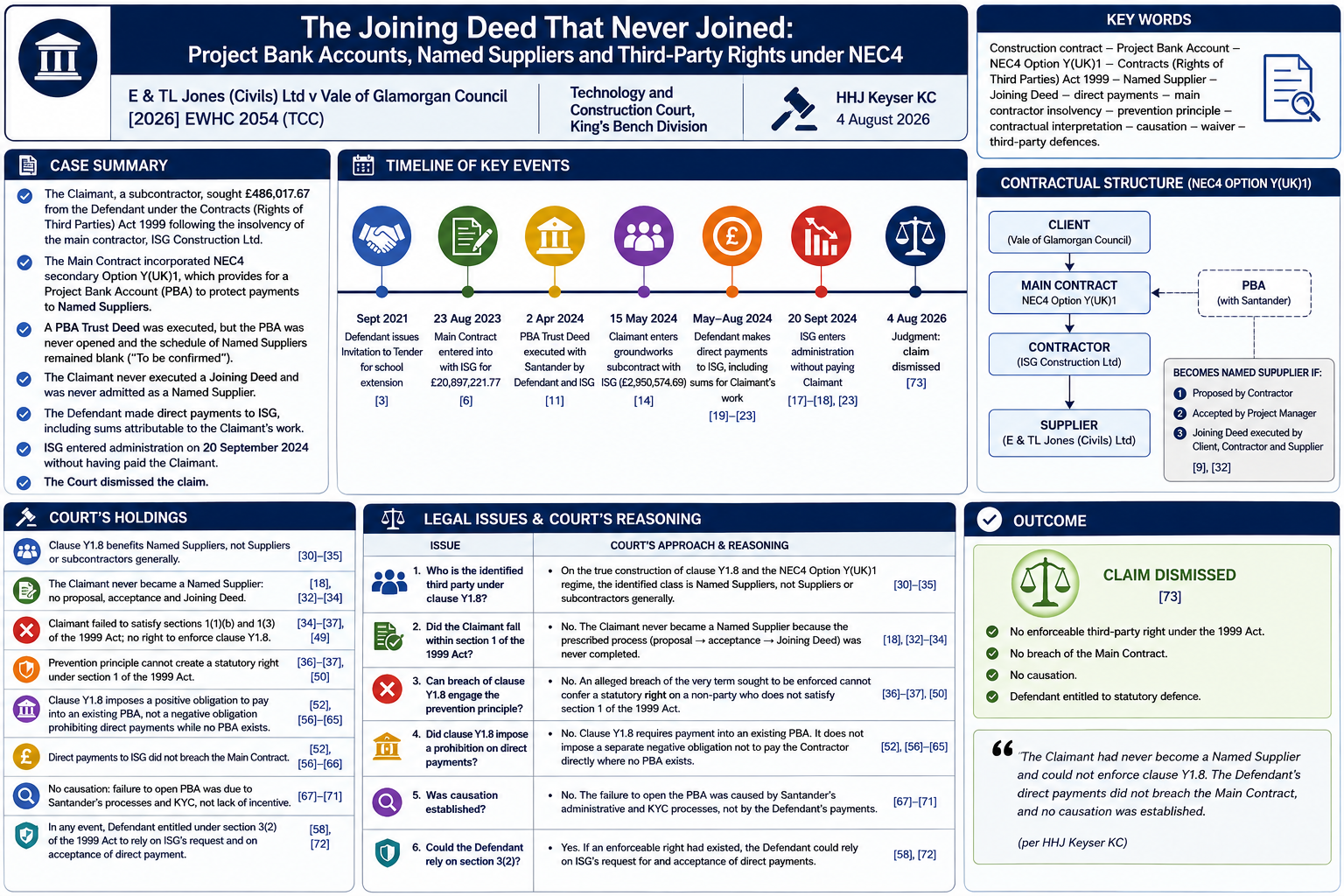
HHJ Keyser KC dismissed a subcontractor’s £486,017.67 claim arising from ISG’s collapse, holding that the claimant never acquired the status needed to enforce the Project Bank Account provisions under NEC4 Option Y(UK)1. [1], [21]–[23], [34]–[37], [49]
E & TL Jones had carried out the works. ISG received payment including sums attributable to those works, then entered administration without paying Jones. Jones relied on the Contracts (Rights of Third Parties) Act 1999 to enforce clause Y1.8 against the Council. [1], [19]–[24]
📌 The TCC held:
🔹 Supplier ≠ Named Supplier
Jones never completed the proposal, acceptance and joinder process or signed a Joining Deed. It was therefore not a Named Supplier and could not enforce clause Y1.8. [18], [32]–[37], [49]
🔹 No standing by circularity
The alleged breach could not itself create the standing required to enforce the clause. [36]–[37], [50]
🔹 No implied ban on direct payments
Clause Y1.8 imposed a positive obligation to pay into an existing PBA. It did not prohibit direct payment while no PBA existed. [52], [56]–[66]
🔹 No causation
On the alternative analysis, Santander’s administrative and KYC delays—not the Council’s payments—prevented the PBA being opened before ISG’s administration. [67]–[71]
🔹 Section 3(2) defence
ISG had requested and accepted direct payments, which would in any event have afforded the Council a defence. [58], [72]
💬 Takeaway: Project Bank Accounts do not protect subcontractors merely because everyone intended them to. The machinery must actually be completed. [3]–[5], [9], [11]–[18], [32]–[35], [55]
In short: no Joining Deed, no Named Supplier status, no enforceable third-party right.
Nigel Davies BSc(Hons) (Q.Surv), PGCert.Psych, GDipLaw, PGDipLP, DipArb, MSc (Built Environment), LLM (Construction Law & Practice), MSc (Mechanical & Electrical), MSc (Psychology), FRICS, FCIOB, FCInstCES, FCIArb, CArb, GMBPsS, Panel Registered Adjudicator, Mediator, Mediation Advocate, Chartered Builder & Chartered Construction Manager, Chartered Surveyor & Civil Engineering Surveyor, Chartered Arbitrator, Author, and Solicitor-Advocate
Adjudicator Assessor and Re-Assessor for the ICE
ICE DRC Member
ICE DRC CPD Committee Chairman
Adjudicator Exam Question Setter for the ICE
CIArb Adjudication Panel Member since 2006
CIArb Arbitration Panel Member since 2006
CIC Adjudication Panel Member since 2010
FIDIC Adjudication Panel Member since 2021
ICE Adjudication Panel Member since 2021
Law Society Panel Arbitrator
RIBA Adjudication Panel Member since 2018
RICS Adjudication Panel Member since 2006
RICS Dispute Board Registered since 2013
TECSA Adjudication Panel Member since 2012
The information & opinions expressed in this article are not necessarily comprehensive, nor do they represent the trenchant view of the author; in any event, this article does not purport to offer professional advice. This article has been prepared as a summary and is intended for general guidance only. In the case of a specific problem, it is recommended that professional advice be sought.
© 2026 Davies & Davies Associates Ltd
Back to Legal Updates