The Fourth Edition of the Technology and Construction Court Guide, published in July 2026, is more than a consolidation of procedural guidance. It reflects the TCC’s response to legislative reform, developing case-management powers, advances in technology and the continuing objective of allocating specialist business proportionately across the court system.
Comparison with the Third Edition, published in October 2022, reveals five developments of particular practical significance: dedicated procedures for Building Safety Act proceedings; a materially stronger approach to alternative dispute resolution following Churchill; express professional obligations governing the use of artificial intelligence; a new emphasis upon issuing proceedings in the TCC centre most closely connected with the dispute; and an increase from £500,000 to £1 million in the indicative dividing line between the London High Court TCC and the Central London County Court.
These are not merely editorial changes. Each has the potential to influence strategic decisions made before proceedings are commenced and throughout the life of a claim. [Fourth Edition, 1.1.4, 1.3.1–1.3.2, 1.6, 3.6 and 9.1–9.2]
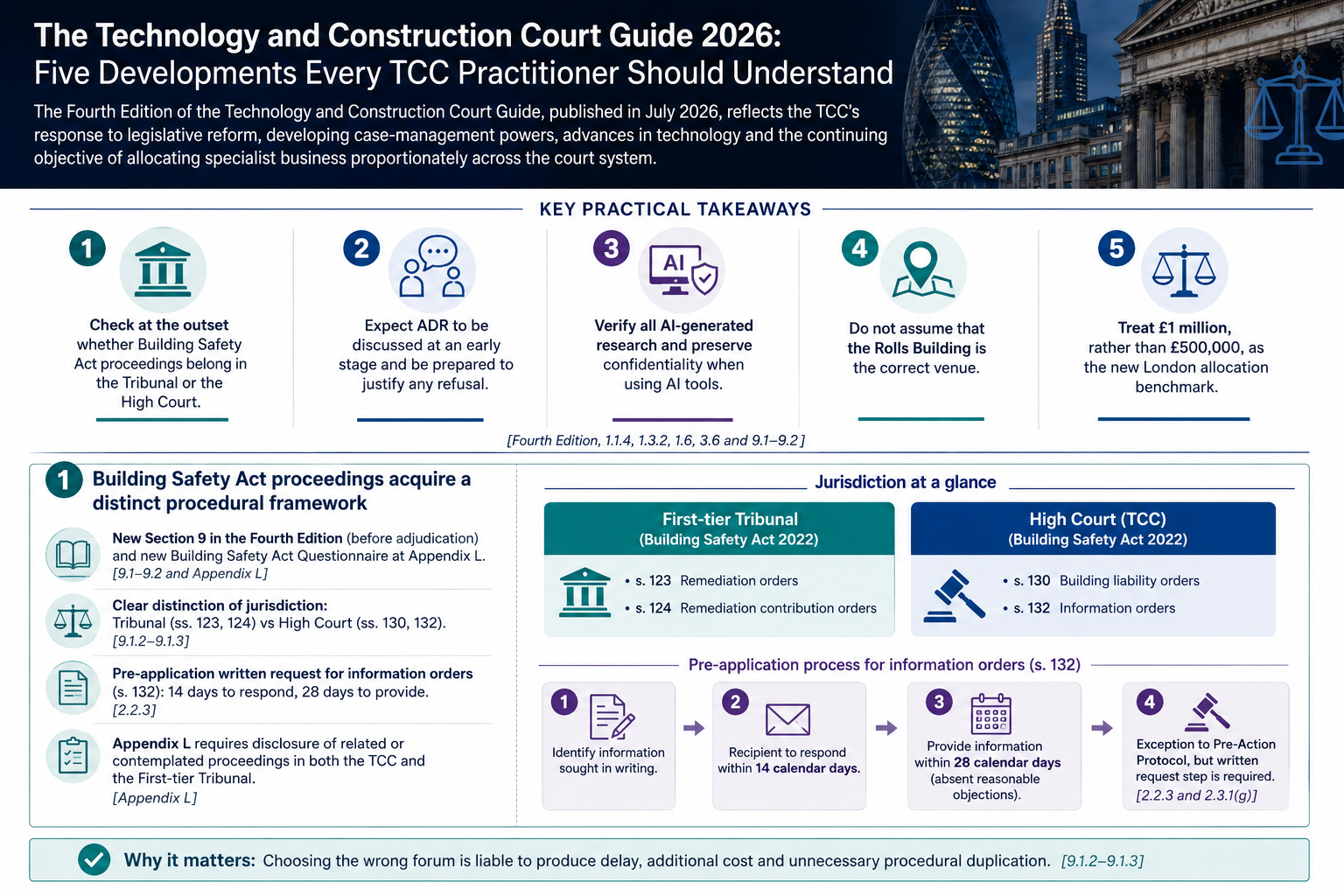
Key Practical Takeaways - Check at the outset whether Building Safety Act proceedings belong in the Tribunal or the High Court.
- Expect ADR to be discussed at an early stage and be prepared to justify any refusal.
- Verify all AI-generated research and preserve confidentiality when using AI tools.
- Do not assume that the Rolls Building is the correct venue.
- Treat £1 million, rather than £500,000, as the new London allocation benchmark.
[Fourth Edition, 1.1.4, 1.3.2, 1.6, 3.6 and 9.1–9.2] |
1. Building Safety Act proceedings acquire a distinct procedural framework
The most substantial structural change is the introduction of a new section devoted to Building Safety Act business. The Third Edition contained no equivalent chapter. In the Fourth Edition, Building Safety Act proceedings appear as a discrete section 9, inserted before the chapter dealing with adjudication and are supplemented by a new Building Safety Act Questionnaire at Appendix L. [Fourth Edition, 9.1–9.2 and Appendix L]
The Guide describes Building Safety Act litigation as an “emerging area of TCC business” and recognises that the procedural arrangements will continue to develop as the TCC and the First-tier Tribunal build a body of authority under the 2022 Act. It also records that there is presently neither a dedicated Practice Direction nor a bespoke claim form for Building Safety Act proceedings. [Fourth Edition, 9.1.1]
Notwithstanding that qualification, the Fourth Edition establishes a clearer procedural structure than previously existed. It distinguishes between applications falling within the jurisdiction of the First-tier Tribunal, including remediation orders under section 123 and remediation contribution orders under section 124, and applications falling within the jurisdiction of the High Court, including building liability orders under section 130 and information orders under section 132. The latter are identified as appropriate TCC claims because they are likely to involve technically complex issues for which determination by a TCC judge is desirable. [Fourth Edition, 9.1.2–9.1.3]
The jurisdictional distinction is of immediate practical importance. An interested person seeking a remediation contribution order under section 124 must apply to the First-tier Tribunal. By contrast, an applicant seeking a building liability order under section 130 will ordinarily be expected to proceed in the High Court and such claims are likely to be suitable for management in the TCC. Choosing the wrong forum is liable to produce delay, additional cost and unnecessary procedural duplication. [Fourth Edition, 9.1.2–9.1.3]
The Guide also integrates Building Safety Act work into the broader description of TCC business. The non-exhaustive list of suitable TCC claims now expressly includes applications or claims under the Building Safety Act 2022, wording absent from the Third Edition. [Third Edition, 1.3.1(a); Fourth Edition, 1.3.1(a)]
The Fourth Edition introduces a specific pre-application expectation for information orders under section 132. A prospective applicant is expected first to identify the information sought in writing. The recipient is expected to respond within 14 calendar days and, absent reasonable objections, to provide the information within 28 calendar days. [Fourth Edition, 2.2.3]
An applicant who has not first made the written request contemplated by paragraph 2.2.3 may face questions as to why that step was not taken. The Guide treats a section 132 application as an exception to the ordinary Pre-Action Protocol but expressly preserves this written-request procedure. [Fourth Edition, 2.2.3 and 2.3.1(g)]
The new Appendix L reinforces the need for procedural coordination. It is to be completed in proceedings or applications under sections 123, 124, 130 or 132 and requires information about related or contemplated proceedings in both the TCC and the First-tier Tribunal. [Fourth Edition, Appendix L]
The practical consequences are significant. Practitioners must identify the correct forum at an early stage, consider the interaction between tribunal and court proceedings, comply with the specific pre-application expectations and provide the court with sufficient information to manage related proceedings coherently. The Fourth Edition therefore supplies the procedural architecture for what is likely to become an increasingly important area of specialist litigation.
2. ADR moves from encouragement to active judicial management
The Third Edition required parties to give serious consideration to ADR and stated that the court might require an explanation where ADR had not been attempted. It also indicated that the court could issue directions to facilitate dispute resolution. [Third Edition, 1.1.4]
The Fourth Edition adopts materially stronger language. If ADR has not been attempted, the court will expect the parties to explain why. More significantly, the Guide states that the court will normally be willing to make directions facilitating ADR and, in an appropriate case, will order the parties to engage in it. The revised paragraph expressly cites Churchill v Merthyr Tydfil County Borough Council [2023] EWCA Civ 1416, together with CPR 1.1(f) and CPR 3.1(2)(o). [Fourth Edition, 1.1.4]
The significance of the change does not lie in making mediation universally compulsory. The Guide preserves judicial discretion and contemplates an order only where the case is appropriate for it. Its importance lies instead in rejecting the assumption that participation in ADR is necessarily a matter for the parties alone. ADR is now expressly situated within the court’s powers to further the overriding objective and actively manage proceedings. [Fourth Edition, 1.1.3–1.1.4]
A final-account dispute arising from a completed construction project illustrates the point. Under the Third Edition, a party refusing mediation might have expected the issue principally to re-emerge when costs were considered. Under the Fourth Edition, the court may be prepared at the first case and costs management conference to direct the parties towards mediation, early neutral evaluation or another process if it considers that doing so is consistent with the overriding objective. [Third Edition, 1.1.4; Fourth Edition, 1.1.4 and 7.1–7.6]
The detailed ADR provisions reinforce this approach. The court may address ADR as part of case management, consider its timing and form and take account of unreasonable non-cooperation. The Guide continues to recognise a range of processes, including mediation, early neutral evaluation and the TCC’s Court Settlement Process. [Fourth Edition, 7.1–7.6]
Appendix E contains a model ADR order under which the parties exchange lists of suitable neutrals, agree the appointment process and, if necessary, seek the court’s assistance in selecting the neutral. It also contemplates a stay of proceedings while the ADR process takes place. [Fourth Edition, Appendix E]
For practitioners, ADR strategy must therefore be addressed deliberately and early. It may no longer be sufficient simply to state that one party is unwilling to mediate. Parties should be prepared to explain whether ADR is appropriate, which form is most likely to be effective and at what stage it should take place. An unsupported refusal may lead not only to adverse costs consequences but, in an appropriate case, to an order requiring participation.
3. Artificial intelligence enters the TCC’s professional framework
The Fourth Edition contains an entirely new section entitled “The Use of Artificial Intelligence”. No corresponding provision appeared in the Third Edition. [Fourth Edition, 1.6]
The starting point is personal responsibility. Legal representatives remain personally responsible for the material placed before the court and are professionally obliged to ensure that it is accurate and appropriate. AI may be used but only consistently with those responsibilities and wider professional obligations. [Fourth Edition, 1.6.1]
The Guide then imposes three specific disciplines.
First, whether the use of AI should be disclosed depends upon the context. However, any doubt must be resolved in favour of disclosure. [Fourth Edition, 1.6.2]
Secondly, legal representatives must preserve confidentiality and protect the privacy of any underlying data in relation to which AI is used. [Fourth Edition, 1.6.3]
Thirdly, any research or case citation generated with AI assistance must be independently verified and the representative must be in a position to confirm that verification has taken place. [Fourth Edition, 1.6.4]
The practical implications are clear. A solicitor using an AI system to assist in preparing a skeleton argument in an adjudication enforcement case cannot rely upon authorities or legal propositions suggested by the software without checking them. Each authority must be verified against an authoritative source and the proposition for which it is cited must be independently confirmed. [Fourth Edition, 1.6.4]
Likewise, a team considering AI-assisted review of project records must first consider how commercially sensitive correspondence, pricing information, design material and personal data will be handled. Uploading confidential documents to an external system without adequate safeguards may conflict with the express requirement to protect confidentiality and privacy. [Fourth Edition, 1.6.3]
The Fourth Edition does not discourage AI. It recognises that AI can be used but places that use within existing duties of competence, candour, confidentiality and professional responsibility. Efficiency gains do not transfer responsibility away from the solicitor, barrister or advocate relying upon the resulting work product. [Fourth Edition, 1.6.1–1.6.5]
4. The Rolls Building is no longer to be treated as the default TCC venue
The Fourth Edition introduces a new section entitled “Issuing in the appropriate TCC centre”. The Third Edition moved directly from acknowledgment of service to transfer and contained no equivalent self-contained provision. [Third Edition, section 3; Fourth Edition, 3.6]
The message is direct: TCC proceedings should always be issued in the most appropriate centre and should not be issued at the Rolls Building by default. Parties must consider the location with which the claim has the most significant links, together with its value, complexity and suitability for case management or trial by a specialist civil circuit judge rather than a High Court judge. [Fourth Edition, 3.6.1]
Where proceedings are commenced in the Rolls Building despite the dispute having stronger links elsewhere, the claimant should provide an explanation at the time of issue. The convenience or preference of the parties’ legal advisers is expressly subordinated to the efficient allocation of specialist judicial resources. [Fourth Edition, 3.6.2]
The court may intervene without waiting for an application from another party. If the Judge in Charge considers on initial review that another centre is more appropriate, a transfer order is likely to be made, subject to the parties’ right to seek its variation or discharge. Even where no transfer order has been made, the parties should attend the first case and costs management conference ready to justify their choice of centre. [Fourth Edition, 3.6.3]
A £750,000 dispute concerning a project in Manchester, involving predominantly Manchester-based witnesses, experts and project records, would therefore be likely to attract close scrutiny if issued in London without a compelling reason. [Fourth Edition, 3.6.1–3.6.3]
Conversely, a technically complex dispute involving a novel point of law may still warrant management or trial by a High Court judge. However, the Guide expressly recognises that High Court judges can sit in regional centres. A case requiring High Court judicial involvement does not therefore necessarily require transfer to London. [Fourth Edition, 3.7.6 and 3.8.4]
Venue selection should accordingly be treated as a substantive commencement decision. Relevant matters may include the location of the project, witnesses, documents and experts; the existence of related proceedings; proportionality; and the availability of specialist judges. The choice should be based upon the dispute’s real connections, not simply the location of the claimant’s solicitors or counsel.
5. The London High Court–County Court boundary rises from £500,000 to £1 million
The final development concerns the allocation of London TCC work between the High Court and the County Court.
Under the Third Edition, the London High Court TCC would not usually accept a case worth less than £500,000 unless adjudication enforcement or another special feature justified determination by a High Court judge. The corresponding transfer provision similarly contemplated transfer to an appropriate County Court where the claim did not exceed £500,000. [Third Edition, 1.3.2 and 3.6.2]
The Fourth Edition replaces that approach with a £1 million indicative dividing line. Subject to adjudication enforcement and other recognised special features, the TCC at the Rolls Building will consider transferring claims of up to £1 million to the Central London County Court unless there is good reason not to do so. In ordinary circumstances, proceedings not exceeding £1 million will be transferred from the Rolls Building to an appropriate TCC County Court. [Fourth Edition, 1.3.2 and 3.7.2]
The practical change is substantial. A £750,000 final-account dispute which, under the Third Edition, would ordinarily have fallen on the High Court side of the indicative dividing line is now a realistic candidate for transfer to the Central London County Court unless some additional feature justifies High Court retention. [Third Edition, 1.3.2; Fourth Edition, 1.3.2 and 3.7.2]
The £1 million figure is not a jurisdictional ceiling. The Central London County Court may hear TCC claims regardless of value and the figure operates as an allocation guide rather than an absolute rule. [Fourth Edition, 20.3.1]
Value is not determinative. The Fourth Edition retains a non-exhaustive list of special features that may justify High Court treatment, including:
- adjudication and arbitration cases;
- international cases;
- new or difficult points of law;
- test cases;
- public procurement claims;
- Part 8 claims and other claims for declarations;
- complex multi-party nuisance claims;
- cases that cannot readily be dealt with effectively by a designated TCC judge in the County Court; and
- claims for injunctions. [Fourth Edition, 1.3.2(a)–(i)]
Accordingly, a £400,000 adjudication enforcement claim may remain in the High Court because adjudication and arbitration cases are expressly recognised as special categories. Equally, a relatively modest dispute involving a genuinely new or difficult point of law may justify High Court retention notwithstanding its value. [Fourth Edition, 1.3.2(a) and (c)]
The position outside London remains different. Claims below £100,000 should ordinarily be issued in the County Court, while claims above that figure may be issued in the High Court, subject to the TCC judge’s transfer powers. This reflects the fact that the same specialist judge will often hear the case whether it is issued in the High Court or the County Court. [Fourth Edition, 20.3.2]
The practical message is therefore not that claim value has ceased to matter but that it is no longer a reliable standalone indicator of forum. Complexity, legal significance, the nature of the relief sought and the availability of suitable specialist judicial resources may be equally or more influential.
Conclusion
The Fourth Edition portrays a court adapting its procedures to a changing litigation environment.
Building Safety Act disputes now operate within a dedicated procedural framework, although the Guide properly recognises that this remains an emerging area. ADR has moved beyond encouragement and is now expressly embedded within the court’s case-management powers, including the possibility of court-ordered participation. Artificial intelligence is recognised as a legitimate professional tool but only subject to duties of verification, confidentiality, disclosure and personal accountability. The allocation of proceedings between TCC centres is treated as a substantive case-management issue rather than an administrative preference. Finally, the increase in the London transfer threshold from £500,000 to £1 million reflects a broader rebalancing of work between the High Court and specialist County Court jurisdictions. [Fourth Edition, 1.1.4, 1.3.2, 1.6, 3.6, 9.1–9.2 and 20.3]
Taken together, the changes require practitioners to address jurisdiction, ADR, AI, venue and court allocation at a much earlier stage. Decisions once treated as secondary matters of procedure are now liable to attract active judicial scrutiny and may materially affect the cost, forum and trajectory of TCC proceedings.
#TechnologyAndConstructionCourt #TCC #ConstructionLaw #BuildingSafetyAct #ADR #ArtificialIntelligence #LegalTechnology #DisputeResolution #Adjudication #Arbitration #HighCourt #CountyCourt #CivilProcedure #LegalUpdate #DDAlegal
The examples in this article are illustrative only and are not intended to predict how the court will exercise its discretion in any individual case.
This article provides general commentary on selected changes and is not a substitute for the Guide, the CPR or legal advice in a particular case.
Nigel Davies BSc(Hons) (Q.Surv), PGCert.Psych, GDipLaw, PGDipLP, DipArb, MSc (Built Environment), LLM (Construction Law & Practice), MSc (Mechanical & Electrical), MSc (Psychology), FRICS, FCIOB, FCInstCES, FCIArb, CArb, GMBPsS, Panel Registered Adjudicator, Mediator, Mediation Advocate, Chartered Builder & Chartered Construction Manager, Chartered Surveyor & Civil Engineering Surveyor, Chartered Arbitrator, Author, and Solicitor-Advocate
Adjudicator Assessor and Re-Assessor for the ICE
ICE DRC Member
ICE DRC CPD Committee Chairman
Adjudicator Exam Question Setter for the ICE
CIArb Adjudication Panel Member since 2006
CIArb Arbitration Panel Member since 2006
CIC Adjudication Panel Member since 2010
FIDIC Adjudication Panel Member since 2021
ICE Adjudication Panel Member since 2021
Law Society Panel Arbitrator
RIBA Adjudication Panel Member since 2018
RICS Adjudication Panel Member since 2006
RICS Dispute Board Registered since 2013
TECSA Adjudication Panel Member since 2012
The information & opinions expressed in this article are not necessarily comprehensive, nor do they represent the trenchant view of the author; in any event, this article does not purport to offer professional advice. This article has been prepared as a summary and is intended for general guidance only. In the case of a specific problem, it is recommended that professional advice be sought.
© 2026 Davies & Davies Associates Ltd
Back to Legal Updates