Wallace Estates Ltd v Durkan Estates Ltd
Technology and Construction Court and First-tier Tribunal (Property Chamber)
Mr Justice Constable and Judge Siobhan McGrath, President of the First-tier Tribunal
10 August 2026
Key Words
Building Safety Act 2022 – remediation order – remediation contribution order – parallel proceedings – joint case management – proceedings heard together – formal consolidation – overlapping facts and issues – inconsistent findings – disclosure – witness statements – expert evidence – judicial composition – costs regimes – separate cost codes – binding factual findings – appellate routes.
- Headnote
- The proceedings arose from disputes concerning a Remediation Agreement dated 1 July 2024, under which Durkan Estates Limited had agreed with Wallace Estates Limited to remedy, at its own cost, relevant defects at Centrillion Point in Croydon within the meaning of section 120 of the Building Safety Act 2022. [1]
- The relevant defects had already been the subject of a remediation order made against Wallace by the First-tier Tribunal on 4 January 2024 following an application by the leaseholders under section 123 of the Building Safety Act 2022. [2]
- After the First-tier Tribunal had refused Wallace an extension of time for compliance with the remediation order, Wallace had purported to terminate the Remediation Agreement and had taken over the remedial works. [2]
- Wallace had subsequently commenced proceedings in the First-tier Tribunal for a remediation contribution order against Durkan Estates Limited and Durkan Holdings Limited, while Durkan Estates Limited had commenced proceedings in the Technology and Construction Court concerning the alleged unlawfulness of the termination and damages. [3–4]
- The applications before the Court and Tribunal concerned whether, and upon what procedural basis, the overlapping proceedings should have been jointly managed and tried together. [7–8]
- The joint hearing had been the first hearing conducted jointly by the President of the First-tier Tribunal and a Judge of the Technology and Construction Court, with Mr Justice Constable sitting both as a High Court Judge and, jointly with Judge Siobhan McGrath, as a Tribunal member. [1]
- The Court and Tribunal had approved the parties’ agreed proposal for joint management and a single hearing because the proceedings involved substantial overlaps of fact and issue, and because that course had avoided inconsistent findings and duplicated work in relation to disclosure, witness statements, expert reports and the trial. [13, 19–22]
- The proceedings had been ordered to be heard together rather than formally consolidated, so that each proceeding had retained its separate identity, parties, procedural rules and judgment. [21–22]
- The procedural differences between the two jurisdictions had been accommodated by directions providing for extended disclosure, one set of witness statements, one set of expert evidence, and permission for the cross-use of documents, statements and reports. [24, 29–32]
- The factual findings made at the joint trial had been directed, by consent, to bind all three parties in both sets of proceedings, notwithstanding that Durkan Holdings Limited had not been a party to the Technology and Construction Court proceedings. [38]
- The trial and Pre-Trial Review had been directed to take place before a Technology and Construction Court Judge and a separate First-tier Tribunal Judge, while earlier case management could have been undertaken by a single Judge capable of sitting in both jurisdictions. [25–27]
- A professional member of the First-tier Tribunal had not been included because that member could have participated only in the Tribunal decision, and because the parties had proposed expert evidence in architecture, fire engineering and quantity surveying. [28]
- The different costs regimes had been addressed by requiring separate cost codes for work undertaken solely in the First-tier Tribunal proceedings, solely in the Technology and Construction Court proceedings, and jointly in relation to both proceedings. [33–36]
- The Court and Tribunal had not decided whether the First-tier Tribunal lacked jurisdiction to determine the lawfulness of the termination or any alleged repudiatory breach, because the matter had not been disputed between the parties or subjected to full argument. [10–11, 23]
- The judgment had provided initial procedural guidance for coordinating overlapping proceedings in the Technology and Construction Court and the First-tier Tribunal where separate proceedings concerned the same building and raised common factual and legal questions. [8, 13–15, 19–24]
- Material Facts
- Durkan Estates Limited and Wallace Estates Limited had entered into the Remediation Agreement on 1 July 2024. [1]
- Durkan had agreed under the Remediation Agreement to remedy, at its own cost, certain relevant defects at Centrillion Point in Croydon. [1]
- Durkan Holdings Limited had been Durkan’s parent company and had been a party to the First-tier Tribunal proceedings but not to the Technology and Construction Court proceedings. [1]
- The defects had been the subject of a remediation order made against Wallace by the First-tier Tribunal on 4 January 2024. [2]
- The remediation order had followed an application made by the leaseholders under section 123 of the Building Safety Act 2022. [2]
- On 24 June 2025, the First-tier Tribunal had considered and rejected Wallace’s application for an extension of the date for compliance with the remediation order. [2]
- On 26 June 2025, Wallace had served a notice purporting to terminate the Remediation Agreement under its contractual machinery and at common law. [2]
- Wallace had thereafter taken over the remedial works. [2]
- On 29 September 2025, Wallace had commenced proceedings in the First-tier Tribunal for a remediation contribution order under section 124(1) of the Building Safety Act 2022 against Durkan Estates Limited and Durkan Holdings Limited. [3]
- Wallace’s then current estimate of its claim had been £13,586,797.02 inclusive of VAT. [3]
- On 6 February 2026, Durkan had commenced proceedings in the Technology and Construction Court seeking a declaration that Wallace’s termination had been unlawful and claiming damages. [4]
- Wallace had counterclaimed for declarations concerning the lawfulness of the termination and had alleged that further defects existed at the development which had not been covered by the remediation order. [4]
- Durkan had disputed the existence of the alleged further defects. [4]
- Durkan had accepted that the defects covered by the remediation order had been its responsibility to remedy. [5]
- By an open offer dated 19 May 2026, Durkan had offered to pay Wallace’s remedial costs to date and thereafter to make instalment payments up to £6,740,268 inclusive of VAT, which Durkan had said represented the amount it would have cost to complete the remedial works. [5]
- By the date of the judgment, Durkan had paid £498,455 inclusive of applicable VAT on account of Wallace’s incurred costs. [5]
- Wallace’s application for reverse summary judgment on Durkan’s claim and summary judgment on its own counterclaim had been dismissed on 30 July 2026. [6]
- Durkan’s application to the Technology and Construction Court had sought an early joint case management hearing after 10 July 2026. [12]
- On 12 February 2026, the First-tier Tribunal had rejected an informal application for joint case management and had required a formal application explaining how the proposed course would advance the proceedings. [16]
- The Durkan entities had made the required formal application to the First-tier Tribunal on 20 May 2026. [17]
- Following consultation with the President of the First-tier Tribunal, the Technology and Construction Court had directed that the joint case management hearing take place on 31 July 2026. [18]
- By the date of that hearing, the parties had agreed that the proceedings should have been managed and heard together. [8, 22]
- The existing First-tier Tribunal listing had also been placed in jeopardy by delays in the experts’ site inspections, which would in any event have required the Tribunal directions to be retimetabled. [18]
- Issues
- The first issue had been whether the Technology and Construction Court proceedings and the First-tier Tribunal proceedings should have been jointly managed and tried together. [7–8, 19–22]
- The second issue had been whether the powers under CPR 3.1(2) and rule 6(3)(b) of the Tribunal Procedure (First-tier Tribunal) (Property Chamber) Rules 2013 permitted and supported the proposed coordinated approach. [13, 19–21]
- The third issue had been whether the proceedings should have been heard together while retaining their separate identities or should instead have been formally consolidated. [19, 21]
- The fourth issue had been how the different procedural regimes governing disclosure, witness evidence and expert evidence should have been aligned without requiring duplicate procedural exercises. [24, 29–32]
- The fifth issue had been how the Court and Tribunal should have been composed for the general management, Pre-Trial Review and trial of the proceedings. [25–28]
- The sixth issue had been whether a professional member of the First-tier Tribunal should have sat with the two Judges. [28]
- The seventh issue had been how findings of fact made at a joint trial should have operated against Durkan Holdings Limited, which had not been a party to the Technology and Construction Court proceedings. [38]
- The eighth issue had been how the substantially no-costs regime of the First-tier Tribunal should have been accommodated alongside the ordinary costs-shifting regime of the Technology and Construction Court. [33–36]
- A further question had arisen from Durkan’s pleaded contention, admitted by Wallace, that the First-tier Tribunal lacked jurisdiction to determine the lawfulness of the termination or whether Durkan had committed a repudiatory breach. [10–11]
- The Court and Tribunal had been required to determine whether it had been appropriate to express any conclusion upon that jurisdictional question when it had not been the subject of dispute or full argument. [23]
- The Court and Tribunal had also identified, but had not been required to resolve, the potential consequences of separate appellate routes arising from a single joint trial. [37]
- Decision
- The Technology and Construction Court proceedings and the First-tier Tribunal proceedings had been ordered to be jointly managed and tried together. [22]
- Joint management had been appropriate because of the substantial overlap of facts and issues between the proceedings. [13, 19, 22]
- The coordinated approach had avoided the risk of inconsistent findings and duplicated expenditure in relation to disclosure, witness statements, expert reports and trial preparation. [13, 19, 22]
- The proceedings had been directed to be heard together rather than formally consolidated. [21–22]
- Each proceeding had therefore retained its separate identity, parties, procedural rules and judgment. [21]
- The trial and Pre-Trial Review had been directed to take place before a Technology and Construction Court Judge and a separate First-tier Tribunal Judge. [25–27]
- General conduct and case management before the Pre-Trial Review could have been undertaken by a single Judge capable of sitting in both jurisdictions. [27]
- The judicial panel had not been required to include a professional member of the First-tier Tribunal. [28]
- Further disclosure had been directed to proceed in accordance with Practice Direction 57AD and rule 18 of the Tribunal Rules, insofar as rule 18 had not been inconsistent with Practice Direction 57AD or the directions. [29]
- The parties had been permitted to use documents, witness statements and expert reports from either proceeding for the purposes of both proceedings. [30]
- A single set of witness statements had been directed to cover both proceedings and to comply with CPR Part 32 and Practice Direction 57AC. [31]
- One set of expert evidence had been directed for both proceedings in the disciplines of architecture, fire engineering and quantity surveying, governed principally by CPR Part 35. [32]
- The findings of fact at the joint trial had been directed, by consent, to bind all three parties in both proceedings. [38]
- The parties had been required to maintain separate cost codes for work undertaken solely in the First-tier Tribunal proceedings, solely in the Technology and Construction Court proceedings, and jointly in relation to both. [35–36]
- The three-way cost coding had preserved the information required for any later argument concerning the apportionment of costs but had not determined how costs would ultimately be allocated. [35–36]
- The earlier First-tier Tribunal listings had been vacated and the trial had been listed primarily for January 2028, with a secondary listing in October 2027 if judicial availability arose. [18, 40]
- The Court and Tribunal had declined to decide whether the First-tier Tribunal lacked jurisdiction to determine the contractual termination or repudiatory breach questions. [23]
- The possible complications arising from two separate appellate routes had also been left for consideration if and when they arose. [37]
- Reasoning
- The power of the Technology and Construction Court had derived from CPR 3.1(2), exercised in furtherance of the overriding objective in CPR 1.1. [19–20]
- CPR 3.1(2) had permitted the Court to consolidate proceedings, try two or more claims on the same occasion, and determine the order in which issues should have been tried. [19]
- The relevant considerations had included the extent of the overlap of parties, facts and issues, the avoidance of inconsistent findings, the cost and delay of multiple proceedings, the stage reached by each proceeding, and whether equivalent advantages could have been obtained by another means. [19]
- The Court’s overriding objective had required the case to be dealt with justly and at proportionate cost, having regard to expense, proportionality, complexity, expedition, fairness and the appropriate use of judicial resources. [20]
- The First-tier Tribunal had possessed a closely analogous power under rule 6(3)(b) of the Tribunal Rules to consolidate or hear together proceedings raising common issues. [21]
- The Tribunal’s overriding objective had additionally required unnecessary formality to be avoided, flexibility to be maintained and the Tribunal’s special expertise to be used effectively. [21]
- Where the criteria for joint management had been satisfied, hearing the proceedings together had generally been preferable to formal consolidation because it had preserved the separate procedural and jurisdictional character of each proceeding. [21]
- The rationale stated in section 9 of the fourth edition of the Technology and Construction Court Guide had been consistency of factual findings, avoidance of duplicated evidence and cost, and the involvement of a single or joint judicial decision-making body across the proceedings. [13–14]
- Durkan’s Technology and Construction Court proceedings had not fallen within the Guide’s defined category of “TCC BSA Proceedings”, because they had concerned contractual termination, repudiation, declarations and damages rather than claims under sections 130 or 132 of the Building Safety Act 2022. [15]
- The general principle underlying the Guide had nevertheless been capable of applying to the proceedings because both sets of proceedings had concerned the same building and had raised overlapping factual and legal issues. [13–15]
- The significant overlap had meant that separate hearings would have risked inconsistent factual findings and repeated disclosure, witness, expert and trial processes. [13, 19, 22]
- The disadvantages caused by the delay in bringing both proceedings to a joint trial had been outweighed by the benefits of consistent findings and the avoidance of duplication. [22, 40]
- A High Court Judge had already been eligible to sit as a Judge of the First-tier Tribunal under sections 4(1)(c), 5(1)(g) and 6(1)(d) of the Tribunals, Courts and Enforcement Act 2007. [25]
- No separate judicial appointment had therefore been required, although the concurrence of the President of the First-tier Tribunal had been necessary. [25]
- The involvement of a Technology and Construction Court Judge and a separate First-tier Tribunal Judge at the Pre-Trial Review and trial had provided sufficient advantages to justify the use of two judicial members. [26]
- Earlier procedural management by one Judge capable of sitting in both jurisdictions had promoted efficiency without affecting the intended composition of the trial panel. [27]
- The inclusion of a professional Tribunal member would have created an additional complication because that member’s participation would have been confined to the Tribunal proceedings and that member’s views would have had to be isolated from the Technology and Construction Court’s decision-making. [28]
- The proposed expert evidence in architecture, fire engineering and quantity surveying had meant that the benefit of a professional member had not outweighed that procedural complication. [28]
- Applying the more extensive disclosure requirements of Practice Direction 57AD across both proceedings had avoided separate disclosure exercises under different standards. [29]
- Because the proceedings had remained separate, the procedural rules would not otherwise have permitted unrestricted use in one proceeding of documents or statements produced in the other. [30]
- Express permission for cross-use had therefore been required to make the joint evidential process effective. [30]
- The requirements of CPR Part 32 and Practice Direction 57AC for witness statements had been more formal than the Tribunal requirements but had not been incompatible with them. [31]
- The use of one set of witness statements had avoided obvious duplication and cost. [31]
- CPR Part 35 and its Practice Direction had been more prescriptive than rule 19 of the Tribunal Rules but had likewise not been incompatible with it. [32]
- A single body of expert evidence had therefore been capable of serving both proceedings. [32]
- The First-tier Tribunal had operated in substance as a no-costs jurisdiction, save for costs recoverable under rule 13 by reason of unreasonable conduct, whereas the ordinary position in the Technology and Construction Court had been that costs followed the event. [34]
- The three-way cost-coding arrangement had preserved a record of the work attributable to each proceeding and of the work common to both. [35–36]
- That arrangement had enabled any later apportionment question to be addressed without prejudging whether or how the costs should ultimately have been apportioned. [35–36]
- Durkan Holdings Limited had not been a party to the Technology and Construction Court proceedings, but the parties’ consent that the joint factual findings should bind all three parties had removed the risk of separate findings against different parties. [38]
- The different appeal routes had remained capable of producing two appeals in different appellate courts concerning the same findings of fact. [37]
- That possible difficulty had not been appropriate for determination at the joint case management hearing and potentially might not have been appropriate for determination in that forum. [37]
- Durkan’s pleaded contention that the First-tier Tribunal lacked jurisdiction to determine the contractual termination and repudiation questions had been admitted by Wallace but had not been fully argued. [10–11, 23]
- The Court and Tribunal had therefore considered it inappropriate to endorse or reject that contention. [23]
- Ratio Decidendi
- Where proceedings in the Technology and Construction Court and the First-tier Tribunal had concerned the same building and had raised substantially overlapping facts or issues, the Court and Tribunal had possessed powers under CPR 3.1(2) and rule 6(3)(b) of the Tribunal Rules respectively to direct that the proceedings should be jointly managed and heard together. [19–22]
- Those powers had been exercisable in accordance with the respective overriding objectives and had supported joint management where it had avoided inconsistent factual findings, duplicated evidence, unnecessary cost and repeated procedural steps. [19–22]
- Where joint management had been appropriate, the proceedings could have been heard together without formal consolidation, so that each proceeding continued to retain its separate identity, parties, procedural rules and judgment. [21–22]
- Different procedural regimes could have been coordinated by adopting compatible common directions for disclosure, witness statements and expert evidence, together with express permission for materials produced in either proceeding to be used in both. [24, 29–32]
- A High Court Judge had been capable of sitting as a Judge of the First-tier Tribunal without a separate appointment, subject to the concurrence of the President of the First-tier Tribunal. [25]
- The Court and Tribunal had been entitled to direct that the Pre-Trial Review and trial should take place before a Technology and Construction Court Judge and a separate First-tier Tribunal Judge, while permitting earlier case management by a single Judge competent to sit in both jurisdictions. [26–27]
- The Court and Tribunal had been entitled to exclude a professional Tribunal member where that member’s participation would have been confined to the Tribunal decision and where specialist expert evidence had reduced the practical benefit of such membership. [28]
- Where the parties had agreed that factual findings made at the joint trial should be binding in both proceedings and against every party, the joint directions could have recorded and given effect to that agreement notwithstanding that one party had participated in only one of the proceedings. [38]
- Where the proceedings remained subject to materially different costs regimes, separate coding of work attributable solely to each jurisdiction and jointly to both had constituted an appropriate case-management mechanism for preserving later questions of costs apportionment. [33–36]
- No part of the ratio had determined whether the First-tier Tribunal possessed jurisdiction to decide questions concerning contractual termination or repudiatory breach when those questions were relevant to an application for a remediation contribution order. [10–11, 23]
- Disposition
- The Durkan entities’ application to the First-tier Tribunal and Durkan’s application to the Technology and Construction Court for joint case management had been approved. [7–8, 22]
- The First-tier Tribunal proceedings and Technology and Construction Court proceedings had been directed to be jointly managed and tried together. [22]
- The existing First-tier Tribunal timetable had been displaced and its prior Pre-Trial Review and trial listings had been vacated. [18, 40]
- A primary trial listing had been fixed for January 2028, with an alternative listing in October 2027 if the Court became available. [40]
- The responsibility for maintaining contact with the listing office concerning the possible October 2027 hearing had rested upon the parties. [40]
- Directions had been made for the judicial composition, disclosure, witness statements, expert evidence, cross-use of materials and binding effect of factual findings at the joint trial. [25–32, 38]
- The parties had been directed to maintain three separate cost codes, while substantive questions of costs and apportionment had been reserved for later determination. [33–36]
- The question whether the First-tier Tribunal lacked jurisdiction to determine the contractual termination or repudiatory breach issues had not been decided. [23]
- The possible consequences of different appellate routes and the different mechanisms for compelling witnesses had also been left for determination only if they arose. [37, 39]
- Held
- Held, that the overlapping Technology and Construction Court and First-tier Tribunal proceedings should have been jointly managed and tried together because they raised substantially common factual and legal issues. [19–22]
- Held, that joint management had furthered the respective overriding objectives by avoiding inconsistent findings, duplicated evidence, repeated procedural steps and unnecessary cost. [19–22]
- Held, that the proceedings should have been heard together rather than formally consolidated, with each retaining its separate identity, parties, procedural rules and judgment. [21–22]
- Held, that section 9 of the Technology and Construction Court Guide had reflected a general principle capable of application beyond proceedings falling strictly within the Guide’s defined expression “TCC BSA Proceedings”. [13–15]
- Held, that the trial and Pre-Trial Review should have been conducted by a Technology and Construction Court Judge and a separate First-tier Tribunal Judge, while earlier case management could have been undertaken by a single Judge capable of sitting in both jurisdictions. [25–27]
- Held, that a professional member of the First-tier Tribunal should not have been included because the resulting procedural complication had not been outweighed by any material benefit in circumstances where the parties were to adduce specialist expert evidence. [28]
- Held, that disclosure should have proceeded principally under Practice Direction 57AD, with rule 18 of the Tribunal Rules applying insofar as it had not been inconsistent with that Practice Direction or the joint directions. [29]
- Held, that express permission should have been given for documents, witness statements and expert reports produced in either proceeding to be used in both proceedings. [30]
- Held, that one set of witness statements compliant with CPR Part 32 and Practice Direction 57AC should have served both proceedings. [31]
- Held, that one set of expert evidence governed principally by CPR Part 35 should have served both proceedings in the disciplines of architecture, fire engineering and quantity surveying. [32]
- Held, that the factual findings made at the joint trial should have been binding in both proceedings and against all three parties in accordance with their consent. [38]
- Held, that the materially different costs regimes should have been accommodated by three-way cost coding for work undertaken solely in the First-tier Tribunal, solely in the Technology and Construction Court, and jointly in relation to both proceedings. [33–36]
- Held, that the three-way cost coding had not determined the eventual incidence or apportionment of costs, which had remained for later decision. [35–36]
- Held, that it had been inappropriate to determine or endorse Durkan’s pleaded contention concerning the limits of the First-tier Tribunal’s jurisdiction because the matter had not been disputed or fully argued. [10–11, 23]
- Held, that the potential complications arising from separate appellate routes should not have been determined at the joint case management hearing. [37]
Comment
Wallace Estates Ltd v Durkan Estates Ltd is not a judgment about who ultimately pays the bill for Centrillion Point. That particular financial thunderstorm remains on the horizon. It is instead about something less glamorous but arguably more important: ensuring that two jurisdictions do not spend several years examining substantially the same building, the same defects, the same witnesses and the same experts before emerging with two different versions of reality. The case arises under FTT case reference LON/00AH/BSB/2025/0611, alongside TCC claim HT-2026-000045.
The judgment was principally concerned with case management rather than determination of the parties' substantive Building Safety Act or contractual rights. The solution adopted by the Court and Tribunal was a practical mechanism for coordinating overlapping proceedings. Where TCC and FTT proceedings substantially overlap, the procedural machinery of CPR 3.1(2) and rule 6(3)(b) permits them to be managed and heard together. The point is not bureaucratic tidiness for its own sake. It is to prevent inconsistent factual findings, duplicated disclosure, repeated witness statements, parallel expert exercises and the magnificently expensive spectacle of lawyers proving the same thing twice. The judgment records the first joint hearing of the President of the FTT and a TCC Judge and provides initial judicial guidance on how this form of coordinated case management may operate in practice.
Importantly, however, cooperation does not mean jurisdictional soup. The proceedings are to be heard together, not formally consolidated. Each retains its own identity, parties, procedural rules and judgment. That distinction is not decorative. It preserves the constitutional and procedural boundaries between the TCC and FTT while allowing both jurisdictions to behave as though they have noticed that the other exists.
The directions reveal how that compromise works in practice. There will be one evidential architecture: common disclosure arrangements, one set of witness statements, one body of expert evidence and express permission for material generated in one proceeding to be used in the other. Findings of fact at the joint trial will bind all three parties in both proceedings, notwithstanding that Durkan Holdings is not a party to the TCC action. Meanwhile, because the FTT and TCC possess very different attitudes to costs, the parties must keep three separate cost codes: FTT-only, TCC-only and joint work. It is difficult to imagine a more lawyerly solution to a lawyerly problem, but it is also a sensible one.
The judgment is equally significant for what it refuses to decide. It does not determine whether the FTT has jurisdiction to decide contractual termination or repudiatory breach questions merely because they bear upon an RCO application. That issue was not fully argued, so the Court and Tribunal declined the tempting judicial sport of answering a difficult question nobody had properly asked them to answer. Nor did they attempt to solve the possible appellate oddity whereby one joint trial might ultimately produce two appeals travelling through different appellate routes. That particular procedural booby trap has been left armed for another day.
The wider importance of Wallace Estates is therefore procedural but substantial. Building Safety Act litigation is plainly capable of spawning interconnected statutory, contractual and technical disputes across jurisdictional boundaries. This judgment supplies a workable model for dealing with that reality: preserve the jurisdictions, coordinate the machinery, use the evidence once, and obtain one coherent set of factual findings. The alternative is duplication, expense and the possibility of contradictory judgments concerning the same concrete, cladding and contracts — which would be an impressive achievement, but not in the good sense.
In short, [2026] EWHC 2133 (TCC) marks an important point at which joint TCC/FTT case management moves from procedural theory into an operating model. It does not resolve the substantive battle between Wallace and Durkan. What it does is decide that, when that battle is eventually fought, everybody will at least be on the same battlefield.
#BuildingSafetyAct #BSA2022 #ConstructionLaw #PropertyLaw #TCC #FirstTierTribunal #CaseManagement #ConstructionLitigation #WallaceVDurkan #UKLaw #LegalUpdate #CaseLaw #DDAlegal
Authorities and Materials
The thematic classifications, descriptions and prioritisation below are editorial. They are not labels or rankings adopted by the Court, and the summaries are paraphrases rather than quotations unless expressly indicated. The list is confined to authorities and materials referred to in the judgment and is not intended to be exhaustive of the relevant law.
Case Law:
Joint Case Management of Parallel TCC and FTT Proceedings — Primary Theme
- No reported judicial authority was cited or relied upon in support of the principles governing joint case management. The Court and Tribunal derived the relevant powers and principles directly from CPR 3.1(2), CPR 1.1, rule 6(3)(b) and rule 3 of the Tribunal Procedure (First-tier Tribunal) (Property Chamber) Rules 2013, together with section 9 of the Fourth Edition of the TCC Guide and the White Book commentary on CPR 3.1(2)(h) and (i). The principal considerations were overlap of parties, facts and issues; avoidance of inconsistent findings; reduction of duplication, cost and delay; the stage reached by the proceedings; and whether equivalent advantages could be achieved by other procedural means. [13], [19]–[22]
Procedural History — Not an Authority Relied Upon
- Wallace Estates Ltd v Durkan Estates Ltd [2026] EWHC 2003 (TCC) — The judgment records that Wallace’s application for reverse summary judgment on Durkan’s claim and summary judgment on its own counterclaim had been dismissed on 30 July 2026. The decision is mentioned as part of the procedural history but is not relied upon as an authority in the reasoning of the present judgment. [6]
Procedural Coordination, Judicial Composition and Evidence — Secondary Theme
- No reported judicial authorities were relied upon in relation to judicial composition, disclosure, witness statements, expert evidence, costs, appeals, the binding effect of factual findings or the mechanisms for compelling witnesses. Those matters were addressed by reference to the applicable statutory provisions, procedural rules, Practice Directions and the TCC Guide, supplemented by bespoke joint case-management directions. [24]–[40]
Prioritisation Summary — Case Law
- No substantive case-law authority formed part of the Court and Tribunal’s legal reasoning on joint case management. The judgment principally provides procedural guidance arising from the first joint hearing of the President of the FTT and a TCC Judge and explains how overlapping proceedings concerning the same building may be coordinated whilst retaining separate procedural identities. [1], [8], [13]–[24]
Legislation and Procedural Rules
Joint Management Powers and Overriding Objectives — Primary Theme
- Civil Procedure Rules, CPR 3.1(2) — The Court identified CPR 3.1(2) as the source of its relevant case-management powers. In particular, CPR 3.1(2)(h) permits consolidation of proceedings, CPR 3.1(2)(i) permits two or more claims to be tried on the same occasion, and CPR 3.1(2)(k) permits the Court to determine the order in which issues are tried. Those powers supplied the procedural foundation for coordinated management of the TCC proceedings alongside the FTT proceedings. [19]
- Tribunal Procedure (First-tier Tribunal) (Property Chamber) Rules 2013, rule 6(3)(b) — The Tribunal identified this as a closely analogous power permitting it to consolidate or hear together two or more sets of proceedings, or parts of proceedings, raising common issues, or to treat a case as a lead case. The judgment treated it as the FTT counterpart to the Court’s powers under CPR 3.1(2). [13], [21]
- Civil Procedure Rules, CPR 1.1 — The Court exercised its case-management powers in furtherance of the overriding objective of dealing with cases justly and at proportionate cost. Relevant considerations included saving expense, proportionality, complexity, expedition, fairness and the appropriate allocation of judicial resources. [19]–[20]
- Tribunal Procedure (First-tier Tribunal) (Property Chamber) Rules 2013, rule 3 — The Tribunal’s corresponding overriding objective was similar but not identical to CPR 1.1. The judgment specifically noted the additional requirements to avoid unnecessary formality, seek flexibility and use the Tribunal’s special expertise effectively. [21]
Building Safety Act Framework — Secondary Theme
- Building Safety Act 2022, section 120 — Referred to in identifying the “relevant defects” which Durkan had agreed to remedy under the Remediation Agreement. [1]
- Building Safety Act 2022, section 123 — The statutory basis of the remediation order made against Wallace following the leaseholders’ application. [2]
- Building Safety Act 2022, section 124(1) — The statutory basis of Wallace’s application to the FTT for a remediation contribution order against the Durkan Entities. [3]
- Building Safety Act 2022, sections 130 and 132 — Referred to through the definition of “TCC BSA Proceedings” in section 9 of the TCC Guide. The Court observed that Durkan’s TCC proceedings, which concerned contractual termination, repudiation, declarations and damages, did not fall within that defined category, although the general principle of coordinated case management remained applicable. [15]
Judicial Constitution and Cross-Jurisdictional Membership — Tertiary Theme
- Tribunals, Courts and Enforcement Act 2007, sections 4(1)(c), 5(1)(g) and 6(1)(d) — Relied upon to explain that a puisne Judge of the High Court is already a Judge of the First-tier Tribunal and Upper Tribunal. No separate appointment was therefore required for a High Court Judge to sit in the FTT, although concurrence of the President of the FTT (Property Chamber) was required. [25]–[27]
Disclosure and Cross-Use of Evidence — Quaternary Theme
- Practice Direction 57AD — The Court directed that further disclosure should proceed principally under PD 57AD, together with rule 18 of the Tribunal Rules insofar as compatible. The use of the more extensive disclosure regime across both proceedings avoided duplicate disclosure exercises under different procedural standards. [29]; Annex 1, [14]–[19]
- Tribunal Procedure (First-tier Tribunal) (Property Chamber) Rules 2013, rule 18 — Applied alongside PD 57AD where not inconsistent. Rule 18(3) was specifically relevant because it restricts the use of a disclosed document to the proceedings in which it was disclosed unless permission is given. [29]–[30]
- CPR 31.22 — Identified as imposing a corresponding restriction on the use of disclosed documents. Because the TCC and FTT proceedings remained separate, express permission was required for documents disclosed in one proceeding to be deployed in the other. [30]
- CPR 32.12 — Referred to as the corresponding restriction governing the use of witness statements. The joint directions expressly permitted cross-use of witness statements between the two proceedings. [30]; Annex 1, [6]
Witness and Expert Evidence — Quinary Theme
- CPR Part 32 and Practice Direction 57AC — The directions required a single set of witness statements for both proceedings, compliant with CPR Part 32 and PD 57AC. The Court observed that these requirements were more formal than those applying in the FTT but were not incompatible with them. [31]
- CPR Part 35 — Applied to the common body of expert evidence in architecture, fire engineering and quantity surveying. The Court regarded its requirements as more prescriptive than rule 19 of the Tribunal Rules, but compatible with them. [32]
- Tribunal Procedure (First-tier Tribunal) (Property Chamber) Rules 2013, rule 19 — Applied to expert evidence insofar as not inconsistent with CPR Part 35 and the joint directions. [32]; Annex 1, [25]
- CPR 35.12 and CPR 35.12(3) — The annexed directions required experts of like discipline to hold discussions and thereafter produce joint statements identifying matters agreed and not agreed. Annex 1, [28]–[29].
Compelling Witnesses — Senary Theme
- Tribunal Procedure (First-tier Tribunal) (Property Chamber) Rules 2013, rule 20 — Identified as the FTT mechanism for requiring a witness to attend. The Court and Tribunal deferred consideration of any practical difference unless and until it became necessary. [39]
- CPR Part 34 — Identified as the corresponding CPR mechanism for compelling attendance of witnesses. [39]
Costs — Septenary Theme
- CPR 3.12(1)(a) — The parties agreed that costs management did not apply in the TCC proceedings because the value stated on the claim form was £10 million or more. The annexed order accordingly dispensed with costs budgeting. [33]; Annex 1, [37].
- Tribunal Procedure (First-tier Tribunal) (Property Chamber) Rules 2013, rule 13 — Referred to as the limited basis upon which costs may be recoverable in the FTT by reason of unreasonable conduct, against the background that the FTT is otherwise, in essence, a no-costs regime. [34]
- CPR Parts 36 and 44 — Referred to as part of the materially different costs regime applicable in the TCC, where the ordinary position is that costs follow the event. [34]
Practice Directions and Procedural Forms — Ancillary Materials
- Practice Direction 60, Appendix C — The annexed directions required each party to complete the prescribed Pre-Trial Review questionnaire before the PTR. Annex 1, [31]–[32].
- Practice Direction 57AD, Appendix 4 — The directions required DEL and WEL to serve a Disclosure Certificate substantially in the form prescribed by Appendix 4. Annex 1, [16].
Prioritisation Summary — Legislation and Procedural Rules
- CPR 3.1(2), CPR 1.1, rule 6(3)(b) and rule 3 of the Tribunal Rules were the central legal framework. They supplied the respective powers and overriding objectives by which the TCC and FTT could coordinate proceedings presenting substantial factual and procedural overlap. [13], [19]–[23]
- The Building Safety Act provisions supplied the statutory context rather than the principal subject of determination. The judgment was concerned with how parallel proceedings arising from that statutory and contractual background should be managed, rather than with finally determining the parties’ substantive BSA liabilities. [1]–[5], [15].
- The disclosure, evidence and costs provisions were important to the practical implementation of joint management. They enabled the two proceedings to remain formally separate while avoiding duplicated disclosure, witness statements, expert evidence and unnecessary cost. [29]–[39]
Legal Texts, Guides and Commentary
Joint Case Management and Procedural Coordination — Primary Theme
- Technology and Construction Court Guide, Fourth Edition, section 9 — The Court explained that the newly drafted section 9 reflected the work of the TCC/BSA Working Group established in May 2024 to promote consistency of approach to Building Safety Act issues across the TCC and FTT. Its rationale was identified as consistency of factual findings, avoidance of duplicated evidence and cost, and the use of a single or joint judicial mind across overlapping proceedings. [13]–[15]
- TCC Guide, section 9.2 — The judgment reproduced the material provisions establishing a procedure for identifying cases in which proceedings concerning the same building may arise in both jurisdictions and for considering whether an Allocation CMC or other coordinated case-management directions are required. [14]
- Appendix L to the TCC Guide — The Appendix L questionnaire is designed to inform the TCC Judge about the relevant building, existing or anticipated proceedings in the FTT or TCC, and the parties’ proposals for management where more than one set of proceedings is likely. The Court observed that Durkan’s earlier TCC application had effectively foreshadowed the function later performed by Appendix L. [14]–[15]
- TCC Guide, paragraph 9.2.5 — Referred to in relation to judicial composition. It contemplated a TCC Judge sitting also as a Judge of the FTT, subject to concurrence of the President of the FTT (Property Chamber). In this case, however, the Court and Tribunal considered that the PTR and trial should be conducted by a TCC Judge and a separate FTT Judge. [25]–[27]
Procedural Commentary — Secondary Theme
- White Book Commentary, note 3.1.9 to CPR 3.1(2)(h) and (i) — The Court expressly referred to the commentary and summarised the relevant considerations: the extent of overlapping parties, facts or issues; the risk of inconsistent findings; the cost and delay associated with multiplicity of proceedings and procedural steps; the stage reached by the proceedings; and whether the same advantages could be achieved by another means, including trying claims on the same occasion. [19]
Prioritisation Summary — Legal Texts, Guides and Commentary
- Section 9 of the Fourth Edition of the TCC Guide was the principal non-legislative source. It supplied the procedural model and rationale for coordinated management of overlapping TCC and FTT proceedings and was treated as capable of broader application even though Durkan’s contractual TCC proceedings did not fall literally within the Guide’s definition of “TCC BSA Proceedings”. [13]–[15]
- The White Book commentary to CPR 3.1(2)(h) and (i) informed the exercise of the Court’s case-management discretion by identifying the principal considerations relevant to consolidation or hearing related proceedings together. [19]
- Appendix L and paragraph 9.2.5 of the TCC Guide were important operational components of the coordinated regime. Appendix L assists early identification and management of overlapping proceedings, while paragraph 9.2.5 addresses the judicial mechanism by which a TCC Judge may also sit in the FTT. [14]–[15], [25]–[27]
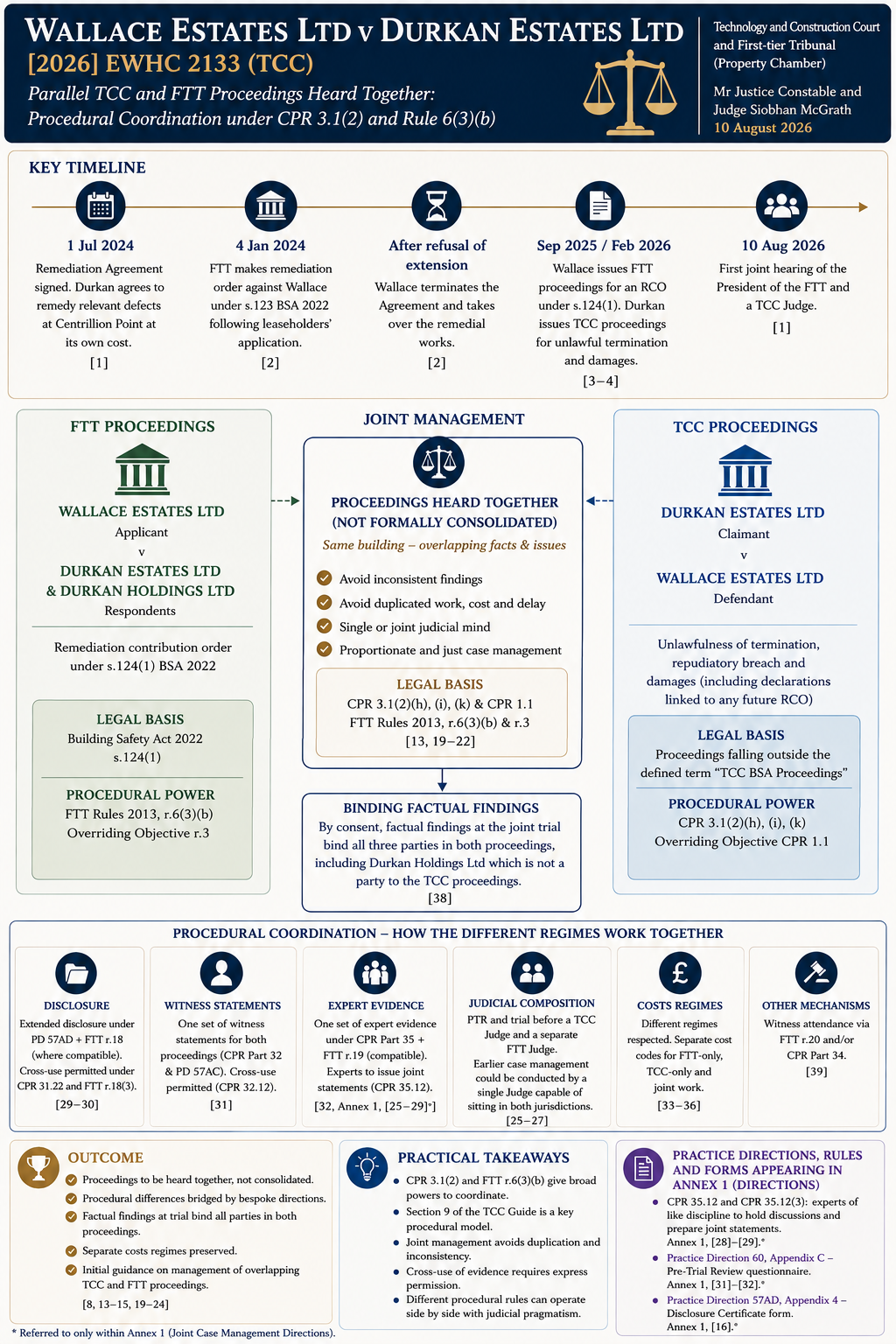
🏗️ Wallace Estates Ltd v Durkan Estates Ltd [2026] EWHC 2133 (TCC)
One Building. Two Jurisdictions. One Coordinated Route to Trial.
This judgment is not about who ultimately pays for the remediation of Centrillion Point.
It is about how the Technology and Construction Court and First-tier Tribunal should manage overlapping proceedings concerning the same building, the same defects and substantially the same factual issues. The decision arose from the first joint hearing of the President of the FTT and a TCC Judge and provides initial guidance on managing overlapping TCC and FTT proceedings.
📌 Five key points
🔹 Heard together, not consolidated
The Court and Tribunal approved joint management because of the substantial overlap of facts and issues. Each proceeding retains its own identity, parties, procedural rules and judgment.
🔹 Coordination, not jurisdictional merger
The TCC relied on CPR 3.1(2) and CPR 1.1. The FTT relied on rule 6(3)(b) and rule 3. The objective was to avoid inconsistent findings, duplicated work and unnecessary cost and delay.
🔹 One evidential framework
The directions provide for extended disclosure, one set of witness statements, one body of expert evidence and cross-use of documents, statements and reports across both proceedings.
🔹 A tailored judicial structure
The PTR and trial will be heard by a TCC Judge and a separate FTT Judge. Earlier case management may be undertaken by a single Judge capable of sitting in both jurisdictions.
🔹 Separate costs regimes preserved
The parties must maintain separate cost codes for FTT-only work, TCC-only work and joint work, preserving later costs and apportionment arguments.
💬 Why does it matter?
The judgment demonstrates how two separate jurisdictions can coordinate proceedings without sacrificing their distinct procedural identities. It provides a practical framework aimed at avoiding duplicated disclosure, repeated witness evidence, multiple expert exercises and inconsistent findings of fact.
Equally important is what the Court did not decide. The judgment expressly leaves unresolved whether the FTT has jurisdiction to determine contractual termination or repudiatory breach issues where those questions arise in the context of an RCO application.
The practical message is simple: preserve the jurisdictions, coordinate the machinery, use the evidence once, and avoid proving substantially the same case twice.
#BuildingSafetyAct #BSA2022 #TechnologyAndConstructionCourt #TCC #FirstTierTribunal #ConstructionLaw #PropertyLaw #ConstructionLitigation #CaseManagement #RemediationContributionOrder #CivilProcedure #LegalUpdate #CaseLaw #DDAlegal
Nigel Davies BSc(Hons) (Q.Surv), PGCert.Psych, GDipLaw, PGDipLP, DipArb, MSc (Built Environment), LLM (Construction Law & Practice), MSc (Mechanical & Electrical), MSc (Psychology), FRICS, FCIOB, FCInstCES, FCIArb, CArb, GMBPsS, Panel Registered Adjudicator, Mediator, Mediation Advocate, Chartered Builder & Chartered Construction Manager, Chartered Surveyor & Civil Engineering Surveyor, Chartered Arbitrator, Author, and Solicitor-Advocate
Adjudicator Assessor and Re-Assessor for the ICE
ICE DRC Member
ICE DRC CPD Committee Chairman
Adjudicator Exam Question Setter for the ICE
CIArb Adjudication Panel Member since 2006
CIArb Arbitration Panel Member since 2006
CIC Adjudication Panel Member since 2010
FIDIC Adjudication Panel Member since 2021
ICE Adjudication Panel Member since 2021
Law Society Panel Arbitrator
RIBA Adjudication Panel Member since 2018
RICS Adjudication Panel Member since 2006
RICS Dispute Board Registered since 2013
TECSA Adjudication Panel Member since 2012
The information & opinions expressed in this article are not necessarily comprehensive, nor do they represent the trenchant view of the author; in any event, this article does not purport to offer professional advice. This article has been prepared as a summary and is intended for general guidance only. In the case of a specific problem, it is recommended that professional advice be sought.
© 2026 Davies & Davies Associates Ltd
Back to Legal Updates