Coventry & Warwickshire Development Partnership LLP v Avison Young (UK) Ltd
Technology and Construction Court, King’s Bench Division
Mr Justice Eyre, 15 September 2026
Key Words
Construction contract – Adjudication enforcement – Professional negligence – NEC Project Manager – NEC Supervisor – Over-certification – Summary judgment – Jurisdiction – Adequacy of reasons – Natural justice – Fair canvassing – Gardiner & Theobald termination assessment – Severance – Professional negligence damages – "Pay now, argue later"
- Headnote
- The Claimant engaged the Defendant between January 2020 and January 2023 to act as NEC Project Manager and NEC Supervisor in relation to major remediation and development works at Gateway South, Coventry. [1, 3]
- The Claimant alleged that the Defendant negligently over-certified interim payments, accepted unsupported reductions in baseline quantities, failed properly to assess progress, and failed adequately to identify defects in the works. [4, 8-15, 29]
- Following adjudication, the Adjudicator determined that the Defendant had failed to exercise the required standard of skill and care and awarded the Claimant £8,729,179.33 inclusive of interest by way of damages. [1, 28-30, 46-48]
- The Defendant resisted enforcement, contending that the Adjudicator had failed to address the dispute referred to him, failed to provide adequate reasons, breached the rules of natural justice, and reached conclusions that should be severed from the remainder of the Decision. [2, 49-50, 63-65, 74, 89-90]
- Mr Justice Eyre held that the Adjudicator had determined the dispute referred, had provided adequate reasons, had complied with the requirements of natural justice, and had acted within jurisdiction. [56-58, 67-73, 81-88]
- The Court further held that the Adjudicator was entitled to rely upon aspects of the Gardiner & Theobald Termination Assessment because the relevance of that material had been fairly canvassed with the parties and they had been afforded a full opportunity to comment upon it. [81-84]
- The Court rejected the Defendant’s severance arguments because the challenged findings formed part of an integrated chain of reasoning leading to a single damages award. [96-98]
- Summary judgment was therefore granted enforcing the adjudicator’s decision in full. [99]
- Material Facts
- The Claimant engaged the Defendant to act as NEC Project Manager and NEC Supervisor in connection with the development of a 215-acre former sewage treatment site requiring extensive earthworks and remediation works. [1, 3]
- Buckingham Group Contracting Ltd was engaged to undertake excavation, treatment and placement of approximately 5,000,000m³ of material, with interim payments assessed by reference to the Price for Work Done to Date ("PWDD"). [3]
- The Claimant alleged that the Defendant accepted unsupported reductions in baseline quantities, accepted overstated progress information, relied excessively upon PEE excavation data rather than EPD placement data, and failed properly to identify defects. [4, 8, 11, 13-15, 29]
- The Claimant further alleged that those failures resulted in substantial overpayments to Buckingham which could not subsequently be recovered following Buckingham’s insolvency. [4, 15]
- The Defendant denied negligence, maintained that its assessments were reasonable, and contended that any variance between certified and correct amounts was negligible and within acceptable tolerances. [5, 17-25]
- The Adjudicator concluded that the Defendant had failed to perform its duties to the required standard of skill and care and awarded damages of £8,729,179.33 inclusive of interest. [46-48]
- The Defendant refused to comply with the award, leading to enforcement proceedings by way of an application for summary judgment. [1]
- Issues
- Whether the Adjudicator failed to provide adequate reasons for the Decision. [49-58]
- Whether the Adjudicator failed to determine the dispute referred to him and thereby acted outside his jurisdiction. [59-73]
- Whether the Adjudicator breached the requirements of natural justice by relying upon the Gardiner & Theobald Termination Assessment. [74-84]
- Whether the Adjudicator breached natural justice in his treatment of retention and defects. [85-88]
- Whether any part of the Decision could or should be severed from the remainder of the award. [89-98]
- Decision
- The Adjudicator provided adequate reasons for the purposes of the Scheme and the parties were able to understand both what had been decided and why. [51-58]
- The Adjudicator determined the dispute referred to him and therefore acted within jurisdiction. [67-73]
- The Adjudicator did not breach the requirements of natural justice through his use of the Gardiner & Theobald Termination Assessment. [81-84]
- The Adjudicator did not breach natural justice in his treatment of retention or defects. [86-88]
- Severance was neither available nor appropriate in relation to the challenged elements of the Decision. [93-98]
- The Claimant was entitled to summary judgment enforcing the adjudicator’s award in full. [99]
- Reasoning
- The Court reiterated that adjudication enforcement proceedings require a robust approach and that adjudicators’ decisions will ordinarily be enforced unless there has been a clear excess of jurisdiction or material breach of natural justice. [7, 45]
- The Court held that reasons must be assessed by reading the decision as a whole and that adjudicators are not required to provide reasons for reasons or address every subsidiary argument advanced by the parties. [51-52]
- Paragraph 5.160 of the Decision was not a bare conclusion but rather the culmination of the Adjudicator’s prior analysis of breach, causation and loss. [56]
- The Adjudicator expressly identified the dispute as one concerning whether the Defendant had failed to perform its duties with the requisite skill and care and whether loss had resulted from that failure. [28, 67]
- Although valuation evidence featured prominently within the Decision, the Adjudicator remained focused upon questions of negligence, causation and damages rather than determining a free-standing valuation dispute. [67-69]
- The Court held that any alleged failure to apply the methodology advocated by the Defendant concerning tolerances or valuation ranges would, at most, amount to answering the right question in the wrong way. [70-71]
- Such an error, if established, would be an error within jurisdiction and not a failure to determine the referred dispute. [59-60, 71]
- The correspondence between the Adjudicator and the parties demonstrated that he repeatedly raised the potential relevance of the Gardiner & Theobald Termination Assessment, disclosed supporting material, invited submissions, and offered a meeting to discuss the issue. [81-82]
- The parties subsequently made detailed submissions regarding the relevance and reliability of that material. [81-82]
- The Court therefore concluded that the relevant issues had been fairly canvassed and that the Adjudicator was entitled to adopt a position distinct from that advanced by either party. [83]
- In relation to retention and defects, the Adjudicator simply accepted aspects of each party’s case whilst rejecting others, which was an entirely conventional adjudicative exercise. [86-88]
- The severance argument failed because the challenged findings formed part of a continuous chain of reasoning leading to a single damages award and could not properly be separated without recasting the Decision itself. [96-98]
- Ratio Decidendi
- An adjudicator who determines the dispute referred to him does not exceed his jurisdiction merely because it is alleged that he adopted an erroneous methodology or reached incorrect conclusions in doing so. [59-60, 71, 73]
- Adequate reasons are provided where the adjudicator’s decision, read as a whole, enables the parties to understand what has been decided and why, notwithstanding that every subsidiary argument is not expressly addressed. [51-58]
- An adjudicator may rely upon a line of reasoning or evidential source not expressly advanced by either party provided the material has been fairly canvassed and the parties have been afforded a fair opportunity to comment upon it. [75-76, 81-84]
- Natural justice does not require an adjudicator to choose exclusively between the parties’ competing positions and permits the adjudicator to accept elements of each case whilst rejecting others. [76, 86-88]
- Severance is inappropriate where the challenged finding forms part of an integrated chain of reasoning leading to a single award and where severance would require recalculation or reformulation of the decision. [93, 96-98]
- Disposition
- The Defendant failed on its adequacy of reasons challenge. [58]
- The Defendant failed on its jurisdiction challenge. [73]
- The Defendant failed on its natural justice challenges. [83-88]
- The Defendant failed on its severance arguments. [98]
- Summary judgment was granted enforcing the Adjudicator’s award of £8,729,179.33 inclusive of interest. [99]
- Held
- Held, that the Adjudicator had provided adequate reasons for his Decision. [51-58]
- Held, that the Adjudicator determined the dispute referred to him and acted within jurisdiction. [67-73]
- Held, that the Adjudicator’s reliance upon the Gardiner & Theobald Termination Assessment did not breach the requirements of natural justice because the issue had been fairly canvassed and the parties had been afforded a full opportunity to comment. [81-84]
- Held, that the Adjudicator’s treatment of retention and defects involved no breach of natural justice. [86-88]
- Held, that severance was unavailable because the challenged findings formed part of an integrated chain of reasoning leading to a single award of damages. [96-98]
- Held, that the Claimant was entitled to summary judgment enforcing the adjudicator’s decision in full. [99]
Comment
Here is the puzzle.
If an adjudicator tells you what material he is considering, explains why he thinks it matters, invites you to comment on it, receives your submissions and then disagrees with you, when exactly does that become a breach of natural justice?
According to Coventry & Warwickshire Development Partnership LLP v Avison Young (UK) Ltd, the answer is: not merely because the decision goes against you.
The case arose from an adjudication concerning the performance of Avison Young (UK) Ltd in its role as NEC Project Manager and NEC Supervisor. The adjudicator concluded that Avison Young had failed to exercise the required standard of skill and care and awarded Coventry & Warwickshire Development Partnership LLP damages of £8,729,179.33 inclusive of interest. Avison Young resisted enforcement on multiple grounds, including adequacy of reasons, jurisdiction, natural justice and severance. The Court rejected every challenge and enforced the award in full. [1-2, 46-48, 58, 73, 83-88, 98-99]
One of the central arguments concerned the adjudicator's use of the Gardiner & Theobald Termination Assessment. Avison Young contended that the adjudicator had relied upon material that neither party had advanced as the basis of its case. The Court examined the correspondence in detail and concluded that the adjudicator had repeatedly identified the material as potentially significant, disclosed supporting documents, invited submissions and even offered a meeting to discuss the point. Both parties subsequently made detailed submissions concerning its relevance and reliability. [81-84]
The Judge noted that Avison Young argued that the assessment should not be relied upon, but did not advance a substantive alternative position addressing the consequences if the adjudicator concluded that it was relevant. The opportunity to address the point had been provided. The fact that the adjudicator ultimately rejected the submissions made to him did not amount to procedural unfairness. [82-84]
The judgment is also a reminder of the distinction between jurisdictional error and error within jurisdiction. Mr Justice Eyre reaffirmed the established principle that an adjudicator who answers the right question in the wrong way remains within jurisdiction. The Defendant's complaint was essentially that the adjudicator had adopted the wrong methodology. Even if that criticism were correct, it would not mean that he had decided a different dispute from the one referred to him. [59-60, 67-73]
Viewed through a psychological lens, the judgment raises an interesting question about how parties experience procedural fairness.
Psychological research has long distinguished between dissatisfaction with an outcome and dissatisfaction with a process. One of the strongest predictors of perceived fairness is the existence of a meaningful opportunity to be heard. Yet there is an important distinction between being heard and being agreed with.
The judgment repeatedly emphasised that natural justice is concerned with whether parties had a fair opportunity to address the issues that mattered. It is not a rule requiring the decision-maker to adopt one party's preferred analysis. Indeed, the authorities reviewed by the Court recognise that an adjudicator may reach a conclusion for which neither party contended, provided the relevant material has been fairly canvassed and both sides had the opportunity to comment. [75-76, 81-84]
That distinction becomes particularly important when substantial amounts of money are involved.
Once parties have committed significant time, expert costs and professional effort to a particular position, it is entirely understandable that rejection of that position can feel difficult to accept. In many disputes there is a natural tendency to equate a strongly held argument with a correct argument. However, the law of natural justice concerns the fairness of the process rather than the correctness of the outcome.
The Court's treatment of the retention and defects issues illustrates the point. The adjudicator accepted aspects of each side's case and rejected others. The Defendant argued that this was unfair because neither party had advanced the precise position ultimately adopted. The Court disagreed. It held that the adjudicator was simply performing a conventional adjudicative function by accepting some submissions, rejecting others and reaching an intermediate conclusion. [86-88]
In one of the more striking passages of the judgment, Mr Justice Eyre observed that it was "verging on the fanciful" to suggest that either side could not have contemplated the possibility that its arguments might be accepted only in part rather than in full. [87]
The Defendant's severance argument met a similar fate. The challenged findings formed part of an integrated chain of reasoning leading to a single damages award. Removing those findings would not have involved excising a discrete decision. It would instead have required recalculating the award on a different basis. The Court therefore concluded that what was sought was not true severance but a recasting of the adjudicator's decision. [96-98]
The practical lesson is therefore slightly sharper than “pay now, argue later”.
It is this: do not confuse an opportunity to persuade with a right to succeed.
Once a party has invested enough time, money and intellectual energy in a position, disagreement can start to feel suspiciously like unfairness. Psychology has several names for that tendency — confirmation bias, escalation of commitment, motivated reasoning — but construction law has a shorter answer: being heard does not mean being agreed with.
In Coventry & Warwickshire Development Partnership LLP v Avison Young (UK) Ltd, Avison Young was heard. At length. The adjudicator considered the material, invited submissions, rejected the argument advanced and reached his own conclusion.
That was not a failure of natural justice.
It was simply what happens when the decision-maker is allowed to decide.
#ConstructionLaw #AdjudicationEnforcement #ProfessionalNegligence #TCC #ProjectManagement #SummaryJudgment #CommercialLitigation #UKLaw #NECContracts #LegalUpdate #CaseLaw #DDAlegal
Authorities and Materials
The thematic classifications, descriptions and prioritisation below are editorial. They are not labels or rankings adopted by the Court, and the summaries are paraphrases rather than quotations unless expressly indicated. The list is confined to authorities and materials referred to in the judgment and is not intended to be exhaustive of the relevant law.
Case Law
Adjudication Enforcement and Jurisdiction — Primary Theme
- Carillion Construction Ltd v Devonport Royal Dockyard Ltd [2005] EWHC 778 (TCC); [2005] EWCA Civ 1358 — A leading authority on adjudication enforcement. The Court relied upon Carillion for the principle that adjudicators’ decisions are ordinarily to be enforced notwithstanding errors of fact, law or procedure, unless the adjudicator has exceeded jurisdiction or committed a material breach of natural justice. The Court also reiterated the need for considerable scepticism when examining technical attempts to resist enforcement. [7], [62]
- Global Switch Estates Ltd v Sudlows Ltd [2020] EWHC 3314 (TCC) — Relied upon for its authoritative summary of the principles governing adjudication enforcement and, in particular, the proposition that where an adjudicator has addressed the question referred, it is irrelevant for enforcement purposes whether the answer was right or wrong. [7], [59]
- Exyte Hargreaves Ltd v NG Bailey Ltd [2023] EWHC 94 (TCC) — Cited for the important distinction between answering the right question in the wrong way, which remains an error within jurisdiction, and answering the wrong question, which may amount to a jurisdictional error. [60]
- William Verry Ltd v North West London Communal Mikvah [2004] EWHC 1300 (TCC) — Cited for the qualification that an error may be so fundamental that it transforms consideration of the referred dispute into determination of a different question altogether, thereby giving rise to a jurisdictional issue. [61]
- Hutton Construction Ltd v Wilson Properties (London) Ltd [2017] EWHC 517 (TCC) — Relied upon in the severance and enforcement discussion for the principle that summary enforcement proceedings are not ordinarily the proper forum for arguments that an adjudicator’s decision, or part of it, was merely wrong. [94]
Natural Justice and Fair Canvassing — Secondary Theme
- Cantillon Ltd v Urvasco Ltd [2008] EWHC 282 (TCC) — The Court relied upon Akenhead J’s well-known summary of the principles governing natural justice in adjudication. A breach must be material, and particular concern arises where an adjudicator determines a decisive or potentially decisive issue on a factual or legal basis that has not been put to the parties for comment. [75], [80]
- Roe Brickwork Ltd v Wates Construction Ltd [2013] EWHC 3417 (TCC) — A central authority in the judgment. It confirms that an adjudicator is not confined to choosing between the competing formulations advanced by the parties. A decision may be reached on a basis for which neither party contended, provided the relevant material was before them and the issues arising from it were fairly canvassed. The principle was applied to the G&T Assessment and to the challenges concerning retention and defects. [76], [83], [87]
- RGB P&C Ltd v Victory House General Partner Ltd [2019] EWHC 1188 (TCC) — Relied upon for the proposition that an adjudicator’s failure expressly to address every subsidiary issue will not ordinarily amount either to a failure to determine the referred dispute or to a material breach of natural justice. [77]
- Premier Modular Ltd v Maidstone and Tunbridge Wells NHS Trust [2026] EWHC 1404 (TCC) — Used as an illustration of the stark circumstances in which an adjudicator may be found to have gone on a “frolic of his own”. There, the central issue had been decided on a basis advanced by neither party and contrary to their common position, without the losing party being given an opportunity to address it. [78]
- Balfour Beatty Construction Ltd v London Borough of Lambeth [2002] EWHC 597 (TCC); [2002] BLR 288 — Considered through Cantillon and Roe Brickwork for the principle that an adjudicator should not determine a case on a factual or legal basis that has not been put to the parties without first giving them an opportunity to make submissions. [75], [76]
- Dawnus Construction Holdings Ltd v Marsh Life Ltd [2017] EWHC 1066 (TCC) — Referred to through the discussion in Coulson on Construction Adjudication as illustrating the broad-based approach adopted by the Court when considering natural justice challenges. The Court will not examine an adjudicator’s reasoning with a “fine-tooth comb” merely to determine whether every subsidiary point has expressly been addressed. [77]
- Pilon Ltd v Breyer Group plc [2010] EWHC 837 (TCC) — Referred to in the discussion in RGB P&C concerning the limited circumstances in which failure to consider an issue may affect enforceability. [77]
- Whyte and Mackay Ltd v Blyth & Blyth Consulting Engineers Ltd [2013] CSOH 54 — Identified in the judgment as a rare example of a case in which an inadvertent failure to deal with an issue was said to affect enforceability. [77]
Adequacy of Reasons — Tertiary Theme
- Thermal Energy Construction Ltd v AE & E Lentjes UK Ltd [2009] EWHC 408 (TCC) — The principal authority cited by the Court in its discussion of adequacy of reasons. The judgment confirms that reasons need not be elaborate or address every subsidiary argument, but must be sufficient to demonstrate that the essential issues have been decided and to enable the parties to understand what was decided and why. [50]-[52]
Professional Negligence, Valuation and Tolerance — Quaternary Theme
- Bratt v Jones [2025] EWCA Civ 562 — Relied upon by the Defendant in support of its argument that liability required consideration of whether the certified assessment fell outside the range of assessments that could reasonably have been reached by a competent professional exercising reasonable skill and care. The Court analysed Bratt but concluded that any failure to adopt that approach would, at most, amount to answering the right question in the wrong way and would not transform the dispute into a different one. [65], [70]-[71]
- Merivale Moore plc v Strutt & Parker [2000] PNLR 498 — Considered alongside Bratt v Jones in relation to the proposition that professional negligence in valuation ordinarily requires the valuation to fall outside the range of values which a reasonably competent valuer could have reached. Even assuming that principle applied by analogy to the Project Manager’s certification exercise, the Court held that failure to apply it would not create a jurisdictional defect. [65], [70]-[71]
Severance of Adjudication Decisions — Ancillary Theme
- Downs Road Development LLP v Laxmanbhai Construction (UK) Ltd [2021] EWHC 2441 (TCC) — Relied upon for the principles governing severance, particularly where the challenged finding forms part of a continuous and connected chain of reasoning culminating in a single award. [93], [96]
- Willow Corp SARL v MTD Contractors Ltd [2019] EWHC 1591 (TCC) — Considered through Downs Road Development as an example of circumstances in which severance may be possible where the relevant issue is genuinely discrete and self-contained. [93], [96]
- Dickie & Moore Ltd v McLeish [2020] CSIH 38 — Considered together with Willow Corp in the discussion of the proper approach to severance. [93]
Professional Negligence Damages — Ancillary Theme
- Townsend v Stone Toms & Partners (No. 2) [1981] EWCA Civ J0511-1 — Relied upon before the Adjudicator in relation to the treatment of retention monies when calculating damages arising from alleged professional negligence. [42]-[43]
Legislation
Adjudicator’s Duty to Give Reasons and Jurisdiction — Primary Theme
- Scheme for Construction Contracts, paragraph 22 — Relevant to the obligation to provide reasons where requested. The Court held that, because the adjudicator’s jurisdiction derives from the statutory Scheme, a failure to provide reasons where required may result in the adjudicator acting outside the jurisdiction conferred by the referral and the Scheme. [50]
Statutory Adjudication Enforcement Regime — Secondary Theme
- Housing Grants, Construction and Regeneration Act 1996 — The statutory policy underlying adjudication informed the Court’s robust approach to enforcement. The judgment reiterates that adjudication is intended to provide a swift, temporarily binding resolution and that enforcement will generally follow unless there is excess of jurisdiction or material procedural unfairness. [7], [94]
Legal Texts and Commentary
Adjudication Procedure and Natural Justice — Primary Theme
- Coulson on Construction Adjudication, 4th ed. — Referred to through RGB P&C Ltd v Victory House. The cited passage emphasised that courts take a broad view of an adjudicator’s reasoning and do not subject decisions to a “fine-tooth-comb” exercise merely to determine whether every subsidiary issue has expressly been mentioned. [77]
TCC Practice and Enforcement Procedure — Secondary Theme
- Technology and Construction Court Guide 2026, paragraph 10.4 — Relied upon in the discussion of severance and summary enforcement. The Guide reinforces the principle that enforcement proceedings are not ordinarily the appropriate vehicle for detailed arguments that an adjudicator’s decision was simply wrong. [94]
Prioritisation Summary
- Adjudication enforcement and jurisdiction formed the controlling framework of the judgment. The central question was whether the Adjudicator had determined the dispute referred and remained within the jurisdiction conferred upon him, not whether every element of his reasoning was legally or factually correct. [7], [59]-[73], [94], [99]
- Natural justice and fair canvassing constituted the principal substantive challenge, particularly in relation to the G&T Assessment and the treatment of retention and defects. The Court’s focus was on whether the parties had been given a fair opportunity to address the material and issues relied upon, rather than whether the Adjudicator ultimately adopted either party’s preferred position. [74]-[88]
- Adequacy of reasons was a distinct and important issue addressed at an early stage of the judgment. The Court held that the Decision, read as a whole, sufficiently explained what had been decided and why, notwithstanding that the Adjudicator did not address every argument in a separately structured or judicial form. [49]-[58]
- Professional negligence, valuation methodology and tolerance provided the context for the Defendant’s argument that the Adjudicator had adopted an impermissible approach to the assessment of professional competence. The Court held that any such methodological error would, at most, amount to answering the right question in the wrong way and would not, without more, give rise to a jurisdictional defect. [64]-[71]
- Severance arose only after the principal jurisdiction and natural justice challenges had failed. The Court rejected severance because the challenged findings formed part of an integrated chain of reasoning and could not be removed without effectively recalculating or reformulating the award. [89]-[98]
- Professional negligence damages arose principally through the Adjudicator’s treatment of retention and the calculation of loss and was of comparatively limited significance to the Court's reasoning on enforcement. Townsend v Stone Toms & Partners (No. 2) was relevant to that discrete damages issue rather than to the broader questions of jurisdiction, natural justice or adequacy of reasons. [42]-[43]
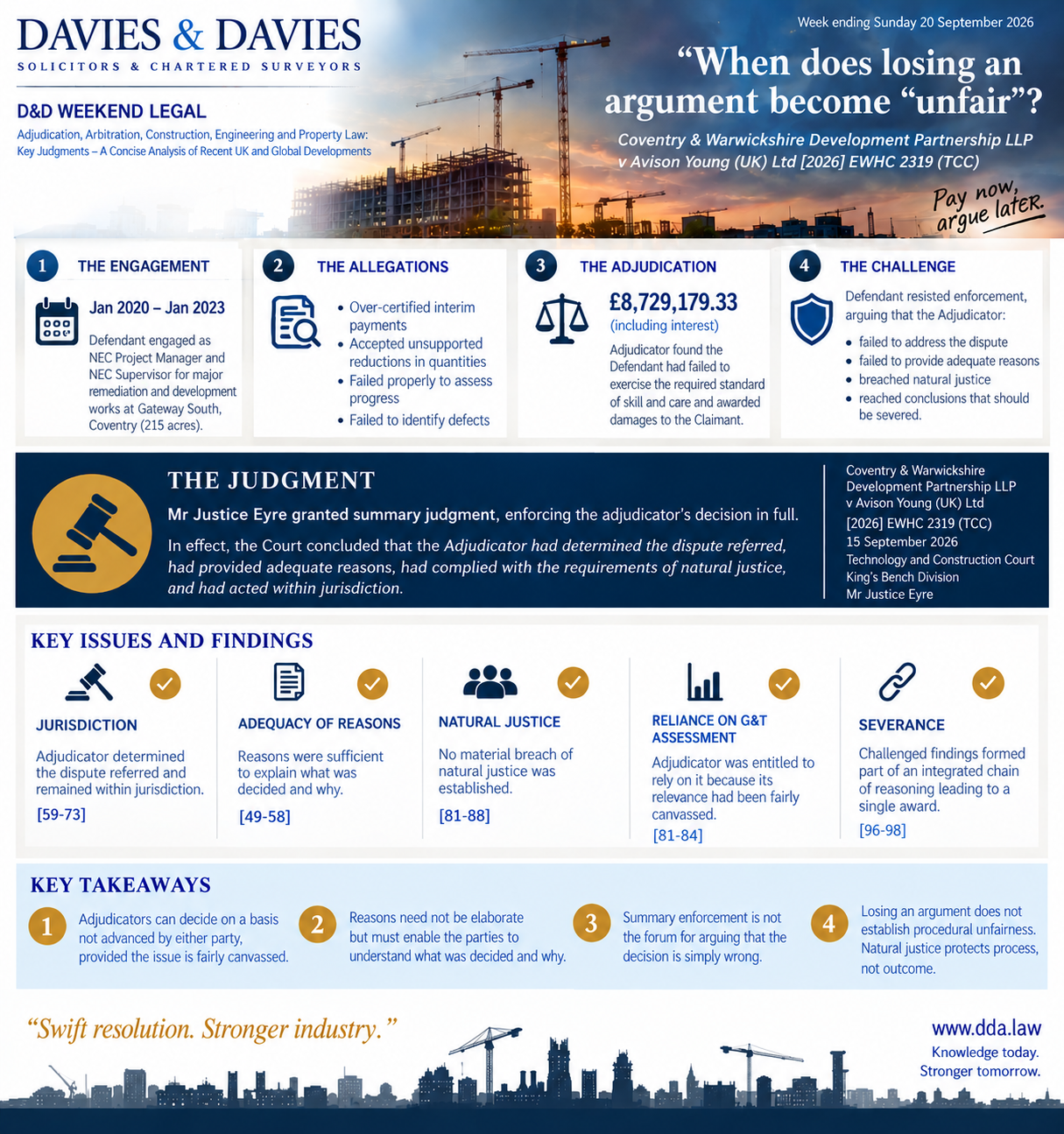
⚖️ Coventry & Warwickshire Development Partnership LLP v Avison Young (UK) Ltd [2026] EWHC 2319 (TCC) — When Does Losing an Argument Become “Unfair”?
If an adjudicator tells you what material he is considering, invites submissions, hears them — and then disagrees with you — is that a breach of natural justice?
Mr Justice Eyre’s answer was essentially: no.
The adjudicator had awarded £8,729,179.33 inclusive of interest after finding failures in Avison Young’s performance as NEC Project Manager and Supervisor. Avison Young resisted enforcement on grounds including jurisdiction, inadequate reasons, natural justice and severance. The Court rejected those challenges and enforced the award.
📌 The key points:
🔹 Reasons: enough to explain what was decided and why. [49–58]
🔹 Jurisdiction: answering the right question in the wrong way is still within jurisdiction. [59–73]
🔹 Natural justice: the G&T material had been fairly canvassed and both parties had the opportunity to address it. [81–84]
🔹 Severance: no. The challenged findings formed part of an integrated chain of reasoning. [89–98]
🧠 The psychological point is simple: being heard is not the same as being agreed with.
Once enough time, cost and intellectual energy have been invested in a position, disagreement can start to feel like unfairness.
Construction law is less sentimental.
An opportunity to persuade is not a right to succeed.
#ConstructionLaw #Adjudication #NaturalJustice #Jurisdiction #NECContracts #TCC #LegalUpdate #CaseLaw #DDAlegal
Nigel Davies BSc(Hons) (Q.Surv), PGCert.Psych, GDipLaw, PGDipLP, DipArb, MSc (Built Environment), LLM (Construction Law & Practice), MSc (Mechanical & Electrical), MSc (Psychology), FRICS, FCIOB, FCInstCES, FCIArb, CArb, GMBPsS, Panel Registered Adjudicator, Mediator, Mediation Advocate, Chartered Builder & Chartered Construction Manager, Chartered Surveyor & Civil Engineering Surveyor, Chartered Arbitrator, Author, and Solicitor-Advocate
Adjudicator Assessor and Re-Assessor for the ICE
ICE DRC Member
ICE DRC CPD Committee Chairman
Adjudicator Exam Question Setter for the ICE
CIArb Adjudication Panel Member since 2006
CIArb Arbitration Panel Member since 2006
CIC Adjudication Panel Member since 2010
FIDIC Adjudication Panel Member since 2021
ICE Adjudication Panel Member since 2021
Law Society Panel Arbitrator
RIBA Adjudication Panel Member since 2018
RICS Adjudication Panel Member since 2006
RICS Dispute Board Registered since 2013
TECSA Adjudication Panel Member since 2012
The information & opinions expressed in this article are not necessarily comprehensive, nor do they represent the trenchant view of the author; in any event, this article does not purport to offer professional advice. This article has been prepared as a summary and is intended for general guidance only. In the case of a specific problem, it is recommended that professional advice be sought.
© 2026 Davies & Davies Associates Ltd
Back to Legal Updates