Entexol Ltd v Sked Construction Ltd
Outer House, Court of Session
Lord Lake, 25 August 2026
Key Words
Adjudication — Enforcement — Natural justice — “Frolic of his own” — Opportunity to respond — Scope of dispute — Delay contra charges — Contractual completion date — Unilateral instruction — Time at large — Reasonable time — Burden of proof — Summary decree — Disputed issue of fact.
- Headnote
- The pursuer, Entexol Limited, was engaged by the defender, Sked Construction Limited, as a subcontractor in connection with works that the defender carried out for Scottish Power Energy Networks PLC. [1]
- Disputes arising under the subcontract were referred to adjudication, and the adjudicator in the second adjudication decided that the defender should pay £113,767 to the pursuer. [1]
- The pursuer sought enforcement of that award, while the defender resisted enforcement on the ground that the adjudicator had breached natural justice by departing from the parties’ submissions and taking a novel approach when he concluded that “time was at large”. [1], [6]
- The relevant part of the adjudication concerned the defender’s claim to deduct contra charges for delay on the basis that an email dated 12 July 2024 had fixed 13 November 2024 as the contractual completion date. [4], [5]
- The adjudicator rejected the contention that the email constituted an instruction fixing the completion date and concluded that, in any event, a binding agreement concerning timely completion could not be imposed by unilateral instruction. [5]
- The adjudicator found that there was no evidence that the pursuer had agreed to that or any other completion date, stated that time was therefore at large, and concluded that the defender had established neither a failure to complete within a reasonable time nor any resulting effect upon its own operations. [5]
- Defender contended that neither party had advanced a case that time was at large and that, after rejecting the alleged completion date, the adjudicator should have invited submissions upon what would have constituted a reasonable period for completion. [6]
- The Court held that the adjudicator’s reference to time being at large had been a consequence of his rejection of the defender’s case and had not constituted the independent introduction of a new issue. [9]
- The defender’s delay claim had failed because it had not established the completion date upon which its case depended, and not because the adjudicator had undertaken investigations or inquiries of his own. [9]
- The adjudicator had not been required to notify the parties that he was minded to reject the defender’s case or to invite further submissions because no equivalent requirement applied in court proceedings and such a requirement would have been inconsistent with the speed, informality, and tight timetable of adjudication. [10]
- The Court found that there was no relevant defence to the enforcement claim and granted decree in terms of the first conclusion. [12]
- The Court refused summary decree in respect of a separate claim for £10,000 because the defender potentially had a defence and the underlying factual dispute could not be resolved on the available material. [8], [11], [12]
- Material Facts
- The pursuer was engaged as a subcontractor by the defender in relation to contract works that the defender carried out for Scottish Power Energy Networks PLC. [1]
- Disputes arose under the subcontract and were referred to adjudication. [1]
- In the second adjudication, the adjudicator decided that the defender should pay £113,767 to the pursuer. [1]
- The dispute referred under the pursuer’s notice of adjudication dated 30 September 2025 arose from the pursuer’s payment notice dated 30 November 2024 and the defender’s pay less notice dated 22 January 2025. [4]
- The adjudicator considered that he was required to determine the true value of the works by reference to the pursuer’s invoice and the defender’s pay less notice. [4]
- The defender’s pay less notice included contra charges said to represent costs incurred because the pursuer had failed to complete the subcontract works on time. [4], [5]
- The defender asserted that an email dated 12 July 2024 had constituted an instruction fixing 13 November 2024 as the completion date. [5]
- The adjudicator found that the email had not constituted an instruction as to the completion date and that a binding agreement concerning timely completion could not, in any event, have been created by unilateral instruction. [5]
- The adjudicator found no evidence that the pursuer had agreed to 13 November 2024 or to any other completion date and accordingly stated that time was at large. [5]
- The adjudicator considered that, with time at large, the defender had been required to establish both that the pursuer had failed to complete within a reasonable time and that the delay had affected the defender’s own operations. [5]
- The adjudicator found that the defender had established neither requirement and decided that no delay damages were due because no completion date had been agreed and the defender had not demonstrated that the pursuer had caused delay to its operations. [5]
- In addition to enforcing the adjudication award, the pursuer sought summary decree for £10,000 on the basis that a condition requiring the provision of further information had been satisfied by the transmission of that information by email. [8]
- The defender maintained that documents remained outstanding and that a dispute therefore continued in relation to the additional claim. [8]
- Issues
- The first issue was whether the adjudicator had breached natural justice by concluding that time was at large when neither party had expressly advanced that case. [1], [3], [6]
- The second issue was whether the adjudicator’s conclusion had taken him outside the matters placed before him or had merely followed from his rejection of the defender’s asserted contractual completion date. [5]–[7], [9]
- The third issue was whether the adjudicator had been required, after rejecting the alleged completion date, to notify the parties and invite submissions upon the reasonable period within which the works should have been completed. [6], [10]
- The fourth issue was whether any error concerning time being at large had been immaterial because the defender had separately failed to establish that delay by the pursuer had caused loss or affected the defender’s operations. [5], [7]
- The fifth issue was whether the pursuer had established an entitlement to summary decree for the separate sum of £10,000 notwithstanding the defender’s contention that required documents remained outstanding. [8], [11]
- Decision
- The adjudicator’s statement that time was at large had been a consequence of his decision upon the case placed before him and had not been the reason for rejecting the defender’s contra charge. [9]
- The defender had based its claim upon a contractual requirement that the works be completed by 13 November 2024, and the adjudicator had been required to decide whether that date had been established. [5], [9]
- Once the adjudicator rejected that alleged completion date, the defender had failed to establish an essential element of its delay claim. [9]
- The defender had not advanced an alternative case that, in the absence of a fixed contractual period, the pursuer had failed to complete the works within a reasonable time. [9]
- The reference to time being at large had therefore been a red herring because the defender’s claim had failed through its inability to establish the completion date upon which it relied. [9]
- The adjudicator had not undertaken investigations or inquiries of his own and had not gone on a “frolic of his own”. [9]
- The adjudicator had not been obliged to notify the parties that he was minded to reject the defender’s argument or to invite further submissions. [10]
- The defender had therefore disclosed no relevant defence to the enforcement claim, and decree was granted in terms of the first conclusion. [12]
- The defender potentially had a defence to the separate £10,000 claim because an unresolved factual dispute remained as to whether the necessary documents had been provided. [8], [11]
- Summary decree upon the third conclusion was accordingly refused, and the action was appointed to a By Order hearing for determination of the further procedure required. [11], [12]
- Reasoning
- It was common ground that an adjudicator’s award would generally be enforced summarily and that the courts would be slow to decline enforcement. [2]
- It was also common ground that enforcement could be refused where the procedure leading to the award had failed to comply with the requirements of natural justice. [2]
- The Court considered Van Oord UK Limited v Dragados UK Limited [2022] CSOH 30, ATG Services (Scotland) Limited v Ogilvie Construction Limited [2024] CSOH 94, and Premier Modular Limited v Maidstone and Tunbridge Wells NHS Trust [2026] EWHC 1404 (TCC). [2], [3]
- Those authorities treated the central question as whether both parties had been afforded an opportunity to respond to the points raised against them. [3]
- Unfairness capable of vitiating a decision arose where a party had not been aware of the point relied upon or had not been given an opportunity to respond before the decision was made. [3]
- The relevant dispute had required the adjudicator to determine whether the defender had established an entitlement to deduct a contra charge on the basis that the subcontract works had not been completed within the time required by the contract. [4], [5], [9]
- That determination necessarily required the adjudicator to decide whether the defender had established 13 November 2024 as the contractual completion date. [5], [7], [9]
- The defender had therefore been aware that the existence of the asserted completion date was a matter that the adjudicator had to decide before the contra charge could be upheld. [6], [9]
- The adjudicator’s rejection of the email as an instruction fixing a completion date had disposed of a factual and legal premise expressly advanced by the defender. [5], [9]
- The conclusion that the works were instead required to be completed within a reasonable time had followed from the absence of an agreed completion date. [9]
- The Court considered that it was open to question whether that consequence was more accurately described as time being at large or as an obligation to complete within a reasonable time but held that the terminology did not affect the outcome. [9]
- The decisive point was that the defender had failed to prove that the works should have been completed by the particular date upon which its contra charge depended. [9]
- The defender had not advanced a contingent case that, if no fixed date existed, the works had nevertheless not been completed within a reasonable time. [9]
- The adjudicator had consequently rejected the case presented by the defender rather than introduced a separate case or undertaken an independent inquiry. [9]
- The defender had failed upon the contra charge because it had not established the asserted contractual completion date, rather than because the adjudicator had independently decided that time was at large. [9]
- The Court rejected the submission that the adjudicator had been bound to notify the parties once he was minded not to accept 13 November 2024 as the contractual completion date. [10]
- No equivalent obligation would have applied in court proceedings, while adjudication had been intended to operate more speedily and informally. [10]
- The tight timetables within which adjudications had to be concluded would have made it impracticable to require an adjudicator to invite further submissions whenever an argument was to be rejected. [10]
- In relation to the £10,000 claim, the available material did not permit the Court to determine whether the pursuer had established its case or to resolve the underlying factual dispute. [8], [11]
- Ratio Decidendi
- An adjudicator did not breach natural justice by rejecting a factual premise expressly advanced by a party and identifying the consequence that followed from that rejection, provided that the adjudicator remained within the issue that the dispute required him to decide. [3], [7], [9]
- Where a party claimed a delay contra charge upon the basis of a particular contractual completion date, the adjudicator was entitled to determine whether that party had established the asserted date. [5], [7], [9]
- The adjudicator did not go on a “frolic of his own” where he rejected the asserted completion date without undertaking independent investigations or inquiries and where the opposing party had disputed that date. [6], [9]
- A conclusion that no fixed completion date had been agreed, and that the obligation was consequently to complete within a reasonable time, arose from the adjudicator’s rejection of the case presented and did not itself introduce a new dispute. [5], [7], [9]
- An adjudicator who was minded to reject a party’s primary argument was not required to notify the parties of that provisional conclusion or to invite submissions upon an alternative case that the party had not advanced. [9], [10]
- The speed, informality, and tight timetable of adjudication were inconsistent with imposing a general requirement that an adjudicator solicit further submissions whenever a party’s pleaded or presented case failed. [10]
- Summary decree was inappropriate where the material before the Court disclosed a potential defence and the claim depended upon an unresolved dispute of fact that could not be determined summarily. [11]
- Disposition
- The Court held that there was no relevant defence to the claim contained in the first conclusion. [12]
- The pursuer’s first plea-in-law was sustained to the extent that the defence to enforcement was found to be irrelevant, and decree was granted in terms of the first conclusion. [12]
- The motion for summary decree in respect of the first conclusion therefore fell away. [12]
- The Court refused to sustain the pursuer’s first plea-in-law in respect of the defence to the third conclusion and refused summary decree for the additional £10,000. [11], [12]
- The case was appointed to a By Order hearing to determine the further procedure required in relation to the third conclusion. [12]
- Held
- Held, that the adjudicator’s conclusion that time was at large had been a consequence of rejecting the defender’s asserted completion date and had not constituted a departure from the dispute placed before him. [5], [9]
- Held, that the adjudicator had not undertaken investigations or inquiries of his own but had rejected the essential basis of the defender’s delay contra charge. [9]
- Held, that the defender had failed to establish that the subcontract works were contractually required to be completed by 13 November 2024. [5], [9]
- Held, that the defender had not advanced an alternative case that, in the absence of a fixed completion date, the works had not been completed within a reasonable time. [9]
- Held, that the adjudicator had not been required to notify the parties that he was minded to reject the asserted completion date or to invite further submissions upon a reasonable period for completion. [6], [10]
- Held, that the adjudication procedure had not failed to comply with the requirements of natural justice and that no relevant defence to enforcement had been established. [2], [3], [9], [10], [12]
- Held, that decree should be granted in terms of the first conclusion enforcing the adjudicator’s award of £113,767. [1], [12]
- Held, that summary decree should be refused in relation to the separate claim for £10,000 because the defender potentially had a defence and an unresolved issue of fact remained. [8], [11], [12]
Comment
What happens when an adjudicator rejects the proposition on which your case depends?
Do you lose?
Or has natural justice somehow been offended because nobody invited you to have another go?
That was the problem in Entexol Ltd v Sked Construction Ltd [2026] CSOH 80.
Sked’s delay contra-charge depended upon one critical proposition: the works had to be completed by 13 November 2024.
The adjudicator rejected it.
No agreed completion date. No established foundation for the delay case as advanced. And, crucially, no alternative case that Entexol had nevertheless failed to complete within a reasonable time.
That should have been the end of that particular argument.
Instead, attention shifted to the adjudicator’s statement that “time was at large”. Sked argued that neither party had advanced that case and that the adjudicator had therefore gone on the familiar judicially disapproved “frolic of his own”.
Lord Lake was unconvinced.
The phrase “time at large” was not the engine of the decision. It was, as the Court put it, something of a red herring. The real problem was much simpler: Sked had failed to establish the completion date upon which its contra-charge depended.
That distinction matters.
An adjudicator who introduces a genuinely new issue and decides the dispute upon it without giving the parties a fair opportunity to respond may create a natural justice problem.
An adjudicator who simply rejects the factual or legal premise of the case advanced has done something rather less exotic.
He has rejected the argument.
And this is where the psychology becomes more interesting than the procedure.
Humans are remarkably good at anchoring.
Once we settle upon a proposition — a completion date, an interpretation, a valuation, a causation theory — we tend to organise the rest of the evidence around it.
Then confirmation bias arrives to lend a hand.
Evidence supporting the anchor looks compelling. Evidence against it develops unfortunate defects.
The longer a dispute continues, the stronger another effect can become: escalation of commitment. Having invested time, cost and professional conviction in Proposition A, it becomes increasingly difficult to ask the one question that actually matters:
What if Proposition A is wrong?
That question is not pessimism.
It is dispute strategy.
Because the obvious follow-up is:
What is Proposition B?
Sked had a primary case: 13 November 2024 was the contractual completion date.
What it did not advance was the alternative case identified by Lord Lake: if there was no fixed contractual period, Entexol had nevertheless failed to complete within a reasonable time.
And the adjudicator was not required to formulate and decide an alternative case which the defender had not advanced.
Nor was he required to announce that he was about to reject the primary argument and invite submissions on what might replace it. Lord Lake observed that no equivalent obligation would arise in court proceedings and that adjudication is deliberately intended to be speedier and more informal.
Otherwise every adjudication would acquire an additional procedural stage:
“I am presently thinking you may be wrong. Would you like to try something else?”
At which point the 28-day process begins to resemble a particularly expensive seminar in collaborative problem-solving.
The sharper lesson from Entexol v Sked is therefore not simply that natural justice has limits.
It is that procedural fairness is not a mechanism for supplying an alternative case that a party chose not to advance.
The Court may refuse enforcement where a party has not had a fair opportunity to address a material point on which the adjudicator relied. That is the genuine natural justice concern.
But that is quite different from expecting the adjudicator to rescue a party from the failure of its primary case by inviting it to formulate a different one.
The practical discipline is simple.
Before advancing any decisive proposition, ask:
What must the decision-maker accept for us to win?
Then ask the more uncomfortable question:
What is our case if they do not?
That is cognitive flexibility applied to dispute resolution.
And it may be one of the most valuable forms of advocacy.
There is one important qualification. Sked did not lose every issue before the Court. Lord Lake refused summary decree on the separate £10,000 claim, because a potentially valid defence remained and the underlying factual dispute could not be resolved on the material available.
So the psychological lesson is not that Sked’s litigation as a whole was misguided.
It is narrower — and more useful.
When a case depends heavily upon one proposition, confidence in that proposition is not enough.
You also need to know what happens when the decision-maker says: No.
Because the real danger is not always that the adjudicator will go on a frolic of his own.
Sometimes the adjudicator stays exactly where he is.
It is your case that has wandered off.
#EntexolVSked #ConstructionLaw #Adjudication #CourtOfSession #NaturalJustice #ScottishLaw #ContractLaw #AdjudicationEnforcement #CSOH80 #UKLaw #ConstructionLaw #DisputeResolution #LegalUpdate #CaseLaw #DDAlegal
Authorities and Materials
The thematic classifications, descriptions and prioritisation below are editorial. They are not labels or rankings adopted by the Court, and the summaries are paraphrases rather than quotations unless expressly indicated. The list is confined to authorities and materials referred to in the judgment and is not intended to be exhaustive of the relevant law.
Case Law:
Natural Justice, Adjudicator Enforcement and the “Frolic of His Own” Principle — Primary Theme
- Van Oord UK Limited v Dragados UK Limited [2022] CSOH 30, [2022] SLT 521 — Lord Lake treated this as the principal authority on enforcement of adjudicators’ awards. It was cited for the proposition that adjudicators’ decisions will generally be enforced summarily and that enforcement will only be refused where the adjudication process failed to comply with the requirements of natural justice. The case was also relied upon for the analysis of when a breach of natural justice may arise in adjudication. [2]
- ATG Services (Scotland) Limited v Ogilvie Construction Limited [2024] CSOH 94 — Cited as reinforcing the principles identified in Van Oord. The judgment relied upon it for the proposition that the essential question is whether the parties had a fair opportunity to respond to the points relied upon by the adjudicator. The focus is on procedural fairness rather than labels such as “frolic of his own”. [3]
- Premier Modular Limited v Maidstone and Tunbridge Wells NHS Trust [2026] EWHC 1404 (TCC) — Cited alongside Van Oord and ATG Services. The case was relied upon for the proposition that natural justice concerns arise where a party has not been made aware of a material point relied upon by the adjudicator or has not been afforded an opportunity to respond to it. [3]
Legislation:
Construction Adjudication and Enforcement — Primary Theme
No statute, regulation, statutory instrument, rule, scheme provision or legislative provision was cited, discussed or relied upon by Lord Lake in reaching the decision. The judgment was determined entirely by reference to common-law principles governing:
- enforcement of adjudicators’ decisions;
- natural justice;
- procedural fairness; and
- the scope of issues properly before an adjudicator. [2]–[10]
Legal Texts & Commentary:
No legal textbooks, practitioner texts, academic works, journal articles, commentaries or learned treatises were cited or relied upon by Lord Lake in the judgment. The reasoning was based exclusively on the authorities identified above and on the facts of the adjudication before him. [2]–[10]
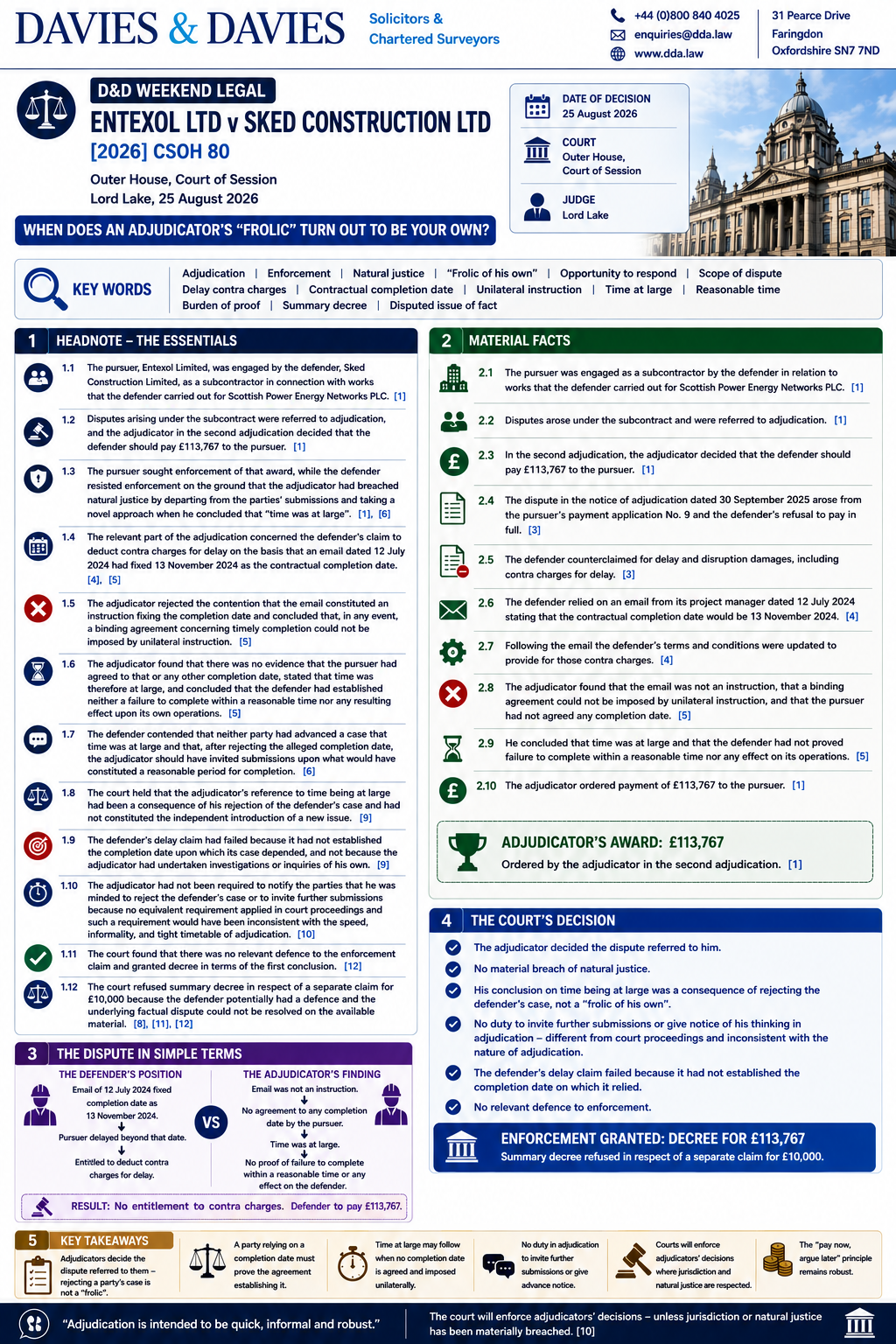
⚖️ Entexol Ltd v Sked Construction Ltd [2026] CSOH 80 — When Does an Adjudicator’s “Frolic” Turn Out to Be Your Own?
What happens when an adjudicator rejects the proposition on which your case depends?
In Entexol v Sked, Lord Lake held that rejecting a party’s case is not the same as inventing a new one.
Entexol was Sked’s subcontractor on works for Scottish Power Energy Networks PLC. In a second adjudication, the adjudicator ordered Sked to pay £113,767. Sked resisted enforcement, arguing that the adjudicator had breached natural justice by concluding that “time was at large”.
📌 The Court held:
🔹 No “frolic of his own”
Sked’s delay contra-charge depended on proving that an email fixed 13 November 2024 as the contractual completion date. The adjudicator rejected that premise. His reference to “time at large” was a consequence of that rejection, not a new dispute.
🔹 No duty to invite a second attempt
The adjudicator was not required to warn Sked that its primary case might fail or invite submissions on a different case. Adjudication is intended to be speedy and informal.
🔹 The missing fallback mattered
Sked had not advanced an alternative case that, absent a fixed date, Entexol had nevertheless failed to complete within a reasonable time.
🔹 The award was enforced
The Court found no relevant defence and granted decree enforcing the £113,767 award.
🔹 But not every issue was summarily decided
Summary decree was refused on a separate £10,000 claim because an unresolved factual dispute remained.
🧠 The practical lesson is broader than natural justice.
When a case depends heavily on one proposition — a completion date, valuation, interpretation or causation theory — ask:
What must the decision-maker accept for us to win?
Then ask:
What is our case if they do not?
Procedural fairness is not a mechanism for supplying an alternative case that a party chose not to advance.
Sometimes the adjudicator has not gone on a frolic at all.
Sometimes it is your case that has wandered off.
#EntexolVSked #ConstructionLaw#Adjudication #CourtOfSession #NaturalJustice #ScottishLaw#ContractLaw #AdjudicationEnforcement #DisputeResolution #LegalUpdate#CaseLaw #DDAlegal
Nigel Davies BSc(Hons) (Q.Surv), PGCert.Psych, GDipLaw, PGDipLP, DipArb, MSc (Built Environment), LLM (Construction Law & Practice), MSc (Mechanical & Electrical), MSc (Psychology), FRICS, FCIOB, FCInstCES, FCIArb, CArb, GMBPsS, Panel Registered Adjudicator, Mediator, Mediation Advocate, Chartered Builder & Chartered Construction Manager, Chartered Surveyor & Civil Engineering Surveyor, Chartered Arbitrator, Author, and Solicitor-Advocate
Adjudicator Assessor and Re-Assessor for the ICE
ICE DRC Member
ICE DRC CPD Committee Chairman
Adjudicator Exam Question Setter for the ICE
CIArb Adjudication Panel Member since 2006
CIArb Arbitration Panel Member since 2006
CIC Adjudication Panel Member since 2010
FIDIC Adjudication Panel Member since 2021
ICE Adjudication Panel Member since 2021
Law Society Panel Arbitrator
RIBA Adjudication Panel Member since 2018
RICS Adjudication Panel Member since 2006
RICS Dispute Board Registered since 2013
TECSA Adjudication Panel Member since 2012
The information & opinions expressed in this article are not necessarily comprehensive, nor do they represent the trenchant view of the author; in any event, this article does not purport to offer professional advice. This article has been prepared as a summary and is intended for general guidance only. In the case of a specific problem, it is recommended that professional advice be sought.
© 2026 Davies & Davies Associates Ltd
Back to Legal Updates