Netomnia Ltd v MJ Quinn Integrated Services Ltd
Technology and Constructin Court, King’s Bench Division
Mr Justice Eyre, 24 July 2026
Key Words
Applications for Payment – Payment Notices – Housing Grants Construction and Regeneration Act 1996 (HGCRA) – Scheme for Construction Contracts – Master Services Agreement (MSA) – Contractual Compliance – Estoppel by Convention – Information Reasonably Required – Purchase Orders – Work Orders – Telecommunications Infrastructure.
- Headnote
- The Claimant, the operator of a fibre-optic network, engaged the Defendant, a telecommunications infrastructure contractor, under a Master Services Agreement dated 7 April 2021 (“the MSA”). The MSA established a contractual regime for interim applications for payment, payment notices, pay less notices, and payment of the notified sum. [1]-[2], [18]-[25]
- On 5 February 2026, the Defendant submitted an application for payment (“the AFP”) claiming £3,770.84. It was one of 168 applications submitted that day, in similar form, claiming an aggregate sum of approximately £4.717 million. The AFP identified Work Order WO 0079 but contained no Purchase Order number, Polygon ID, or Feature ID. [3], [38]
- An adjudicator determined that the AFP was valid and that the Claimant’s payment notice had been served out of time. He awarded the Defendant £3,794.60, comprising the amount claimed together with interest. [4]
- The Claimant commenced Part 8 proceedings seeking, among other relief, a declaration that the AFP did not comply with clause 6.5 of the MSA and was therefore incapable of constituting a valid payment notice for the purposes of section 110B(4) of the HGCRA. [5]-[10]
- The Court held that the AFP failed to comply with clause 6.5.4 because it was not accompanied by information reasonably required to verify the accuracy of the sums claimed. In the contractual and commercial context, the relevant Polygon ID and Feature IDs were information reasonably required for that purpose. [54]-[57]
- The AFP also failed to comply with clause 6.5.5 because it did not reference Purchase Order PO-008324. That Purchase Order had been provided to the Defendant and was the corresponding Purchase Order for the services and deliverables to which the AFP related. [60]-[72]
- The Court rejected the Defendant’s alternative contention that the MSA failed to provide an adequate mechanism for determining payments under section 110 of the HGCRA, with the consequence that the Scheme for Construction Contracts applied. [53], [59], [71]-[72]
- The Defendant’s estoppel by convention defence also failed. There was no evidence of a communicated and shared assumption that the Claimant would accept applications identifying only a Work Order and omitting a Purchase Order number, Polygon ID, and Feature ID. [73]-[75]
- The AFP did not comply with clause 6.5 of the MSA and was not a payment notice for the purposes of section 110B(4) of the HGCRA. The Claimant was entitled to declaratory relief. [76].
- Material Facts
- The parties entered into the MSA on 7 April 2021. It operated as a framework agreement under which the Claimant could call off the Defendant’s services for the construction and installation of telecommunications infrastructure throughout the United Kingdom. [1], [18]-[20]
- The Claimant’s network was organised through a hierarchy of Exchanges, Polygons, Features, and Premises. Each Polygon and Feature was allocated a unique identifying number. [14]-[15]
- Works were called off under individual Work Orders. Following execution of a Work Order, the Claimant issued one or more Purchase Orders. Each Purchase Order related to a single Polygon and a single Work Order, whereas a Work Order could relate to more than one Polygon. [16]
- The Claimant used electronic systems, including ODIN and QGIS, to manage the works. Those systems contained the relevant Polygon IDs and Feature IDs and were accessible to the Defendant. [17]
- Clause 6.5 of the MSA required an application for payment to:
- state the sum considered due;
- explain the basis of calculation;
- provide a breakdown of the activities performed;
- be accompanied by documentation and other information reasonably required to verify the accuracy of the invoice; and
- reference the corresponding Purchase Order for the applicable services or deliverables. [22]
- Under clauses 6.6-6.8, the Claimant was required to issue a payment notice within five days after the due date. The final date for payment was 14 days after the due date, and any pay less notice had to be issued no later than one day before the final date for payment. [25]
- Work Order WO 0079 related to works at Stoneycroft and, unusually, concerned only one Polygon, numbered 291115. [16], [34]
- Purchase Order PO-008324 was dated 29 August 2023 and was emailed on 30 August 2023 to Lauren Maloney, a member of the Defendant’s accounts team. It referred to Stoneycroft, Polygon 291115, and Work Order 0079. [35], [37]
- The evidence showed that Ms Maloney did not process or circulate the Purchase Orders sent to her. The Defendant did not, however, notify the Claimant that the Purchase Orders were being ignored or provide an alternative address for their delivery. [37], [66]
- On 5 February 2026, the Defendant submitted the AFP. It sought payment of £3,770.84, comprising sums said to be due for indexation and for network adjustments and permits. [38]
- The AFP identified Work Order WO 0079 and the Stoneycroft location but did not identify Purchase Order PO-008324, Polygon 291115, or any relevant Feature IDs. [3], [38]
- The Claimant issued a payment notice stating that no sum was due and subsequently maintained that the AFP was invalid because it lacked the information needed to verify the claim. [39]
- Following an adjudication in the Defendant’s favour, the Claimant commenced Part 8 proceedings. The live substantive issue was whether the AFP was capable of constituting a valid payment notice, the Court determining that question independently of the adjudicator’s decision. [4]-[10]
- Although the proceedings were expected to inform the parties’ treatment of the other 167 applications submitted on the same day, the Court emphasised that it had not seen those applications and that its conclusions could not necessarily be applied to them without further examination. [11]
- Issues
- Whether the Polygon ID and Feature IDs were information reasonably required to verify the accuracy of the AFP for the purposes of clause 6.5.4 of the MSA. [10(i)], [54]-[57]
- Whether Purchase Order PO-008324 had been provided to the Defendant. [10(ii)(a)], [60]-[67]
- Whether Purchase Order PO-008324 was the corresponding Purchase Order for the services and deliverables to which the AFP related. [10(ii)(b)-(c)], [68]-[71]
- Whether clause 6.5.5 required the Defendant to reference that Purchase Order and, if so, whether the AFP failed to comply with the clause. [10(ii)(d)], [59], [71]-[72]
- Whether the MSA failed to provide an adequate mechanism for determining what payments became due, within section 110 of the HGCRA, so that the relevant provisions of the Scheme for Construction Contracts applied. [10(ii)(e)], [46]-[53], [59], [72]
- Whether the parties’ previous dealings gave rise to an estoppel by convention preventing the Claimant from relying on the AFP’s non-compliance with clause 6.5. [10(iii)], [73]-[75]
- Decision
- The Polygon ID and relevant Feature IDs were information reasonably required to verify the accuracy of the AFP. Their omission meant that the AFP did not comply with clause 6.5.4. [56]-[57]
- Purchase Order PO-008324 had been provided to the Defendant when it was emailed to a member of the Defendant’s accounts team. The fact that the recipient did not process or circulate it internally did not mean that it had not been provided to the Defendant. [60]-[67]
- Purchase Order PO-008324 was the corresponding Purchase Order for the AFP because it related to Polygon 291115 and to the services and deliverables in respect of which the claims for indexation and permits were advanced. [68]-[71]
- The AFP failed to comply with clause 6.5.5 because it did not reference Purchase Order PO-008324. [71]-[72]
- The MSA provided an adequate contractual mechanism for determining payments. The Scheme for Construction Contracts therefore did not apply. [71]-[72]
- The Defendant did not establish the factual foundation required for an estoppel by convention. [73]-[75]
- The AFP did not comply with clause 6.5 of the MSA and was therefore incapable of constituting a payment notice under section 110B(4) of the HGCRA. [76]
- The Claimant was entitled to the declaratory relief sought, subject to submissions as to the precise form of the declaration. [76]
- Reasoning
- Clause 6.5.4: information reasonably required for verification
- The question whether information was “reasonably required” under clause 6.5.4 was to be determined objectively and in the factual and commercial context in which the contractual payment mechanism operated. [54]-[56]
- The Court rejected the Defendant’s submission that the AFP should be assessed in isolation. Although Work Order WO 0079 happened to relate to a single Polygon, the MSA governed a nationwide operation involving:
- more than 100 Exchanges;
- 12,396 Polygons;
- more than five million Features;
- more than 200 Work Orders issued to the Defendant;
- multiple contractors; and
- numerous applications for payment. [14]-[17], [56(i)-(v)]
- Many Work Orders related to more than one Polygon. A Work Order reference would therefore not ordinarily enable the Claimant to identify the Polygon, the relevant works, or the Purchase Order against which payment was to be authorised. [16], [56(iii)]
- The Claimant’s systems used Feature IDs to identify the relevant Polygon and the Polygon ID to identify the relevant Purchase Order. The Purchase Order was then used to authorise payment. [17], [56(vi)]
- The contractual and statutory timetable was material. Receipt of a valid application triggered the due date, following which the Claimant had only five days to issue its payment notice and a further limited period in which to issue any pay less notice. [25], [56(vii)]
- The Court held that the verification obligation had to be assessed having regard to the general run of applications, not merely the unusual fact that this particular Work Order concerned a single Polygon. The Claimant was entitled to require the information normally needed to verify payment claims efficiently and consistently. [56(xi)]
- The permit claim related to a particular Polygon, even though it was not associated with individual Features. The Defendant could therefore have supplied the relevant Polygon ID. [56(viii)]
- The indexation claim required the Claimant to identify the underlying works and verify that those works had been completed and previously paid for. It was not sufficient for the Defendant merely to assert that the works had been completed and that the indexation uplift was therefore due. [56(x)]
- The Defendant knew, or could readily obtain, the relevant identifiers. The Polygon ID appeared in the Work Order, and the Feature IDs were available through ODIN or QGIS. [17], [56(xii)]
- Accordingly, the Polygon ID and Feature IDs were information reasonably required to verify the AFP. By providing only the Work Order reference, the Defendant failed to comply with clause 6.5.4. [57]
- Clause 6.5.5: corresponding Purchase Order
- The Court rejected the argument that Purchase Order PO-008324 had not been provided to the Defendant because it had not been sent to its registered office. The Purchase Order was not a contractual notice governed by clause 19, and the requirement that it be “submitted to the Supplier” did not require delivery in hard copy to the registered office. [60]-[64]
- The MSA was to be construed as a commercial document. Requiring every Purchase Order to be delivered physically to the registered office would have been artificial and contrary to the commercial purpose of the agreement. [64]
- Clause 6.5.5 formed part of a set of requirements intended to enable the Claimant readily to check the Defendant’s entitlement to payment. Referencing a Purchase Order enabled the Claimant to identify the relevant Polygon and the services or deliverables concerned. [65]
- Purchase Order PO-008324 had been emailed to a member of the Defendant’s accounts team shortly after execution of the Work Order and more than two years before submission of the AFP. The Defendant had not instructed the Claimant to send Purchase Orders elsewhere or informed it that Purchase Orders sent to that employee were being ignored. [66]
- Any mistaken internal belief that Purchase Orders were generated only after completion of the works was inconsistent with the MSA, which contemplated that a Purchase Order would specify the services or deliverables “to be supplied”. [66(v)]
- The circumstances of transmission therefore did not prevent the Defendant from referring to Purchase Order PO-008324 and did not deprive the document of its contractual status as a Purchase Order. [67]
- Purchase Order PO-008324 was the corresponding Purchase Order because it related to Polygon 291115, and any entitlement under the AFP arose from services or deliverables associated with that Polygon. [68]
- The indexation claim remained referable to the Purchase Order. The fact that indexation could increase the amount payable above the sum stated in the Purchase Order did not mean that the Purchase Order ceased to correspond to the claim. The possibility of an increase or reduction was inherent in clause 6.13 of the MSA. [69]
- The permit claim was also referable to the Purchase Order. The permits had been obtained to enable the works covered by the Purchase Order to be carried out, and the Purchase Order identified both the relevant Work Order and Polygon. [70]
- A corresponding Purchase Order therefore existed, had been provided to the Defendant, and should have been referenced in the AFP. [71]
- Adequacy of the payment mechanism
- The Defendant’s argument that the MSA lacked an adequate payment mechanism depended on its contention that no corresponding Purchase Order existed or had been provided. Once those factual premises were rejected, the argument necessarily failed. [59], [71]-[72]
- On the facts of this case, clause 6.5.5 remained effective as part of the contractual mechanism for determining when payment became due. The Defendant’s failure to comply with that mechanism did not render the mechanism itself inadequate for the purposes of section 110 of the HGCRA. [71]-[72]
- Estoppel by convention
- An estoppel by convention required a shared assumption, communicated expressly or impliedly between the parties, upon which the parties had conducted their dealings and from which it would be unfair or unjust for one party to depart. [73]-[74]
- The AFP contained only the Work Order reference. It omitted the Purchase Order number, Polygon ID, and all relevant Feature IDs. To establish the alleged convention, the Defendant therefore needed to show a practice of the Claimant accepting applications containing only a Work Order reference and none of the other identifiers. [75]
- The evidence did not establish such a practice. At most, it showed that the Claimant may previously have paid some applications which omitted a Purchase Order reference. It did not show that the Claimant had accepted applications which also omitted both the Polygon ID and Feature IDs. [43], [75]
- There was therefore no communicated and shared assumption capable of supporting an estoppel by convention. It was unnecessary to determine whether the MSA’s no-waiver, amendment, and entire-agreement provisions would otherwise have prevented reliance on an estoppel. [73]-[75]
- Ratio Decidendi
- reasonably required to verify its accuracy, the question of what is reasonably required is to be determined objectively in the commercial and operational context of the contractual payment regime. [54]-[57]
- Identifiers which enable the payer to locate the relevant works, establish the applicable Purchase Order, and verify the sums claimed within the contractual and statutory payment timetable may constitute information reasonably required for verification, even where the claim might exceptionally be identifiable by other means. [54]-[57]
- Where a contract requires an application for payment to reference the corresponding Purchase Order, failure to do so renders the application contractually non-compliant where a corresponding Purchase Order exists and has been provided to the contractor. [65]-[72]
- A Purchase Order may remain the corresponding Purchase Order notwithstanding that contractual indexation or ancillary items increase the sum claimed beyond the amount originally stated in it, provided that the claim remains referable to the services or deliverables covered by that Purchase Order. [68]-[70]
- On the facts of this case, the existence of a corresponding Purchase Order and the availability of the relevant identifying information meant that clause 6.5.5 remained effective as part of the contractual payment mechanism, with the consequence that the Defendant's argument based upon inadequacy of the payment mechanism failed. [71]-[72]
- Where an application for payment fails to satisfy applicable contractual requirements, it is not a notification “in accordance with the contract” for the purposes of section 110B(4)(b) of the HGCRA and, in those circumstances, cannot operate as a valid payee payment notice. [51], [76]
- An estoppel by convention cannot arise without evidence of a shared assumption, communicated between the parties and reflected in their dealings, which corresponds to the particular departure from the contractual requirements relied upon. [73]-[75]
- Disposition
- The Claimant succeeded on the substantive issue arising in its Part 8 claim. [76]
- The AFP did not comply with clause 6.5 of the MSA. [76]
- The AFP was not a payment notice for the purposes of section 110B(4) of the HGCRA. [76]
- The Defendant failed on its arguments concerning:
- compliance with clause 6.5.4;
- compliance with clause 6.5.5;
- the alleged inadequacy of the contractual payment mechanism;
- the application of the Scheme for Construction Contracts; and
- estoppel by convention. [57], [72], [75]
- The Claimant was entitled to declaratory relief, subject to submissions as to the precise form of the declaration. [76]
- Held
- The relevant Polygon ID and Feature IDs were information reasonably required to verify the accuracy of the AFP and that their omission rendered the AFP non-compliant with clause 6.5.4 of the MSA. [56]-[57]
- That Purchase Order PO-008324 had been provided to the Defendant when it was emailed to a member of the Defendant’s accounts team. [60]-[67]
- That Purchase Order PO-008324 was the corresponding Purchase Order for the services and deliverables to which the AFP related, including the claims for indexation and permits. [68]-[71]
- The AFP failed to comply with clause 6.5.5 because it did not reference Purchase Order PO-008324. [71]-[72]
- The MSA provided an adequate mechanism for determining payments under section 110 of the HGCRA and that the Scheme for Construction Contracts did not apply. [71]-[72]
- The Defendant failed to establish an estoppel by convention preventing the Claimant from relying on the contractual requirements of clause 6.5. [73]-[75]
- The AFP was not a payment notice for the purposes of section 110B(4) of the HGCRA. [76]
- The Claimant was entitled to declaratory relief. [76]
Comment
The judgment reinforces the principle that an application for payment must satisfy not only the statutory requirements of the HGCRA but also any additional contractual requirements which the parties have agreed as conditions of a valid application. [22], [51], [76]
The central issue was not whether the Defendant had carried out the underlying works, nor whether the sums claimed might ultimately have been recoverable. Rather, the issue was whether the AFP complied with the payment machinery established by clause 6.5 of the MSA so as to operate as a valid payment notice under section 110B(4) of the HGCRA. [6]-[10], [49], [76]
The Court approached that question by considering the contractual requirements in their commercial and operational context. The MSA governed a nationwide telecommunications infrastructure project involving more than 100 Exchanges, 12,396 Polygons, in excess of five million Features, numerous contractors, substantial numbers of Work Orders, and large volumes of applications for payment. [14]-[17], [56(i)-(v)]
Against that background, the Court regarded the contractual identifiers required by the MSA as serving a practical verification function. The Court concluded that the Polygon ID and relevant Feature IDs formed part of the information reasonably required to verify the accuracy of the AFP, particularly where the Claimant was required to operate within a contractual and statutory timetable requiring a payment notice to be served within five days of the due date. [25], [56(vi)-(xii)], [57]
The judgment also illustrates the significance of contractual Purchase Order requirements within a payment mechanism. The Court held that Purchase Order PO-008324 had been provided to the Defendant when it was sent to a member of the Defendant’s accounts team and that the Defendant’s internal handling of the document did not alter that conclusion. [35], [37], [63]-[67]
Equally, the Court rejected the contention that the claims for indexation and permits fell outside the scope of the relevant Purchase Order. Those claims remained referable to the same services, deliverables, Work Order, and Polygon to which Purchase Order PO-008324 related, with the result that it remained the corresponding Purchase Order for the purposes of clause 6.5.5. [68]-[70]
An important aspect of the judgment is the distinction between a defective application and a defective contractual mechanism. The Court held that the existence of a corresponding Purchase Order and the availability of the relevant identifying information meant that the contractual payment mechanism remained effective and operable. On the facts of the case, the Defendant’s failure to comply with that mechanism did not render the mechanism itself inadequate for the purposes of section 110 of the HGCRA. [59], [67]-[72]
The Court also adopted an orthodox approach to estoppel by convention. The evidence did not establish any communicated and shared assumption that applications omitting a Purchase Order reference, Polygon ID, and Feature IDs would nonetheless be treated as contractually compliant. In the absence of such evidence, the estoppel defence could not succeed. [73]-[75]
The broader significance of the decision lies in its emphasis on contractual certainty within construction payment regimes. The decision indicates that contractual informational and verification requirements are likely to be enforced where they serve a legitimate verification purpose and are consistent with the statutory payment framework. [22], [51], [54]-[57], [65], [76]
The judgment therefore serves as a reminder that a payment application must comply with the contractual machinery from which it derives its legal effect. An application which omits information required by the contract may fail as a valid payment notice. That conclusion does not determine whether the applicant has any underlying substantive entitlement to payment, which was not the issue before the Court. [51], [57], [71]-[72], [76]
Viewed in that way, the decision was not concerned with imposing technical obstacles to payment. It was concerned with enforcing contractual requirements adopted to enable the efficient verification and administration of payment claims within a substantial and complex operational environment. [56], [65], [76]
The judgment must nevertheless be applied with care. Mr Justice Eyre expressly declined to indicate whether, or to what extent, the conclusions reached in relation to this AFP could be applied to the other 167 applications submitted on the same day. Each application would require consideration of its own contents and factual context. [11]
#ConstructionLaw #Netomnia #MJQuinn #PaymentApplications #HGCRA #TCC #HighCourt #ContractCompliance #PaymentNotices #EstoppelByConvention #MasterServicesAgreement #Adjudication #DisputeResolution #LegalUpdate #CaseLaw #DDAlegal
Authorities
Editorial note: The thematic classifications and prioritisation below are editorial and are not labels used by the Court.
Case Law:
Payment Notices and Contractual Compliance — Primary Theme
- Advance JV v Enisca Ltd [2022] EWHC 1152 (TCC) — The Court cited this decision for Joanna Smith J’s summary that, to qualify as a valid notice, a payment notice must comply with the statutory requirements and with any more restrictive contractual requirements, in both substance and form. That proposition informed the Court’s analysis of whether the AFP complied with clauses 6.5.4 and 6.5.5 of the MSA. [51]
- Henia Investments Inc v Beck Interiors Ltd [2015] EWHC 2433 (TCC) — The Court referred to Henia through Joanna Smith J’s summary in Advance JV v Enisca Ltd. It was the underlying authority for the proposition that a payment notice must comply with applicable contractual requirements where those requirements are more restrictive than the statutory minimum. [51]
- Bennett (Construction) Ltd v CIMC MBS Ltd [2019] EWCA Civ 1515 — The Court referred to Bennett in two distinct contexts. First, the Claimant relied upon it when accepting that the contractual requirement for prior written Acceptance or Sign Off was to be treated as satisfied where the Defendant was entitled to such acceptance or sign off. Secondly, the Defendant relied upon it in support of an interpretation of clause 6.5.5 under which a Purchase Order need only be referenced where a corresponding Purchase Order existed and had been provided to the contractor. The Court found it unnecessary to determine that latter point because a corresponding Purchase Order existed and had been provided to the Defendant. [24], [59], [71]
Estoppel by Convention — Secondary Theme
- Deerns UK Ltd v VDC LHR11 Ltd [2026] EWHC 1509 (TCC) — The Court adopted the analysis of estoppel by convention previously set out by Mr Justice Eyre in Deerns and applied it to the Defendant’s case. That analysis required the Defendant to establish a communicated and shared assumption upon which the parties had conducted their dealings and from which it would be unfair or unjust for the Claimant to depart. [73]-[74]
- Mears Ltd v Shoreline Housing Partnership Ltd [2015] EWHC 1396 (TCC), 160 Con LR 157 — Cited through Deerns, this authority contained Akenhead J’s formulation of the requirements for an estoppel by convention. Those requirements included: (a) a shared assumption of fact or law, or an assumption made by one party and acquiesced in by the other; (b) communication of that assumption between the parties; (c) reliance upon, or material influence arising from, the assumption; and (d) unfairness, injustice, or unconscionability sufficient to prevent a party from departing from the convention. [73]
- C Spencer Ltd v MW High Tech Projects UK Ltd [2019] EWHC 2547 (TCC), [2019] BLR 643 — Also cited through Deerns, this authority was referred to for O’Farrell J’s concise statement that, where parties conduct their dealings on the basis of a shared underlying assumption, neither will be permitted to depart from that assumption where it would be unfair or unjust to do so. [73]
Contractual Interpretation and the Interaction between the HGCRA and Contractual Payment Machinery — Tertiary Theme
- Bennett (Construction) Ltd v CIMC MBS Ltd [2019] EWCA Civ 1515 — In addition to its relevance to the contractual requirements governing payment applications, Bennett was relied upon by the Defendant in support of a construction of clause 6.5.5 which would avoid the conclusion that the MSA failed to provide an adequate payment mechanism under section 110 of the HGCRA. The Court did not determine that wider interpretative issue because it found that a corresponding Purchase Order existed, had been provided to the Defendant, and could have been referenced in the AFP. [24], [59], [71]-[72]
Prioritisation Summary — Case Law
- Payment Notices and Contractual Compliance was the central theme because the principal issue was whether the AFP complied with clauses 6.5.4 and 6.5.5 of the MSA so as to constitute a payment notice for the purposes of section 110B(4) of the HGCRA. [7], [51], [57], [71]-[72], [76]
- Estoppel by Convention was a secondary issue raised to prevent the Claimant from relying upon the AFP’s non-compliance with clause 6.5 and was addressed only after the Court had considered the operation of clauses 6.5.4 and 6.5.5. [73]-[75]
- Contractual Interpretation and the Interaction between the HGCRA and the Payment Mechanism was relevant to the Defendant's alternative arguments concerning clause 6.5.5 and the adequacy of the contractual payment machinery but did not determine the outcome because the Court found that a corresponding Purchase Order existed and had been provided to the Defendant. [59], [67]-[72]
Legislation:
Payment Notices under the HGCRA and Contractual Compliance — Primary Theme
- Housing Grants, Construction and Regeneration Act 1996, s.110B(4) — This was the central statutory provision in the case. The Court considered whether the AFP constituted a notification given “in accordance with the contract” and was therefore capable of operating as a payment notice under section 110B(4). The Court concluded that, because the AFP failed to comply with clauses 6.5.4 and 6.5.5 of the MSA, it was not a notification given in accordance with the contract and was therefore not a payment notice for the purposes of section 110B(4). [6]-[8], [49], [76]
- Housing Grants, Construction and Regeneration Act 1996, s.110A(1) and s.110A(3) — The Court referred to these provisions as setting out the statutory framework and content requirements for a notice given by the payee. Section 110A(3) required the notice to specify (a) the sum considered to be, or to have been, due at the payment due date and (b) the basis upon which that sum was calculated. These provisions formed part of the statutory framework within which the Court considered whether the AFP could constitute an effective payment notice. [48]-[49], [51]
- Housing Grants, Construction and Regeneration Act 1996, s.111 — The Court referred to section 111 as providing that the payer must pay the notified sum on or before the final date for payment. The provision formed part of the statutory payment regime and explained the significance of whether the AFP constituted a valid payment notice. [50]
Adequacy of the Contractual Payment Mechanism and Operation of the Scheme — Secondary Theme
- Housing Grants, Construction and Regeneration Act 1996, s.110(1) — The Court referred to section 110(1) as requiring every construction contract to provide (a) an adequate mechanism for determining what payments become due under the contract and when they become due and (b) a final date for payment in relation to any sum which becomes due. The Defendant argued that clause 6.5.5 rendered the MSA non-compliant with section 110(1) because it allegedly required reference to a corresponding Purchase Order in circumstances where no such Purchase Order existed or had been provided. The Court rejected that contention because a corresponding Purchase Order existed and had been provided to the Defendant. [46], [53], [59], [71]-[72]
- Housing Grants, Construction and Regeneration Act 1996, s.110(3) — The Court referred to section 110(3) as providing that, where a construction contract does not contain an adequate mechanism for determining payments, the relevant provisions of the Scheme for Construction Contracts apply. The Defendant relied upon section 110(3) in support of its argument that the relevant provisions of the Scheme applied in place of the allegedly inadequate contractual mechanism. The Court found that section 110(3) was not engaged because the MSA contained an adequate payment mechanism. [47], [53], [72]
- Scheme for Construction Contracts, paragraph 2 — The Court referred to paragraph 2 of the Scheme as providing a mechanism for determining the amount of instalment, stage, or periodic payments. The provision was cited as part of the Court's explanation of how the Scheme would operate if it applied. [52]
- Scheme for Construction Contracts, paragraph 4 — The Court referred to paragraph 4 of the Scheme as providing that payment becomes due on the later of (a) the expiry of seven days following the relevant period identified in paragraph 2(1) or (b) the making of a claim by the payee. The Defendant relied upon paragraph 4 in arguing that, if the Scheme applied, there was no requirement for the AFP to take any particular contractual form or comply with the information requirements in clause 6.5. The Court rejected that contention because the Scheme did not apply. [52]-[53], [72]
General Statutory Payment Framework — Tertiary Theme
- Housing Grants, Construction and Regeneration Act 1996, s.109 — The Court referred to section 109 as establishing the statutory entitlement to payment by instalments, stage payments, or other periodic payments under construction contracts. The provision formed part of the statutory background to the payment regime but did not materially influence the determination of the substantive issues. [45]
Prioritisation Summary — Legislation
- Payment Notices under the HGCRA and Contractual Compliance was the primary legislative theme because the Court’s central task was to determine whether the AFP satisfied the contractual conditions necessary for it to constitute a payment notice for the purposes of section 110B(4) of the HGCRA. [6]-[8], [49], [51], [57], [71]-[72], [76]
- Adequacy of the Contractual Payment Mechanism and Operation of the Scheme was the secondary legislative theme because it arose from the Defendant’s alternative argument that clause 6.5.5 deprived the MSA of an adequate payment mechanism, thereby engaging section 110(3) and the relevant provisions of the Scheme for Construction Contracts. The Court rejected that contention after finding that a corresponding Purchase Order existed and had been provided to the Defendant. [53], [59], [71]-[72]
- General Statutory Payment Framework provided legislative context but was not determinative of the outcome. The Court referred to section 109 when summarising the statutory payment regime before turning to the substantive issues. [45]-[50]
- Section 110B(4) of the HGCRA was ultimately determinative because the Court concluded that non-compliance with clauses 6.5.4 and 6.5.5 of the MSA meant that the AFP was not a notification given “in accordance with the contract” and therefore could not operate as a valid payment notice for the purposes of section 110B(4). [51], [57], [71]-[72], [76]
Legal Texts & Commentary:
No Identified Legal Texts or Commentary Cited — Primary Theme
- No legal texts, practitioner works, textbooks, encyclopaedias, guidance publications, academic commentary, or treatises were cited in the judgment. The judgment did not cite any legal textbook, practitioner work, encyclopaedia, academic article, guidance publication, or other secondary legal source. The Court’s reasoning proceeded by reference to: (a) the terms of the MSA; (b) the relevant provisions of the Housing Grants, Construction and Regeneration Act 1996; (c) the Scheme for Construction Contracts; (d) the factual and documentary evidence; and (e) the judicial authorities cited in the judgment. No independent legal text or commentary was identified or relied upon. [44]-[76]
Contractual Interpretation and Commercial Construction — Secondary Theme
- No legal text or commentary was cited in relation to contractual interpretation. The Court construed clauses 6.5.4 and 6.5.5 by reference to the contractual language, the structure and purpose of the payment provisions, and the commercial and operational context in which the MSA functioned. No textbook, practitioner commentary, or academic treatment of contractual interpretation was referred to. [54]-[72]
Estoppel by Convention — Tertiary Theme
- No legal text or commentary was cited in relation to estoppel by convention. The applicable principles were derived from judicial authority, principally the analysis adopted in Deerns UK Ltd v VDC LHR11 Ltd, which in turn referred to Mears Ltd v Shoreline Housing Partnership Ltd and C Spencer Ltd v MW High Tech Projects UK Ltd. The Court did not rely upon any textbook, practitioner guide, or academic commentary on estoppel. [73]-[75]
Construction Payment Legislation and the HGCRA — Quaternary Theme
- No legal text or commentary was cited in relation to the HGCRA or the Scheme for Construction Contracts. The Court addressed the statutory payment regime directly by reference to the relevant legislative provisions and the judicial authorities concerning the validity of payment notices and the adequacy of contractual payment mechanisms. No practitioner text, statutory commentary, academic article, or guidance publication was cited. [44]-[53]
Prioritisation Summary — Legal Texts & Commentary
- No legal texts or commentary were cited in the judgment. The absence of secondary legal sources is a notable feature of the judgment. The Court resolved the issues by applying the contractual provisions, the statutory framework, the factual evidence, and the relevant case law. [44]-[76]
- Case law rather than legal commentary formed the intellectual framework of the judgment. Judicial authority, rather than legal commentary, provided the principal legal framework. The judgment referred to authorities including: (a) Advance JV v Enisca Ltd; (b) Henia Investments Inc v Beck Interiors Ltd; (c) Bennett (Construction) Ltd v CIMC MBS Ltd; (d) Deerns UK Ltd v VDC LHR11 Ltd; (e) Mears Ltd v Shoreline Housing Partnership Ltd; and (f) C Spencer Ltd v MW High Tech Projects UK Ltd. No secondary legal source was cited in support of the Court’s reasoning. [24], [51], [59], [73]-[75]
- Absence of legal texts and commentary is itself a notable feature of the judgment. The judgment illustrates a judicial approach based upon direct application of the contractual provisions, the statutory framework, and established judicial authority, without recourse to textbooks, practitioner works, or academic commentary. [44]-[76]
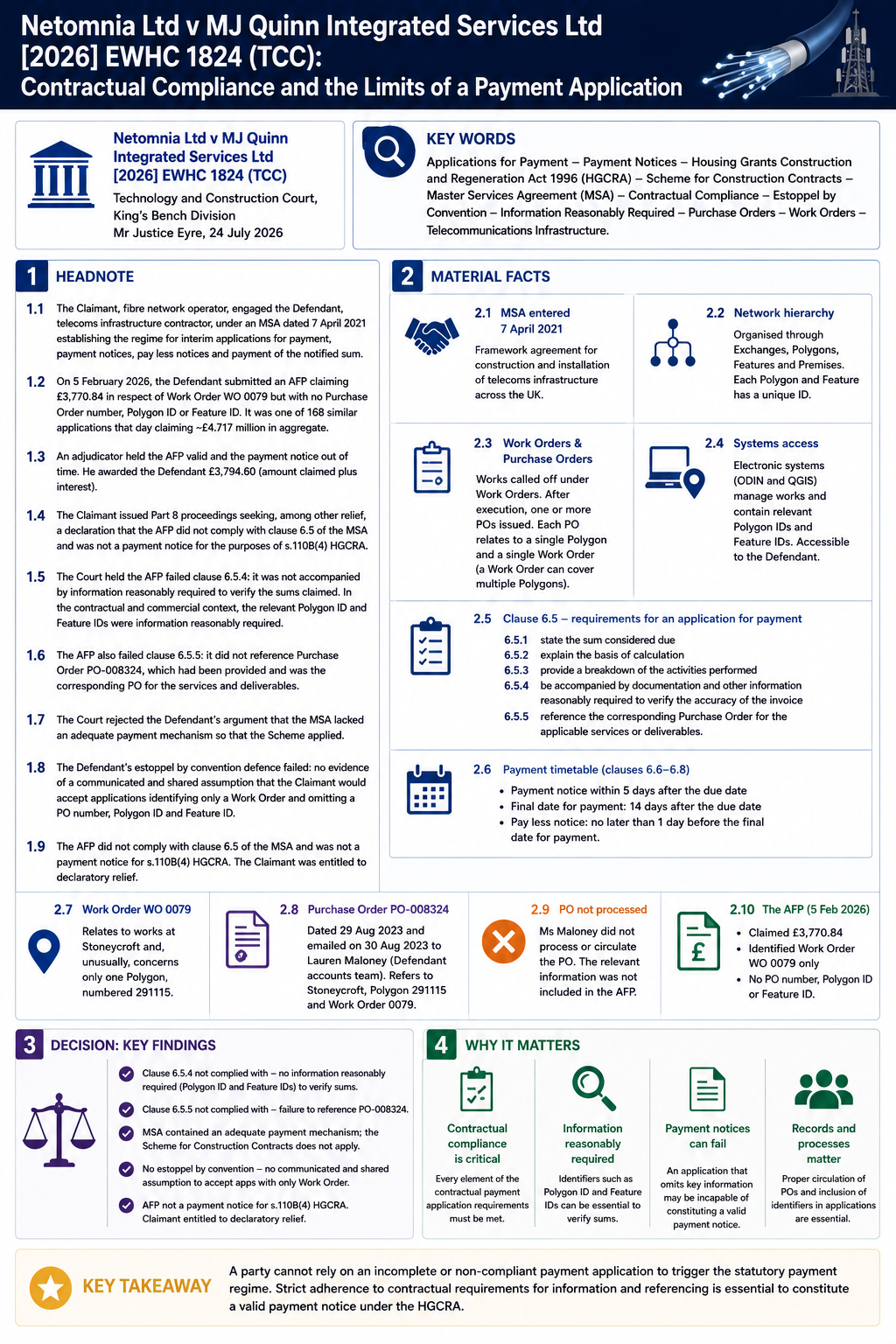
Mr Justice Eyre held that an application for payment failed because it did not comply with the parties’ agreed contractual requirements.
The AFP claimed £3,770.84 and was one of 168 applications submitted that day, totalling approximately £4.717 million. It identified Work Order WO 0079 but omitted the corresponding Purchase Order, Polygon ID, and relevant Feature IDs.
The adjudicator had found the AFP valid and awarded £3,794.60, including interest. Netomnia then sought a declaration that the AFP did not comply with clause 6.5 of the MSA and was not a payment notice under section 110B(4) of the HGCRA.
📌 The TCC held:
🔹 No Identifiers, No Verification: In a nationwide operation involving more than 100 Exchanges, 12,396 Polygons, over five million Features, multiple contractors, and hundreds of Work Orders, a bare Work Order reference was not enough. [56]-[57]
🔹 The Purchase Order Had Been Provided: PO-008324 had been emailed to a member of MJ Quinn’s accounts team more than two years before the AFP. Internal failure to process or circulate it did not mean it had not been provided. [60]-[67]
🔹 Indexation Did Not Break the Link: The indexation and permit claims remained referable to the same services, Work Order, Polygon, and Purchase Order. [68]-[70]
🔹 The Contractual Mechanism Was Adequate: Failure to comply with the agreed machinery did not make that machinery inadequate under section 110. The Scheme did not apply. [71]-[72]
🔹 No Estoppel by Convention: There was no shared and communicated assumption that applications containing only a Work Order reference would be accepted as compliant. [73]-[75]
🧠 Authorities included Advance JV, Henia, Bennett, Deerns, Mears, and C Spencer.
💬 The case was not about whether the sums might ultimately have been recoverable. It was about whether the AFP complied with the contractual machinery necessary to give it legal effect.
It did not.
The lesson is simple: where the contract requires identifiers, supporting information, and a corresponding Purchase Order, those requirements are part of the payment mechanism—not administrative garnish.
Nigel Davies BSc(Hons) (Q.Surv), PGCert.Psych, GDipLaw, PGDipLP, DipArb, MSc (Built Environment), LLM (Construction Law & Practice), MSc (Mechanical & Electrical), MSc (Psychology), FRICS, FCIOB, FCInstCES, FCIArb, CArb, GMBPsS, Panel Registered Adjudicator, Mediator, Mediation Advocate, Chartered Builder & Chartered Construction Manager, Chartered Surveyor & Civil Engineering Surveyor, Chartered Arbitrator, Author, and Solicitor-Advocate
Adjudicator Assessor and Re-Assessor for the ICE
ICE DRC Member
ICE DRC CPD Committee Chairman
Adjudicator Exam Question Setter for the ICE
CIArb Adjudication Panel Member since 2006
CIArb Arbitration Panel Member since 2006
CIC Adjudication Panel Member since 2010
FIDIC Adjudication Panel Member since 2021
ICE Adjudication Panel Member since 2021
Law Society Panel Arbitrator
RIBA Adjudication Panel Member since 2018
RICS Adjudication Panel Member since 2006
RICS Dispute Board Registered since 2013
TECSA Adjudication Panel Member since 2012
The information & opinions expressed in this article are not necessarily comprehensive, nor do they represent the trenchant view of the author; in any event, this article does not purport to offer professional advice. This article has been prepared as a summary and is intended for general guidance only. In the case of a specific problem, it is recommended that professional advice be sought.
© 2026 Davies & Davies Associates Ltd
Back to Legal Updates