Svella Connect Ltd v Virgin Media Ltd
Technology and Construction Court, King’s Bench Division
The Honourable Mr Justice Pepperall, 26 August 2026
Key Words
Commercial contracts – Implied terms – Good faith – Relational contracts – NEC standard terms – Framework agreements – Mutual trust and co-operation – Work allocation – No guarantee of work – Competitive tendering – Termination rights – Exit and settlement agreement – Business efficacy – Necessity – Obviousness – Marks & Spencer – Bates v Post Office – Summary judgment – Strike out – Amendment of statements of case – CPR Parts 3, 17 and 24.
- Headnote
- Virgin Media Limited applied for summary judgment or, alternatively, strike out in respect of claims advanced by Svella Connect Limited arising from three Framework Agreements and a subsequent Exit & Settlement Agreement. [1]
- Svella had originally advanced claims including fraudulent misrepresentation, intimidation, causing loss by unlawful means, breaches of alleged implied duties of good faith, aggravated and exemplary damages, disgorgement, equitable compensation and an account of profits. [1]
- Before the hearing, Svella abandoned all of the challenged claims except its claims for breach of alleged implied duties of good faith, proposed extensive amendments to its good faith case and withdrew its 187-page Reply. [2]-[4]
- The remaining dispute concerned whether Svella had a real prospect of establishing that duties of good faith were implied into the Framework Agreements and the Exit & Settlement Agreement and whether it should be permitted to plead its revised allegations of breach. [4], [55]
- The Framework Agreements were detailed commercial agreements based upon NEC standard terms, extending to more than 200 pages, and expressly required the parties to act in “a spirit of mutual trust and co-operation”. [23], [90]
- The Framework Agreements did not guarantee Svella any work, conferred no exclusivity, allowed Virgin Media to obtain competing quotations and decide where individual Work or Package Orders should be placed, and contained substantial termination rights. [25], [27]-[32], [92]-[93]
- Pepperall J held that the critical enquiry was not whether a contract could be labelled “relational”. The court must first examine the parties' express bargain and then apply the orthodox principles governing implication of terms. [83]-[86]
- The Bates criteria were no more than a useful sense-check. [73]-[86]
- The court held that there was no contractual gap in the Framework Agreements requiring the pleaded duties of good faith to be implied and that the proposed terms were neither necessary nor obvious. [90]-[95]
- The Exit & Settlement Agreement was an even less promising candidate for an implied duty of good faith. It was a carefully negotiated agreement designed to regulate the ending of a troubled contractual relationship and contained defined promises subject to express qualifications. [115]-[129]
- The revised allegations of breach either duplicated claims arising under express contractual provisions, failed to disclose completed causes of action, or concerned matters already comprehensively regulated by the contractual machinery. [130]-[140]
- Summary judgment was granted in favour of Virgin Media on the claims for breach of the alleged implied duties of good faith. Permission to plead the revised allegations in paragraph 1 of Appendix 2 was refused. [141.1]-[141.4]
- Material Facts
- Virgin Media created and expanded fibre-optic networks throughout the United Kingdom using contractors engaged under framework agreements. From 2023 it provided network services to its single customer, nexfibre. [6]
- Virgin Media entered into the Lightning Framework Agreement with NMCN plc on 7 May 2019 and two Morpheus Framework Agreements with NMCN on 14 February 2020. [7]
- Following NMCN’s administration, the Framework Agreements were novated to Svella in October 2021. [8]
- Before each financial year, nexfibre produced an Opportunity Plan identifying anticipated volumes and locations of work. Virgin Media then negotiated provisional allocations with its framework contractors, taking account of matters including price, past performance, quality, health and safety and capacity. [9]
- Those allocations were provisional. Work ultimately depended upon nexfibre calling it down, detailed design, relevant approvals, formal contractor proposals and nexfibre’s final approval to build. [10]
- Historically, actual work volumes had sometimes fallen materially below the volumes shown in the Opportunity Plans. Contractors therefore did not invariably receive all work provisionally allocated during the annual planning process. [11]
- Svella pleaded that the Framework Agreements were relational contracts involving substantial communication, co-operation, predictable performance, mutual trust and confidence and expectations of loyalty, from which duties of good faith should be implied. [12]
- Svella alleged that, from about March 2024, Virgin Media applied pressure concerning rates and working practices, reduced build volumes, threatened not to renew or extend the Morpheus Framework Agreements and pressured Svella to bring those agreements to an end. [13]-[14]
- On 24 July 2024, the parties entered into the Exit & Settlement Agreement. Svella waived claims asserted under the Morpheus Framework Agreements while Virgin Media agreed to award further work under the Lightning Framework Agreement in accordance with Schedules 1 and 2. [15]
- Schedule 1 defined the “FY25 Allocation” as 74,000 installations plus 22,000 brought forward, giving a contractual allocation figure of 96,000. [34]
- The judgment separately records that Schedule 2 identified 96,372 installations. In November 2024 nexfibre materially scaled back its FY25 plans, leaving only approximately 26,000 of those installations planned for that year. [17]
- Virgin Media agreed to grant 50% of the FY25 Allocation, subject to its governance process and Svella’s quality and delivery KPI performance. [35]-[36]
- Virgin Media also agreed to postcode exclusivity across the Central Area for the remainder of the FY25 Allocation, but only to the extent that build projects actually proceeded in that area. [35]-[36.2]
- For FY26, Virgin Media agreed to grant a minimum of 15% of the full Central Area volume, again subject to governance. If nexfibre rejected a build, Virgin Media was required to use reasonable endeavours to replace it with additional volume. [35]-[36.3]
- Virgin Media denied that any broader duties of good faith were implied. It maintained that the alleged duties were unnecessary, inconsistent with the express bargain and unsupported by the contractual structure. [19]-[20]
- Issues
- Whether Svella had a real prospect of establishing that duties of good faith were implied into the Framework Agreements, whether as terms implied in fact or in law. [55.1], [89]-[114]
- Whether Svella had a real prospect of establishing that duties of good faith were implied into the Exit & Settlement Agreement. [55.1], [115]-[129]
- Whether characterising a contract as “relational” provided an independent or alternative basis for implying duties of good faith. [67]-[88]
- Whether the nine characteristics identified in Bates v Post Office (No. 3) constituted a determinative legal test or merely a sense-check within the orthodox implication analysis. [73]-[86]
- Whether the express provisions of the Framework Agreements left any contractual gap requiring an implied duty of good faith. [90]-[114]
- Whether the nature and terms of the Exit & Settlement Agreement supported implication of the pleaded duties. [115]-[129]
- Whether the proposed revised allegations of breach in Appendix 2 disclosed viable causes of action with a real prospect of success. [130]-[140]
- Whether Svella should receive permission under CPR Part 17 to plead those revised allegations. [51], [54]-[55], [130]-[141]
- Decision
- Svella had no real prospect of establishing the pleaded duties of good faith under the Framework Agreements. [114], [141.1]
- Svella had no real prospect of establishing the pleaded duties of good faith under the Exit & Settlement Agreement. [129], [141.2]
- Summary judgment was granted in favour of Virgin Media on the claims for breach of those alleged implied duties. [141.3]
- It was therefore unnecessary to determine Virgin Media’s alternative strike-out application in relation to those claims. [141.3]
- Svella was permitted to amend its Particulars of Claim in accordance with its second draft, save that permission was refused to plead the new particulars of breach in paragraph 1 of Appendix 2. [141.4]
- Reasoning
- Pepperall J began with orthodox principles. A court considers implication only after completing the process of construing the express terms of the contract. [56]
- A term may be implied in fact where it is necessary to give the particular agreement business efficacy or is sufficiently obvious to go without saying. A term may also be implied in law as a necessary incident of a particular class of contractual relationship. [57]-[65]
- Fairness was not enough. A court could not imply a term into a detailed commercial agreement merely because the term seemed reasonable or because the parties might have agreed to it if somebody had thought to suggest it. [61]-[65]
- The implication process could not be used to rewrite the parties' bargain according to what a court might regard as fairer or commercially preferable. [62], [65]
- A proposed implied term could not survive where it contradicted or displaced an express term. [61], [65]
- The authorities concerning relational contracts did not create a special route around those principles. Pepperall J regarded the term “relational” as capable of describing the quality of a relationship, but not as determining whether an additional contractual duty should be implied. [82]-[88]
- The critical enquiry was whether the parties had fully expressed their bargain and, if not, whether the proposed term satisfied the orthodox requirements for implication. [83]-[86]
- The Bates characteristics remained useful, but as a sense-check rather than a substitute for Marks & Spencer and the conventional law on implied terms. [73]-[86]
- Necessity remained at the heart of the enquiry whether implication was said to arise in fact or in law. [87]-[88]
- The Framework Agreements were detailed commercial contracts extending to more than 200 pages. They already expressly required the parties to act in “a spirit of mutual trust and co-operation”. [90]
- They nevertheless contained no guarantee that Virgin Media would place work with Svella, no geographical exclusivity, rights to invite competitive bids and substantial termination rights. Individual Work or Package Orders were separate contracts. [91]-[93]
- Pepperall J characterised the commercial substance of the Framework Agreements as arrangements under which Svella had pre-qualified to compete for work, without any guarantee that work would actually be awarded. [93]
- There was therefore no gap requiring the pleaded duties of good faith to make the Framework Agreements commercially workable. Nor were the proposed duties so obvious that both parties would necessarily have assented to them had an officious bystander raised the point. [95]
- Applying Bates as a sense-check did not improve Svella’s position. The agreements were not especially long term, did not require the pleaded substantial investment, gave no exclusivity and generated no expectation of loyalty beyond the obligations the parties had expressly chosen to impose. [96]-[112]
- The court therefore concluded that the Framework Agreements were not relational contracts in the relevant sense and that no pleaded duty of good faith was implied either in fact or in law. [112]-[114]
- The Exit & Settlement Agreement presented an even clearer case. Its purpose was to regulate the parties’ separation following a troubled commercial relationship. It contained carefully negotiated and qualified promises rather than an open-ended collaborative venture. [115]-[127]
- In particular, the parties had expressly agreed that Virgin Media would use reasonable endeavours to replace FY26 volume where nexfibre rejected a build. There was no need to superimpose an additional implied duty of good faith upon an issue the parties had already addressed expressly. [116], [123]
- Pepperall J described the Exit & Settlement Agreement as a “hard-edged settlement transaction”. There was no identified contractual gap and nothing in its wording or context suggesting an expectation of mutual trust, confidence or loyalty. [122]-[124]
- The revised allegations of breach also failed independently. Where Svella alleged that money or work was contractually due, the express contractual provisions supplied the cause of action. If the money or work was not contractually due, good faith could not be used to manufacture an obligation that the contract did not contain. [131]
- Certain allegations did no more than plead that Virgin Media “intended to” adopt particular courses of action. No such action was alleged to have occurred, no resulting loss was pleaded and no relief was claimed. There was therefore no completed cause of action. [132]
- The contractual machinery governing Service Levels, audits, Performance Improvement Plans, suspension and step-in rights was detailed and express. The relevant contractual standard was frequently one of reasonableness. An implied good faith obligation would not fill a gap; it would rewrite the agreed scheme. [134]-[138]
- Ratio Decidendi
- The characterisation of a commercial agreement as “relational” is not a freestanding test for the implication of a duty of good faith. The court must first construe the express bargain and apply the orthodox principles governing implied terms. [82]-[88]
- The characteristics identified in Bates v Post Office (No. 3) are a useful sense-check when examining the nature of a contractual relationship, but they do not constitute an alternative to the established requirements of necessity, business efficacy or obviousness. [73]-[86]
- Where sophisticated commercial parties have comprehensively regulated a matter by express contractual provisions, an implied duty of good faith will not ordinarily be implied merely to supplement, duplicate or alter that express contractual scheme. [79]-[85], [90]-[95], [136]-[138]
- An express obligation to act in a spirit of mutual trust and co-operation does not of itself justify implying a broader and differently formulated duty of good faith where the contract otherwise comprehensively defines the parties’ rights and obligations. [90], [103]-[114]
- Proof that a contract possesses relational characteristics does not, without more, establish a duty of good faith implied by law. Necessity remains the touchstone. [87]-[88], [113], [128]
- Where liability depends upon whether an express obligation to pay money, allocate work or follow performance machinery has been breached, an implied duty of good faith adds nothing to the analysis and cannot create an obligation absent from the express bargain. [131]-[139]
- Disposition
- Virgin Media succeeded on its application for summary judgment in respect of the alleged implied duties of good faith under the Framework Agreements. [114], [141.1], [141.3]
- Virgin Media succeeded on its application for summary judgment in respect of the alleged implied duties of good faith under the Exit & Settlement Agreement. [129], [141.2]-[141.3]
- The alternative strike-out application required no further determination in relation to those claims. [141.3]
- Svella received permission to amend its Particulars of Claim in accordance with its second draft, except in relation to the revised particulars of breach at paragraph 1 of Appendix 2. [141.4]
- Permission to plead those revised allegations was refused. [140]-[141.4]
- Held
- Held, that the correct starting point when considering whether a duty of good faith should be implied into a commercial contract was the parties’ express bargain and the orthodox law governing implication of terms. [83]-[88]
- Held, that classification of an agreement as relational did not provide a freestanding or alternative basis for implying a duty of good faith. [82]-[88]
- Held, that the Bates criteria were a useful sense-check but did not displace the requirements governing implication in fact or in law. [73]-[88]
- Held, that the Framework Agreements contained no contractual gap requiring implication of the pleaded duties of good faith and that those duties were neither necessary nor obvious. [90]-[95]
- Held, that the Framework Agreements were not relational contracts in the relevant sense and that the pleaded duties of good faith were not implied into them either in fact or in law. [112]-[114]
- Held, that the Exit & Settlement Agreement was a carefully negotiated, hard-edged settlement transaction that contained no relevant gap requiring implication of the pleaded duties. [115]-[128]
- Held, that no pleaded duties of good faith were implied into the Exit & Settlement Agreement either in fact or in law. [127]-[129]
- Held, that the revised allegations of breach either duplicated express contractual claims, failed to disclose completed causes of action, or concerned matters already governed by detailed contractual provisions. [130]-[140]
- Held, that summary judgment was granted in favour of Virgin Media upon the implied good faith claims. [141.1]-[141.3]
- Held, that permission to plead the revised particulars of breach in paragraph 1 of Appendix 2 was refused. [141.4]
Comment
Svella Connect Ltd v Virgin Media Ltd is an important antidote to one of the more seductive habits in modern commercial litigation: finding the word “relational”, sprinkling it over a contract, and hoping a duty of good faith will grow underneath.
Pepperall J was prepared to put the brakes on that approach.
The judgment does not abolish relational contracts. Nor does it deny that good-faith obligations can, in an appropriate case, be implied. What it does is put the horse firmly back in front of the contractual cart. Before asking whether the relationship feels relational, collaborative, trusting or otherwise deserving of judicial warmth, read the contract.
All of it.
That mattered here because these were not skeletal agreements held together by a handshake and mutual optimism. The Framework Agreements ran to more than 200 pages. They were based upon NEC terms. They expressly required “mutual trust and co-operation”. They addressed tendering, work orders, performance, auditing, Service Levels, PIPs, suspension, step-in rights, competitive bidding and termination.
Most inconveniently for Svella’s implied-term case, they also said there was no guarantee of work.
That is quite a difficult provision to improve upon by implication.
Svella’s argument therefore collided with a basic obstacle: one cannot usually fill a contractual gap where the alleged gap is already occupied by words the parties chose to put there.
The point is particularly sharp because the contract already contained the language one might instinctively associate with good faith: “mutual trust and co-operation”. Yet Pepperall J did not treat those words as a seed from which an altogether broader duty could be cultivated. They were part of the bargain, not permission to rewrite the rest of it.
The treatment of Bates is equally significant. Its nine characteristics have become familiar travelling companions in good-faith cases. But familiarity can produce doctrinal inflation. A checklist intended to assist can slowly become a test; a test can become a shortcut; and before long everybody is counting relational characteristics as though nine ticks produce a complimentary implied term.
They do not.
Pepperall J brought the exercise back to first principles. Bates is a sense-check. The real question remains whether, after construing the express agreement, an additional term is necessary or sufficiently obvious according to the orthodox law of implied terms.
In other words, “relational” describes. It does not conjure.
The Exit & Settlement Agreement made Svella’s position harder still. Settlement agreements are not normally written at the beginning of a beautiful commercial friendship. This one was designed to regulate the parties’ separation after difficulties had already emerged. Pepperall J called it what it was: a “hard-edged settlement transaction”.
Trying to find an unexpressed expectation of loyalty inside a negotiated exit agreement is therefore a little like searching a decree absolute for evidence that everybody intended to give the marriage another go.
There was another practical lesson in the proposed breach case. If the contract required Virgin Media to pay money or allocate work, Svella could sue on the express term. If the contract did not require it, a duty of good faith could not be deployed as a contractual photocopier to produce an obligation missing from the original.
The same applied to the performance machinery. The parties had already negotiated detailed standards governing audits, monitoring, PIPs, suspension and intervention. The court was not going to replace carefully drafted tests of reasonableness with a generalised obligation of good faith simply because one side preferred the sound of it.
And then there were the allegations about what Virgin Media “intended” to do. Intention may be fascinating evidence. It is not automatically a cause of action. A commercial director discussing ugly options does not, merely by having the conversation, necessarily breach a contract. Causes of action usually require something rather more operational than an unattractive thought.
The practical lesson is therefore refreshingly orthodox.
Before pleading good faith, identify the gap.
Not the unfairness.
Not the unpleasant conduct.
Not the long relationship.
Not the word “collaboration”.
The gap.
Then ask whether the proposed term is genuinely necessary or obvious, whether it can be expressed clearly, and whether it is consistent with what the parties actually wrote.
If the contract already answers the question, “good faith” is not a judicial delete key.
#SvellaConnect #VirginMedia #ContractLaw #CommercialLitigation #RelationalContracts #GoodFaith #SummaryJudgment #TCC #EnglishLaw #NECContracts #LegalUpdates #CaseLaw #DDAlegal
Authorities and Materials
The thematic classifications, descriptions and prioritisation below are editorial. They are not labels or rankings adopted by the Court, and the summaries are paraphrases rather than quotations unless expressly indicated. The list is confined to authorities and materials referred to in the judgment and is not intended to be exhaustive of the relevant law.
Case Law:
Implication of Terms – Primary Theme
- Marks & Spencer plc v BNP Paribas Securities Services Trust Co (Jersey) Ltd [2015] UKSC 72, [2016] AC 742 — The principal modern authority on terms implied in fact. Pepperall J relied upon it for the proposition that implication follows construction of the express terms, that fairness alone is insufficient, and that business necessity and obviousness are capable of operating as alternative routes to implication. [56], [63]-[65], [83]-[88]
- BP Refinery (Westernport) Pty Ltd v Shire of Hastings (1977) 180 CLR 266 — Cited for the familiar five conditions governing implication: reasonableness and equity, business efficacy, obviousness, clarity of expression and consistency with the express contract. [61]
- Philips Electronique Grand Public SA v British Sky Broadcasting Ltd [1995] EMLR 472 (CA) (19 October 1994) — Relied upon for the caution that implication must not become an exercise in hindsight whereby the court fashions a term that appears attractive after the contractual crisis has arisen. [56], [62]
- Ali v Petroleum Co of Trinidad & Tobago [2017] UKPC 2, [2017] ICR 531 — Applied for the proposition that implication must not become contractual rewriting and that necessity cannot be diluted into mere improvement of the bargain. [65]
- Torre Asset Funding Ltd v Royal Bank of Scotland plc [2013] EWHC 2670 (Ch) — Cited for the difficulty of confidently inferring omitted intentions from lengthy and carefully drafted commercial agreements and for the significance of uncertainty in proposed implied terms. [66]
Good Faith and Relational Contracts – Primary Theme
- Yam Seng Pte Ltd v International Trade Corporation Ltd [2013] EWHC 111 (QB), [2013] 1 Lloyd's Rep 526 — The foundational modern authority considered in relation to good faith and relational contracts. The judgment discussed Leggatt J’s analysis that English law does not impose a general duty of good faith upon all commercial contracts but may imply such a duty in an appropriate case by orthodox methodology. [67]-[69]
- Sheikh Al Nehayan v Kent [2018] EWHC 333 (Comm) — Considered for Leggatt LJ’s further explanation of relational contracts as relationships involving long-term collaboration, integrity and co-operation where not every aspect can necessarily be exhaustively specified in writing. [70], [72]
- Bates v Post Office (No. 3) [2019] EWHC 606 (QB) — Fraser J identified nine characteristics of relational contracts. Pepperall J treated those characteristics as useful indicia or a sense-check, but not as a statutory-style test capable of replacing the orthodox law governing implied terms. [73]-[86]
- UTB LLC v Sheffield United Ltd [2019] EWHC 2322 (Ch) — Fancourt J’s reasoning was influential. The case warned against replacing the question whether a term is necessary or obvious with a threshold question whether the contract is “relational”. [77], [82]-[86]
- Cathay Pacific Airways Ltd v Lufthansa Technik AG [2020] EWHC 1789 (Ch) — Relied upon for the distinction between genuinely open-ended collaborative arrangements and detailed agreements in which sophisticated commercial parties have already specified their obligations with precision. [79]-[80]
- Candey Ltd v Bosheh [2022] EWCA Civ 1103, [2022] 4 WLR 84 — Coulson LJ’s judgment was relied upon for the orthodox approach to implication, for treating the Bates criteria as a sense-check rather than a substitute legal test, and for cautioning against veering away from orthodox implication principles. [64], [74], [76], [83]-[86]
- Astor Management AG v Atalaya Mining plc [2017] EWHC 425 (Comm), [2018] 1 All ER (Comm) 547 — Demonstrated that no additional good-faith obligation need be implied where an express obligation, there one of reasonable endeavours, already regulates the relevant matter. [81], [85]
- Globe Motors Inc v TRW Lucas Varity Electric Steering Ltd [2016] EWCA Civ 396 — Referred to within the discussion in UTB for the proposition that a duty of good faith can only be implied where the language and context of the contract permit it. [77]
- Russell v Cartwright [2020] EWHC 41 (Ch) — Falk J’s endorsement of the UTB approach was noted. [78]
- Essex County Council v UBB Waste (Essex) Ltd (No. 2) [2020] EWHC 1581 (TCC), 191 ConLR 77 — Pepperall J referred to his earlier observation that the Bates factors were useful indicia rather than statutory criteria. [75], [97]
- Ellis v John Benson Ltd [2025] EWHC 2096 (KB) — Freedman J’s analysis was cited for the observation that the general drift of the authorities concerning good faith is towards implication in fact rather than implication in law. [71], [87]
Terms Implied in Law – Secondary Theme
- Société Générale v Geys [2012] UKSC 63, [2013] 1 AC 523 — Cited for the distinction between terms implied in fact into a particular contract and terms implied in law as necessary incidents of a class of contractual relationships. [57]
- Liverpool City Council v Irwin [1977] AC 239 — Considered as the classic example of a term implied in law as a necessary incident of a contractual relationship. Necessity remained central. [58], [70]
- Crossley v Faithful & Gould Holdings Ltd [2004] EWCA Civ 293 (16 March 2004), [2004] ICR 1614 — Considered in relation to established terms implied by law and the concept of necessity within recognised contractual relationships. [59], [87]
Summary Judgment, Strike Out and Amendment
- Swain v Hillman [2001] 1 All ER 91 — Applied for the distinction between a realistic and merely fanciful prospect of success under CPR Part 24. [49]
- ED & F Man Liquid Products Ltd v Patel [2003] EWCA Civ 472 — Cited for the requirement that a realistic case must carry some degree of conviction and for the principle that the court need not accept evidence uncritically merely because it is advanced in opposition to summary judgment. [49]
- Royal Brompton Hospital NHS Trust v Hammond (No. 5) [2001] EWCA Civ 550 — Relied upon for the need to consider not only the evidence presently before the court but evidence reasonably expected to be available at trial. [49]
- Doncaster Pharmaceuticals Group Ltd v Bolton Pharmaceutical Co 100 Ltd [2006] EWCA Civ 661 (26 May 2006), [2007] FSR 3 — Cited for the caution against finally deciding matters where fuller factual investigation may materially alter the evidential picture. [49]
- ICI Chemicals & Polymers Ltd v TTE Training Ltd [2007] EWCA Civ 725 — Relied upon for the countervailing principle that a court should decide a short point of law or construction where all necessary material is already available. [49]
- Okpabi v Royal Dutch Shell plc [2021] UKSC 3 — Applied in relation to CPR 3.4 and the usual requirement to accept pleaded facts unless contradictory, demonstrably untrue or unsupportable. [50]
- Habibsons Bank Ltd v Standard Chartered Bank (HK) Ltd [2011] EWCA Civ 1335, [2011] QB 943 — Considered in relation to the requirements governing amendments to statements of case. [51]
- Elite Property Holdings Ltd v Barclays Bank plc [2019] EWCA Civ 204 — Applied for the need for proposed amendments to contain a coherent and properly particularised cause of action and for the relationship between amendment and the “real prospect of success” test. [51], [54]
- Farah v British Airways plc [1999] EWCA Civ 3052 — Cited for caution in summarily disposing of claims in developing areas of law where development may properly depend upon facts established at trial. [51]
- Amersi v Leslie [2023] EWHC 1368 (KB) — Referred to in the discussion of the principles governing amendment and summary disposal. [51]
Entire Agreement Clauses and Implications
- JN Hipwell & Son v Szurek [2018] EWCA Civ 674 — Cited for the proposition that an entire agreement clause does not necessarily prevent implication of a term where implication is otherwise required for business efficacy. [97]
- Novoship (UK) Ltd v Mikhaylyuk [2015] EWHC 992 (Comm) — Referred to in support of the proposition that entire agreement clauses do not ordinarily preclude implication because implication concerns what the written contract properly means. [97]
- Seadrill Management Services Ltd v OAO Gazprom [2010] EWCA Civ 691 — Cited in the same context concerning entire agreement clauses and implied terms. [97]
- Harrison v Shepherd Homes Ltd [2011] EWHC 1811 (TCC) — Also referred to in relation to the effect of entire agreement clauses upon implication. [97]
Legal Texts and Commentary:
- Chitty on Contracts, 36th ed., para 17-007 — Considered in relation to terms implied in law and the broader policy factors that may inform whether a term is a necessary incident of a recognised class of contractual relationship. [60], [87]
- Lewison, The Interpretation of Contracts, 8th ed., para 3.140 — Referred to concerning the proposition that entire agreement clauses do not usually prevent the implication of terms. [97]
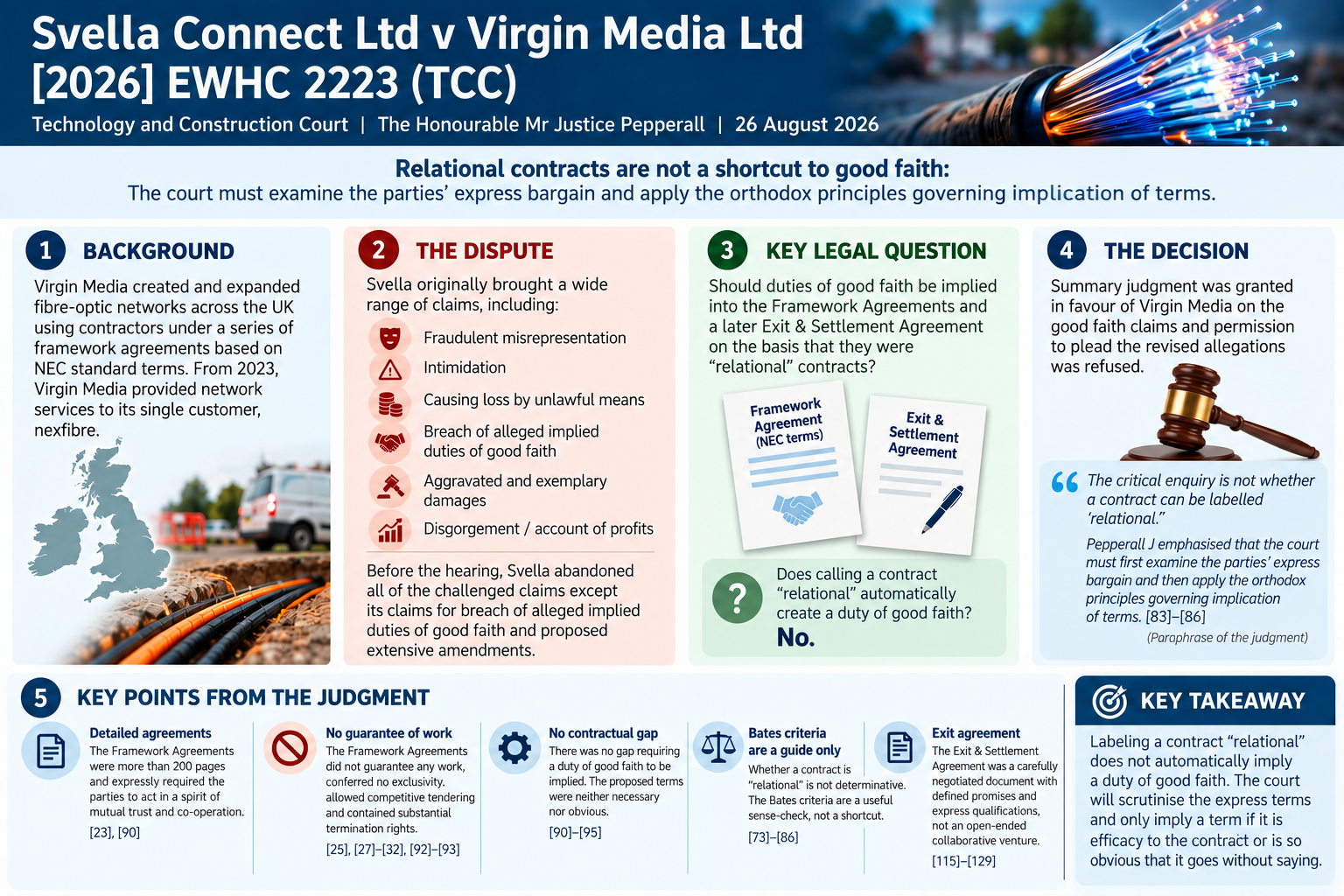
⚖️ Svella Connect Ltd v Virgin Media Ltd [2026] EWHC 2223 (TCC)
Relational Contracts Are Not a Shortcut to Good Faith
Pepperall J has delivered an important TCC judgment on implied good-faith obligations and relational contracts.
The message is refreshingly orthodox.
📌 Key points from the judgment
🔹 Start With the Contract
The first question is not whether the relationship feels “relational”. The court must construe the express bargain and apply the ordinary rules governing implied terms.
🔹 Bates Is a Sense-Check
The nine Bates v Post Office characteristics may help test the nature of the relationship, but they are not a replacement for necessity, business efficacy or obviousness.
🔹 No Gap, No Implied Term
The Framework Agreements ran to more than 200 pages, expressly required mutual trust and co-operation, but also contained no guarantee of work, no exclusivity and extensive provisions governing bidding, performance and termination.
The court found no contractual gap requiring a broader duty of good faith.
🔹 Settlement Agreements Are Different Animals
The Exit & Settlement Agreement was described as a “hard-edged settlement transaction”. It regulated the ending of a troubled relationship rather than creating an open-ended collaborative venture.
🔹 Good Faith Cannot Rewrite the Bargain
If an express term required payment or allocation of work, the express term supplied the remedy.
If it did not, good faith could not manufacture the obligation afterwards.
💬 The practical lesson is simple:
Before pleading good faith, find the contractual gap.
“Relational” is a description, not a magic word.
And where the contract has already answered the question, an implied duty cannot be used as a judicial editing function.
#ConstructionLaw #ContractLaw #GoodFaith #RelationalContracts #TCC #ImpliedTerms #NEC #CommercialLaw #SummaryJudgment #LegalUpdate #CaseLaw #DDAlegal
Nigel Davies BSc(Hons) (Q.Surv), PGCert.Psych, GDipLaw, PGDipLP, DipArb, MSc (Built Environment), LLM (Construction Law & Practice), MSc (Mechanical & Electrical), MSc (Psychology), FRICS, FCIOB, FCInstCES, FCIArb, CArb, GMBPsS, Panel Registered Adjudicator, Mediator, Mediation Advocate, Chartered Builder & Chartered Construction Manager, Chartered Surveyor & Civil Engineering Surveyor, Chartered Arbitrator, Author, and Solicitor-Advocate
Adjudicator Assessor and Re-Assessor for the ICE
ICE DRC Member
ICE DRC CPD Committee Chairman
Adjudicator Exam Question Setter for the ICE
CIArb Adjudication Panel Member since 2006
CIArb Arbitration Panel Member since 2006
CIC Adjudication Panel Member since 2010
FIDIC Adjudication Panel Member since 2021
ICE Adjudication Panel Member since 2021
Law Society Panel Arbitrator
RIBA Adjudication Panel Member since 2018
RICS Adjudication Panel Member since 2006
RICS Dispute Board Registered since 2013
TECSA Adjudication Panel Member since 2012
The information & opinions expressed in this article are not necessarily comprehensive, nor do they represent the trenchant view of the author; in any event, this article does not purport to offer professional advice. This article has been prepared as a summary and is intended for general guidance only. In the case of a specific problem, it is recommended that professional advice be sought.
© 2026 Davies & Davies Associates Ltd
Back to Legal Updates