Taylor Wimpey UK Ltd v Taylor Woodrow Construction & Anor
Pepperall J, 7 October 2026
On the facts of this case, the dismissal of a developer's claim under s.1(1)(a) DPA did not prevent a equitable owner from pursuing an independent claim under s.1(1)(b). Finality attached to the right that had been determined in arbitration, not to every statutory right arising from the same alleged defects. [33]–[35], [46]–[48], [60]–[62]
Key Words
Defective Premises Act 1972 – Building Safety Act 2022 – retrospective limitation – s.135(6) BSA – abuse of process – Henderson v Henderson – collateral attack – Hunter abuse – arbitration – privity of interest – statutory causes of action – equitable owner – assignment – building liability order – strike out – CPR Part 24. [6]–[7], [21]–[64]
- Headnote
- The claimant, Taylor Wimpey UK Ltd ("TWUK"), brought proceedings under s.1(1)(b) of the Defective Premises Act 1972 ("DPA") concerning alleged fire-safety defects at Victoria Wharf, Cardiff, and sought a building liability order under s.130 of the Building Safety Act 2022 ("BSA") against the contractor's parent company. [12]
- An associated company, Taylor Wimpey Developments Ltd (TWDL), had previously pursued arbitration against Taylor Woodrow Construction (Woodrow). Its contractual and DPA claims were dismissed as statute-barred on 12 May 2022. Section 135 BSA subsequently extended limitation for historic s.1 DPA claims to 30 years, but s.135(6) preserved the final determination of TWDL’s claim. Its remaining tort claim was dismissed on 1 March 2024, fundamentally because no concurrent or co-extensive duty of care was owed. [4]–[10]
- Woodrow sought strike out under CPR r.3.4(2)(b), alleging Henderson v Henderson abuse and an impermissible collateral attack upon the arbitral awards. Held, dismissing the application, that TWUK’s statutory cause of action was independent of TWDL’s, there was no relevant privity of interest, and the circumstances did not establish either form of abuse. The court declined to entertain summary judgment without a properly constituted Part 24 application. [21], [33]–[37], [46]–[51], [60]–[64].
- Material Facts
- In or around 2005, TWDL appointed Woodrow to design and build Victoria Wharf, comprising seven high-rise residential buildings in Cardiff. The contracts were executed as deeds. Practical completion occurred between 11 November 2005 and 3 July 2008. [2]
- Following the Grenfell Tower fire, fire-safety defects were identified. A letter before action was sent on 20 October 2020 and a standstill agreement followed, by which time more than twelve years had elapsed since completion of the final phase. [3]
- TWDL commenced arbitration on 2 August 2021, claiming remedial costs in contract, negligence and under the DPA. Chantal-Aimée Doerries QC was appointed arbitrator. TWDL, as contractual employer, was the sole claimant. [4]
- On 12 May 2022, the arbitrator held that the contractual and DPA claims were statute-barred under the law then in force. Section 135 BSA came into force on 28 June 2022, retrospectively extending limitation for old s.1 DPA claims to 30 years. On 27 September 2022, the arbitrator held that s.135(6) prevented TWDL from reviving its finally determined DPA claim. [5]–[7]
- On 22 May 2023, TWDL’s solicitors disclosed an agreement dated 21 December 2007 transferring its UK property development and housebuilding business to TWUK with effect from 1 January 2008. The transfer included an equitable interest in Victoria Wharf and purported to assign rights under certain contracts. No notice of assignment to Woodrow was evidenced. [8]
- TWUK had funded professional and investigatory fees, including the arbitration and separate proceedings against the architects. TWDL nevertheless argued that it had suffered the losses claimed; Woodrow disputed that proposition because TWDL had sold its business and was not undertaking remedial work. [9]
- On 1 March 2024, the arbitrator dismissed the tort claim, principally for want of a concurrent or co-extensive duty of care. She also made findings concerning the design compliance of the external wall systems. The later court judgment recognised that some of those issues might recur in TWUK’s proceedings. [10], [62]–[62.3]
- TWUK issued proceedings on 28 October 2025. Its DPA allegations largely mirrored the arbitration claim concerning external walls, with an additional steelwork claim. TWDL was TWUK’s immediate parent and the companies shared directors. Woodrow relied upon their close relationship, overlapping allegations and common solicitors in seeking strike out. [12]–[16]
- Issues
- Whether TWUK’s independent DPA claim constituted Henderson v Henderson abuse because it could and should have been pursued alongside TWDL’s arbitration claim. [24]–[31], [36]–[37], [47]–[51]
- Whether the corporate relationship and the 2007 transfer agreement established privity of interest sufficient to bind TWUK to the outcome of TWDL’s arbitration. [38]–[46]
- Whether TWUK’s proceedings were an abusive collateral attack upon the arbitral awards, including findings made when determining TWDL’s tort claim. [52]–[62]
- Whether the court should consider arguments for summary disposal of the building liability order claim without a formal Part 24 application. [17], [63]
- Decision
- Woodrow’s application under CPR r.3.4(2)(b) was dismissed. Neither Henderson abuse nor an impermissible collateral attack was established. TWUK's claim was permitted to proceed. [64]
- The court declined to consider summary judgment without a properly constituted Part 24 application. It did not determine substantive DPA liability or grant a building liability order against Vinci. [63]–[64]
- Reasoning
- Independent statutory rights
- Section 1 DPA imposes duties to the person to whose order a dwelling is provided under s.1(1)(a), and to every person acquiring a legal or equitable interest in it under s.1(1)(b). The same defective work may therefore generate independent causes of action for multiple claimants. TWDL’s rights as employer did not exhaust the rights of TWUK or the leaseholders. [32]–[35]
- Applying Rendlesham Estates plc v Barr Ltd, the court explained that the employer and qualifying owners could claim the full cost of necessary repairs, with safeguards against double recovery. There had been no earlier recovery here because TWDL’s claim had been dismissed. [33], [35]
- The limits of the arbitration agreement
- TWDL was contractually bound to arbitrate its DPA dispute. TWUK was not a party to the building contract and had no standing to insist upon joinder or an independent arbitral reference. Without agreements altering that position, TWDL’s route was arbitration and TWUK’s route was litigation. [36]
- TWUK would only sensibly have pursued its independent DPA claim once limitation was extended on 28 June 2022. By then, TWDL’s DPA claim had already been dismissed. Pepperall J considered consent to consolidation in late May or early June 2023 most unlikely: it would have introduced a DPA claim into an imminent evidentiary hearing directed to the surviving tort claim. [37]
- Privity and the transfer agreement
- Gleeson v J Wippell & Co Ltd, Johnson v Gore Wood & Co and Resolution Chemicals Ltd v H Lundbeck A/S required examination of the identity of interests, the relationship between the parties and whether it was just to bind the new party to the earlier outcome. Different corporate personality did not automatically dispose of the question, but shared ownership and directors did not answer it either. [38]–[40]
- The transfer agreement appeared to cover only the contract concerning block 1 because its definition of Business Contracts was confined to contracts unperformed at 1 January 2008. No written notice had been given under s.136 of the Law of Property Act 1925, so any assignment could only operate in equity. [41]–[43]
- The court left undecided whether the assignment of contractual rights extended to TWDL’s statutory DPA claim. A broad dispute resolution clause could encompass such a claim, but it did not necessarily follow that an assignment clause should receive the same construction. [44]
- Even assuming an equitable assignment of the DPA cause of action, the contractual restriction permitted assignment only by way of legal assignment. The equitable assignment was therefore ineffective against Woodrow. More fundamentally, TWUK’s pleaded claim relied upon its own statutory rights as equitable owner, rather than assigned contractual benefits. There was no relevant privity of interest. [45]–[46]
- Henderson abuse
- The burden lay upon Woodrow, and the threshold was high. The question was whether permitting the proceedings would be manifestly unfair or bring the administration of justice into disrepute. The court distinguished the several res judicata principles identified in Virgin Atlantic Airways Ltd v Zodiac Seats UK Ltd; the first four were common ground not to be in play. TWDL remained unable to challenge the dismissal of its own claim. [21]–[25]
- Johnson required a broad merits-based assessment of all the circumstances. A claim that could have been raised earlier was not automatically a claim that should have been raised earlier. MW High Tech Projects UK Ltd v Outotec (USA) Inc supported a generous view of the circumstances considered; Aldi Stores Ltd v WSP Group plc supplied the procedural guidance concerning related proceedings. Culpable conduct was not a prerequisite to abuse. [27]–[31]
- The court gave five reasons for rejecting the application: the plurality of statutory duties; TWUK’s independent claim and the practical limits on pursuing it in arbitration; the limitation-only dismissal of TWDL’s DPA claim; Parliament’s deliberate retrospective extension of limitation; and the continuing independent rights of the leaseholders. [47.1]–[47.5]
- Delay expressly contemplated by Parliament did not justify striking out a claim brought well within the extended period. The arbitration also meant Woodrow had already investigated most of the allegations. Requiring it to meet the merits of TWUK’s claim was not unjust harassment. [47.4], [48]–[51]
- Collateral attack and the tort findings
- Hunter v Chief Constable of the West Midlands Police concerned a collateral attack upon a final decision which the claimant had had a full opportunity to contest. Bragg, Arthur JS Hall & Co v Simons and Mueen-Uddin v Secretary of State for the Home Department explained the public interest in finality and the limits upon striking out a proper invocation of the court’s jurisdiction. [52]–[58]
- Michael Wilson & Partners Ltd v Sinclair established that an arbitral award can found an abuse argument. There is no categorical immunity for subsequent litigation following arbitration, although abuse involving a non-party will be rare and requires careful examination of the circumstances. [59]
- The earlier DPA decisions concerned only TWDL’s limitation position and the statutory protection of its final determination. TWUK challenged neither. Its own statutory claim had not been decided, and the arbitrator had made no findings on the merits of the DPA claim. [60]–[61]
- The court expressly acknowledged possible overlap with the tort findings. Even assuming a collateral challenge, it would not be abusive: Parliament intended to extend residential building liability; the DPA claim had failed on limitation; the tort claim fundamentally failed for want of a duty and focused upon design rather than workmanship and materials; TWUK had no opportunity to contest the arbitration; and apartment owners retained independent DPA rights. [62.1]–[62.5]
- Ratio Decidendi
- On these facts, TWUK’s independent cause of action as equitable owner under s.1(1)(b) DPA was not barred as Henderson abuse by an associated employer company’s unsuccessful arbitration under s.1(1)(a). The relevant circumstances included the absence of a reasonable route for pursuing TWUK’s claim in the arbitration, the limitation-only dismissal of TWDL’s DPA claim, and Parliament’s retrospective extension of limitation. [33]–[37], [47]–[51]
- Privity of interest depended upon the rights and subject matter in dispute, not corporate proximity alone. TWUK’s independent statutory claim as owner was distinct from TWDL’s claim as employer and did not depend upon the purported contractual assignment. [38]–[46]
- A claim which did not challenge the earlier decisions on another claimant’s limitation position was not a collateral attack upon those decisions. Possible overlap with findings in the surviving tort claim did not, in the circumstances, establish manifest unfairness or damage to public confidence in the administration of justice. [60]–[62]
- Disposition
- Application dismissed. TWUK’s DPA claim and its request for a building liability order remained available for determination in the proceedings. The judgment decided the abuse application, not the merits of those claims. [12], [63]–[64]
- Held
- Held, that TWUK was not TWDL’s privy in respect of its independent cause of action under s.1(1)(b) DPA, and that pursuing that right in these circumstances was neither Henderson abuse nor an impermissible collateral attack upon the arbitral awards. [33]–[35], [46]–[51], [60]–[62]
- Held, that Woodrow’s strike-out application was dismissed and the court would not circumvent the procedural requirements for summary judgment. [63]–[64]
Comment
How do you win an arbitration and still find yourself facing a claim about the same allegedly defective buildings?
The same development. Familiar allegations. Closely connected companies. It has all the appearances of a dispute refusing to leave the room. But appearances are where the trouble starts.
Woodrow had successfully resisted TWDL’s DPA claim on limitation grounds. TWUK, however, possessed an independent statutory right as equitable owner. The earlier decision remained intact. Its protective reach simply stopped short of swallowing somebody else’s claim. [33]–[35], [46]–[48], [60]–[62]
The psychological temptation arrives quickly. A victory invites a wonderfully comfortable conclusion: this is finished. Familiar defects, solicitors and corporate connections can then start looking like proof that the next claim must be the old one wearing a different tie.
Ziva Kunda’s work on motivated reasoning explains how a preferred conclusion can influence the arguments we retrieve and the evidence we find persuasive. The brain remains industrious. It merely becomes rather selective about its instructions. Peter Wason’s hypothesis-testing research identifies a related danger: collecting evidence consistent with an explanation can leave its weaknesses undiscovered. More similarities may produce greater confidence without resolving the decisive difference.
That is a warning for anyone analysing the dispute, rather than a diagnosis of the parties. Here, the decisive difference was statutory. TWDL’s cause of action as employer arose under s.1(1)(a) DPA. TWUK relied upon its own right under s.1(1)(b) as equitable owner, rather than an assigned claim belonging to TWDL. The same allegedly defective wall could generate distinct rights. Concrete does not insist upon a single claimant. [32]–[35], [45.3]
The Building Safety Act’s retrospective limitation extension therefore had consequences beyond the claimant that originally pursued proceedings. Section 135(6) preserved TWDL’s finally determined claim. It did not turn that determination into immunity from every independent DPA claim concerning the development. [6]–[7], [25], [47.1]–[47.3]
Nor could TWUK simply have demanded a chair at the arbitration. TWDL was bound to arbitrate; TWUK could not insist upon joinder. Pepperall J considered subsequent consent to consolidation most unlikely and concluded that TWUK’s claim could not reasonably have been pursued there. The absence of relevant privity was also significant. Familiar territory did not establish abuse. [36]–[37], [46]–[48]
The leaseholders’ rights had not evaporated either. Striking out TWUK would still have left individual apartment owners with independent statutory claims—a rather elaborate way of making a dispute disappear by potentially multiplying it. [34]–[35], [47.5], [62.5]
The Court found no abusive collateral attack, even allowing for possible overlap with the later tort findings. TWUK’s claim proceeds. Substantive DPA liability and the requested building liability order against Vinci remain undetermined. [60]–[64]
So how did Woodrow win and still face another claim? It won the limitation argument against TWDL.
The legal trap is to assume that a final determination of one statutory right necessarily determines every statutory right arising from the same defects. On the facts of this case, Pepperall J held that it did not. [33]-[35], [46]-[48], [60]-[62]
#ConstructionLaw #BuildingSafetyAct #DefectivePremisesAct #BuildingSafety #TCC #AbuseOfProcess #Arbitration #Limitation #BuildingLiabilityOrders #TaylorWimpey #LegalUpdate #DDAlegal
Authorities and Materials
The thematic classifications and priorities below are editorial. They are not classifications adopted by the Court. Descriptions are paraphrases. Authorities appearing only within quoted passages are identified separately. No textbook, practitioner work or academic commentary is cited in the judgment.
Case Law:
Abuse and finality
- Henderson v Henderson (1843) 3 Hare 100 — The foundational rule concerning matters which could and should have been advanced in earlier proceedings. [24]–[27]
- Johnson v Gore Wood & Co [2002] 2 AC 1 — The central broad merits-based approach to Henderson abuse and the endorsement of a sufficient identity of interests when considering privity. [27], [39], [58]
- Virgin Atlantic Airways Ltd v Zodiac Seats UK Ltd [2013] UKSC 46, [2014] AC 160— Distinguishes cause of action estoppel, successive claims on the same cause, merger, issue estoppel, Henderson abuse and the general procedural prohibition on abuse. The first four were not in play here. [24]–[25]
- Bragg v Oceanus Mutual Underwriting Assoc (Bermuda) Ltd [1982] 2 Lloyd’s Rep 132 — Burden of establishing abuse; relitigation between different parties is not automatically abusive and does not reverse that burden. [21], [54]
- Calyon v Michailaidis [2009] UKPC 34 — The exacting threshold of manifest unfairness or disrepute to the administration of justice. [21]–[22]
- Michael Wilson & Partners Ltd v Sinclair [2017] EWCA Civ 3, [2017] 1 WLR 2646 — High threshold, assessment of all circumstances, and the possibility of abuse founded upon an arbitral award. Cases involving a non-party require caution. [23], [58]–[59]
- MW High Tech Projects UK Ltd v Outotec (USA) Inc [2024] EWCA Civ 844, [2024] 4 WLR 85— A generous view of the circumstances relevant to the abuse assessment. [28]
- PJSC National Bank Trust v Mints [2022] EWHC 871 (Comm), [2022] 1 WLR 3099 — The potentially relevant distinction between seeking substantive relief and essentially defensive involvement. [29]
- Aldi Stores Ltd v WSP Group plc [2007] EWCA Civ 1260, [2008] 1 WLR 748 — No necessary requirement of culpability; related proceedings should be raised with the court in the relevant commercial litigation circumstances. Woodrow relied upon this guidance, but its application did not establish abuse here. [15], [30]–[31]
- National Crime Agency v Simkus [2016] EWHC 255 (Admin), [2016] 1 WLR 3481 — The observation about never being required to meet a claim’s merits informed the court’s assessment of Woodrow’s position. [49]–[51]
Privity and statutory rights
- Gleeson v J Wippell & Co Ltd [1977] 1 WLR 510 — Sufficient identification between parties, judged by reference to the subject matter, to make it just to bind one to a decision involving the other. [38]–[39]
- Resolution Chemicals Ltd v H Lundbeck A/S [2013] EWCA Civ 924, [2014] RPC 5 — Interest in the earlier subject matter, the reality of the relationship with the earlier party, and the justice of binding the new party. [40]
- Rendlesham Estates plc v Barr Ltd [2014] EWHC 3968 (TCC), [2015] 1 WLR 3663 — Independent rights to repair costs under the DPA and safeguards against double recovery. [33], [35]
- Linden Gardens Trust Ltd v Lenesta Sludge Disposals Ltd [1994] 1 AC 85 — Relied upon when holding that the purported equitable assignment was ineffective against Woodrow given the contractual restriction. [45.2]
Collateral attack
- Hunter v Chief Constable of the West Midlands Police [1982] AC 529 — Collateral attack upon a final decision which the claimant had a full opportunity to contest. [52]–[53]
- Arthur JS Hall & Co v Simons [2002] 1 AC 615 — Public interest underlying Hunter abuse and the limits upon extending finality principles beyond identical parties. [55]
- Mueen-Uddin v Secretary of State for the Home Department [2024] UKSC 21; [2025] AC 945 — Proper use of jurisdiction to protect rights, public confidence in justice, and the requirement of a full opportunity to contest the earlier decision. The Taylor Wimpey judgment refers to this authority using the spelling “Mueed-Uddin”. [56]–[57]
Dispute resolution clauses and assignment
- Fiona Trust & Holding Corp v Privalov [2007] UKHL 40, [2007] 4 All ER 951 — Broad construction of arbitration clauses. That approach did not necessarily determine the scope of the assignment clause. [44]
- BDW Trading Ltd v Ardmore Construction Ltd [2024] EWHC 3235 (TCC) — Cited on the scope of dispute resolution clauses in relation to DPA claims. [44]
- Crest Nicholson Regeneration Ltd v Ardmore Construction Ltd [2026] EWHC 789 (TCC); [2026] TCLR 4 — Also cited on dispute resolution jurisdiction over DPA claims. [44]
Authorities within quoted passages
- Conquer v Boot [1928] 2 KB 336; King v Hoare (1844) 13 M & W 494; Duchess of Kingston’s Case (1776) 20 State Tr 355; Hoysted v Federal Commissioner of Taxation (1921) 29 CLR 537; and Thoday v Thoday [1964] P 181 appear within the Virgin Atlantic explanation of res judicata. [24] The Parakou case [2011] 2 HKLRD 1 and the first-instance judgment of Teare J appear within the Michael Wilson passage on prior arbitration; the judgment does not supply their full case titles there. [59]
Statutory procedural and contractual materials:
- Defective Premises Act 1972, s.1(1)(a) and (b) — Duties to the person ordering the dwelling and to persons acquiring legal or equitable interests; the source of the independent causes of action. [32]–[35]
- Building Safety Act 2022, s.135 and s.135(6); Limitation Act 1980 — Retrospective extension of limitation to 30 years for historic s.1 DPA claims, with preservation of claims already finally determined. [6]–[7], [18], [25], [47.3]–[47.4], [60]
- Building Safety Act 2022, s.130 — TWUK’s requested building liability order against Vinci. Entitlement to such an order was not decided. [12], [17], [63]–[64]
- Law of Property Act 1925, s.136 — Written notice required for the legal assignment considered here. [43]
- Civil Liability (Contribution) Act 1978 — Mentioned in the opening description of the case. Paragraph [20] records the claimant’s argument concerning a potential contribution claim by the architects. The judgment does not separately resolve a substantive contribution claim. [1], [20]
- CPR r.3.4(2)(b) — Power to strike out abuse of process. CPR Part 24, particularly r.24.5 — Procedural machinery which the court declined to circumvent. [21], [63]
- Building contracts, amended clause 18.1.2; transfer agreement dated 21 December 2007, clause 8.1 and definition of Business Contracts — Arbitration obligations, restrictions upon assignment and the scope of the purported transfer. [8], [36], [41]–[45].
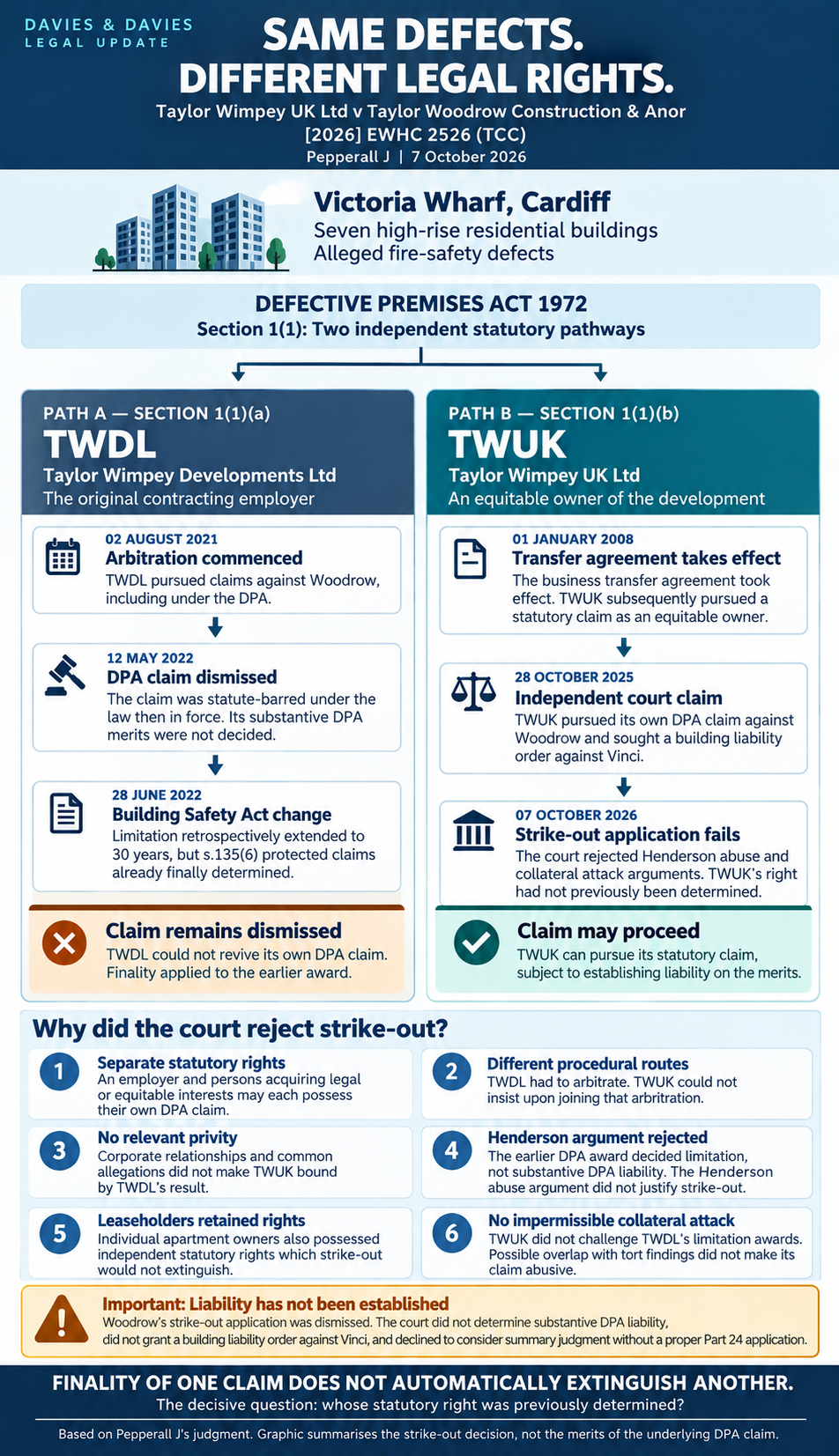
The Building Safety Act Strikes Again: Defeating One DPA Claim Does Not Defeat Them All
Taylor Wimpey UK Ltd v Taylor Woodrow Construction & Anor
[2026] EWHC 2526 (TCC) | Pepperall J | 7 October 2026
A contractor defeats a DPA claim in arbitration. The law changes. Another company in the same corporate group brings proceedings concerning substantially the same alleged defects.
Surely the dispute is over?
Not necessarily. The critical question is whose statutory right was actually determined?
Taylor Wimpey Developments Ltd (TWDL) had its DPA claim against Taylor Woodrow Construction dismissed as time-barred in May 2022. The Building Safety Act 2022 subsequently extended limitation for historic s.1 DPA claims to 30 years, but s.135(6) preserved TWDL's final arbitral determination. [5]–[7]
Taylor Wimpey UK Ltd (TWUK), however, relied upon a separate statutory cause of action as an equitable owner under s.1(1)(b) DPA, rather than an assigned version of TWDL's claim as employer under s.1(1)(a). [32]–[35], [45]–[46]
Woodrow sought strike-out, arguing Henderson v Henderson abuse and an impermissible collateral attack upon the arbitration.
Pepperall J rejected both arguments.
The companies' close corporate relationship did not establish relevant privity of interest. TWUK could not insist upon joining TWDL's arbitration, and its independent claim could not reasonably have been pursued there. Crucially, the earlier DPA claim had failed on limitation, not following a determination of substantive DPA liability. [36]–[37], [46]–[51]
The individual leaseholders also retained independent statutory rights. Striking out TWUK would not have extinguished those potential claims. [47.5], [62.5]
The decision is fact-sensitive. A prior arbitral award can support an abuse argument, and separate corporate personality is not an automatic answer to Henderson. But TWUK was not challenging the determination of TWDL's limitation position. [38]–[40], [59]–[62]
The important qualification: TWUK's claim may proceed, but liability remains to be established. No building liability order was made against Vinci, and the Court declined to entertain summary judgment without a proper CPR Part 24 application. [63]–[64]
The practical lesson?
When considering finality and alleged relitigation, distinguish the underlying defects from the statutory rights arising from them.
The same defects do not necessarily mean the same cause of action.
Finality protects what has been determined. It does not automatically extinguish another claimant's independent statutory right.
#ConstructionLaw #BuildingSafetyAct #DefectivePremisesAct #TCC #AbuseOfProcess #Arbitration #TaylorWimpey #LegalUpdate #DDAlegal
Nigel Davies BSc(Hons) (Q.Surv), PGCert.Psych, GDipLaw, PGDipLP, DipArb, MSc (Built Environment), LLM (Construction Law & Practice), MSc (Mechanical & Electrical), MSc (Psychology), FRICS, FICE, FCIOB, FCInstCES, FCIArb, CArb, GMBPsS, Panel Registered Adjudicator, Mediator, Mediation Advocate, Chartered Builder, Chartered Construction Manager, Chartered Surveyor, Chartered Civil Engineering Surveyor, Chartered Arbitrator, Author, Solicitor-Advocate and PhD Candidate in Experimental Psychology (UCL)
Adjudicator Assessor and Re-Assessor for the ICE
ICE DRC Member
ICE DRC CPD Committee Chairman
Adjudicator Exam Question Setter for the ICE
CIArb Adjudication Panel Member since 2006
CIArb Arbitration Panel Member since 2006
CIC Adjudication Panel Member since 2010
FIDIC Adjudication Panel Member since 2021
ICE Adjudication Panel Member since 2021
Law Society Panel Arbitrator
RIBA Adjudication Panel Member since 2018
RICS Adjudication Panel Member since 2006
RICS Dispute Board Registered since 2013
TECSA Adjudication Panel Member since 2012
The information & opinions expressed in this article are not necessarily comprehensive, nor do they represent the trenchant view of the author; in any event, this article does not purport to offer professional advice. This article has been prepared as a summary and is intended for general guidance only. In the case of a specific problem, it is recommended that professional advice be sought.
© 2026 Davies & Davies Associates Ltd
Back to Legal Updates