Westgreen Construction Ltd v Kiryukhina
Technology and Construction Court, King’s Bench Division
Mrs Justice O’Farrell DBE, 18 August 2026
Key Words
Construction contract – JCT Standard Building Contract Without Quantities 2016 – Advance payments – Interim certificates – Gross valuation – Contractual reimbursement mechanism – Adjudication enforcement – Summary judgment – Excess of jurisdiction – Natural justice – Stay of execution – CPR 83.7 – Pay now, argue later – Contractual interpretation – Course of dealing – Indemnity costs
- Headnote
- The Claimant contractor sought summary judgment to enforce an adjudication decision requiring the Defendant employer to pay £733,062.40 arising from the omission of £650,000 of advance payments from Interim Certificate 25. [1]-[3], [16], [18]-[24], [27]
- The advance payments were expressly governed by clause 4.7 of the Contract Particulars, which provided that reimbursement would occur only upon specified contractual events including agreement and payment of the final account, issue of the final certification regime, or termination under the contractual provisions. [9]-[10]
- The Contract Administrator omitted the advance payments from the gross valuation in Interim Certificate 25, thereby effecting reimbursement of those sums before any contractual condition for repayment had arisen. [15]-[20]
- The Defendant resisted enforcement on the grounds that the adjudicator exceeded his jurisdiction by determining matters relating to the parties' course of dealing and that he committed material breaches of natural justice. [2], [40], [54]-[55]
- The Defendant also sought a stay of execution, contending that repayment of the advance payments would shortly arise through termination and/or the final account process. [3], [64], [69]-[72]
- The court held that the adjudicator decided the dispute referred to him, committed no material breach of natural justice, and was entitled to consider the parties' operation of the contractual mechanism when resolving the dispute. [39]-[53], [57]-[62]
- The court further held that none of the contractual conditions for reimbursement of the advance payments had arisen and that there were no special circumstances justifying a stay of execution. [69]-[73]
- Summary judgment was granted, the stay application was refused, and costs were awarded on an indemnity basis. [63], [74]
- Material Facts
- The parties entered into a JCT Standard Building Contract Without Quantities 2016 Edition with bespoke amendments in relation to refurbishment and construction works at a residential property in St John's Wood, London. [5]-[7]
- The contract sum was £9,989,324.55. [7]
- Clause 4.7 and the Contract Particulars provided for two advance payments totalling £650,000 comprising £350,000 upon appointment and £300,000 at 25% contract duration. [8]-[10]
- The Contract Particulars prescribed an exclusive mechanism for reimbursement of the advance payments upon specified contractual events. [10]
- Following payment, the advance payments were included within interim applications and interim certificates up to and including Interim Application 22. [12]
- In May 2025 the Contract Administrator sought to amend the contract retrospectively to permit recovery of the advance payments through interim valuations before agreement of the final account. [13]
- The Claimant refused to agree to any such amendment. [14]
- By Interim Certificate 25 dated 25 March 2026 both advance payments had been omitted from the gross valuation, resulting in reimbursement of the £650,000 to the Defendant. [16]
- The Claimant commenced adjudication, asserting that none of the contractual conditions for reimbursement had occurred and that the advance payments should have remained within the gross valuation. [18]-[21]
- The adjudicator determined that £733,062.40 was due to the Claimant and ordered payment accordingly. [24]
- Issues
- Whether the adjudicator exceeded his jurisdiction by considering the parties' course of dealing and treatment of advance payments under earlier interim certificates. [40]-[45]
- Whether the adjudicator committed a material breach of natural justice by considering breach of clause 4.7 and alleged matters said to have been introduced for the first time in the Claimant's Reply. [54]-[61]
- Whether the Claimant was entitled to summary judgment enforcing the adjudication decision. [63]
- Whether execution of the judgment should be stayed pursuant to CPR 83.7(1). [64]-[73]
- Decision
- The adjudicator did not exceed his jurisdiction. [53]
- There was no material breach of natural justice. [62]
- The Claimant was entitled to summary judgment enforcing the adjudication decision. [63]
- The Defendant failed to establish any special circumstances warranting a stay of execution. [68]-[73]
- The application for a stay of execution was refused. [73]-[74(ii)]
- The Defendant was ordered to pay the Claimant's costs on an indemnity basis. [74(iii)]
- Reasoning
- The court reaffirmed that adjudication enforcement proceedings were governed by the well-established principles stated in Carillion v Devonport Royal Dockyard, namely that adjudicators' decisions should ordinarily be enforced notwithstanding errors of fact, law, or procedure. [32]-[33]
- Applying Cantillon Ltd v Urvasco Ltd, the court held that an adjudicator was entitled to consider any evidence, argument, or material advanced by the parties in resolving the dispute referred. [35], [39]
- The essential dispute concerned whether the advance payments should have been included in the gross valuation for Interim Certificate 25. [39]
- Evidence concerning the inclusion of the advance payments in previous interim certificates formed part of the Claimant's Referral and was common ground between the parties. [41]
- The Defendant herself relied upon evidence concerning the parties' intention and operation of the advance payment mechanism. [43], [45]
- The adjudicator was therefore entitled to consider both the contractual wording and the practical operation of the contract when resolving the dispute. [47]-[52]
- In relation to natural justice, the court accepted that the adjudicator's observations regarding breach of clause 4.7 went beyond what was strictly necessary to determine the dispute. [57]
- However, both parties had been invited to make submissions on the relevant authority and had been afforded an opportunity to address the issue. [56], [58]
- The finding of breach did not form part of the substantive relief awarded and gave rise to no damages award. [58]
- The alleged new argument based on previous interim certificates was not new because it had been advanced in the Referral. [44], [61]
- The Defendant had adequate opportunities through both the Response and Rejoinder to address those matters. [45], [60]-[61]
- The stay application failed because there was no suggestion that the Claimant was insolvent, unable to repay, or at risk of dissipating assets. [68]
- The court held that clause 4.7 expressly prescribed the contractual circumstances in which the advance payments would be reimbursed, and that none of those contractual triggers had been satisfied. [69]-[70], [73]
- The final account remained unresolved and any future entitlement to reimbursement was contingent rather than accrued. [70]-[71]
- The court distinguished JPA v Sentosa because there was no evidence of insolvency risk and no evidence that the Claimant had delayed the final account process. [72]
- Ratio Decidendi
- An adjudicator did not exceed jurisdiction by considering evidence relating to the parties' operation of a contractual mechanism where such evidence formed part of the material advanced by the parties in support of their respective cases on the dispute referred. [35], [39], [41]-[53]
- A finding or observation that was not necessary to determine the dispute did not constitute a material breach of natural justice where the parties had been given an opportunity to make submissions on the issue, the finding formed no part of the operative relief awarded, and no prejudice resulted. [56]-[58]
- Where a contract expressly prescribes the conditions for reimbursement of advance payments, those conditions cannot be bypassed through interim certification before they have occurred. [10], [49]-[50], [69]-[70]
- A stay of execution following adjudication enforcement would not ordinarily be granted where there was no insolvency risk, no dissipation risk, and no accrued contractual entitlement to immediate reimbursement. [66]-[73]
- Disposition
- The Claimant succeeded on its application for summary judgment. [63], [74(i)]
- The adjudicator's decision was enforced in the sum of £650,000 together with VAT of £43,615, the adjudicator's fee of £19,866, accrued interest of £2,493.12, and continuing daily interest. [74(i)]
- The Defendant failed on the jurisdiction challenge. [53], [63]
- The Defendant failed on the natural justice challenge. [62]-[63]
- The Defendant failed on the application for a stay of execution. [73]-[74(ii)]
- The Defendant was ordered to pay the Claimant's costs on an indemnity basis. [74(iii)]
- Held
- Held, that the adjudicator decided the dispute referred to him and did not exceed his jurisdiction by considering the parties' course of dealing relating to the treatment of advance payments in earlier interim certificates. [41]-[53]
- Held, that no material breach of natural justice occurred because the parties had adequate opportunities to address the relevant issues and the matters complained of did not affect the substantive relief awarded. [56]-[62]
- Held, that the contractual mechanism governing reimbursement of the £650,000 advance payments had not been triggered and therefore the omission of those sums from the gross valuation was not contractually justified. [10], [16], [19], [49]-[50]
- Held, that the Defendant failed to establish any special circumstances for the purposes of CPR 83.7. [65]-[73]
- Held, that summary judgment enforcing the adjudicator's decision was granted. [63], [74(i)]
- Held, that the application for a stay of execution was refused. [73], [74(ii)]
- Held, that the Defendant was liable for the Claimant's costs on the indemnity basis. [74(iii)]
Comment
Westgreen Construction Ltd v Kiryukhina [2026] EWHC 2189 (TCC) is a brisk reminder that adjudication enforcement is not an invitation to rerun the adjudication wearing a different wig. The TCC’s starting point remains uncompromising: an adjudicator’s decision is to be enforced unless the jurisdictional defect is plain or the procedure obviously unfair. Mere disagreement, even disagreement dressed in the ceremonial robes of “jurisdiction” and “natural justice”, does not acquire supernatural powers simply by being repeated in the High Court.
The central contractual point was equally unforgiving. Clause 4.7 prescribed when the £650,000 advance payments could be reimbursed. None of those events had occurred. The Contract Administrator had previously tried to secure agreement to an earlier clawback mechanism; Westgreen declined. Yet Interim Certificate 25 subsequently achieved, by arithmetic, what had not been achieved by agreement: the £650,000 disappeared from the gross valuation. The court rejected that approach because it was inconsistent with the agreed contractual mechanism governing reimbursement of the advance payments. [49]-[50], [69]-[73]
The jurisdiction challenge fared no better. The dispute was whether the advance payments had wrongly been omitted from Interim Certificate 25. In deciding that dispute, the adjudicator was entitled to examine the contract, the parties’ arguments and the way the payment machinery had actually been operated. That was not an excursion beyond jurisdiction; it was the job. The earlier certificates were already in play, the parties themselves had relied upon their dealings and intentions, and the adjudicator decided the dispute referred to him by reference to material they had put before him.
Natural justice then arrived, but without much luggage. O’Farrell J accepted that the adjudicator had gone somewhat further than necessary when characterising the premature reimbursement as a breach of clause 4.7. That observation, however, went nowhere operative: the parties had been invited to address the point, no damages were awarded for the breach, and it formed no part of the relief granted. Likewise, the supposedly “new” reliance on earlier certificates was not new at all; it had appeared in the Referral, and the defendant had ample opportunity to answer it. A fair opportunity to respond is what natural justice requires. It does not guarantee a favourable response from the tribunal afterwards.
The stay application completed the hat-trick. There was no insolvency risk, no dissipation risk and, most importantly, no presently accrued contractual entitlement to repayment of the advance payments. Common-law termination did not activate clause 4.7, the final account remained unresolved, and the second adjudication—helpful though it might be—had not somehow transformed an interim valuation into a final account. The money might become repayable later. “Might later” is not the same thing as “is now”, a distinction occasionally troublesome in litigation but devastatingly simple in English.
Accordingly, Westgreen obtained summary judgment enforcing the adjudicator’s decision for £650,000, together with £43,615 VAT, the £19,866 adjudicator’s fee, accrued interest of £2,493.12, continuing interest at £155.82 per day, and indemnity costs. The stay was refused. The broader ratio of the decision was that evidence relating to the operation of a contractual mechanism could properly be considered where it formed part of the parties' arguments on the dispute referred, and that agreed contractual reimbursement machinery could not be displaced by interim certification before the contractual conditions for repayment had arisen. [35], [39], [41]-[53], [49]-[50], [69]-[73]
The practical lesson is therefore pleasingly brutal. Read the clause. Obey the clause. And if an adjudicator applies the clause in a way you dislike, “jurisdiction” is not a magic word that makes £650,000 disappear. The adjudication regime remains deliberately impatient with attempts to convert ordinary complaints about reasoning into exceptional grounds for non-enforcement. Pay now, argue later is not merely a slogan attached to the statutory scheme. In Westgreen, it was the difference between an enforceable award and an expensive attempt to persuade the TCC that the contractual machinery produced a result rather different from the one its express terms appeared to prescribe.
#ConstructionLaw #Adjudication #TCC #JCTContract #SummaryJudgment #AdvancePayments #ContractLaw #LegalPrecedent #WestgreenvKiryukhina #UKLaw #LegalUpdate #CaseLaw #DDAlegal
Authorities and Materials
The thematic classifications, descriptions and prioritisation below are editorial. They are not labels or rankings adopted by the Court, and the summaries are paraphrases rather than quotations unless expressly indicated. The list is confined to authorities and materials referred to in the judgment and is not intended to be exhaustive of the relevant law.
Case Law:
Adjudication Enforcement, Jurisdiction and Natural Justice — Primary Theme
- Carillion Construction Ltd v Devonport Royal Dockyard Ltd [2005] EWHC 778 (TCC); [2005] EWCA Civ 1358 — The court adopted the well-established enforcement principles summarised in Carillion. The principle relied upon was that adjudicators’ decisions should be enforced even where they contain errors of fact, law or procedure, save where there has been an excess of jurisdiction or serious/material breach of natural justice. The Court of Appeal authority was relied upon for the proposition that resistance to enforcement should succeed only in rare cases where the adjudicator decided a question not referred or acted in an obviously unfair manner. [32]-[33]
- Cantillon Ltd v Urvasco Ltd [2008] EWHC 282 (TCC) — This was the central authority relied upon in relation to both jurisdiction and natural justice. The court relied upon Cantillon for the proposition that a dispute referred to adjudication includes any defence available to the responding party and that an adjudicator may consider any evidence, argument or material deployed by the parties in resolving the dispute. The court also relied upon Cantillon for the test of a material breach of natural justice and the principle that there is no breach where parties have had a fair opportunity to address a point. [35]-[36], [39], [56]
- McAlpine PPS Pipeline Systems Joint Venture v Transco plc [2004] EWHC 2030 (TCC) — The court referred to McAlpine v Transco for the principles governing identification of the dispute referred to adjudication and the distinction between deciding the dispute referred and deciding a different dispute. [34]
- JPA Design and Build Ltd v Sentosa (UK) Ltd [2009] EWHC 2312 (TCC) — The court considered JPA v Sentosa in two contexts. First, the authority had been raised during the adjudication and formed part of the natural justice challenge. Secondly, it was relied upon by the Defendant in support of a stay application. The court distinguished the case because it involved insolvency concerns and delay in progressing the final account, neither of which existed here. [56], [72]
- KNS Industrial Services (Birmingham) Ltd v Sindall Ltd [2000] EWHC Technology 75; [2001] 75 Con LR 71 — Referred to within the quotation from Cantillon as authority supporting the proposition that all grounds of defence available to a responding party fall within the scope of the referred dispute. [35]
Stay of Execution and Adjudication Enforcement — Secondary Theme
- Wimbledon Construction Company 2000 Ltd v Vago [2005] EWHC 1086 — This was the principal authority governing the stay application. The court relied upon Wimbledon v Vago for the principles that adjudication produces a temporary but enforceable result, that the successful party should generally not be kept out of its money, and that inability to repay or other special circumstances may justify a stay, subject to the established qualifications. [66]
- Gosvenor London Ltd v Aygun Aluminium UK Ltd [2018] EWCA Civ 2695 — The court relied upon Gosvenor for the additional principle that a stay may be justified where there is a real risk of dissipation of the adjudication sum. [67]
- AWG Construction Services v Rockingham Motor Speedway [2004] EWHC 888 — Referred to within the quoted principles from Wimbledon v Vago for the proposition that the court must approach stay applications having regard to the policy favouring prompt enforcement of adjudicators’ decisions. [66]
- Herschell Engineering Limited v Breen Property Limited (unreported, 28th July 2000) — Referred to within Wimbledon v Vago for the proposition that probable inability to repay may amount to special circumstances warranting a stay and that a stay will not usually be granted where the claimant’s financial position is substantially unchanged from the position that existed when the contract was entered into. [66]
- Bouygues (UK) Ltd v Dahl-Jensen (UK) Ltd [2000] EWCA Civ 50 — Referred to within Wimbledon v Vago for the principle that a stay will usually be granted where a claimant is in insolvent liquidation or indisputably insolvent. [66]
- Rainford House Limited v Cadogan Limited (unreported, 13.2.01) — Referred to alongside Bouygues in relation to the grant of stays where insolvency is established. [66]
- Absolute Rentals v Glencor Enterprises Limited (unreported, 16.1.00) — Referred to within Wimbledon v Vago for the principle that a stay will not usually be justified where the claimant’s financial position has been caused, wholly or substantially, by the defendant’s failure to pay sums awarded. [66]
Construction Adjudication and Arbitration Authorities Referred to within Cantillon / Carillion — Background Theme
- Amec Civil Engineering Ltd v Secretary of State for Transport [2005] EWCA Civ 291; [2005] BLR 227 — Referred to within Cantillon as authority concerning the meaning and identification of a dispute. [35]
- Collins (Contractors) Ltd v Baltic Quay Management (1994) Ltd [2004] EWCA Civ 1757 — Referred to within Cantillon concerning the identification and crystallisation of disputes. [35]
- Balfour Beatty Construction Ltd v London Borough of Lambeth [2002] EWHC 597 (TCC) — Referred to within Cantillon as an example of circumstances in which an adjudicator decides a case on a basis not advanced by either party. [36]
- Discain Project Services Limited v Opecprime Development Limited [2000] BLR 402; [2001] EWHC Technology 435 — Referred to in the Carillion summary as authority recognising that adjudication decisions will not be enforced where jurisdiction has been exceeded or natural justice materially breached. [32]
- Pegram Shopfitters Limited v Tally Weijl (UK) Limited [2003] EWCA Civ 1750; [2004], 1 All ER 818 — Referred to within Carillion in relation to jurisdictional excesses and serious breaches of natural justice. [32]
- Amec Capital Projects Limited v Whitefriars City Estates Limited [2004] EWCA Civ 1418; [2005] BLR 1 — Referred to within Carillion as authority demonstrating that errors of fact, law or procedure do not ordinarily justify refusal of enforcement. [32]
- C&B Scene Concept Design Limited v Isobars Limited [2002] EWCA Civ 46; [2002] Building Law Reports 93 — Referred to within Carillion as authority supporting enforcement notwithstanding adjudicative errors. [32]
- Levolux AT Limited v Ferson Contractors Limited [2003] EWCA Civ 11; 86 Construction Law Reports 98 — Referred to within Carillion as authority supporting enforcement notwithstanding adjudicative errors. [32]
Procedural Rules and Contractual Materials
Enforcement of Judgments and Stays — Primary Theme
- Civil Procedure Rules, CPR 83.7(1) — The court applied CPR 83.7(1), which empowers the court to stay execution of a money judgment where special circumstances render enforcement inexpedient or where the applicant is unable to pay the judgment debt. [3], [64]-[65]
Contractual Termination and Reimbursement Machinery — Secondary Theme
- JCT Standard Building Contract Without Quantities 2016 (Clause 4.7 and Contract Particulars) — Although contractual rather than statutory, the provisions prescribed the contractual circumstances in which the advance payments were to be reimbursed. The contractual conditions for reimbursement had not occurred. [8]-[10], [49]-[50], [69]-[73]
- JCT Standard Building Contract Without Quantities 2016 (Clause 4.14) — The court considered clause 4.14 as part of the parties’ competing arguments regarding the composition of the gross valuation and whether advance payments formed part of the interim certification mechanism. [11], [39], [42], [44], [48]-[50]
- JCT Standard Building Contract Without Quantities 2016 (Clause 8.12) — The court referred to clause 8.12 because clause 4.7 contemplated reimbursement of the advance payments following termination under the contractual termination machinery and subsequent valuation. [10]
Legal Texts and Commentary:
No legal text, textbook, practitioner work, academic commentary or comparable secondary source is cited in the judgment. The court’s legal analysis proceeds principally from the contractual provisions, CPR 83.7 and the authorities identified above. [32]-[73]
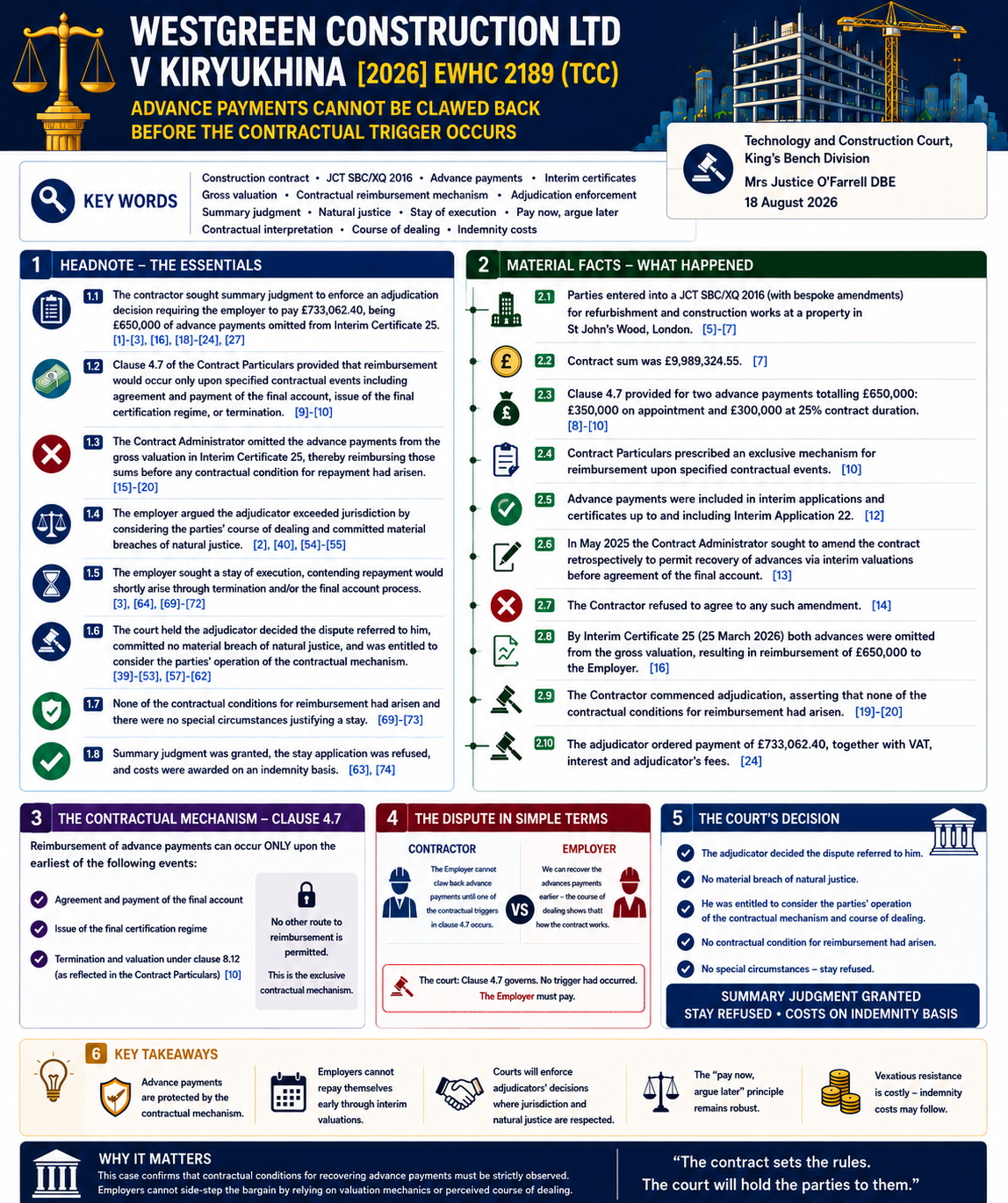
🏗️ Westgreen Construction Ltd v Kiryukhina [2026] EWHC 2189 (TCC)
Advance Payments Cannot Be Clawed Back Before the Contractual Trigger Occurs
Mrs Justice O'Farrell DBE enforced an adjudicator's decision arising from the premature clawback of £650,000 in advance payments under a JCT Standard Building Contract Without Quantities 2016.
The case ultimately turned on a straightforward contractual point. Clause 4.7 specified the circumstances in which those advance payments could be reimbursed. None of those contractual triggers had occurred. The Contract Administrator nevertheless omitted the advance payments from Interim Certificate 25, effectively clawing them back before the contract permitted reimbursement.
📌 Key points from the judgment
🔹 The Contractual Trigger Governs
Where a contract expressly prescribes the conditions for reimbursement of advance payments, those conditions cannot be bypassed through interim certification.
🔹 No Jurisdictional Excess
The adjudicator was entitled to consider the contractual wording, earlier certificates and the parties' operation of the contractual payment mechanism when deciding the dispute referred.
🔹 No Material Breach of Natural Justice
The parties had a fair opportunity to address the relevant issues, and no material breach of natural justice arose.
🔹 No Stay of Execution
There was no insolvency risk, no dissipation risk, and no presently accrued entitlement to repayment. A future repayment claim was not enough.
🔹 Pay Now, Argue Later
Summary judgment was granted. The stay was refused. The claimant recovered the £650,000 together with VAT, interest, the adjudicator's fee and indemnity costs.
🧠 The court applied established authorities including Carillion v Devonport Royal Dockyard, Cantillon v Urvasco, Wimbledon v Vago and JPA v Sentosa.
💬 The practical lesson is simple:
A repayment right does not arise because one party wishes it had arisen. It arises when the contract says it arises.
Where parties have expressly agreed the circumstances in which advance payments may be reimbursed, those contractual triggers cannot be sidestepped through interim certification.
Read the clause. Obey the clause.
#ConstructionLaw #Adjudication #TCC #JCTContract #AdvancePayments #SummaryJudgment #NaturalJustice #Jurisdiction #PayNowArgueLater #LegalUpdate #CaseLaw #DDAlegal
Nigel Davies BSc(Hons) (Q.Surv), PGCert.Psych, GDipLaw, PGDipLP, DipArb, MSc (Built Environment), LLM (Construction Law & Practice), MSc (Mechanical & Electrical), MSc (Psychology), FRICS, FCIOB, FCInstCES, FCIArb, CArb, GMBPsS, Panel Registered Adjudicator, Mediator, Mediation Advocate, Chartered Builder & Chartered Construction Manager, Chartered Surveyor & Civil Engineering Surveyor, Chartered Arbitrator, Author, and Solicitor-Advocate
Adjudicator Assessor and Re-Assessor for the ICE
ICE DRC Member
ICE DRC CPD Committee Chairman
Adjudicator Exam Question Setter for the ICE
CIArb Adjudication Panel Member since 2006
CIArb Arbitration Panel Member since 2006
CIC Adjudication Panel Member since 2010
FIDIC Adjudication Panel Member since 2021
ICE Adjudication Panel Member since 2021
Law Society Panel Arbitrator
RIBA Adjudication Panel Member since 2018
RICS Adjudication Panel Member since 2006
RICS Dispute Board Registered since 2013
TECSA Adjudication Panel Member since 2012
The information & opinions expressed in this article are not necessarily comprehensive, nor do they represent the trenchant view of the author; in any event, this article does not purport to offer professional advice. This article has been prepared as a summary and is intended for general guidance only. In the case of a specific problem, it is recommended that professional advice be sought.
© 2026 Davies & Davies Associates Ltd
Back to Legal Updates