Scot Frame Timber Engineering Ltd v JAT Construction Ltd
[2026] EWHC 2892 (TCC) | HHJ Kelly, 11 November 2026
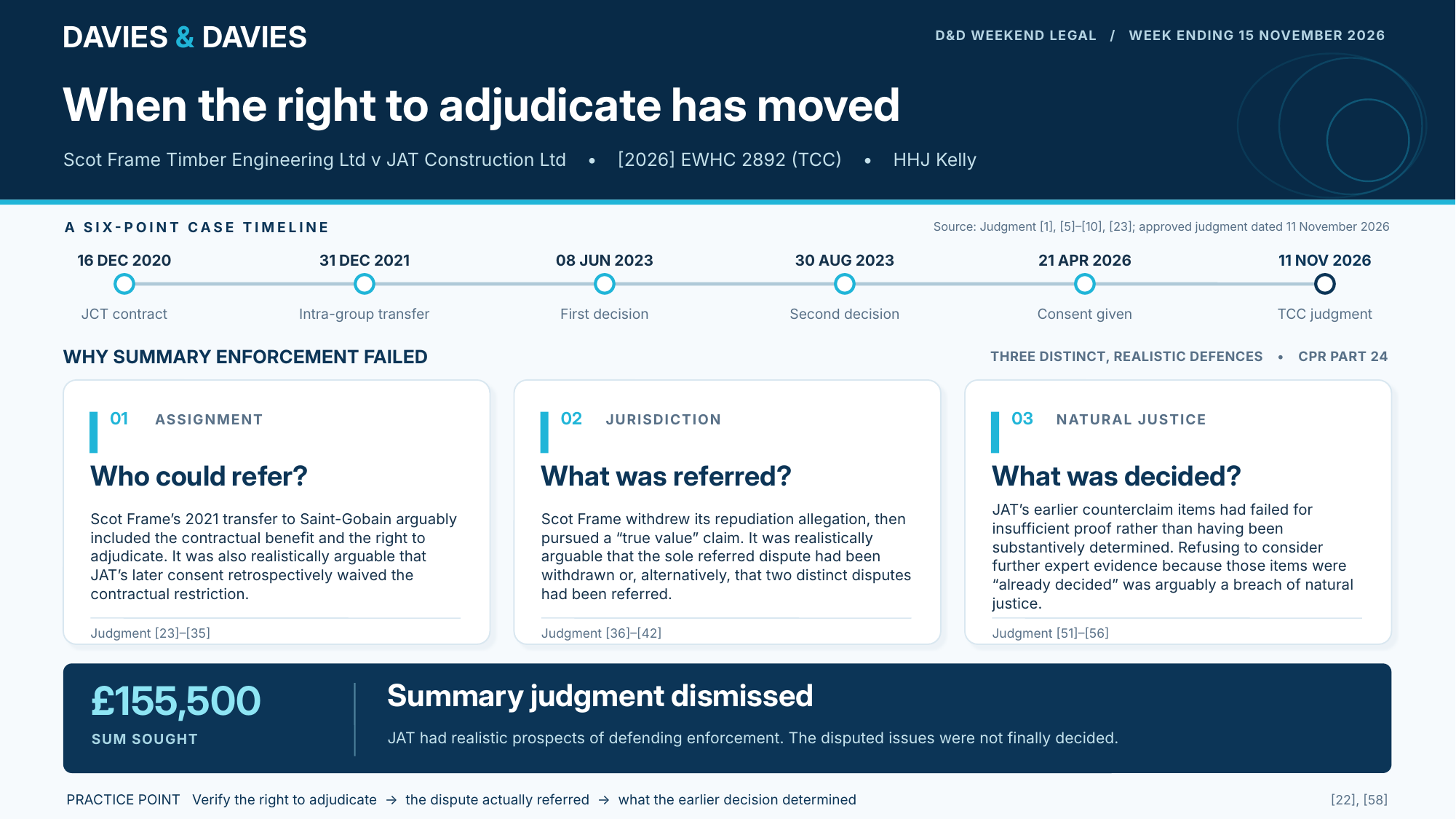
An adjudicator’s decision might determine the amount payable between parties but its enforceability still depended upon the referring party’s entitlement to adjudicate, the scope of the dispute referred and the proper identification of matters previously decided. [16]–[17], [22]–[42], [46]–[56]
In Scot Frame Timber Engineering Ltd v JAT Construction Ltd, the Technology and Construction Court refused summary enforcement of two adjudication decisions after concluding that JAT had realistic prospects of establishing (i) that the contractual right to adjudicate had been assigned before the references commenced, (ii) that the adjudicator lacked jurisdiction to make the First Decision, and (iii) that the Second Decision had been made in material breach of natural justice. [22]–[35], [42], [52]–[58]
The judgment was particularly significant for its treatment of retrospective consent to assignment, the jurisdictional consequences of withdrawing the central basis upon which a dispute had been referred, and the distinction between a claim substantively determined and one which had failed for insufficient evidence. [23]–[42], [51]–[56]
Importantly, the Court decided that JAT had realistic prospects of establishing those defences to enforcement and did not finally determine their ultimate merits. [22]
Key Words
Construction adjudication – Summary enforcement – CPR Part 24 – Assignment of contractual benefit – Equitable assignment – Right to adjudicate – Law of Property Act 1925, s.136 – Anti-assignment clause – Retrospective consent – Retrospective waiver – One dispute – Multiple disputes – Withdrawal of repudiation allegation – True-value claim – Payment Notice – Pay Less Notice – Previous adjudication – Further expert evidence – Natural justice – Adjudicator’s fees – Jurisdictional reservation – Stay of execution. [14]–[20]
- Headnote
- Scot Frame Timber Engineering Ltd (“Scot Frame”) sought summary judgment enforcing two decisions made by the adjudicator on 8 June and 30 August 2023 respectively, arising from a JCT Minor Works Building Contract 2016 with contractor’s design. JAT Construction Ltd (“JAT”) resisted enforcement on grounds concerning assignment, the jurisdiction of the adjudicator in the First Adjudication and the exclusion of evidence in the Second Adjudication. [1]–[2], [5]–[9]
- The assignment issue arose from an Intra Group Business Sale/Purchase Agreement dated 31 December 2021 between Scot Frame and Saint-Gobain Construction Products UK Ltd (“Saint-Gobain”). JAT argued that the benefit of the construction contract, including the right to adjudicate, had passed to Saint-Gobain before either reference. Clause 3.1 of the Contract prohibited assignment without the other contracting party’s consent, and JAT subsequently gave written retrospective consent to the assignment on 21 April 2026. [10]–[13], [23]–[35]
- HHJ Kelly dismissed the application for summary judgment. JAT had a realistic prospect of establishing that the contractual benefit had been assigned in equity before the adjudications and that JAT had been entitled retrospectively to waive Scot Frame’s non-compliance with the anti-assignment provision. [22]–[35]
- JAT also had a realistic prospect of establishing that the adjudicator lacked jurisdiction to make the First Decision because either the single dispute founded upon JAT’s alleged repudiatory breach had been withdrawn or more than one dispute had been referred. [36]–[42]
- JAT’s payment of its share of the adjudicator’s fees did not conclusively establish waiver of its jurisdictional objection because the correspondence, considered as a whole, disclosed a realistically arguable reservation concerning liability for the principal sum. [43]–[45]
- JAT further had a realistic prospect of successfully arguing that the adjudicator had acted in breach of natural justice by refusing to consider further expert evidence upon the basis that the relevant counterclaim items had already been considered and rejected in the First Adjudication. [52]–[56]
- None of the assignment, jurisdiction or natural-justice defences was finally determined because the Court’s task under CPR Part 24 had been confined to deciding whether JAT had realistic prospects of successfully defending enforcement. [14]–[16], [22], [58].
- Material Facts
- JAT engaged Scot Frame to design, supply and erect timber-frame structure works at a site near Penmaenmawr in North Wales. The parties entered into a JCT Minor Works Building Contract 2016 with contractor’s design on or around 16 December 2020. [5], [9]
- By March 2021, the parties’ relationship had deteriorated. Scot Frame alleged that JAT had refused it entry to the site and had thereby committed a material and repudiatory breach of the Contract, whereas JAT maintained that Scot Frame’s works had been defective and incomplete and that Scot Frame had itself been in repudiatory breach. [5]
- On 31 December 2021, Scot Frame entered into an Intra Group Business Sale/Purchase Agreement with Saint-Gobain, both companies being wholly owned subsidiaries of Compagnie de Saint-Gobain. [10]
- The Agreement provided for Saint-Gobain to acquire Scot Frame’s business as a going concern, together with contracts, book debts, claims, general assets and other choses in action relating to the business. [13]
- The Agreement also contained machinery dealing with contracts or rights which could not effectively be transferred without third-party agreement or novation, including obligations to procure assignment or novation and, in certain circumstances, to hold the benefit of the relevant contract or right on trust for Saint-Gobain. [13]
- Scot Frame’s accounts subsequently recorded that its trade and assets had been transferred to Saint-Gobain on 31 December 2021, that Scot Frame had become dormant and that its balance-sheet assets had reduced from £11.1 million to £50,000. [34]–[35]
- Scot Frame commenced the First Adjudication on 6 April 2023. Its Referral sought declarations concerning JAT’s alleged repudiation, the value of the works and the resulting sum due. [6], [36]
- During the First Adjudication, Scot Frame withdrew its allegation that JAT had repudiated the Contract and stated that it was content for the adjudicator to determine the case upon a true-value basis. JAT immediately challenged jurisdiction because the claim had proceeded as a damages claim but was thereafter being presented as a payment claim. [37]
- The adjudicator proceeded to determine the value of the works and issued the First Decision on 8 June 2023. He valued the works at £402,500, identified £155,500 as outstanding after previous payments, and allowed JAT deductions of £23,824.94 based upon concessions made by Scot Frame. [6]
- Following the First Decision, Scot Frame sought payment of £155,500. Paragraph [7] of the judgment records that Scot Frame issued a Notice to Pay on 4 July 2023 and that JAT served a Pay Less Notice on 7 July 2023, stating that the sum due was nil by reference to counterclaims and deductions which it had failed to establish in the First Adjudication. [7]
- The parties' agreed facts, reproduced at paragraph [9] of the judgment, separately record that Scot Frame issued a Payment Notice on 7 July 2023 and that JAT issued a Pay Less Notice on the same date. The judgment therefore contains an apparent inconsistency concerning the date of Scot Frame's payment notice. That discrepancy is noted without attempting to resolve it, since the Court did not determine the enforcement application by reference to the difference between those dates. [7], [9], [49], [58]
- Scot Frame commenced the Second Adjudication on 7 August 2023 and relied upon the First Decision in asserting an entitlement to £155,500. [8]–[9]
- The adjudicator determined that the Payment Notice and Pay Less Notice were valid and that the amount stated in the Pay Less Notice was sufficiently clear. [49]
- JAT relied upon the Pay Less Notice to assert that nothing was payable because it was entitled to withhold £207,307.28, and it asked the adjudicator to determine the quality and true value of Scot Frame’s works in light of what it described as new and substantiated evidence. [48]
- The adjudicator declined to consider the further expert evidence of Mr Bunton and Mr Gibb because he considered that the underlying matters had already been considered and rejected in the First Adjudication. [8], [54]
- JAT reimbursed its share of the adjudicator’s fees on 4 October 2023. Scot Frame argued that this payment had waived JAT’s jurisdictional objection to the First Decision. [9], [43]–[45]
- The correspondence concerning the fees nevertheless recorded that JAT remained considering its position concerning the principal sum. [44]
- (Editorial note: The judgment identifies one of JAT's experts as “Mr Gibb” at paragraph [8] and “Mr Gibbs” at paragraph [54]. The analysis uses “Mr Gibb” consistently, following the earlier identification. The variation in the judgment does not affect the legal issues considered.)
- Issues
- Had Scot Frame assigned the Contract and the associated right to adjudicate to Saint-Gobain before the two references and, if so, when had that assignment taken effect? [20], [23]–[35]
- Had the First Adjudication involved a single dispute founded upon repudiation which Scot Frame subsequently withdrew, or had the reference impermissibly contained more than one distinct dispute? [20], [36]–[42]
- Had the adjudicator possessed jurisdiction to proceed to determine a freestanding true-value claim in the First Adjudication? [20], [36]–[42]
- Had JAT waived its jurisdictional objection by reimbursing its share of the adjudicator’s fees? [43]–[45]
- Had the potential jurisdictional defect affecting the First Decision automatically deprived the adjudicator of jurisdiction in the Second Adjudication? [20], [46]
- Had the adjudicator wrongly treated counterclaim items which had failed for insufficient proof as matters previously determined upon their merits and thereby refused to consider material evidence in breach of natural justice? [20], [47]–[56]
- Would a stay of execution have been appropriate if enforcement had succeeded? [20], [57]
- Decision
- The application for summary judgment was dismissed. [58]
- The Court emphasised that JAT had been required to establish realistic prospects of successfully defending the claim and that its findings did not constitute final determinations of the underlying issues. [22]
- It was realistically arguable that the Contract, sums due under it and the associated right to adjudicate had been assigned to Saint-Gobain on 31 December 2021. [23]–[29]
- It was separately realistically arguable that clause 3.1 operated for JAT’s benefit as obligor and that JAT had been entitled retrospectively to waive Scot Frame’s non-compliance with the contractual restriction upon assignment. [30]–[33]
- It was realistically arguable that the adjudicator lacked jurisdiction to make the First Decision because either the sole repudiation dispute had been withdrawn or the reference contained both a repudiation dispute and a separate freestanding payment valuation dispute. [36]–[42]
- JAT’s reimbursement of the adjudicator’s fees did not conclusively establish waiver because, when the correspondence was considered as a whole, JAT had a realistic answer to Scot Frame’s election argument. [43]–[45]
- The possible jurisdictional defect affecting the First Decision did not automatically affect jurisdiction in the Second Adjudication. [46]
- JAT nevertheless had a realistic prospect of establishing a material breach of natural justice because the adjudicator had disregarded its further expert evidence upon a potentially mistaken understanding of what had actually been determined in the First Decision. [51]–[56]
- No separate hearing concerning a stay was required because neither adjudication decision had been enforced. [57]
- Reasoning
- The enforcement threshold
- CPR Part 24 required JAT to establish a realistic rather than fanciful prospect of successfully defending the enforcement claim. [14]–[15]
- A realistic defence had to carry some degree of conviction and had to amount to more than a merely arguable case. [15]
- The ordinary policy favoured prompt enforcement of adjudicators’ decisions notwithstanding errors of fact or law within jurisdiction, subject principally to a realistic prospect of establishing an excess of jurisdiction or a material breach of natural justice. [16]
- An adjudicator’s answer to the right question remained binding notwithstanding error, whereas an answer to a question outside the adjudicator’s jurisdiction could render the decision unenforceable. [16]
- The Court expressly qualified its conclusions by stating that its findings concerned realistic prospects of defending the claim and were not final determinations of the underlying disputes. [22]
- The refusal of summary judgment therefore established neither that Scot Frame had conclusively lost title to adjudicate nor that either adjudication decision had finally been shown to be invalid. [22], [58]
- Assignment: title to adjudicate travels with the benefit
- The Court proceeded upon the principle that assignment of the benefit of a contract included assignment of the associated right to adjudicate. [17]
- Section 136 of the Law of Property Act 1925 prescribed requirements for a legal assignment, including notice to the other contracting party, but the absence of notice did not necessarily prevent the contractual benefit from passing in equity. [17], [26]–[27]
- Two analytically distinct questions therefore arose. The first concerned whether the Intra Group Business Sale/Purchase Agreement had been capable of effecting an equitable transfer of Scot Frame’s rights on 31 December 2021, and the second concerned the legal effect of clause 3.1 and JAT’s subsequent retrospective waiver of non-compliance with that provision. [12]–[13], [23]–[33]
- As to the first question, the Court considered it realistically arguable that the Contract had been assigned on 31 December 2021. [28]–[29]
- The Contract and money owed under it constituted assets, while the ability to adjudicate constituted a chose in action falling within the terms of the intra-group Agreement. [29]
- The absence of notice to JAT did not itself prevent an assignment from taking effect in equity. The relevant distinction was between the requirements necessary to perfect a legal assignment under section 136 and the possibility that the contractual benefit had already passed in equity. [26]–[29]
- Clause 3.1 raised a separate contractual obstacle because Scot Frame had agreed not to assign the Contract or rights under it without JAT’s consent. [12], [30]
- The intra-group Agreement had required Scot Frame to seek the necessary consent, but Scot Frame had not done so. [13], [30]
- HHJ Kelly considered it realistically arguable that Scot Frame could not rely upon its own failure to request consent as rendering an otherwise valid assignment a nullity. [30]
- The Court further considered it realistically arguable that clause 3.1 operated, in relation to Scot Frame’s proposed assignment, for the benefit of JAT as obligor. [31]–[32]
- Although clause 3.1 referred to both parties, it could arguably be regarded as containing two reciprocal unilateral protections because only the party whose counterparty proposed to assign would require the protection of the clause on any particular occasion. [31]–[32]
- On that analysis, it was realistically arguable that JAT had been entitled retrospectively to waive Scot Frame’s non-compliance and to enforce the Contract as though the restriction had been omitted. [31]–[32]
- JAT’s written consent dated 21 April 2026 therefore raised a question distinct from whether an equitable transfer had occurred in 2021: the issue was whether JAT could retrospectively waive the contractual restriction with which Scot Frame had not complied when the earlier transfer occurred. [23]–[33]
- The Court also rejected Scot Frame’s contention that the Contract had been incapable of assignment merely because consent had not been obtained. The Contract had been capable of assignment, although it had not been assigned at law when consent had not been sought. [33]
- The financial evidence supported the underlying transfer analysis because Scot Frame’s accounts recorded the transfer of its trade and assets to Saint-Gobain on 31 December 2021, its subsequent dormancy and a substantial reduction in its assets. [34]–[35]
- The Court did not finally determine either that an effective assignment had occurred on 31 December 2021 or that retrospective waiver conclusively resolved the effect of clause 3.1. It determined that JAT had a realistic prospect of establishing the assignment defence and that the matter therefore could not be disposed of summarily against it. [22]–[35]
- The First Adjudication: identifying the dispute actually referred
- The Notice and Referral placed JAT’s alleged repudiation, valuation at termination and consequential monetary relief together. [36], [41]
- During the First Adjudication, Scot Frame abandoned its repudiation allegation and stated that it was content for the adjudicator to determine the case upon a true-value basis. [37]
- The adjudicator identified difficulty in reconciling the changed position with the relief sought in the Notice and Referral, while JAT immediately challenged jurisdiction and invited the adjudicator to resign. [37]–[41]
- The Court accepted that adjudicators were to be afforded latitude and that the question of what had been referred was not to be approached in an unduly restrictive or overly legalistic manner. [16], [42]
- Nevertheless, it was realistically arguable that the dispute as framed throughout had concerned JAT’s alleged repudiation of the Contract by refusing Scot Frame entry to the site. [39]–[42]
- If the reference constituted one dispute for relief arising from repudiatory breach, withdrawal of that allegation arguably removed the dispute upon which the adjudicator’s jurisdiction rested. [42]
- Alternatively, if the Notice and Referral had also contained a separate freestanding payment valuation dispute, it was realistically arguable that more than one dispute had been referred. [42]
- On either analysis, JAT had a realistic prospect of establishing that the adjudicator lacked jurisdiction to make the First Decision. [22], [42]
- Paying fees: conduct must be read as a whole
- A party which paid an adjudicator’s fees without reserving its jurisdictional position could waive its objection and elect to treat the resulting decision as valid and enforceable. [16]
- Scot Frame relied upon correspondence in which JAT had proposed to make payment “as per the Adjudicator’s Decision”. [43]
- In the subsequent correspondence concerning the invoice, however, JAT’s representative stated that JAT remained considering its position in respect of the principal sum. [44]
- HHJ Kelly declined to treat the fee-payment language in isolation and held that, when the correspondence was considered as a whole, JAT had a realistically arguable answer to the allegation that it had waived its jurisdictional objection. [45]
- The payment of the fees did not therefore conclusively amount to an unequivocal acceptance of substantive liability under the First Decision. [45]
- As a matter of practice, the issue demonstrated the advantage of maintaining an express contemporaneous reservation whenever adjudicator’s fees were paid notwithstanding a continuing jurisdictional objection. [43]–[45]
- The Second Adjudication: what was actually decided first time?
- The potential jurisdictional defect affecting the First Decision did not automatically invalidate or deprive the adjudicator of jurisdiction in the Second Adjudication. [46]
- The Second Adjudication therefore required separate analysis, including consideration of the extent to which the First Decision had resolved matters which JAT sought to advance under its later Pay Less Notice. [46]–[50]
- The Court’s statement of the applicable law relied upon Prater Ltd v John Sisk & Son (Holdings) Ltd for the proposition that the first decision remained binding unless successfully challenged, but that a successful challenge to the first decision would not automatically render the second decision a nullity. [16]
- The Court referred to Hitachi Zosen Inova AG v John Sisk & Son Ltd for the requirement to focus intently upon what the first adjudicator had decided and for the proposition that an adjudicator could reject a valuation for want of adequate evidence without precluding valuation of the same work under a subsequent application supported by better evidence. [16]
- The Court also relied upon Sudlows Ltd v Global Switch Estates 1 Ltd for the fact-sensitive enquiry into whether the same or substantially the same dispute had been referred and for the suggested test of whether the later adjudication could produce a result fundamentally incompatible with that reached in the earlier adjudication. [16]
- Those authorities required the Court to distinguish between impermissibly reopening something actually determined and advancing a later dispute which did not impinge upon the earlier determination. [16]
- The Second Adjudication concerned Scot Frame’s entitlement to payment and JAT’s reliance upon deductions advanced through a valid Pay Less Notice. [47]–[50]
- JAT contended that £207,307.28 was deductible and asked the adjudicator to determine the quality and true value of Scot Frame’s work in light of what it described as new and substantiated evidence. [48]
- The adjudicator accepted the validity of the Payment Notice and Pay Less Notice but treated the First Decision as preventing reconsideration of matters advanced through JAT’s counterclaim. [49]–[52]
- The critical question was not merely whether the same subject matter had appeared in the First Adjudication, but what the First Decision had actually determined. [16], [51]–[56]
- In the First Decision, the adjudicator had considered that several counterclaim items appeared likely to be valid but had concluded that JAT had failed adequately to establish the relevant contractual case, causation and evidence of loss. [51]
- Save where Scot Frame had made concessions, the adjudicator had not substantively determined those counterclaim items against JAT. He had instead determined that insufficient evidence had been presented to establish them in the First Adjudication. [55]–[56]
- The binding effect of an earlier adjudication decision had to be identified by reference to what that adjudicator had actually decided. It did not necessarily follow that every contention advanced, every item mentioned or every claim unsuccessfully pursued had been substantively determined for the purposes of a subsequent adjudication. The relevant enquiry required identification of the particular issue decided and the extent to which the later reference concerned the same or substantially the same dispute. [16], [51]–[56]
- The distinction between substantive rejection and evidential insufficiency was important, but it was not conclusive in isolation. The production of further or improved evidence did not, merely by itself, entitle a party to reopen a dispute which had already been determined. Conversely, where an earlier decision established only that a claim had not been sufficiently proved upon the evidence then available, a later dispute, particularly one arising under a subsequent payment application, might properly permit consideration of materially improved evidence without contradicting the earlier determination. [16], [51]–[56]
- The significance of Hitachi Zosen, Prater and Sudlows lay in the requirement to identify the precise scope and binding effect of the earlier decision. The controlling question was not simply whether the subject matter or underlying factual allegations overlapped, but whether the later adjudication sought a determination fundamentally incompatible with something actually decided in the earlier adjudication. That enquiry remained one of substance, fact and degree. [16]
- In the present case, HHJ Kelly considered it realistically arguable that the First Decision had not substantively determined JAT's disputed counterclaim items against it, but had instead found that the evidential case then advanced was insufficient. The adjudicator's subsequent refusal to consider further expert evidence upon the footing that those items had already been determined therefore arguably attributed a wider preclusive effect to the First Decision than its actual findings justified. [51]–[56]
- Stay of execution
- CPR 83.7 permitted the Court to stay execution where special circumstances rendered enforcement inexpedient or the applicant lacked the ability to pay. [18]
- The authorities also recognised that a claimant’s probable inability to repay the judgment sum following final determination could constitute special circumstances, subject to consideration of whether its financial position had materially changed since the contract was made. [19]
- The parties agreed that any issue concerning a stay could be addressed when judgment was handed down. [57]
- No separate determination became necessary because the adjudication decisions had not been enforced. [57]
- Ratio Decidendi: Principles Governing Summary Enforcement
- The ratio of the judgment was conditioned by the application before the Court. Under CPR Part 24, HHJ Kelly was required to determine whether JAT had a realistic prospect of successfully defending enforcement and was not required finally to adjudicate the merits of the assignment, jurisdictional and natural-justice defences. [14]–[16], [22]
- The decisive holding was that JAT had demonstrated realistic defences sufficient to prevent summary enforcement of the two adjudication decisions. [22]–[35], [42]–[45], [52]–[58]
- For that purpose, it was realistically arguable that the contractual benefit, including the associated right to adjudicate, had passed to Saint-Gobain by equitable assignment before either adjudication had commenced. [23]–[29]
- It was separately realistically arguable that the contractual restriction upon assignment did not defeat that case because clause 3.1 operated for JAT’s benefit as obligor and JAT could therefore waive Scot Frame’s non-compliance retrospectively. [30]–[33]
- It was also realistically arguable that the adjudicator lacked jurisdiction to make the First Decision because either the single dispute founded upon JAT’s alleged repudiatory breach had been withdrawn or the reference had contained more than one distinct dispute. [36]–[42]
- JAT’s payment of its share of the adjudicator’s fees did not eliminate that realistic jurisdictional defence where the correspondence, considered as a whole, remained capable of showing that JAT had not unequivocally accepted liability under the substantive award. [43]–[45]
- The possible want of jurisdiction affecting the First Decision did not automatically invalidate the Second Decision, which required separate jurisdictional and natural-justice analysis. [46]
- The existence and extent of any binding effect arising from the First Decision depended upon identifying what the adjudicator had actually determined, rather than merely identifying claims or subject matters previously advanced before him. [16], [51]–[56]
- Where counterclaim items had previously failed because they had not been sufficiently proved, rather than because their underlying merits had been substantively determined adversely to JAT, the refusal to consider material further evidence supporting those items in the later adjudication gave rise to a realistic defence based upon breach of natural justice. [51]–[56]
- Those propositions were sufficient to defeat summary enforcement but were not final determinations that the assignment had been effective, that the First Decision had been made without jurisdiction or that the Second Decision had been made in breach of natural justice. [22], [58]
- Disposition
- Scot Frame’s application for summary judgment to enforce the First and Second Decisions was dismissed. [58]
- The issue of a stay of execution was not separately determined because the adjudication decisions had not been enforced. [57]
- The disputed questions concerning assignment, jurisdiction, waiver and natural justice remained unresolved beyond the Court’s conclusion that they afforded JAT realistic prospects of defending summary enforcement. [22], [58]
- Held
- Held, that JAT had a realistic prospect of establishing that Scot Frame had assigned the benefit of the Contract, including the associated right to adjudicate, to Saint-Gobain before either adjudication had commenced. [23]–[35]
- Held, that the absence of the notice required to perfect a legal assignment did not prevent an assignment from taking effect in equity. [26]–[29]
- Held, that it was realistically arguable that clause 3.1 operated for JAT’s benefit as obligor and that JAT could therefore retrospectively waive Scot Frame’s non-compliance with the prohibition upon assignment without consent. [30]–[33]
- Held, that JAT had a realistic prospect of establishing that the adjudicator lacked jurisdiction to make the First Decision because either the single repudiation dispute had been withdrawn or more than one dispute had been referred. [36]–[42]
- Held, that JAT’s reimbursement of its share of the adjudicator’s fees did not conclusively waive its jurisdictional objection when the relevant correspondence was considered in its entirety. [43]–[45]
- Held, that the possible jurisdictional defect affecting the First Decision did not automatically deprive the adjudicator of jurisdiction in the Second Adjudication. [46]
- Held, that JAT had a realistic prospect of establishing a material breach of natural justice where further expert evidence supporting its valid Pay Less Notice had been excluded upon the basis that the counterclaim items had already been decided, when those items had previously failed for want of sufficient proof rather than having been substantively determined against JAT. [49]–[56]
- Held, that Scot Frame was not entitled to summary judgment and that its application was dismissed. [58]
Comment
Two Decisions, One Assignment: When Adjudication’s Foundations Shift
£155,500 was claimed and two adjudications had been completed, but neither decision was summarily enforced. The immediate difficulty was not principally the arithmetic; it was whether Scot Frame still held the right to adjudicate, what dispute had actually been referred and what the First Adjudication had actually decided. [6]–[8], [23]–[35], [42], [52]–[58]
There were three distinct traps.
The first was corporate. An intra-group business transfer could affect title to contractual rights notwithstanding that the original contracting company continued to exist. Here, the Court considered it realistically arguable that the Contract, money due under it and the associated right to adjudicate had passed to Saint-Gobain before the adjudications commenced. [23]–[35]
HHJ Kelly did not decide conclusively that those rights had passed. She decided that JAT’s case had at least a realistic prospect of succeeding. [22]–[35]
The practical warning was nevertheless clear. Before serving a notice of adjudication, a referring party which had undergone a sale, transfer or intra-group reorganisation needed to verify that it continued to hold the relevant contractual chose in action and associated right to adjudicate.
The second trap was jurisdictional. A referring party might regard repudiation, valuation and payment as alternative routes towards recovery of substantially the same sum, but those routes were not necessarily interchangeable for jurisdictional purposes. The Notice of Adjudication and Referral remained central to identifying the dispute which the adjudicator had been appointed to determine. [16], [36]–[42]
The change of position during the First Adjudication exposed that difficulty. Scot Frame withdrew its repudiation allegation while continuing to pursue a true-value determination. The resulting question was whether it had merely narrowed a constituent element of the dispute already referred or had removed the jurisdictional foundation of that dispute and sought determination of another. [37]–[42]
The third trap was evidential. A claim could fail because its substantive merits had been determined adversely or because the evidence presented had been insufficient to establish it. Those outcomes might produce the same immediate payment result, but their implications for a subsequent adjudication could be materially different. [51], [55]–[56]
The First Adjudicator had not determined that every alleged defect and item of loss was substantively unfounded. He had considered that several items appeared likely to be valid but had identified deficiencies in JAT’s proof of contractual basis, causation and loss. [51], [55]–[56]
In the Second Adjudication, further expert evidence sought to address those deficiencies. By treating the underlying matters as already determined, the adjudicator arguably excluded a defence which had not previously been substantively decided. [52]–[56]
Adjudicative finality and decision classification
The distinctive feature of the case was the relationship between decision finality and decision classification. Before deciding whether an earlier adjudication prevented consideration of a matter in a later adjudication, it was necessary to identify precisely what kind of finding the earlier adjudicator had made. [16], [51]–[56]
That distinction could become obscured because an unsuccessful claim produced the same immediate result whether it had been rejected on its substantive merits or merely not proved. In either case, the claimant received nothing, but the legal consequences for a subsequent adjudication could differ materially. [51], [55]–[56]
The Second Adjudication therefore required careful classification. Was the adjudicator being asked to decide again something which had already been decided, or was he being asked to determine a claim which had previously failed because the necessary evidential case had not been made out? [50]–[56]
This was consistent with the authorities collected in the judgment. Prater established that a possible defect in the First Decision did not automatically invalidate the Second Decision. Hitachi Zosen required close attention to what had actually been decided and recognised that a claim which had failed for want of adequate valuation evidence might properly be advanced under a subsequent application with better evidence. Sudlows required a fact-sensitive assessment of whether the later dispute impinged upon the first decision or could produce a result fundamentally incompatible with it. [16]
The legal safeguard was analytical specificity. Rather than asking whether “the defects”, “the counterclaim” or “the deductions” had previously appeared before an adjudicator, the relevant enquiry was narrower: what proposition had actually been determined, upon what evidential basis, and with what consequence for the subsequent dispute? [16], [51]–[56]
Behavioural commentary
The distinction between an issue substantively determined and one not established upon the evidence also provides a useful point of connection between adjudication and the psychology of judgment and decision-making.
The difficulty is not necessarily that decision-makers consciously disregard information or refuse to reconsider earlier conclusions. A useful analytical question arises when a complex earlier determination is represented by a simplified category.
An adjudicator may determine that a counterclaim has not been established because the evidence is insufficient to demonstrate contractual breach, causation or loss. For the immediate purposes of the decision, the practical result is that the counterclaim fails.
But the description “counterclaim rejected” does not necessarily preserve the full reasoning which produced that outcome.
It may conceal a distinction between a substantive finding that the counterclaim is unfounded and a finding that the party bearing the burden of proof has not discharged it upon the available evidence.
That distinction may become important when the same underlying matters arise in a subsequent adjudication.
The psychological literature offers two relevant conceptual analogies.
Anchoring describes the tendency for an initial reference point to influence subsequent judgment. Tversky and Kahneman's research (1974) provides a foundational account of this phenomenon. Applied as an analytical analogy, an earlier classification of a claim as “rejected” might become a reference point for evaluating whether later evidence should be considered.
Belief perseverance concerns the persistence of an established interpretation despite the introduction of information which might justify reconsideration. Anderson, Lepper and Ross (1980) examined how explanatory beliefs could persist even after their original evidential foundations had been discredited.
Neither phenomenon is established merely because an adjudicator treats an earlier decision as binding. Nor does the present judgment demonstrate that the adjudicator was affected by either.
HHJ Kelly made no findings concerning cognitive bias, anchoring, belief perseverance or the psychological processes of any participant. Her reasoning concerned the legal consequences of the adjudicator's treatment of the First Decision and his refusal to consider further evidence. [51]–[56]
The behavioural concepts are therefore editorial analogies, not explanations of the adjudicator's actual cognition.
The broader analytical concern is that the process of summarising an earlier decision can remove information essential to determining its subsequent legal effect.
An earlier finding may be described as “rejected”, “not proved”, “valued at nil” or “not determined”. Those descriptions may sometimes produce similar immediate financial consequences, but they are not necessarily interchangeable for the purposes of adjudicative finality.
The safeguard is to preserve the distinction between the outcome of a decision and the reasoning which defines its scope.
For adjudicators, that means identifying expressly whether a claim or item has been:
Rejected upon its substantive merits;
- Valued at nil upon the evidence available;
- Not established because the evidential burden has not been discharged; or
- Left undecided.
Those categories require careful application to the actual reasons given and the dispute referred; they are not substitutes for analysing the decision itself.
For parties and advisers, the corresponding lesson is that the mere appearance of an issue in an earlier adjudication does not conclusively establish that it has been substantively determined.
The legal question is not simply whether the earlier adjudicator considered the subject matter, but what the adjudicator actually decided and whether the later dispute seeks to reopen that determination. [16], [51]–[56]
Practical implications
Parties undertaking intra-group reorganisations should verify title to contractual claims before commencing adjudication because assignment of the contractual benefit could carry the right to adjudicate with it. [17], [23]–[35]
Referring parties should formulate the Notice of Adjudication around one identifiable dispute and should exercise caution before withdrawing a central factual or legal premise upon which the referred claim had been constructed. [16], [36]–[42]
A party maintaining a jurisdictional objection while paying adjudicator’s fees should reserve its position expressly and contemporaneously rather than relying upon the Court subsequently to infer its reservation from the wider correspondence. [43]–[45]
Before relying upon an earlier decision to prevent consideration of a later defence or claim, parties and adjudicators should identify the precise proposition determined and distinguish substantive rejection from evidential failure. [16], [51]–[56]
Conclusion
Scot Frame v JAT Construction concerned the boundaries of summary enforcement rather than any departure from the ordinary policy that adjudicators’ decisions should be enforced promptly. JAT succeeded at this stage because its objections crossed the CPR Part 24 threshold and represented realistic defences rather than fanciful attempts to avoid enforcement. [14]–[16], [22], [58]
The judgment exposed three matters which had to remain analytically separate: ownership of the right to adjudicate, jurisdiction over the dispute actually referred, and the binding effect of matters actually determined in an earlier adjudication. [17], [23]–[42], [46]–[56]
An adjudication decision validly made within jurisdiction would ordinarily bind the parties on an interim basis unless and until the dispute was finally determined by litigation, arbitration or agreement. [16], [19]
That temporary binding effect did not answer the logically prior questions whether the referring party possessed the relevant right to adjudicate, whether the adjudicator had remained within the jurisdiction conferred by the reference, or what propositions the earlier decision had actually determined. [17], [23]–[42], [46]–[56]
The lesson from Scot Frame was not that adjudication lacked temporary finality. It was that the binding effect of an adjudication decision had to be understood by reference to the adjudicator’s jurisdiction and, where an earlier decision was relied upon in a later adjudication, by identifying precisely what that earlier decision had actually determined. [16], [42], [46], [51]–[56]
#ConstructionLaw #ConstructionAdjudication #TCC #Assignment #NaturalJustice #AdjudicationEnforcement #DDAlegal
Authorities and Materials
The headings below are editorial classifications; they are not classifications adopted by the Court.
- Case law
- Assignment of contractual benefit, equitable assignment and retrospective waiver
- Paragon Group Ltd v FK Facades Ltd [2026] EWHC 78 (TCC) – Assignment of the benefit of a construction contract includes assignment of the associated right to adjudicate. The principle was central to JAT's contention that Scot Frame had transferred its entitlement to refer disputes to adjudication to Saint-Gobain before either adjudication commenced. [17], [23]–[29]
- Musst Holdings Ltd v Astra Asset Management UK Ltd [2023] EWCA Civ 128 – A contractual prohibition upon assignment without consent may operate for the benefit of the party entitled to withhold that consent. Where the relevant provision protects that party's interests, the beneficiary may waive non-compliance retrospectively. The Court relied upon this principle when considering whether JAT could retrospectively waive Scot Frame's failure to obtain consent under clause 3.1 of the Contract. HHJ Kelly referred specifically to paragraphs [83]–[86] of Falk LJ's judgment. [17], [30]–[33]
- Linden Gardens Trust Ltd v Lenesta Sludge Disposals Ltd and others [1994] 1 AC 85 – Cited in the Court's discussion of the requirements for an effective legal assignment and contractual restrictions upon assignment. HHJ Kelly distinguished the absence of the notice required for a legal assignment under section 136 of the Law of Property Act 1925 from the possibility that the contractual benefit had nevertheless passed in equity. The equitable-assignment proposition was separately supported by the contractual commentary cited in the judgment. [17], [26]–[29]
- Previous adjudication decisions, temporary finality and the same or substantially the same dispute
- Hitachi Zosen Inova AG v John Sisk & Son Ltd [2019] EWHC 495 (TCC) – The enquiry into the binding effect of an earlier adjudication must focus intently upon what the first adjudicator actually decided. An adjudicator may determine that the evidence supporting a particular interim payment application is insufficient to establish a valuation without thereby deciding that no value could become payable under a subsequent application. A later adjudication concerning the valuation of the same work, arising from a subsequent application supported by improved evidence, may therefore fall within jurisdiction. This distinction was particularly material to JAT's contention that the First Decision had rejected its counterclaim items for insufficient proof rather than substantively determining their underlying merits. [16], [51]–[56]
- Sudlows Ltd v Global Switch Estates 1 Ltd [2023] EWCA Civ 813; [2023] 1 CLC 932 – Whether a subsequent adjudication concerns the same or substantially the same dispute as an earlier adjudication is a question of fact and degree requiring a flexible and substantive assessment. A relevant, although not invariably decisive, consideration is whether the later adjudication could produce a result fundamentally incompatible with the earlier decision. HHJ Kelly cited Coulson LJ's formulation at paragraph [59], emphasising the importance of determining whether the later reference sought something diametrically opposed to what had previously been decided. [16]
- Prater Ltd v John Sisk & Son (Holdings) Ltd [2021] EWHC 1113 (TCC); 196 ConLR 207 – An adjudicator's earlier decision remains binding upon the parties unless and until successfully challenged before the Court. However, a successful jurisdictional challenge to the first decision does not automatically establish that a subsequent adjudication decision is also a nullity. HHJ Kelly applied this distinction when recognising that the possible absence of jurisdiction in the First Adjudication did not automatically deprive the adjudicator of jurisdiction in the Second Adjudication. [16], [46]
- Natural justice and the obligation to consider material defences
- Pilon Ltd v Breyer Group plc [2010] EWHC 837 (TCC) – An adjudicator's failure or refusal to consider matters and evidence advanced by the responding party as a defence may constitute a breach of natural justice. Although determining the legal and factual validity of a defence ordinarily falls within the adjudicator's jurisdiction, declining to consider that defence upon the mistaken premise that it has already been determined raises a different question. The principle was relevant to the adjudicator's refusal to consider JAT's further expert evidence in the Second Adjudication. [16], [52]–[56]
- Quietfield Ltd v Vascroft Contractors Ltd [2006] EWCA Civ 1737; [2007] BLR 67 – Cited alongside Pilon in support of the distinction between determining a defence adversely to the responding party and failing to consider the defence at all. The Court relied upon the principle that failure to address material matters or evidence relied upon by a responding party, including refusal upon an erroneous understanding of an earlier adjudication, may constitute a breach of natural justice. Any such breach must be material to justify resistance to enforcement. [16], [52]–[56]
- Adjudication jurisdiction, identification of the referred dispute and severance
- Witney Town Council v Beam Construction (Cheltenham) Ltd [2011] EWHC 2332 (TCC); [2011] BLR 707; 139 ConLR 1 – The identification of the dispute referred to adjudication requires a commonsense approach rather than an unduly restrictive or overly legalistic interpretation of the Notice of Adjudication. A single dispute may comprise several constituent elements, but where the applicable procedure permits referral of only one dispute, two separate and distinct disputes cannot validly be referred together. HHJ Kelly relied upon these principles when considering whether Scot Frame's original reference comprised one repudiation-based dispute or two separate disputes involving repudiation and a freestanding true-value payment claim. [16], [36]–[42]
- Flexidig Ltd v M&M Contractors (Europe) Ltd [2020] EWHC 847 (TCC) – The Court should adopt a practical and commonsense approach when identifying the matters referred to adjudication and afford adjudicators appropriate latitude in interpreting the scope of the dispute. The authority was relevant to the Court's assessment of Scot Frame's Notice and Referral, although that latitude did not eliminate the realistically arguable jurisdictional objection arising from the subsequent withdrawal of the repudiation allegation. [16], [42]
- AECOM Design Build Ltd v Staptina Engineering Services Ltd [2017] EWHC 723 (TCC) – The adjudicator's jurisdiction is principally derived from the construction contract and the Notice of Adjudication, which defines the dispute referred. However, the ambit of the reference may be widened by the nature of the defence or defences advanced by the responding party. The judgment cited this principle as part of the governing framework for identifying the permissible scope of an adjudicator's determination. [16]
- Cantillon Ltd v Urvasco Ltd [2008] EWHC 282 (TCC) – Where a single dispute has been referred to adjudication, a valid jurisdictional or natural-justice objection affecting the decision may prevent severance of individual parts of that decision. The Court cited Akenhead J's analysis at paragraphs [60]–[78] for the proposition that, in those circumstances, the decision is either valid and enforceable or invalid and unenforceable. [16]
- Summary judgment, adjudication enforcement and the limits of judicial intervention
- Easyair Ltd v Opal Telecom Ltd [2009] EWHC 339 (Ch) – The principles governing summary judgment require the Court to distinguish between a defence with a realistic prospect of success and one which is merely fanciful. A realistic defence must carry some degree of conviction and amount to more than a merely arguable case. HHJ Kelly adopted this framework when assessing whether JAT had established sufficient grounds to resist summary enforcement of the adjudication decisions. [15], [22]
- Swain v Hillman [1999] EWCA Civ 3053; [2001] 2 All ER 91 – Cited through the summary judgment principles set out in Easyair for the requirement that the party resisting summary judgment demonstrate a realistic rather than fanciful prospect of success. The principle informed the threshold applied to JAT's assignment, jurisdictional and natural-justice defences. [15], [22]
- ED&F Man Liquid Products Ltd v Patel [2003] EWCA Civ 472 – A realistic defence must carry some degree of conviction and must be more than merely arguable. The Court cited this authority through Easyair when identifying the standard which JAT had to satisfy to defeat Scot Frame's application for summary judgment. [15], [22]
- Bouygues UK Ltd v Dahl-Jensen UK Ltd[2000] EWCA Civ 507; [2001] 1 All ER (Comm) 1041; [2001] CLC 927 – An adjudicator's decision is not ordinarily rendered unenforceable merely because the adjudicator has made an error of fact or law while answering a question within jurisdiction. The distinction is between answering the correct question incorrectly and answering a question which the adjudicator had no jurisdiction to determine. The Court cited Chadwick J's formulation that an adjudicator's answer to the right question in the wrong way remains binding, whereas an answer to the wrong question may be a nullity. [16]
- Waiver of jurisdictional objections through payment of adjudicator's fees
- Wales and West Utilities Ltd v PPS Pipeline Systems GmbH [2014] EWHC 54 (TCC) – Payment of an adjudicator's fees without reserving a jurisdictional objection may amount to waiver of that objection and an election to treat the decision as valid and enforceable. A reservation may be expressed orally, in writing or by conduct. HHJ Kelly applied this principle when examining whether JAT's reimbursement of its share of the adjudicator's fees amounted to waiver, concluding that the correspondence as a whole disclosed a realistically arguable reservation concerning the substantive sum awarded. [16], [43]–[45]
- Stay of execution and the financial circumstances of the enforcing party
- Wimbledon Construction Company 2000 Ltd v Derek Vago [2005] EWHC 1086 (TCC); [2005] BLR 374 – An adjudicator's decision is ordinarily intended to be enforced promptly, but the enforcing party's likely inability to repay the judgment sum following final determination may constitute special circumstances justifying a stay of execution. The Court must also consider whether the enforcing party's financial position is substantially the same as when the relevant contract was made, since financial circumstances which have not materially deteriorated will not ordinarily justify a stay. HHJ Kelly cited paragraph [26] of the authority when setting out the principles governing a possible stay. No separate determination was required because summary enforcement was refused. [19], [57]
- Legislation:
- Assignment of contractual rights and the distinction between legal and equitable assignment
- Law of Property Act 1925, section 136(1) – Governs the requirements for a legal assignment of contractual rights, including the giving of notice to the other contracting party. The Court distinguished the requirements for an assignment effective at law from the possibility that the benefit of a contract could nevertheless be assigned in equity without the requisite notice. HHJ Kelly considered it realistically arguable that Scot Frame had assigned the benefit of the Contract, including the associated right to adjudicate, to Saint-Gobain on 31 December 2021, notwithstanding the absence of notice sufficient to perfect a legal assignment. The Court further considered whether JAT's retrospective consent could waive non-compliance with the separate contractual prohibition upon assignment contained in clause 3.1. The section did not itself determine the effectiveness of that retrospective waiver. [17], [23]–[33]
- Summary judgment and enforcement of adjudicators' decisions
- Civil Procedure Rules, CPR 24.2 – Governs the Court's power to grant summary judgment. The applicable question was whether the party resisting summary judgment had a realistic, rather than fanciful, prospect of successfully defending the claim and whether there was any other compelling reason for trial. In adjudication enforcement proceedings, the Court applied that threshold to determine whether JAT had realistic prospects of establishing an excess of jurisdiction or a material breach of natural justice sufficient to defeat summary enforcement. HHJ Kelly emphasised that the conclusions reached under this procedure were not final determinations of the underlying assignment, jurisdictional or natural-justice disputes. [14]–[16], [22], [58]
- Statutory adjudication framework and restrictions upon the scope of a reference
- Housing Grants, Construction and Regeneration Act 1996, section 104, as amended – Defines construction contracts for the purposes of the statutory adjudication regime. The parties agreed that their JCT Minor Works Building Contract was a qualifying construction contract within section 104 and contained a compliant adjudication procedure. That statutory qualification formed the foundation of the parties' contractual entitlement to refer disputes to adjudication, subject to the separate question whether Scot Frame had assigned the contractual benefit and associated right to adjudicate before commencing the references. [9], [17], [23]–[29]
- Scheme for Construction Contracts (referred to in the judgment as “the Scheme”) – The Court referred to the restriction applicable where a construction contract incorporates the Scheme, under which only a single dispute may be referred to adjudication at one time. A single dispute may comprise several constituent elements, including questions of breach, causation and loss, but two separate and distinct disputes cannot validly be referred together under that procedure. The principle informed HHJ Kelly's consideration of whether Scot Frame's First Adjudication involved one dispute founded upon repudiatory breach which was subsequently withdrawn, or two separate disputes concerning repudiation and a freestanding true-value payment claim. On either analysis, JAT had a realistic prospect of establishing that the adjudicator lacked jurisdiction to make the First Decision. The judgment identifies the Scheme by description rather than by its full statutory instrument title. [16], [36]–[42]
- Stay of execution and the Court's enforcement discretion
- Civil Procedure Rules, CPR 83.7 – Confers discretion upon the Court to stay execution of a judgment or order for payment of money where special circumstances render enforcement inexpedient or where the applicant is unable to pay. The Court identified the potential inability of an enforcing claimant to repay a judgment sum following final determination as a circumstance capable of supporting a stay, subject to consideration of whether its financial position had materially changed since the relevant contract was made. JAT sought a stay in the alternative, but the parties agreed that any such issue could be considered when judgment was handed down. No separate determination became necessary because Scot Frame's application for summary enforcement was dismissed. [18]–[20], [57]–[58]
- Construction (Design and Management) Regulations 2015, regulations 8–10 – These provisions were expressly invoked by JAT in the First Adjudication as part of its allegations concerning Scot Frame's contractual performance and statutory compliance. JAT sought a declaration that Scot Frame had breached regulations 8–10, alongside allegations concerning defective and incomplete work, workmanship and contractual breach. The judgment reproduced that contention when identifying the relief sought in the First Adjudication. HHJ Kelly did not independently interpret the individual regulations or determine whether Scot Frame had breached them. Their relevance to the enforcement proceedings was therefore evidential and contextual, principally concerning the scope of JAT's defence and counterclaim, rather than constituting an independently decided issue of statutory liability. [36]
- Legal Texts & Commentary:
- Equitable assignment of contractual rights and retrospective waiver of contractual restrictions
- Chitty on Contracts, 16th Edition, paragraphs 23-001, 23-004 and 26-049 – The Court relied upon Chitty for two related principles concerning the assignment of contractual rights and the waiver of contractual provisions.
- First, paragraphs 23-001 and 23-004 were cited for the distinction between legal and equitable assignment. Although an assignment of contractual rights which failed to satisfy the statutory notice requirements of section 136 of the Law of Property Act 1925 would not take effect as a legal assignment, the absence of such notice did not necessarily prevent the assignment from taking effect in equity.
- Secondly, paragraph 26-049 was cited for the principle that where a contractual provision had been inserted solely for the benefit of one party, that party could elect to waive non-compliance retrospectively, without requiring the assent of the other contracting party, and enforce the contract as though the provision had been omitted. Conversely, one party could not unilaterally waive compliance with a provision intended for the benefit of both parties.
- HHJ Kelly applied these principles when considering whether Scot Frame had equitably assigned the benefit of its Contract, including the associated right to adjudicate, to Saint-Gobain on 31 December 2021, notwithstanding the absence of notice sufficient to perfect a legal assignment. The Court also considered it realistically arguable that clause 3.1 of the Contract, although expressed reciprocally, operated for JAT's benefit as obligor in relation to Scot Frame's proposed assignment, thereby permitting JAT retrospectively to waive Scot Frame's failure to obtain consent.
- The Court did not finally determine the effectiveness of the assignment or retrospective waiver, but concluded that JAT had a realistic prospect of establishing those matters sufficient to resist summary enforcement. [17], [23]–[35]
- Adjudication jurisdiction and the prohibition upon referring multiple disputes
- Coulson on Construction Adjudication, 4th Edition, paragraph 18.07 – The Court referred to Coulson when identifying the jurisdictional restriction applicable where a construction contract incorporates an adjudication procedure permitting referral of only one dispute at a time.
- The text was cited for the principle that a single dispute may contain several constituent elements, such as breach of contract, causation and the assessment of resulting loss, without thereby becoming multiple disputes. However, where the matters referred comprise two separate and distinct disputes, the simultaneous reference of both disputes under a procedure permitting only one dispute is contrary to the governing adjudication framework and may be fatal to the adjudication.
- The Court also referred to the potential significance of a Notice of Adjudication which identifies disputes in the plural, while recognising that the substance of the matters referred must be assessed through a commonsense approach rather than an unduly restrictive or overly legalistic interpretation.
- HHJ Kelly applied these principles when considering the scope of Scot Frame's First Adjudication. The Court found it realistically arguable that the reference had comprised either a single dispute founded upon JAT's alleged repudiatory breach, subsequently withdrawn by Scot Frame, or two distinct disputes involving repudiatory breach and a freestanding true-value payment claim.
- On either analysis, JAT had a realistic prospect of establishing that the adjudicator lacked jurisdiction to proceed to determine the true value of the works following Scot Frame's withdrawal of its repudiation allegation. [16], [36]–[42]
Behavioural research — editorial analogies only
- Tversky, A and Kahneman, D (1974), “Judgment under Uncertainty: Heuristics and Biases”, Science 185, 1124–1131 – anchoring heuristic. DOI: 10.1126/science.185.4157.1124
- Anderson, C A, Lepper, M R and Ross, L (1980), “Perseverance of Social Theories: The Role of Explanation in the Persistence of Discredited Information”, Journal of Personality and Social Psychology 39(6), 1037–1049 – belief perseverance. doi.org/10.1037/h0077720
- Those studies were not cited by HHJ Kelly, and no psychological assessment of the adjudicator or any other participant was suggested.
Editorial qualification: The refusal of summary judgment was not a final ruling that the assignment had occurred, that either adjudication decision was void or that natural justice had definitively been breached. The Court decided that JAT had realistic prospects of establishing defences sufficient to prevent summary enforcement. [22], [58]
Nigel Davies BSc(Hons) (Q.Surv), PGCert.Psych, GDipLaw, PGDipLP, DipArb, MSc (Built Environment), LLM (Construction Law & Practice), MSc (Mechanical & Electrical), MSc (Psychology), FRICS, FICE, FCIOB, FCInstCES, FCIArb, CArb, GMBPsS, Panel Registered Adjudicator, Mediator, Mediation Advocate, Chartered Builder, Chartered Construction Manager, Chartered Surveyor, Chartered Civil Engineering Surveyor, Chartered Arbitrator, Author, Solicitor-Advocateand PhD Candidate in Experimental Psychology (UCL)
Adjudicator Assessor and Re-Assessor for the ICE
ICE DRC Member
ICE DRC CPD Committee Chairman
Adjudicator Exam Question Setter for the ICE
CIArb Adjudication Panel Member since 2006
CIArb Arbitration Panel Member since 2006
CIC Adjudication Panel Member since 2010
FIDIC Adjudication Panel Member since 2021
ICE Adjudication Panel Member since 2021
Law Society Panel Arbitrator
RIBA Adjudication Panel Member since 2018
RICS Adjudication Panel Member since 2006
RICS Dispute Board Registered since 2013
TECSA Adjudication Panel Member since 2012
The information & opinions expressed in this article are not necessarily comprehensive, nor do they represent the trenchant view of the author; in any event, this article does not purport to offer professional advice. This article has been prepared as a summary and is intended for general guidance only. In the case of a specific problem, it is recommended that professional advice be sought.
© 2026 Davies & Davies Associates Ltd
Back to Legal Updates