Serapid Ltd v Octavius Infrastructure Ltd
Technology and Construction Court, King’s Bench Division
Moody J, 22 October 2026
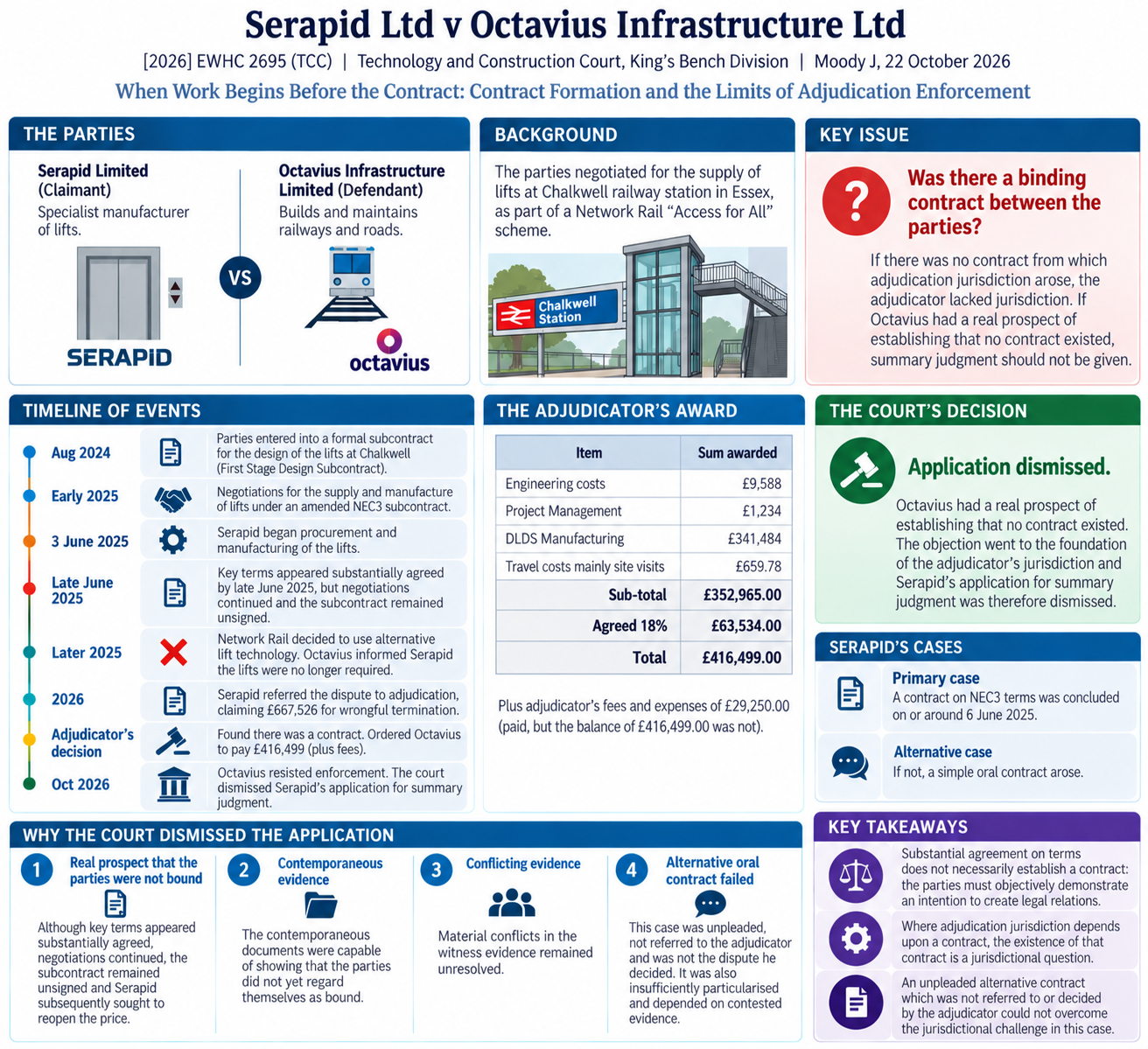
The fact that substantial work had been undertaken and contractual terms were largely agreed did not, without more, entitle Serapid to summary enforcement of the adjudicator's decision. Where the responding party had a real prospect of establishing that no contract existed, the objection went to the foundation of the adjudicator's jurisdiction. The Court was required to distinguish agreement upon terms from an objectively demonstrated intention to be legally bound. [35]–[40], [47]–[49]
Key Words
Construction contract – Contract formation – NEC3 Engineering and Construction Subcontract – Objective intention to create legal relations – Commencement of procurement – Unsigned subcontract – Execution as a deed – Adjudication jurisdiction – Housing Grants, Construction and Regeneration Act 1996 – Statutory Scheme for Construction Contracts – Enforcement – Summary judgment – CPR Part 24 – Real prospect of success – Alternative oral contract – Unpleaded case – Scope of adjudication reference – Jurisdictional challenge – Contemporaneous evidence – Witness evidence.
- Headnote
- Serapid Limited ("Serapid") applied for summary judgment to enforce an adjudicator's decision ordering Octavius Infrastructure Limited ("Octavius") to pay £416,499, exclusive of VAT, following Network Rail's decision to adopt alternative lift technology and Octavius's notification that Serapid's services were no longer required. Octavius resisted enforcement on the basis that no binding contract had been concluded and that the adjudicator consequently lacked jurisdiction. [1]–[3], [20]–[25]
- Serapid contended that the parties had concluded an amended NEC3 Engineering and Construction Subcontract on or around 6 June 2025. Alternatively, it argued in the enforcement proceedings that a simple oral contract had arisen. The adjudicator had accepted the existence of the NEC3 subcontract, notwithstanding the absence of formal execution, and had awarded compensation following what he determined to be termination at will. [3], [21]–[24], [30]
- Held, dismissing the application, that Octavius had a real prospect of establishing that no contract existed. Although important commercial and legal terms appeared substantially agreed by late June 2025, the contemporaneous documents were capable of demonstrating that the parties did not yet regard themselves as bound. Negotiations continued, the proposed subcontract remained unsigned, and Serapid subsequently sought to reopen the price. Material conflicts in the witness evidence also remained unresolved. [35]–[40]
- Serapid could not overcome the jurisdictional objection by advancing an alternative oral contract. That case was unpleaded, had not been referred to the adjudicator and was not the dispute he had decided. It was also insufficiently particularised and depended upon contested evidence. [41]–[46]
- The court distinguished cases concerning competing contractual bases which nevertheless engaged the same statutory adjudication regime. Octavius did not merely dispute which contract governed the relationship: it maintained that no contract existed at all. Because that contention had a real prospect of success, the existence of a contract remained a genuine jurisdictional issue unsuitable for summary determination. [47]–[49]
- Material Facts
- Octavius was the main contractor to Network Rail Infrastructure Limited ("NRIL") for an Access for All scheme at Chalkwell railway station, Essex. The project involved replacing an existing footbridge and providing two lifts. Serapid, a specialist lift manufacturer, was approached to supply and install lifts incorporating its Dual Lift Drive System ("DLDS"). The parties had an existing relationship, including a formally executed First Stage Design Subcontract for Chalkwell dating from August 2024. [2], [4]–[5]
- On 9 December 2024, Octavius invited Serapid to tender for the Stage 2 works under a proposed subcontract incorporating NEC3 terms. Serapid's quotation dated 14 February 2025 offered to undertake the works for £872,175 but specified that its own general terms and conditions would apply exclusively. [6]
- On 20 May 2025, Octavius circulated a further draft subcontract identifying the works, a proposed start date of 6 June 2025, completion on 26 November 2026 and a price of £872,175. Certain Contract Data remained incomplete, and the draft expressly contemplated execution as a deed. It also stated that completion of the Contract Data in full was essential to creating a complete contract. [7]–[8]
- Serapid's solicitors produced substantial proposed amendments on 27 May 2025. Following a meeting on 4 June, outstanding matters included defects provisions, the fee percentage, limitation of liability under clause X18.1 and indemnities under clause 20.3. The parties agreed an 18% fee proposal and other matters on 12 June, with the drafting of clause X18 resolved on 16 June. [9], [11]–[12]
- On 13 June 2025, Octavius indicated that the comments had been closed and that a revised subcontract order would be issued for final acceptance. On 16 June, its senior project manager stated that he believed all legal and commercial issues had been resolved, while asking whether Serapid had commenced procurement despite the absence of a signed subcontract order. He indicated that the subcontract order would follow as a priority. [11]–[14]
- Serapid relied upon those communications as evidence that the substantive bargain had already been concluded. Moody J considered that the 16 June email demonstrated that the terms were essentially agreed, but could also suggest that the sender recognised the need for signature before the parties became bound. [13]–[14], [38]
- Subsequent correspondence continued to refer to contractual finalisation and signature. On 27 June, Octavius recorded Serapid's concern about its price and its intention to provide a revised quotation. In July and August, representatives of both parties continued discussing the execution of the contracts. [15]–[16]
- Serapid's August 2025 Execution Strategy referred to the company's decision to restart industrialisation in anticipation of the project, "prior to being under contract", and described its significant commercial exposure. The court regarded the document as capable of suggesting that scope, price, programme and execution remained unresolved and that Serapid was proceeding without believing itself contractually bound. [16]
- Following a discussion on 24 August, Octavius maintained that commercial matters remained outstanding. On 3 September 2025, Octavius formally notified NRIL under the main-contract early-warning procedure that it had yet to agree a contract with Serapid for the lift works. The notice predated the dispute and was significant contemporaneous evidence of Octavius's position. [17]–[18]
- In October 2025, Serapid re-priced the proposed works. On 28 October, it issued a revised Chalkwell quotation of £1,065,000, materially exceeding the earlier figure of £872,175. [19]
- On 7 November 2025, Octavius informed Serapid that NRIL had changed the specified lift technology and that Serapid's services were no longer required. Octavius expressly denied having any contractual obligation concerning the manufacture or installation of the lifts. [20]
- Serapid commenced adjudication, alleging wrongful termination and claiming £667,526. The adjudicator, Wayne Lord, concluded that the parties had substantially agreed the NEC3 subcontract terms in or around 6 June 2025, with remaining matters concluded by 16 June. He decided that a contract existed and that Octavius had terminated it at will. [21]–[24]
- The adjudicator awarded £416,499, comprising assessed costs of £352,965 and an 18% addition of £63,534, together with fees and expenses of £29,250. Octavius paid the adjudicator's fees but not the substantive award. Serapid therefore sought summary enforcement. [24]–[25]
- Issues
- Whether Octavius had a real prospect of establishing that no binding contract had been concluded notwithstanding substantial agreement upon contractual terms and Serapid's commencement of procurement. [26]–[27], [31]–[40]
- Whether the parties' communications and conduct objectively demonstrated an intention to create immediate legal relations or supported Octavius's contention that formal execution was contemplated before the parties became legally bound. [31]–[39]
- Whether the adjudicator's determination that a contract existed was sufficient to establish jurisdiction for enforcement purposes where that very issue remained genuinely disputed. [21]–[23], [28]–[29], [47]–[49]
- Whether Serapid could rely upon an alternative oral contract which had not been pleaded, referred to the adjudicator or determined in the adjudication. [30], [41]–[46]
- Whether summary judgment could properly be granted notwithstanding unresolved disputes of fact potentially requiring witness evidence and cross-examination. [26]–[27], [40], [45]–[49]
- Decision
- Serapid's application for summary judgment was dismissed. Octavius had a real prospect of establishing that no contract existed between the parties. [35], [49]
- The substantial agreement of legal and commercial terms did not conclusively establish a binding contract. The contemporaneous evidence supported an arguable case that the parties contemplated formal execution before becoming legally bound. [37]–[39]
- Serapid's alternative oral-contract case was rejected on both procedural and substantive grounds. [41]–[46]
- The absence of any contract, if ultimately established, would go to the foundation of the adjudicator's jurisdiction. The court therefore refused to enforce the adjudicator's decision summarily. [47]–[49]
- Importantly, the court did not finally determine that no contract existed, nor did it finally decide the underlying entitlement to payment. Its decision was that the jurisdictional defence had sufficient substance to defeat summary judgment. [26]–[27], [35], [49]
- Reasoning
- Summary judgment and adjudication enforcement
- CPR r.24.3 permitted summary judgment only where the opposing party had no real prospect of succeeding on the relevant claim, defence or issue and there was no other compelling reason for trial. Applying Easyair Ltd v Opal Telecom Ltd, the court had to distinguish a realistic defence from a fanciful one, without conducting a mini-trial. It also had to consider evidence reasonably expected to become available at trial. [26]–[27]
- The court recognised the established policy favouring the prompt enforcement of adjudicators' decisions. Carillion Construction Ltd v Devonport Royal Dockyard Ltd confirmed that ordinary errors of law, fact or procedure do not ordinarily justify refusing enforcement. However, excess of jurisdiction and serious breaches of natural justice remain recognised grounds of resistance. [28]–[29]
- The distinction was fundamental. Octavius was not simply alleging that the adjudicator had incorrectly interpreted a contractual term or assessed compensation. It disputed the existence of the contractual relationship from which adjudication jurisdiction was said to arise. [1], [21]–[23], [47]–[48]
- The objective test for contract formation
- The parties did not materially disagree about the applicable legal principles. The court referred to the formulation in Keating on Construction Contracts, which directed attention to intention to contract, sufficient agreement upon essential terms, commercial and legal workability, and acceptance in accordance with any stipulated requirements. [31]
- The controlling authority was RTS Flexible Systems Ltd v Molkerei Alois Müller GmbH & Co KG. Whether a binding contract exists, and upon what terms, is determined objectively from what the parties communicated by words and conduct, rather than their undisclosed subjective intentions. [32]–[33]
- The fact that some terms remained unresolved did not inevitably preclude contract formation. Equally, the fact that most substantive terms had been agreed did not establish that the parties intended to become bound immediately. The question remained whether, objectively assessed from their words and conduct, the parties intended to create legal relations notwithstanding the matters or formalities which remained outstanding. [31]–[34]
- The court contrasted British Steel Corp v Cleveland Bridge and Engineering Co, where manufacture commenced while material matters remained under negotiation and no binding contract was found, with DAZN Ltd v Coupang Corporation, where a binding agreement could be identified from the parties' email communications. The distinction depended upon the particular facts and the objectively manifested agreement. [34]
- Uncertainty as to when the alleged contract arose
- Serapid's pleaded case identified formation "on or about 6 June 2025". In submissions, that position shifted to 13 June and alternatively 20 June. Serapid also introduced the alternative contention that a simple oral contract had been concluded during June. [3], [30], [36]
- Moody J regarded the inability to identify clearly the relevant offer, acceptance or moment of contractual formation as supporting the realistic possibility that no contract had been concluded. The new alternative case also suggested an implicit recognition that the pleaded NEC3 case might fail. [36]
- The judgment did not establish that uncertainty about the precise date of formation must always defeat a contractual claim. Rather, in the circumstances of these negotiations, that uncertainty contributed to the conclusion that Octavius's defence could not properly be dismissed as fanciful. [31]–[37]
- Agreement upon terms was not necessarily agreement to be bound
- The court accepted that important contractual terms appeared substantially agreed by late June 2025. Nevertheless, contemporaneous documents supported the argument that neither party then considered itself legally committed. [37]
- The evidence included the contemplated execution of the Stage 2 subcontract as a deed, the formal execution of the earlier design subcontract, repeated references to signature and finalisation, Serapid's internal Execution Strategy, and continued negotiations following the alleged formation date. [5], [8], [15]–[19], [37]
- Particularly significant was Serapid's attempt to reopen the price. Its revised quotation of £1,065,000 in October 2025 was capable of undermining the contention that the parties had already concluded a binding agreement at the earlier price. [15], [19], [37]
- These matters did not conclusively establish that signature was legally indispensable. They demonstrated, however, that Octavius had a realistic argument that the parties objectively intended formal execution to precede legal commitment. [37]–[38]
- The significance of procurement before signature
- Serapid placed considerable emphasis upon having manufactured or procured equipment over approximately five months. It argued that a commercial party would not ordinarily undertake such expenditure without believing itself contractually protected. [39]
- The court identified a difficulty with that submission: procurement had commenced on 3 June 2025, before even Serapid's alleged formation date. The commencement of work therefore could not, without further evidence, demonstrate that a subsequent contract had already arisen. [39]
- Earlier correspondence also showed that Serapid had contemplated obtaining protection for procurement expenditure through a letter of intent, an equipment purchase order and a cancellation arrangement. The parties had therefore considered mechanisms by which procurement might proceed before finalisation of the proposed subcontract. [39]
- Moody J regarded Octavius's 16 June email as arguably consistent with the circumstances in British Steel: a request for performance to proceed while the parties awaited formal contractual documentation. [38]
- The analytical distinction is between conduct evidencing performance and conduct evidencing contractual assent. Performance may support an inference that a contract exists, but its evidential weight depends upon the whole course of dealing and the legal significance objectively attributable to the parties' communications. [32]–[34], [38]–[39]
- The limitations of documentary determination
- The court recognised that relevant factual disputes could not necessarily be resolved from the documentary record alone. In the adjudication, the adjudicator had encountered conflicting witness evidence and elected to determine the formation issue by reference to the documents. [40]
- Moody J identified meetings on 4 June, 10 June and 24 August 2025 as occasions on which disputed conversations might materially affect the assessment of contractual intention and agreement. [40]
- Accordingly, the case was not suitable for summary disposal merely because an adjudicator had reached a conclusion on the available documents. A fuller evidential examination could affect the outcome, and the court was not required to decide those disputed matters in a mini-trial. [27], [40]
- The alternative oral-contract case
- Serapid sought to argue that, even if no NEC3 subcontract existed, the parties had concluded a simple oral contract which would nevertheless engage the statutory adjudication regime. [3], [30]
- The court rejected that alternative on procedural and substantive grounds. First, Serapid's Particulars of Claim identified only the amended NEC3 subcontract, its clause W2.5.1 and a reference under that subcontract. Permission to amend would be required to advance a different contractual case. [42]
- Secondly, the alternative oral contract was not the contract identified in the Notice of Adjudication and had not formed the basis of the adjudicator's decision. The referred dispute concerned an NEC3 Engineering and Construction Subcontract allegedly concluded on or around 6 June 2025. [43]
- Thirdly, the alternative was insufficiently particularised. Serapid had not established clarity as to when or by whom the alleged oral agreement was made, the circumstances of offer and acceptance, or the agreed price and scope. [44]
- Fourthly, its determination would require the examination of disputed witness evidence. Even if the procedural objections could be overcome, Octavius retained a real prospect of establishing that no such contract existed. [45]–[46]
- Contract formation as a jurisdictional foundation
- Serapid relied upon authorities concerning disputes where different contractual routes might nevertheless lead to the application of the same statutory adjudication scheme. The court referred to the line of cases beginning with Pegram Shopfitters Ltd v Tally Weijl (UK) Ltd and extending to High Tech Construction Ltd v WLP Trading and Marketing Ltd. [47]
- Moody J did not need to resolve the complexities arising where a contract undoubtedly exists but its precise identity or terms remain disputed. Octavius had a real prospect of demonstrating that the parties had not entered into any contract at all. [47]
- The court adopted the relevant principle identified by Constable J in High Tech: where one party asserts that a contract containing an adjudication provision governs the relationship, while the other maintains that no contract exists, the formation issue goes to the heart of jurisdiction. If the no-contract contention has a reasonable prospect of success, and the jurisdictional objection has not been waived, summary enforcement should be refused. [47]–[48]
- The adjudicator's decision on jurisdiction did not prevent the court from considering that objection. The adjudicator had made a non-binding determination that a contract existed, but the court was entitled to examine whether the challenge raised a genuinely arguable absence of jurisdiction. [2], [21]–[23], [47]–[49]
- Ratio Decidendi
- Where an adjudicator's jurisdiction depended upon the existence of a construction contract, and a properly maintained and unwaived jurisdictional objection raised a real prospect that no contract existed at all, summary judgment enforcing the adjudicator's decision should not be given. [26]–[29], [47]–[49]
- The existence and terms of a construction contract must be assessed objectively from the parties' words and conduct. Substantial agreement upon contractual terms and commencement of performance do not necessarily establish immediate contractual intention where the parties may have contemplated further agreement or formal execution before becoming bound. [31]–[34], [37]–[39]
- In assessing a contract-formation defence on summary judgment, the court may take account of uncertainty about the alleged offer and acceptance, continued negotiations, contemporaneous statements concerning contractual status and disputed witness evidence reasonably capable of affecting the outcome at trial. [26]–[27], [35]–[40]
- An alternative contractual basis not pleaded, referred to adjudication or determined by the adjudicator cannot, in the circumstances of this case, overcome the jurisdictional objection to enforcement. The court also found the particular alternative oral-contract case substantively vulnerable. [41]–[46]
- The decision concerns the threshold for summary enforcement, not a final determination that the parties did not contract. The decisive finding was that Octavius's no-contract defence had a real prospect of success. [35], [47]–[49]
- Disposition
- Serapid's application for summary judgment was dismissed. [49]
- The adjudicator's substantive award of £416,499 was not summarily enforced. The adjudicator's fees and expenses of £29,250 had already been paid. [24]–[25], [49]
- The judgment left the underlying contractual formation dispute unresolved. It established that Octavius's defence had sufficient substance to require determination beyond the summary judgment application. [35]–[40], [49]
- Held
- Held, that Octavius had a real prospect of establishing that no contract had been concluded with Serapid notwithstanding the commencement of procurement and substantial progress in negotiating the proposed NEC3 subcontract. [35]–[40]
- Held, that uncertainty concerning the date and mechanism of formation, continued negotiations, references to contractual execution and the reopening of price were matters capable of supporting a realistic defence to the allegation that the parties had become legally bound. [36]–[39]
- Held, that the commencement or continuation of procurement did not, without more, establish contract formation, particularly where procurement preceded the alleged agreement and the parties had contemplated interim protective arrangements. [39]
- Held, that Serapid's alternative oral-contract case was not properly available in the enforcement proceedings and, in any event, was subject to substantial factual and evidential difficulties. [41]–[46]
- Held, that the question whether any contract existed went to the foundation of the adjudicator's jurisdiction, rather than merely to the interpretation or identification of an existing contractual relationship. [47]–[48]
- Held, that Serapid was not entitled to summary judgment and its application was dismissed. [49]
Comment
The £416,499 Question: When Does a Contract Actually Exist?
How can months of manufacturing, extensive contractual negotiations and a £416,499 adjudicator's award still leave a company unable to secure summary enforcement?
Surely somebody agreed to something.
In Serapid v Octavius, that was precisely the problem. The adjudicator found a contract. Octavius said there was none. Moody J decided that Octavius had a real prospect of being right. [21]–[25], [35], [49]
An impressive amount of commercial activity for a contractual relationship whose legal existence remained unresolved.
But perhaps the most interesting question is not contractual. It is psychological.
When does being heavily committed to a project start to feel like proof that everyone else is legally committed too?
Barry Staw's research on escalation of commitment (1976) reveals an intriguing feature of human decision-making: previous investment can encourage further commitment, even when circumstances suggest that the original decision deserves reconsideration.
The commercial implications are familiar.
A project begins. Money is committed. Work progresses. Programmes are updated. Meetings multiply. Eventually, the activity acquires its own momentum.
And momentum can start looking suspiciously like agreement.
The distinction matters because commercial commitment and contractual commitment are not the same thing.
The psychological observations concern general features of commercial decision-making, not the motivations or mental processes of either party or its representatives. Moody J made no findings about cognitive bias. The research provides an analytical framework for considering the risks associated with commencing work before contractual arrangements are settled.
Serapid commenced procurement on 3 June 2025, before the date upon which it originally alleged that the contract had been concluded. Earlier correspondence also contemplated obtaining protection through a letter of intent, purchase order and cancellation arrangement. [39]
In other words, the documentary history demonstrated that procurement could be contemplated before a final subcontract was agreed.
Starting work was evidence of activity. Whether it was evidence of contractual assent was an entirely different question.
There is a second psychological complication: hindsight bias.
Baruch Fischhoff's research (1975) demonstrated how knowing an outcome can distort judgments about its prior predictability. Once events have unfolded, their earlier development may appear more inevitable than it really was.
Contractual negotiations are particularly fertile territory for this problem.
Imagine reviewing six months of correspondence after a major procurement commitment. Several emails report that matters are almost settled. Important terms have been negotiated. Everyone appears keen to proceed.
Looking backwards, it is easy to see a contract gradually emerging.
Rather less easy is identifying the precise point at which that emerging agreement became legally binding.
That was one difficulty for Serapid.
Its pleaded case identified formation on or about 6 June 2025. In submissions, the date moved to 13 June and alternatively 20 June. A further argument suggested that, even without the NEC3 subcontract, a simple oral agreement had arisen. [3], [30], [36]
A variety of possible contractual birthdays, but no sufficiently conclusive evidence to eliminate Octavius's defence.
The problem was not that a contract must always have an easily identifiable ceremonial moment. English law does not require every commercial bargain to announce its arrival with a signature and a trumpet.
It was that the uncertainty formed part of a wider documentary picture capable of supporting Octavius's contention that the parties had not yet become bound. [31]–[38]
Peter Wason's work on confirmation bias (1960) helps explain another general danger.
Once a person adopts a hypothesis, supporting evidence can become more persuasive than contradictory evidence. The risk is not necessarily deliberate selectivity. It is that evidence consistent with an existing interpretation may receive greater attention than evidence capable of disproving it.
Consider the hypothesis: “The parties must have contracted because the project was proceeding.”
The supporting material is attractive: negotiated terms, procurement, programme discussions and repeated requests for progress.
But a proper contract-formation analysis must also confront the evidence pointing in another direction.
Here, the earlier design subcontract had been formally executed. The proposed Stage 2 subcontract contemplated execution as a deed. Subsequent correspondence referred to contractual finalisation and signature. Serapid's August Execution Strategy referred to commercial exposure before being under contract. In October, Serapid issued a substantially higher quotation. [5], [8], [15]–[19], [37]
None of those matters conclusively established that there was no contract.
But they supplied more than enough material to make the contrary argument realistic.
The email of 16 June 2025 captured the difficulty particularly well.
Octavius's project manager indicated that he believed the legal and commercial issues had been resolved. That sounded promising. Yet he also stated that the subcontract order would follow and asked whether procurement had commenced despite the absence of a signed order. [12]–[14], [38]
An agreement awaiting paperwork?
Or negotiations substantially completed, with legal commitment still awaiting formal execution?
The email could arguably support either interpretation.
And that is precisely why the court could not treat Octavius's defence as fanciful.
The distinction between RTS Flexible Systems and British Steel is important here. An unsigned document does not necessarily prevent contract formation. Equally, manufacturing goods while negotiations continue does not necessarily establish a contract. The answer depends upon what the parties objectively communicated by their words and conduct, assessed in its proper context, rather than upon the commercial consequences of concluding that a contract did or did not exist. [32]–[34], [38]–[39]
Then comes the adjudication problem.
The adjudicator had considered the material and concluded that a contract existed. But an adjudicator's determination of his own jurisdiction cannot, merely by being made, conclusively establish the contractual foundation upon which that jurisdiction depends.
Otherwise, establishing jurisdiction would be wonderfully straightforward.
Decide that you have it.
And there it is.
Unfortunately, the law requires rather more.
The courts strongly favour enforcement of adjudicators' decisions, including decisions containing errors of fact or law. A jurisdictional objection is different. Where a properly maintained and unwaived objection raises a real prospect that no contract existed at all, the court cannot simply treat the adjudicator's contrary conclusion as conclusive. [28]–[29], [47]–[48]
Serapid's alternative oral-contract argument encountered a further obstacle.
The alleged NEC3 subcontract was the contractual basis pleaded and referred to adjudication. The alternative oral contract had not been pleaded, referred or determined. Nor were its alleged formation, offer, acceptance, price and scope clearly identified. [41]–[46]
The court was not prepared to uphold summary enforcement by reference to a different contractual case lacking those procedural and substantive foundations.
There is an important practical lesson for adjudicators.
An adjudicator may properly need to reach a provisional conclusion about contract formation to determine whether to proceed. However carefully reasoned, that jurisdictional determination does not necessarily bind the enforcement court. Where the issue turns upon disputed conversations, incomplete documentation and competing inferences, a final resolution may require evidence beyond that available in adjudication.
For contractors and subcontractors, the lesson is equally uncomfortable.
A project can become operationally urgent long before its contractual arrangements are secure.
The parties may agree the technical solution, the likely price, the programme and the broad allocation of risk. They may even begin spending considerable sums.
But if their communications remain consistent with an intention to complete further contractual formalities before becoming bound, commercial progress alone may not answer the legal question.
This is why letters of intent, purchase orders, cancellation provisions and properly documented interim agreements deserve more attention than they sometimes receive.
The relevant questions are straightforward: What has been offered? What has been accepted? On which terms? By whom? And did the parties objectively intend to be bound at that point?
Rather less glamorous than ordering specialist equipment.
Potentially rather more valuable.
Moody J did not decide that Serapid and Octavius never contracted. He found that Octavius had a real prospect of establishing that no contract existed. The application for summary judgment was therefore dismissed. [35], [47]–[49]
The underlying contractual question remained unresolved.
And therein lies the answer to the £416,499 mystery.
Doing the work, believing an agreement exists and legally concluding one are three different things.
The first may be obvious. The second may be entirely sincere. The third requires objective evidence of contractual assent.
A project can be well under way while the contract is still waiting to begin.
#ConstructionLaw #ConstructionAdjudication #ContractFormation #NEC3 #TCC #BehaviouralPsychology #CognitiveBias #AdjudicationEnforcement #DisputeResolution #DDAlegal
Authorities and Materials
The thematic classifications below are editorial and are not classifications adopted by the court. Descriptions are paraphrases of the judgment's treatment of the authorities.
Case Law:
Contract formation
- RTS Flexible Systems Ltd v Molkerei Alois Müller GmbH & Co KG [2010] UKSC 14 — The leading Supreme Court authority on the objective assessment of contractual formation, intention to create legal relations and agreement upon essential terms, including where formal documentation remains incomplete. [32]–[33]
- British Steel Corporation v Cleveland Bridge and Engineering Co Ltd [1984] 1 All ER 504 — Manufacture commenced while a formal subcontract remained under negotiation and no concluded contract was found. Moody J regarded Octavius's case as arguably analogous, namely a request to proceed pending a formal contract. [34], [38]
- DAZN Ltd v Coupang Corporation [2025] EWCA Civ 1083 — A contrasting example in which the Court of Appeal identified a binding agreement from email communications. [34]
Summary judgment and adjudication enforcement
- Easyair Ltd v Opal Telecom Ltd [2009] EWHC 339 (Ch) — Principles governing realistic prospects of success, the prohibition upon conducting a mini-trial and consideration of evidence reasonably expected at trial. [27]
- AC Ward & Sons Ltd v Catlin (Five) Ltd [2009] EWCA Civ 1098 — Court of Appeal approval of the Easyair principles. [27]
- Carillion Construction Ltd v Devonport Royal Dockyard Ltd [2005] EWCA Civ 1358 — The strong policy of adjudication enforcement notwithstanding ordinary errors, subject to recognised exceptions for excess of jurisdiction and serious breaches of natural justice. [28]
Adjudication jurisdiction and contractual basis
- Pegram Shopfitters Ltd v Tally Weijl (UK) Ltd [2003] EWCA Civ 1750, [2004] 1 WLR 2082 — Identified by the parties as part of the line of authority concerning different contractual bases and adjudication jurisdiction. Moody J found that the complexities arising in those cases did not require resolution. [47]
- High Tech Construction Ltd v WLP Trading and Marketing Ltd [2026] EWHC 152 (TCC) — Distinguishes disputes about the contractual route giving rise to adjudication from cases in which the resisting party maintains that no contract exists. A realistically arguable absence of any contract may preclude summary enforcement where the jurisdictional objection has not been waived. [47]–[48]
Textbook and Practitioner Commentary:
- Keating on Construction Contracts, 12th edition (2024), paragraph [2-023] — The four-part analytical approach to contractual formation relied upon by both parties and discussed by Moody J. [31]
Statutory, Procedural and Contractual Materials:
- Housing Grants, Construction and Regeneration Act 1996 and the statutory adjudication regime — It was common ground that, on the hypothesis that the alleged NEC3 subcontract existed, the statutory scheme under the 1996 Act applied. [21]
- CPR r.24.3 — Summary judgment test requiring the absence of a real prospect of success and of any other compelling reason for trial. [26]
- NEC3 Engineering and Construction Subcontract — The contractual form alleged by Serapid, including the amended terms, Option W2, clause 93 and the termination table. [3], [6]–[12], [24], [42]–[43]
- First Stage Design Subcontract, August 2024 — The earlier formally executed agreement considered as part of the parties' course of dealing. [4]–[5], [37]
- Proposed Stage 2 Subcontract and Contract Data — The unexecuted proposed contractual documentation, including incomplete data, the contemplated execution as a deed and the requirement for completion of the Contract Data. [7]–[8]
Behavioural Research Mentioned in the Editorial Comment:
- Staw, B M (1976). "Knee-Deep in the Big Muddy: A Study of Escalating Commitment to a Chosen Course of Action." Organizational Behavior and Human Performance, 16(1), 27–44. https://doi.org/10.1016/0030-5073(76)90005-2
- Fischhoff, B (1975). "Hindsight ≠ Foresight: The Effect of Outcome Knowledge on Judgment Under Uncertainty." Journal of Experimental Psychology: Human Perception and Performance, 1(3), 288–299. https://doi.org/10.1037/0096-1523.1.3.288
- Wason, P C (1960). "On the Failure to Eliminate Hypotheses in a Conceptual Task." Quarterly Journal of Experimental Psychology, 12(3), 129–140. https://doi.org/10.1080/17470216008416717
These publications support the general behavioural concepts discussed. They were not authorities cited by Moody J, and their inclusion does not suggest that any party or witness in the proceedings exhibited the psychological phenomena described.
Editorial qualification: The dismissal of the summary judgment application did not constitute a final determination that no contract existed. That distinction governs the headnote, ratio, disposition and commentary above.
Nigel Davies BSc(Hons) (Q.Surv), PGCert.Psych, GDipLaw, PGDipLP, DipArb, MSc (Built Environment), LLM (Construction Law & Practice), MSc (Mechanical & Electrical), MSc (Psychology), FRICS, FICE, FCIOB, FCInstCES, FCIArb, CArb, GMBPsS, Panel Registered Adjudicator, Mediator, Mediation Advocate, Chartered Builder, Chartered Construction Manager, Chartered Surveyor, Chartered Civil Engineering Surveyor, Chartered Arbitrator, Author, Solicitor-Advocateand PhD Candidate in Experimental Psychology (UCL)
Adjudicator Assessor and Re-Assessor for the ICE
ICE DRC Member
ICE DRC CPD Committee Chairman
Adjudicator Exam Question Setter for the ICE
CIArb Adjudication Panel Member since 2006
CIArb Arbitration Panel Member since 2006
CIC Adjudication Panel Member since 2010
FIDIC Adjudication Panel Member since 2021
ICE Adjudication Panel Member since 2021
Law Society Panel Arbitrator
RIBA Adjudication Panel Member since 2018
RICS Adjudication Panel Member since 2006
RICS Dispute Board Registered since 2013
TECSA Adjudication Panel Member since 2012
The information & opinions expressed in this article are not necessarily comprehensive, nor do they represent the trenchant view of the author; in any event, this article does not purport to offer professional advice. This article has been prepared as a summary and is intended for general guidance only. In the case of a specific problem, it is recommended that professional advice be sought.
© 2026 Davies & Davies Associates Ltd
Back to Legal Updates