Secretary of State for Housing, Communities and Local Government v Urban Splash Limited and Others
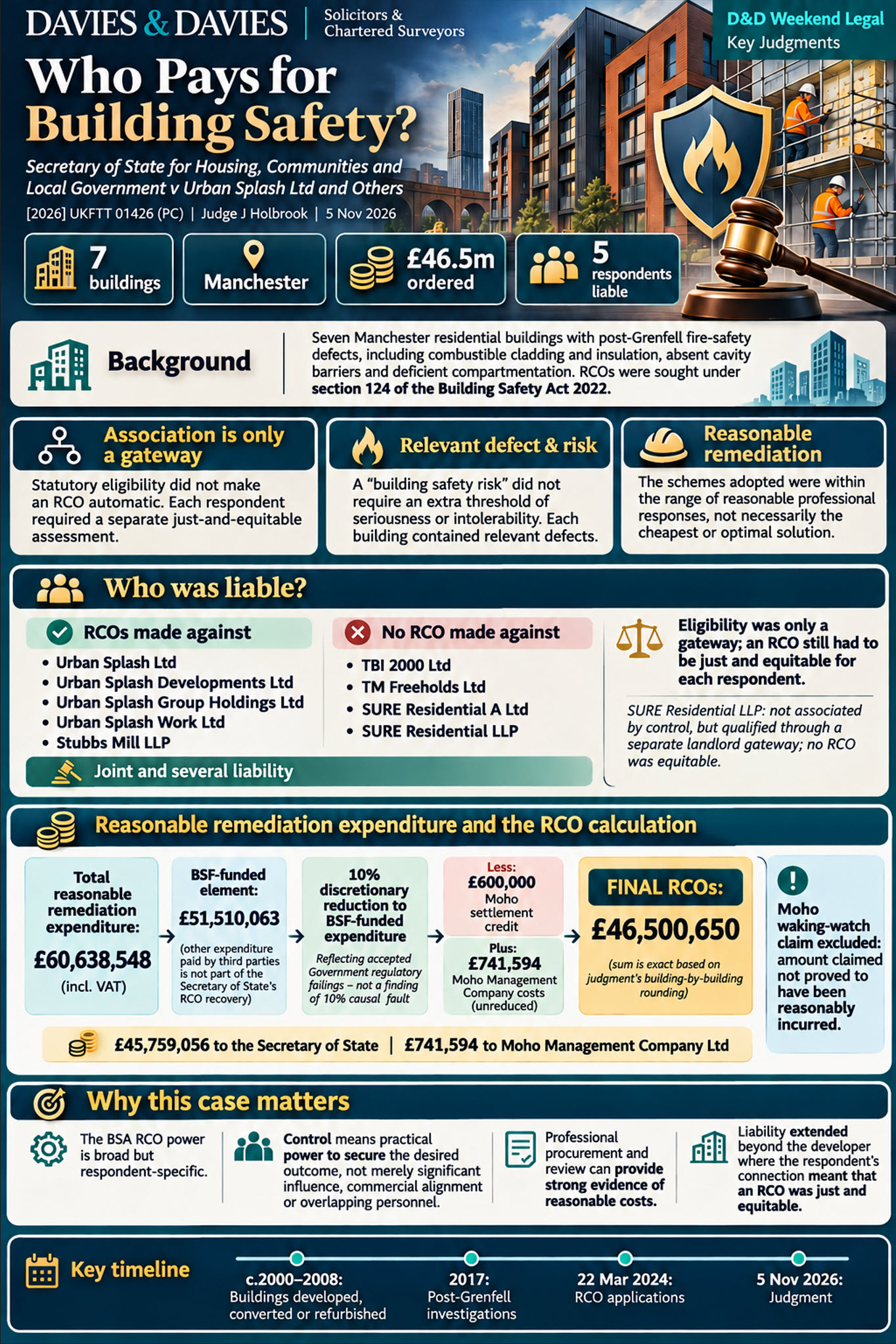
Seven Manchester buildings • £46,500,650 ordered • Five respondents jointly and severally liable
In Secretary of State for Housing, Communities and Local Government v Urban Splash Limited and Others [2026] UKFTT 01426 (PC), the First-tier Tribunal considered remediation contribution orders (RCOs) concerning seven Manchester buildings under the Building Safety Act 2022. It accepted £60.64 million in reasonable remediation expenditure, holding that remediation need not be the cheapest solution, provided it fell within the range of reasonable professional responses. The statutory RCO power was broad but association was only a gateway to liability. The Tribunal distinguished practical control from commercial influence, reasonable remediation from hypothetical cheaper alternatives, and statutory eligibility from the separate requirement that an order be just and equitable [124–128, 423–451, 576–585]. Applying a discretionary 10% reduction to Building Safety Fund expenditure in recognition of accepted Government regulatory failings, without apportioning causative responsibility, it ordered £46,500,650 against five respondents jointly and severally, while declining orders against four others. The decision confirms that association does not automatically establish liability and equitable responsibility requires a respondent-specific assessment.
Key Words
Building Safety Act 2022 – Remediation contribution order – Relevant defect – Building safety risk – Fire spread – Combustible cladding and insulation – Cavity barriers – Compartmentation – Reasonable remediation costs – Alternative remedial schemes – Building Safety Fund – VAT – Waking watch – Associated entities – Corporate control – Limited liability partnership – Practical control – Commercial influence – Just and equitable – Developer liability – Corporate group – Family investment companies – Regulated investment fund – Third-party investors – Government regulatory responsibility – Retrospective liability – A1P1 – Article 6 – Joint and several liability.
- Headnote
- The Secretary of State sought remediation contribution orders (“RCOs”) under section 124 of the Building Safety Act 2022 (“BSA”) concerning seven Manchester residential buildings developed by Urban Splash Limited between approximately 2000 and 2008. The proceedings concerned the identification of relevant fire-safety defects, the reasonableness of more than £60 million of remediation expenditure, corporate association and the Tribunal’s “just and equitable” discretion. [1–5, 35–46, 69–117]
- The Tribunal held that a “building safety risk” under section 120(5) did not have to meet a freestanding threshold of seriousness or intolerability. Risk severity nevertheless remained relevant to the reasonableness of the proposed response. Each Building contained relevant defects, and the schemes adopted were within the range of reasonable professional responses. [77–93, 106–117, 124–151]
- The Applicant proved £60,638,548 of reasonable remediation expenditure, inclusive of VAT. Procurement, contract administration, cost review and Building Safety Fund scrutiny were positive evidence of reasonableness: an RCO hearing was not a conventional construction final-account audit. The separate Moho waking-watch claim failed for want of adequate evidence of quantum. [160–187, 222–235, E117–E122]
- In applying section 121(8), the Tribunal distinguished the practical power to secure outcomes from significant commercial influence. SURE Residential LLP was not associated through the alleged control relationship, although it fell within a separate landlord gateway for two Buildings; Stubbs Mill LLP was associated through materially common control. Statutory eligibility did not itself make an RCO just and equitable. [374–385, 423–451, 533–573, 576–585, 828–833]
- It was just and equitable to impose RCOs upon the developer, three closely connected Urban Splash companies and Stubbs Mill LLP but not upon separate family investment companies or entities forming part of a regulated investment fund whose assets were held overwhelmingly for investors unconnected with the Urban Splash enterprise. The Tribunal applied a discretionary 10% reduction to BSF-funded expenditure in recognition of accepted governmental regulatory failings, expressly without apportioning causative responsibility. [647–853]
- The five liable Respondents were ordered, jointly and severally, to pay £46,500,650, comprising £45,759,056 payable to the Secretary of State and £741,594 payable directly to Moho Management Company Ltd. [857–882]
- Material Facts
- Urban Splash Limited had developed or converted Burton Place, Chips Building, Christabel House, Emmeline House, Moho Building, Sylvia House and The Box Works in Manchester between approximately 2000 and 2008. [3, 35, 249]
- Christabel House, Emmeline House and Sylvia House were collectively known as the Three Towers and comprised 13-storey residential tower blocks dating from the 1960s which had been refurbished and overclad between approximately 2006 and 2008. [G1–G2]
- Following the Grenfell Tower fire in June 2017, investigations were undertaken into the fire safety of the seven Buildings. [1–3]
- The alleged defects principally comprised combustible insulation and façade materials, absent or ineffective cavity barriers and fire-stopping, and defective compartmentation capable of facilitating vertical or horizontal fire spread. [69, 106–112]
- The Buildings differed substantially in their design and construction but the Tribunal found that each contained relevant fire-safety defects and that the remediation undertaken represented a reasonable response to those defects. [11, 27–32]
- The principal remediation projects involved removal of external wall systems, combustible insulation and other combustible components, installation of non-combustible replacement materials, reinstatement of cavity barriers and fire-stopping, and associated consequential and integration works. [118–123]
- The total remediation expenditure reasonably incurred or to be incurred was £60,638,548 inclusive of VAT. [231–232]
- The BSF-funded element comprised £22,954,848 for Burton Place, £4,705,670 for Chips Building, £1,472,075 for Christabel House, £2,027,778 for Emmeline House, £18,092,248 for Moho Building, £495,390 for Sylvia House and £1,762,054 for The Box Works. [233]
- Moho Management Company Ltd had separately incurred £741,594 inclusive of VAT in connection with the Moho remediation project. [220–221, 234]
- Urban Splash Limited no longer traded and was technically insolvent but it remained within the group because its accumulated tax losses continued to confer an economic benefit upon other companies in the wider enterprise. [264–267, 276]
- Urban Splash Developments Limited had become the principal vehicle through which the Urban Splash enterprise continued its property-development activities following a restructuring in 2013. [253–258, 268–269]
- Urban Splash Group Holdings Limited sat at the apex of the surviving corporate group and represented the point at which ultimate ownership and control of the enterprise resided. [263, 270–271]
- Urban Splash Work Limited was an active commercial-property investment company which had long formed part of the wider Urban Splash property-centred enterprise. [250, 272–279]
- TBI 2000 Limited was a family-owned investment company holding private investment assets for Tom Bloxham and members of his family. [280–286]
- TM Freeholds Limited was a joint-venture investment company involving interests associated with Tom Bloxham and Mark Hawthornthwaite and was engaged in acquiring and managing residential freehold interests. [287–292]
- SURE Residential A Limited and SURE Residential LLP formed part of a regulated alternative investment fund investing in completed residential property rather than undertaking property development. [293–307]
- More than 94% of the units in that Fund were held by investors unconnected with the Urban Splash enterprise. [339]
- SURE Residential LLP had acquired a small number of completed flats at Christabel House and Sylvia House, but it had not participated in the development of either Building and had no responsibility for their external walls or the relevant defects. [342, 828–832]
- Stubbs Mill LLP had been established by the five individuals described as the “Urban Splash 5” to acquire and redevelop the Stubbs Mill property through a structure which enabled those individuals to obtain Business Premises Renovation Allowance. [346–356]
- The Stubbs Mill development had been acquired from an Urban Splash company and subsequently developed, managed and financed through substantial commercial and financial connections with Urban Splash entities. [354, 360–364]
- The Secretary of State commenced the seven RCO applications on 22 March 2024 and subsequently joined R5–R11 to the proceedings in November 2024. [35–36]
- The applications against Shed KM Holding Limited and Shed KM Limited were withdrawn following a mediated settlement reached before the final hearing, under which £600,000 was paid towards the Moho remediation costs. [37, 343–345, 859]
- The final hearing occupied seven weeks between April and July 2026 and involved extensive factual, expert and documentary evidence. [47–61]
- Issues
- Whether each of the Buildings contained a “relevant defect” within section 120 of the BSA and, in particular, whether a “building safety risk” required proof of a material, appreciable or intolerable risk. [69–93]
- Whether a feature could constitute a defect by reference to current building standards notwithstanding that it might have complied with the standards applicable when the Building was originally constructed. [84–89]
- Whether the remediation schemes adopted fell within the range of reasonable professional responses to the relevant defects or represented unnecessary and disproportionately extensive remediation encouraged by the availability of BSF funding. [118–151]
- Whether expenditure could be reasonable notwithstanding the possible existence of a cheaper alternative and whether R1–R4 had established any technically viable and materially cheaper alternative scheme. [127–151, 188–196]
- What evidential standard applied when determining whether the remediation expenditure had been reasonably incurred and what weight could be given to competitive tendering, contract administration, professional review and BSF scrutiny. [160–218]
- Whether consequential works, maintenance benefits, alleged betterment, irrecoverable VAT and the Moho waking-watch costs fell within the recoverable expenditure. [152–159, 220–230]
- Whether SURE Residential LLP and Stubbs Mill LLP were associated with Urban Splash Limited under sections 121(5)(b) and 121(8). [365–378]
- Whether control under section 121(8) had to arise from formal corporate rights or could be exercised through common individuals and practical arrangements. [379–451]
- Whether it was just and equitable to make RCOs against the developer and each associated Respondent. [574–646]
- Whether the Government’s acknowledged role in systemic regulatory failures should affect the amount recoverable from the Respondents. [686–706]
- Whether the retrospective imposition of remediation liabilities infringed A1P1 or Article 6 of the ECHR. [626–644]
- Whether the liabilities of the Respondents against whom RCOs were made should be apportioned or imposed on a joint and several basis. [863–876]
- Decision
- Each of the seven Buildings contained relevant defects relating to fire safety. [11, 114–117]
- The expression “building safety risk” in section 120(5) referred to any qualifying risk arising from fire spread or collapse and did not require the risk to reach a specified degree of seriousness or intolerability. [77–93]
- The remediation schemes adopted for the seven Buildings fell within the range of reasonable professional responses to the relevant defects. [27–31, 124–151]
- The Applicant established a prima facie case that the remediation expenditure was reasonable through evidence of competitive procurement, professional contract administration, cost-consultant review, BSF scrutiny, payment records and expert assessment. [160–185]
- R1–R4 did not displace that case by establishing excessive rates, unnecessary categories of work or a coherent and materially cheaper alternative remediation scheme. [188–218]
- The Tribunal found that £60,638,548 inclusive of VAT had reasonably been incurred or was reasonably to be incurred in remedying, or otherwise in connection with, the relevant defects. [231–235]
- The waking-watch costs claimed in respect of Moho were excluded because their reasonableness had not been established by adequate evidence. [222–223, E117–E122]
- SURE Residential LLP was not associated with Urban Splash Limited through the alleged corporate-control relationship because its independent governance prevented the parent company from securing the outcomes of its investment decisions. Its ownership of leases of flats in Christabel House and Sylvia House nevertheless brought it within the separate landlord gateway under section 124(3) but did not make an RCO just and equitable. [533–537, 828–833]
- Stubbs Mill LLP was associated with Urban Splash Limited because the persons collectively controlling it were materially the same persons who controlled Urban Splash Group Holdings Limited, and no independent layer of governance equivalent to that of SURE Residential LLP existed. [566–573]
- It was just and equitable to make RCOs against Urban Splash Limited, Urban Splash Developments Limited, Urban Splash Group Holdings Limited, Urban Splash Work Limited and Stubbs Mill LLP. [647–762, 834–853]
- It was not just and equitable to make RCOs against TBI 2000 Limited, TM Freeholds Limited, SURE Residential A Limited or SURE Residential LLP. [763–833]
- A 10% reduction was applied to the BSF-funded remediation expenditure to reflect the Government’s accepted contribution to the systemic circumstances producing the building-safety crisis. [699–706]
- The Respondents’ Convention-rights objections were rejected. [626–644]
- The five liable Respondents were ordered to pay £46,500,650 on a joint and several basis. [857–876]
- Reasoning
- Relevant defects and building safety risk
- Section 120 required the Tribunal first to identify a defect before determining whether that defect arose from relevant works and caused a building safety risk. [77–89]
- The concept of a defect was broad and was capable of including a deficiency assessed against current building standards, even where the feature might have complied with standards applicable at the time of construction. [88–89]
- The tolerability of the risk did not determine whether a building safety risk existed because the statutory definition referred to “a risk” without qualification or gradation. [90–91]
- The Tribunal treated Edgewater (Stevenage) as binding Upper Tribunal authority, although it recognised that the particular observations concerning “a risk” were obiter and had arisen on an issue which had become academic and had not been fully argued. Those observations had nevertheless been given expressly for the guidance of other tribunals, were highly persuasive and were considered correct. [90–92]
- The degree of risk remained relevant when considering the scope of the remediation reasonably required, thereby avoiding the consequence that every relevant defect automatically justified extensive work. [92–93]
- Contemporary investigation reports, photographs, design material and professional assessments provided a sufficient evidential basis for determining the pre-remediation condition of the Buildings notwithstanding that much of the original construction had subsequently been removed or concealed. [27, 94–117]
- The Tribunal preferred the Applicant’s fire-engineering evidence because it applied the correct statutory test and made reasonable use of the available contemporary professional material. [94–117]
- Reasonableness of the remediation schemes
- The fact that a remediation scheme had been developed upon professional advice was a significant indicator of reasonableness but did not make the scheme presumptively reasonable. [124–128]
- The fact that works had received BSF funding similarly constituted relevant evidence but did not preclude the Tribunal from examining whether the particular scheme had been a reasonable response to the defects. [125–128]
- The proper question was whether the adopted scheme fell within the range of responses reasonably available to competent professionals, rather than whether it was the cheapest, best or optimal solution. [127–128]
- The existence of a cheaper alternative would not necessarily render the adopted scheme unreasonable where both approaches fell within the range of reasonable professional choices. [127, 189, 196]
- The scope of the projects had evolved principally because intrusive investigations and opening-up had disclosed further combustible construction, voids, compartmentation defects and service penetrations. [144–151]
- The evidence did not establish that the projects had proceeded upon an indiscriminate assumption that all combustible materials had to be removed, because components had been retained where professional assessment supported retention. [145–147]
- R1–R4 had not produced an admissible and developed alternative scheme which demonstrated that the relevant fire-safety objectives could have been achieved at materially lower cost. [148–151, 188–196]
- Quantum and the evidential approach
- Section 124(2) did not expressly require costs to have been reasonably incurred, and the Tribunal did not read such a requirement into that subsection; the reasonableness of the expenditure was instead relevant to the exercise of the discretion under section 124(1). [66–68]
- The Applicant bore the ultimate burden of establishing that the expenditure had been reasonably incurred. [160, 181]
- Once the Applicant had established a prima facie evidential case through the procurement, administration, review and payment evidence, a Respondent seeking to displace that case needed to identify a properly grounded challenge. That did not reverse the legal burden, which remained with the Applicant. [160, 181–183]
- The professional judgments made during procurement, contract administration, cost review and BSF approval were not conclusive, but constituted substantive positive evidence rather than merely an absence of evidence of unreasonableness. [172–185]
- The RCO proceedings were not concerned with contractors’ contractual entitlements and did not require the Tribunal to reconstruct every final-account item, prolongation claim or variation as if determining a conventional construction dispute. [178–187]
- Ms Allen’s provisional percentage reductions did not establish that the disputed expenditure was excessive because they principally reflected the absence of further substantiation rather than a positive conclusion that the costs were unreasonable. [206–218]
- The expenditure associated with the replacement lettering at Chips required close scrutiny because of its scale and principally architectural purpose, but no viable and materially cheaper alternative satisfying the relevant planning, architectural and fire-performance requirements had been established. [30, D28–D33, D44–D46]
- The betterment argument failed because R1–R4 had not identified, quantified or valued any discrete improvement, pecuniary benefit or avoided expenditure capable of supporting a deduction. [156–159]
- Irrecoverable VAT formed an integral part of the price which the management companies had been required to pay to secure the remediation works and was therefore a cost within section 124(2). [224–230]
- The Moho waking-watch claim was distinguishable because it had not been subjected to equivalent procurement, commercial, professional or expert scrutiny and its reasonableness had not been established. [E117–E122]
- Association and control
- Section 121(8) referred to the power to secure that one body corporate’s affairs were conducted in accordance with another body corporate’s wishes. [372–378]
- The words “directly or indirectly” demonstrated that control was not confined to conventional corporate ownership chains or formal constitutional rights. [423–432]
- A body corporate necessarily acted through human agents, and the powers of individuals common to two entities could therefore provide the means through which one entity exercised control over the other. [427–435]
- Common individuals did not automatically establish control because the statutory controller remained the body corporate and a connection had to be established between that body’s wishes and the exercise of power over the other entity. [433–435]
- The degree of power required was materially stronger than significant influence and involved a practical ability to secure the desired result. [441–451]
- The Fund associated with SURE Residential LLP had a close and mutually beneficial relationship with Urban Splash, but independent participants retained the power to analyse, negotiate, approve or reject proposed transactions. [457–536]
- Evidence that proposals advanced by Mr Bloxham had been refused demonstrated that commercial influence did not amount to practical command. [507–518]
- Stubbs Mill LLP did not possess an equivalent independent governance structure, and the five individuals collectively controlling it were materially the same individuals who controlled Urban Splash Group Holdings Limited. [549–573]
- The commonality of control, together with the operational and financial relationship between Stubbs Mill LLP and the wider Urban Splash enterprise, established the requisite statutory control. [568–573]
- The just and equitable discretion
- Association constituted a jurisdictional gateway but did not make an RCO automatic. [576–584, 713–718]
- The discretion was broad, fact-sensitive and directed towards whether the particular liability should fairly be imposed upon the particular Respondent in all the circumstances. [580–585, 624–625]
- The statutory scheme placed the developer at the head of the hierarchy of responsibility and treated public funding as a measure of last resort. [586–595, 610–617]
- A Respondent’s connection with the relevant Building was highly important but was not an additional jurisdictional condition. [596–605]
- Responsibility for defects, participation in the development, receipt of profits, continuity with the development enterprise and the interests of investors or creditors were relevant considerations rather than freestanding legal tests. [606–623]
- Urban Splash Limited’s status as the developer which had procured the design and construction of all seven Buildings provided an exceptionally powerful reason for requiring it to bear the remediation costs. [662–667]
- Its post-Grenfell assistance, insolvency and limited ability to obtain contributions from other participants were relevant but did not override its primary position. [668–682]
- Urban Splash Developments Limited represented the continuation of the development enterprise formerly conducted through Urban Splash Limited and benefited from substantial continuity of ownership, control, personnel, purpose and commercial identity. [732–739]
- Urban Splash Group Holdings Limited stood at the apex of the surviving enterprise and continued to derive an economic relationship with Urban Splash Limited through the retention and use of its accumulated tax losses. [740–751]
- Urban Splash Work Limited performed a different corporate function but was a longstanding component of the same property-centred enterprise under common ownership and control. [752–762]
- TBI 2000 Limited and TM Freeholds Limited held private or family investment assets without a meaningful connection to the Buildings or the relevant development enterprise. [763–783]
- An order against TM Freeholds Limited would also have affected independent joint-venture investors who had no connection with the development of the Buildings. [778, 782–783]
- The Fund’s historical and commercial connection with Urban Splash did not justify imposing the liabilities upon assets held overwhelmingly for independent third-party investors. [787–819]
- SURE Residential A Limited crossed the association gateway through common directorship, but that relatively technical connection did not provide a sufficient reason for making an order against it. [820–827]
- SURE Residential LLP’s limited landlord interests in Christabel House and Sylvia House satisfied the separate landlord gateway under section 124(3) but provided no sufficient connection with their development or remediation liabilities to make an RCO just and equitable. [828–833]
- Stubbs Mill LLP was more closely connected because it was a property-development vehicle owned and controlled by the senior leadership of Urban Splash and had been developed, managed and financed through substantial links with the wider enterprise. [843–853]
- Government responsibility
- The Hackitt Review and the Grenfell Tower Inquiry had identified systemic failures involving the regulatory framework, statutory guidance, building control, enforcement and parts of the construction industry. [688–698]
- The Tribunal did not determine the Government’s legal liability or attempt to apportion causative responsibility between the Government and Urban Splash. [696–698]
- The accepted findings were nevertheless relevant because the Secretary of State represented the department responsible for the building-safety regime in force when the Buildings were developed. [699–700]
- Had the Buildings been shown to comply with the applicable contemporary regulations and guidance, the Government-responsibility argument would have carried materially greater weight. [701–704]
- The Tribunal regarded approximately 20% as the outer limit of an adjustment in the hypothesised circumstances of this case, using the standard VAT rate as a practical benchmark rather than a measure of governmental responsibility. [701–702]
- Because aspects of the original construction had failed to comply with the regulations or guidance applicable at the time, the force of the argument was materially reduced. [703–704]
- A 10% reduction of the BSF-funded expenditure represented the Tribunal’s broad evaluative judgment as to the adjustment necessary to produce a just and equitable result. [705–706]
- The reduction did not apply to the £741,594 incurred by Moho Management Company Ltd because that expenditure had not been funded from public money. [705]
- Human rights
- The retrospective reallocation of economic burdens formed a deliberate and central feature of Parliament’s response to historical building-safety defects. [631–633]
- The decisions in BDW Trading Ltd v URS Corporation Ltd and Adriatic Land 5 Ltd v Long Leaseholders at Hippersley Point demonstrated that retrospective interference with economic interests was capable of pursuing legitimate public objectives consistently with A1P1. [631–633]
- The broad “just and equitable” discretion already required consideration of fairness, burden, proportionality, investors’ interests and the practical consequences of an order. [628–636]
- A1P1 therefore did not require a separate legal test operating outside the section 124 assessment. [634–636]
- The Article 6 objection failed because the Respondents had been provided with extensive disclosure, expert evidence, legal representation and a seven-week hearing in which every material issue could be contested. [637–644]
- Joint and several liability
- Section 124 permitted joint and several RCO liability where that form of order was just and equitable but did not make such liability the automatic starting point whenever orders were made against multiple Respondents. [863–866]
- The differences between the five liable Respondents justified separate consideration of whether orders should be made against them but did not provide an evidentially principled basis for allocating different proportions of the remediation expenditure. [867–870]
- None of the associated Respondents could rationally be linked to a particular Building, defect or category of cost, and any percentage allocation would have been impressionistic rather than evidence-based. [867, 873–875]
- Apportionment would also have created a material risk of under-recovery because Urban Splash Limited was technically insolvent and held no substantial assets. [868, 873]
- Joint and several liability therefore provided the appropriate just and equitable outcome. [873–876]
Ratio Decidendi
The propositions below identify the reasoning central to the Tribunal’s determination. Although described here as the ratio decidendi, the decision of the First-tier Tribunal did not itself constitute binding precedent. The propositions must be read consistently with the binding appellate authorities applied by the Tribunal and with the fact-sensitive nature of the section 124 discretion.
- Applying the construction stated in Edgewater (Stevenage), the Tribunal held that “a risk” in section 120(5) included any qualifying risk to people in or about a building arising from fire spread or collapse, without an additional threshold of materiality, seriousness or intolerability. [77–93]
- The degree or tolerability of a building safety risk was relevant to the remediation reasonably required and to the exercise of the section 124 discretion but did not determine whether a relevant defect existed. [90–93, 114–117]
- In deciding whether it was just and equitable to require a Respondent to contribute towards remediation expenditure, the Tribunal had to consider whether the adopted scheme fell within the range of reasonable professional responses rather than whether it was the cheapest or optimal solution. [66–68, 124–128, 188–196]
- Competitive procurement, professional contract administration, cost-consultant review and BSF scrutiny could constitute positive evidence establishing a prima facie case of reasonableness, without requiring the Applicant to prove every cost item to the standard ordinarily expected in a construction final-account dispute. [160–187]
- Once the Applicant had established a prima facie evidential case, a Respondent seeking to displace it needed to identify a properly grounded challenge. That was a practical evidential response, not a reversal of the legal burden: the Applicant retained throughout the ultimate burden of proving that the expenditure had been reasonably incurred. [160, 181–183]
- Control under section 121(8) was a question of practical power and could in principle be exercised indirectly through common individuals but required the ability to secure the desired outcome rather than significant influence, commercial alignment or overlapping personnel. [423–451]
- The statutory association of an entity provided a gateway to the section 124 jurisdiction but did not itself make an RCO just and equitable. [576–584, 713–718]
- The just and equitable discretion required a Respondent-specific assessment in which the Tribunal could consider the Respondent’s connection with the Building, the developer and the relevant enterprise, together with the burden and practical consequences of making the proposed order. [596–625]
- Where a developer had procured and commercially benefited from the development of buildings containing relevant defects, the statutory hierarchy provided an exceptionally powerful starting point in favour of requiring the developer, rather than the taxpayer, to meet the reasonable remediation costs. [662–667]
- In determining whether it was just and equitable to make an RCO against an associated entity, the Tribunal was entitled to take account of the nature and substance of that entity’s relationship with the developer and with the continuing property enterprise, notwithstanding that the associated entity had not itself developed the relevant buildings. [713–762, 834–853]
- Governmental responsibility for accepted systemic regulatory failures was capable of forming part of the section 124 discretion, but any deduction remained an evaluative adjustment rather than an apportionment of legal or causative responsibility. [696–706]
- Joint and several liability could be imposed where no principled basis existed for apportionment and divided liability would create a material risk that otherwise recoverable remediation expenditure would remain unpaid. [863–876]
- Disposition
- RCOs were made against Urban Splash Limited, Urban Splash Developments Limited, Urban Splash Group Holdings Limited, Urban Splash Work Limited and Stubbs Mill LLP in respect of each of the seven Buildings. [7–8, 854–876]
- The five Respondents were jointly and severally liable for £20,659,363 in respect of Burton Place. [861]
- The five Respondents were jointly and severally liable for £4,235,103 in respect of Chips Building. [861, 881]
- The five Respondents were jointly and severally liable for £1,324,867 in respect of Christabel House. [861]
- The five Respondents were jointly and severally liable for £1,825,000 in respect of Emmeline House. [861]
- The five Respondents were jointly and severally liable for £15,683,023 payable to the Secretary of State in respect of the BSF-funded Moho expenditure and £741,594 payable directly to Moho Management Company Ltd. [860–862, 880]
- The five Respondents were jointly and severally liable for £445,851 in respect of Sylvia House. [861]
- The five Respondents were jointly and severally liable for £1,585,849 in respect of The Box Works. [861]
- The aggregate amount payable was £46,500,650, of which £45,759,056 was payable to the Secretary of State and £741,594 was payable to Moho Management Company Ltd. [862]
- No RCOs were made against TBI 2000 Limited, TM Freeholds Limited, SURE Residential A Limited or SURE Residential LLP. [9, 780–783, 827, 833]
- The applications against Shed KM Holding Limited and Shed KM Limited had been withdrawn following settlement. [9, 37, 343–345]
- Payment was required within 28 days of the Decision, namely by 4.00 pm on 3 December 2026. [877–881]
- Held:
- That each of the seven Buildings contained relevant fire-safety defects, and that “a risk” in section 120(5) did not require a separate threshold of seriousness or intolerability. The degree of risk nevertheless remained relevant to the reasonable remedial response. [77–93, 106–117]
- That the adopted remediation schemes were within the range of reasonable professional responses; a hypothetical cheaper scheme did not, without more, establish that the schemes implemented were unreasonable. [124–151, 188–196]
- That £60,638,548 inclusive of VAT had reasonably been incurred or was reasonably to be incurred in connection with the relevant defects, but that the amount claimed for the Moho waking watch had not been proved to have been reasonably incurred and was excluded. [160–187, 222–235, E117–E122]
- That section 121(8) permitted indirect control through common individuals but required a practical power to secure how the controlled entity’s affairs were conducted, not merely influence or commercial alignment. [423–451]
- That SURE Residential LLP was not associated through the alleged control route because of its independent governance, while Stubbs Mill LLP was associated through materially common control. SURE Residential LLP nevertheless satisfied the separate landlord gateway in respect of Christabel House and Sylvia House, but its limited landlord interests did not make an RCO just and equitable. [533–573, 828–833]
- That statutory association was a jurisdictional gateway only; the just-and-equitable discretion required an assessment specific to the proposed Respondent and the particular liability. [576–625]
- That RCOs were just and equitable against Urban Splash Limited, Urban Splash Developments Limited, Urban Splash Group Holdings Limited, Urban Splash Work Limited and Stubbs Mill LLP, but not against TBI 2000 Limited, TM Freeholds Limited, SURE Residential A Limited or SURE Residential LLP. [647–853]
- That the accepted Government regulatory failures justified a discretionary 10% reduction in the BSF-funded element; this was not a finding that the Government caused 10% of the defects or expenditure, and the deduction did not apply to Moho Management Company Ltd’s own costs. [696–706]
- That the Convention-rights objections did not prevent the orders and that joint and several liability was just and equitable, there being no principled basis for apportionment and a material risk of under-recovery. [626–644, 863–876]
- That the five liable Respondents were jointly and severally ordered to pay £46,500,650: £45,759,056 to the Secretary of State and £741,594 to Moho Management Company Ltd. [857–882]
Comment
The £46.5 Million Question: When Does Association Become Responsibility?
Seven buildings. More than £60 million of reasonable remediation expenditure. An original developer which was technically insolvent. And £46.5 million ultimately ordered against five companies and partnerships. [3–12, 231–235, 264–267, 857–876]
Yet four other Respondents were not made subject to an order. [9, 763–833]
Why?
The immediate answer lay in sections 121 and 124 of the Building Safety Act 2022. The more interesting answer lay in the distance between having statutory power to require a contribution and having a principled reason to exercise it. [365–451, 574–625]
Association was the gateway. It was not the destination. [576–585, 713–718]
That distinction ran through the decision.
The Secretary of State was not seeking an order requiring Urban Splash to carry out remediation. The remediation had already been undertaken, with approximately £51.5 million funded or to be funded by the Building Safety Fund. The dispute concerned who should ultimately bear that financial burden. [3–5, 11–13, 231–234]
An obvious temptation was to view the case as a search for solvent pockets but the Tribunal did not adopt that approach. [13–20, 713–853]
It made orders against the original developer, the continuation of its development enterprise, the group parent, a longstanding commercial-property company and Stubbs Mill LLP. [647–762, 834–853]
It declined to impose liability upon the family investment companies and the Fund entities whose circumstances and connections were materially different. [763–833]
The question was therefore not simply:
Who had assets?
It was:
Why should this particular Respondent bear this particular liability? [576–625]
That was an important distinction.
The BSA expressly permitted an RCO to be made against specified landlords, developers and persons associated with them. It did not make separate corporate personality irrelevant or require every person crossing a statutory gateway to contribute. [40–41, 576–625]
Eligibility opened the door.
The “just and equitable” test determined whether the Tribunal should walk through it.
Three questions, not one
The technical evidence demonstrated another important separation.
Was there a relevant defect creating a qualifying building-safety risk?
Was the remediation undertaken, and the expenditure claimed, a reasonable response to it?
And was it just and equitable for this particular Respondent to meet those costs? [69–117, 124–218, 574–625]
Those were three different questions.
An affirmative answer to the first did not determine the second. And neither automatically determined the third. [90–93, 124–128, 576–625]
Under section 120(5), the Tribunal applied the Upper Tribunal’s construction that “a risk” did not require an additional threshold of seriousness or intolerability. [90–92]
A qualifying risk did not justify any conceivable remediation.
The degree of risk remained relevant when considering what remedial response was reasonable. [92–93, 124–128]
That mattered for expert evidence.
A fire engineer might establish the existence and mechanism of a qualifying fire-safety risk. That did not, by itself, establish that the most extensive available remedial scheme was reasonable. [90–93, 124–128]
The next question concerned the response.
Why these works?
Why this scope?
Why this cost?
And what reasonable alternatives were available when the decisions were actually being taken? [124–151]
£9 million became £23 million
Burton Place moved from an initial estimate of approximately £9 million to expenditure approaching £23 million. Moho moved from initial BSF approval of approximately £9.9 million to more than £18 million. [28–29]
Those figures deserved scrutiny.
But a large increase was a question requiring explanation, not itself evidence of extravagance.
Opening-up and intrusive investigations revealed previously concealed construction and additional defects, and R1–R4 did not establish an equivalent, technically workable and materially cheaper alternative scheme. [144–151, 188–196]
That created an interesting problem of hindsight.
Fischhoff’s research showed how knowledge of an outcome could affect judgments about what could previously have been foreseen. [Fischhoff (1975), pp. 288–299]
Looking backwards from a £23 million final figure, a £9 million starting estimate might appear obviously inadequate.
But was it obvious then?
Conversely, once a completed remediation scheme existed, an alternative solution might appear retrospectively straightforward.
But was it a reasonable and demonstrably compliant alternative when the relevant decision had to be made?
The psychological point was editorial rather than evidential. The Tribunal made no finding of hindsight bias.
The practical point was simpler:
Reconstruct the decision with the information available at the time.
A related caution arose from escalation of commitment.
Staw’s research examined circumstances in which responsibility for an earlier decision, combined with adverse consequences, could encourage further commitment to the chosen course of action. [Staw (1976), pp. 27–44]
Long-running remediation projects involving redesign, intrusive discoveries, variations and substantial sunk expenditure provided circumstances in which that possibility could be worth testing.
But testing was not diagnosing.
The Tribunal did not find that the Urban Splash remediation projects were driven by escalation of commitment. It found the schemes reasonable. [124–151, 188–196]
The useful question for an expert was therefore not:
Did the cost go up?
It was:
Why did it go up, what was known at each decision point, and what realistic alternatives remained?
The invoice was not the whole case
Quantum produced another important lesson.
An RCO proceeding was not a retrospective final-account arbitration. [178–187]
The Applicant did not have to begin again and prove every variation, prolongation cost and measured item as though the original construction account had never been administered. [178–187]
Competitive tendering mattered.
Professional administration mattered.
Cost-consultant review mattered.
BSF scrutiny mattered. [160–187]
None was conclusive.
Together, however, they constituted substantive positive evidence capable of establishing a prima facie case of reasonableness. [172–185]
The ultimate burden remained with the Applicant. But once that evidential case existed, a Respondent needed a properly grounded reason for challenging it rather than merely identifying further documentation which it would have preferred to see. [160, 181–183, 206–218]
That distinction substantially undermined the provisional percentage deductions advanced in the quantity-surveying challenge. [206–218]
Moho’s waking-watch claim demonstrated the other side of the principle.
A waking watch might have been necessary.
Money might have been spent.
But neither proposition established that the amount claimed had been reasonably incurred. [222–223, E117–E122]
That amount was therefore excluded. [222–223, E117–E122]
Necessity of the measure and proof of the reasonable cost of the measure were not the same thing.
Influence was not control
Section 121(8) raised a different problem.
Corporate groups and investment structures rarely presented themselves as neat diagrams showing exactly where practical power lay.
There might be common directors.
Shared history.
Commercial dependency.
A powerful founder.
Common branding.
Repeatedly successful proposals.
None necessarily answered the statutory question. [423–451]
The question was whether the allegedly controlling body possessed the practical power to secure that the affairs of the other entity were conducted in accordance with its wishes. [423–451]
SURE Residential LLP could say no.
And, importantly, the evidence demonstrated occasions when proposals associated with Mr Bloxham had been refused. [507–518]
Stubbs Mill LLP presented a materially different picture. It lacked an equivalent independent layer of governance, and materially the same individuals exercised collective control amid substantial operational and financial connections with the wider Urban Splash enterprise. [549–573]
That distinction provided a useful evidential lesson.
If control was alleged, look for the unsuccessful proposal.
Who could refuse?
Who actually refused?
What happened when interests diverged?
The answers might reveal more about practical control than a dozen examples of everyone agreeing.
Nickerson’s review of confirmation bias provided an interesting parallel. Evidence consistent with an existing hypothesis might acquire disproportionate weight if contradictory possibilities were not actively tested. [Nickerson (1998), pp. 175–220]
“The founder was influential” was one proposition.
“The founder could secure the outcome” was another.
The BSA required the latter. [441–451]
Again, that was an editorial analytical analogy. It was not a psychological finding about any party, witness or member of the Tribunal.
Fairness could not be read from the balance sheet
Crossing a statutory gateway did not answer the ultimate section 124 question.
The continuing Urban Splash enterprise stood in a materially different position from private family investment companies and a regulated residential fund overwhelmingly held for unrelated investors. [713–833]
The interests of those independent investors did not create immunity.
But they mattered. [787–833]
Nor did a lack of direct involvement in developing one of the Buildings necessarily provide a complete answer where the Respondent had a sufficiently substantive relationship with the developer and continuing property enterprise. [713–762, 834–853]
That explained why the case could not be reduced to:
Developer liable. Associated companies liable. Everyone else safe.
The actual analysis was considerably more discriminating.
And then the public recovery was reduced by 10%
Perhaps the most striking aspect of the decision was the treatment of Government responsibility.
The Tribunal considered the accepted systemic regulatory failures identified by the Hackitt Review and Grenfell Tower Inquiry relevant to the statutory discretion. [688–700]
It did not decide that Government had caused 10% of the defects.
It did not undertake a tortious apportionment of responsibility.
And it did not establish a standard 10% deduction for future RCO claims. [696–706]
The Tribunal made an evaluative adjustment to the BSF-funded element because Government’s accepted role in the wider regulatory circumstances was relevant to what was just and equitable. [699–706]
Its reference to approximately 20% as the outer limit arose in a hypothesised case in which the Buildings had complied with the regulations and guidance applying when constructed. The standard VAT rate supplied a practical benchmark, not a measurement of governmental fault. [701–704]
Because aspects of the Buildings had not complied even with contemporary requirements, the argument carried less force. [703–704]
The resulting adjustment was 10%. [705–706]
That figure was memorable.
It should not become a tariff.
Five Respondents. One liability.
The conclusion on joint and several liability appeared, at first sight, to pull in the opposite direction from the Respondent-specific exercise, but it did not. [863–876]
The Tribunal first considered whether there was sufficient justification for making an order against each Respondent. [647–853]
Only then did it consider how liability should operate between those against whom orders had been justified. [863–876]
There was no principled evidential basis for attributing particular Buildings, defects or categories of expenditure to the different associated Respondents. [867, 873–875]
Dividing the liability by percentages would therefore have been impressionistic.
It would also have risked under-recovery because the original developer was technically insolvent. [868, 873]
The result was therefore:
Individual justification. Collective payment liability. [873–876]
What should practitioners keep?
Three evidential files.
1. Defect and risk.
What was defective? What fire or collapse mechanism created the qualifying risk? What did the intrusive investigation actually reveal? [69–117]
2. Remediation and cost.
What options were considered? Why was the selected scheme chosen? What changed during opening-up? Who reviewed the design, tender, variations and expenditure? [124–218]
3. Respondent and responsibility.
What was the statutory gateway? Who controlled whom? Who could say no? What was the entity’s substantive connection with the developer and enterprise? Whose economic interests would ultimately bear the order? [365–451, 576–625, 713–853]
Keep the chronology.
Keep the rejected alternatives.
Keep the reasons for changing course.
Keep the evidence of who could approve and who could refuse.
Those records might ultimately matter more than a retrospective assertion that the remediation was reasonable, the costs inevitable or the corporate control obvious.
The three strands interacted.
They did not answer the same question.
And strength in one could not quietly repair weakness in another.
The BSA permitted the Tribunal to reach beyond the developer. It did not permit the analysis to stop at the first available balance sheet.
#BuildingSafetyAct #RemediationContributionOrders #ConstructionLaw #FireSafety #PropertyLaw #CorporateControl #BuildingSafetyFund #DisputeResolution #BehaviouralPsychology #DDAlegal
Authorities and Materials
The following themes are ranked by their significance in the Tribunal’s reasoning and are editorial classifications, not headings adopted by the Tribunal. Cases are listed once under their principal theme. Bracketed references are to the paragraphs of the supplied judgment.
Case Law:
- The purpose of RCOs, the allocation of remediation costs and the “just and equitable” discretion
- Triathlon Homes LLP v Stratford Village Development Partnership & Ors [2024] UKFTT 26 (PC); [2025] EWCA Civ 846 [590, 594-595, 598, 601, 610-617, 620, 648, 664, 733] — The First-tier Tribunal identified the anti-avoidance purpose of the association provisions and the hierarchy of responsibility; the Court of Appeal placed the developer at the head of that hierarchy and treated public funding as a last resort. Importantly, the Court of Appeal recognised that an RCO need not be just and equitable against every eligible or solvent associate, even where refusing it leaves costs with the taxpayer. The existence and strength of a respondent’s connection with the building inform, but do not replace, the statutory discretion.
- Edgewater (Stevenage) Limited & Ors v Grey GR Limited Partnership [2026] UKUT 18 (LC) [80, 84, 90-93, 591-592, 600-601, 621, 864-866, 875] — The Upper Tribunal explained the anti-avoidance dimension of section 124 but rejected participation in the development or receipt of its profits as an additional statutory condition for an RCO. Effects on third-party investors may be relevant to fairness. It also confirmed that joint and several liability is permitted where just and equitable but is not the automatic starting point. Separately, its observations on “a risk” in section 120(5) were treated as highly persuasive guidance that no additional seriousness threshold applies, while the degree of risk may affect the remedial response.
- URS Corporation Ltd v BDW Trading Ltd [2025] UKSC 21 [586-587, 607, 631-633, 642] — The Supreme Court’s description of Part 5 of the BSA informed the Tribunal’s twofold statement of statutory purpose: remediation of building-safety risks and fair allocation of the associated costs away from leaseholders. The judgment also recognised the policy of holding those responsible for building-safety defects accountable and the deliberate retrospective operation of the statutory mechanisms. BDW concerned building liability orders, not an RCO under section 124.
- Crest Nicholson Regeneration Ltd v Ardmore Construction Ltd (in administration) & Others [2026] EWHC 789 (TCC) [588, 607-609] — In considering building liability orders, Constable J described the legislative purpose of making those responsible for historic building-safety problems bear appropriate remediation costs. The Tribunal used that reasoning to illuminate statutory purpose, while rejecting any suggestion that causation, receipt of profit or fault was an additional universal prerequisite to an RCO.
- Association and corporate control: effective power rather than commercial influence
- Farnborough Airport Properties Company v HMRC [2019] EWCA Civ 118 [400, 415, 438-441, 445-446, 449, 489] — The Court of Appeal, applying tax legislation, required a practical ability to secure that a company’s affairs were conducted in accordance with the controller’s wishes, not merely formal powers or influence. Although the tax definition specified narrower sources of control than section 121(8) of the BSA, the Tribunal found the decision materially helpful as to the degree of power required: effective command of outcomes, not simply persuasive or commercial influence.
- CIR v Lithgows Ltd (1960) 39 TC 270 [400, 438-445, 449] — Lord President Clyde distinguished the power to carry an isolated resolution from power to secure the continuing conduct of a company’s affairs in accordance with the controller’s wishes. The Tribunal adopted that distinction in assessing the continuing and substantial power required under section 121(8), while recognising that the earlier tax provision defined the permissible sources of control more narrowly.
- 381 Southwark Park Road RTM Co Ltd v Click St Andrews Ltd (In Liquidation) [2024] EWHC 3569 (TCC), 219 ConLR 29 [430-432] — In construing the identical control wording in section 131(4) of the BSA, the High Court held that indirect control could exist through an intermediate corporate ownership chain and noted the same individual directing the relevant companies. The Tribunal regarded the case as of limited assistance where no comparable corporate chain existed; it did not resolve whether the powers of common individuals could independently establish control.
- Westbrook Dolphin Square Ltd v Friends Life Ltd (No.2) [2014] EWHC 2433 (Ch) [448] — Referred to in distinguishing the Companies Act concepts of a rights-based subsidiary and the wider notion of a subsidiary undertaking, which may involve dominant influence or unified management. The Tribunal considered those company-law and accounting categories unsuitable as substitutes for the distinct section 121(8) BSA control test.
- Relevant defects and the statutory meaning of “building safety risk”
- Secretary of State v Canary Riverside Estate Management Limited & Ors LON/00BG/BSA/2024/0005 [80, 84, 90-93] — The earlier First-tier Tribunal decision was relied upon in the debate over whether a building-safety risk required a threshold of seriousness. Its approach supported a broad reading of the statutory risk definition while leaving the nature and magnitude of the risk relevant to whether particular expenditure or an order would be just and equitable. The Tribunal expressly recognised that Canary Riverside was not binding authority.
- Remediation costs, replacement works and betterment
- Endurance Corporate Capital Ltd v Sartex Quilts & Textiles Ltd [2020] EWCA Civ 308 [156-159] — The Court of Appeal’s approach to betterment in damages supported the need for a proper evidential foundation before deducting an alleged benefit arising from replacement works. The Tribunal rejected the proposed betterment allowance because R1-4 had neither identified nor valued a discrete benefit or avoided expenditure that could justify a quantified deduction.
- Retrospectivity, property rights and the right to a fair hearing
- Adriatic Land 5 Ltd v Long Leaseholders at Hippersley Point [2025] EWCA Civ 856 [631-636] — The Court of Appeal considered retrospective interference with landlords’ pre-existing economic rights under the BSA and accepted that such interference could be justified by legitimate public aims within the scope of A1P1. The Tribunal treated this as supporting the compatibility of retrospective cost allocation in principle, while retaining the requirement for a fact-specific and proportionate section 124 assessment.
- Zielinski and Others v France (1999) 28 EHRR 776 [642-644] — The Strasbourg authority concerned legislative interference aimed at influencing the outcome of existing judicial proceedings. The Tribunal distinguished that mischief from the BSA’s general retrospective reallocation of building-safety liabilities and rejected the contention that Article 6 had been infringed in the extensively contested proceedings before it.
- Judgment listed in the preliminary table but not analysed in the numbered reasons
- Plough Investments v Manchester City Council [1989] 1 EGLR 244 [127] — This case appears in the judgment’s preliminary list of cases referred to. No discussion of it, or identifiable reliance upon a legal proposition from it, appears in the numbered reasons; accordingly no principle is attributed to it here.
Legislation:
The following enactments and other expressly identified legislative instruments are grouped by their significance to the Tribunal’s reasoning. References are to the judgment’s numbered paragraphs, footnotes and appendices. Instruments mentioned only by abbreviation, or as regulatory context, are distinguished from provisions the Tribunal actually applied.
- Core Building Safety Act jurisdiction, statutory eligibility and allocation of remediation costs
- Building Safety Act 2022 (BSA) [35-46, 63-93, 124-128, 160-235, 365-451, 574-646, 854-882] — The governing legislation. Sections 117 and 120 define the relevant-building and relevant-defect framework, including the risk to persons from fire spread or collapse; section 119 fixes the qualifying time; section 121 identifies when bodies corporate or partnerships are associated, including the power of control under section 121(8); and section 124 creates the RCO jurisdiction. Section 124(2) permits payments to a specified recipient for costs incurred or to be incurred in remedying, or otherwise in connection with, relevant defects, while section 124(3) limits potential payers to defined categories of landlord, developer and associate. Section 124(1) separately requires the Tribunal to consider an order just and equitable; eligibility does not automatically produce liability, and the statute permitted the orders made here on a joint and several basis.
- The Building Safety (Leaseholder Protections) (Information etc) Regulations 2022 (identified by that abbreviation in a quoted passage from Triathlon) [611] — Mentioned in the Tribunal’s quotation of the earlier First-tier Tribunal decision in Triathlon as operating with section 124 to create a hierarchy or cascade of liability for relevant defects. The Urban Splash judgment does not give the instrument’s full title, identify particular provisions of it, or undertake a separate construction of those regulations; the reference is retained as quoted rather than expanded by assumption.
- Corporate association, legal personality and competing statutory concepts of control
- Companies Act 2006 [402-403, 447-448] — Used as a comparator rather than as the test governing BSA association. The judgment discusses section 405 in the context of group-accounting consolidation, section 1159 on subsidiaries and section 1162 on subsidiary undertakings. It also distinguishes the persons-with-significant-control regime, described in the decision as arising under the Companies Act, from the stricter practical power to secure outcomes required by BSA section 121(8): significant influence or control for company-law disclosure purposes does not, without more, prove control under the BSA.
- Corporation Tax Act 2010 [395, 400, 439-445] — Sections 1154 and 1155 were cited by the parties in support of an approach to indirect control through chains of corporate ownership. Section 1124(2), considered in Farnborough Airport, defines control by reference to specified shareholding, voting or constitutional powers sufficient to secure that a company’s affairs are conducted in accordance with a person’s wishes. The Tribunal considered the level and continuity of power required instructive but emphasised that BSA section 121(8) is broader as to the means of establishing control.
- Income Tax Act 1952 [400 n. 38, 440-442 n. 45] — Section 333(1), discussed in CIR v Lithgows and identified as a predecessor of the modern tax-control wording, supplied a historical statutory comparator. Its requirement of power to secure the conduct of a company’s affairs informed the distinction between practical, continuing control and the ability to carry an isolated decision; its permissible sources of power were narrower than under BSA section 121(8).
- Limited Liability Partnerships Act 2000 [372, 376 n. 34] — Section 1(2) establishes that an LLP is a body corporate. This mattered because R10 and R11 were examined under the body-corporate association test in BSA section 121(5), rather than the separate statutory test applicable to a “partnership” as defined by BSA section 121(11).
- Historic building-control legislation, fire safety and the technical scope of remediation
- Building Act 1984 [133, 136] — Identified as the enabling Act under which Building Regulations are made. Section 6 authorises the Approved Documents providing practical guidance on how regulatory requirements may be satisfied. The Tribunal distinguished that guidance from the functional legal requirements themselves and recognised that compliance could be achieved by alternative means.
- Building Regulations 2010 [133-136, 144-151] — The regulatory version in force when the buildings were remediated. The Tribunal described regulations 4, 7 and 8 and Part B of Schedule 1: building work was to satisfy applicable functional requirements, use proper materials and workmanship, and secure reasonable standards of health and safety. It considered B3(3) and B3(4) on compartmentation and concealed fire spread and B4(1) on external fire spread and discussed the amended regulation 7(2) classification requirement for materials incorporated into external walls or specified attachments of relevant buildings, subject to exceptions.
- Building Regulations 2000 [133-134, 136; Appendix C, C40-C42] — Identified as the Building Regulations applicable when six of the seven buildings were constructed or converted. Their functional fire-safety requirements and associated Approved Document B guidance formed part of the evidence concerning whether aspects of original construction complied with the standards then in force. The Tribunal rejected treating subsequent standards as the sole test of historic non-compliance.
- Building Regulations 1991 [133-134; Appendix F, F28-F29] — Identified as applicable to the original construction of The Box Works. The Tribunal referred to the functional Part B fire-safety framework, including the duty to inhibit unseen fire spread through concealed spaces; the appendix addressed Requirement B3(4) when assessing the original building and its defects.
- Building (Amendment) Regulations 2018 [135 n. 16] — Expressly identified in the footnote accompanying the Tribunal’s account of amendments to the Building Regulations 2010, in the context of the regulation 7(2) classification requirement for relevant external-wall materials. The judgment does not attribute every aspect of the quoted contemporary rule to this instrument individually.
- Building (Amendment) (England) Regulations 2022 [135 n. 16] — Named alongside the 2018 amending regulations as part of the amendments to the 2010 regime. The Tribunal used the resulting framework to explain the context of post-Grenfell remediation, without separately construing this instrument or identifying which precise words of regulation 7(2) each amendment introduced.
- The Regulatory Reform (Fire Safety) Order 2005 (the title used in the judgment) [Appendix C, C9] — Mentioned in evidence about an early Burton Place fire-engineering appraisal, which considered a more limited life-safety intervention directed towards compliance with the Fire Safety Order as one option alongside more extensive external-wall replacement. The appendix does not give the Order’s full legislative title or year or decide a disputed issue of its interpretation.
- Regulated investment funds and the independence of fund governance
- Financial Services and Markets Act 2000 [303 and n. 32] — Section 235(1) defines the relevant collective-investment-scheme arrangements; section 235(2), quoted in the decision, requires participants not to have day-to-day control over the management of the property. Those provisions provided the regulatory context for separating fund investors from the manager, investment adviser and operating entities, relevant to the Tribunal’s assessment of whether Urban Splash could secure the Fund’s decisions.
- Alternative Investment Fund Managers Regulations 2013 [304-307] — Identified as the domestic implementation of the AIFMD framework, alongside corresponding FCA Handbook provisions. The Tribunal explained that the regime requires an authorised alternative investment fund manager with portfolio-management and risk-management responsibilities; this regulated allocation of functions helped explain the independent governance arrangements material to the rejection of alleged corporate control of R10.
- Alternative Investment Fund Managers Directive (AIFMD) — EU directive, not a UK Act or statutory instrument [304-305] — Identified as the source of the alternative-investment-fund regulatory framework reflected in the 2013 Regulations and FCA Handbook. It was discussed as background to the requirements for an authorised manager and separated governance functions, not as an independently adjudicated legal claim.
- Interpretation compatible with Convention rights and retrospective liability
- Human Rights Act 1998 [626-644] — Section 3(1) requires primary legislation, so far as possible, to be read and given effect compatibly with Convention rights. The Respondents relied upon Article 1 of the First Protocol (protection of possessions) and Article 6 (fair hearing) to resist retrospective financial liability. The Tribunal considered fairness and proportionality within the broad BSA section 124 just-and-equitable assessment and held that the proceedings had afforded a fair opportunity to contest the claims. The European Convention on Human Rights and its First Protocol were considered as Convention instruments, not as additional UK statutes or regulations.
Scope note. Approved Document B, PAS 9980, the FCA Handbook and Building Safety Fund guidance are described in the judgment but are not presented as separate Acts or statutory regulations. The full legislative titles of the “LPI Regulations” and the “Fire Safety Order” are not supplied in the judgment and have not been inferred.
Legal Texts & Commentary:
The following are the identifiable published inquiry reports, explanatory materials, Government guidance, professional standards and regulatory commentary referred to in the judgment. They are ranked by their significance to the reasoning, rather than by publication date. Descriptions distinguish findings adopted by the Tribunal from parties’ submissions and technical background. References are to the judgment’s numbered paragraphs, footnotes or building-specific appendices. No conventional legal textbook or academic law-review commentary is expressly cited in the judgment.
- Independent inquiries and regulatory reviews: Government responsibility and the section 124 discretion
- Report of the Public Inquiry into the Fire at Grenfell Tower on 14 June 2017, Phase 2 (September 2024) [690-695, 696-706; nn. 88-90] — The Tribunal examined the Inquiry’s findings concerning historic failures of central government, the building-control system and statutory fire-safety guidance, including the response to warnings about combustible external-wall materials. It also recognised the Inquiry’s criticism of participants in the construction industry. Taken with the Hackitt Review, those accepted findings made Government’s contribution to systemic regulatory failures relevant to the just-and-equitable discretion, but did not establish the Government’s legal or quantified causative responsibility for these Buildings. The 10% BSF-funded reduction was an evaluative adjustment, not an apportionment of fault.
- Independent Review of Building Regulations and Fire Safety (Hackitt Review), Interim Report (December 2017) [688-689, 693, 696-700, 705-706; n. 87] — The Tribunal set out Dame Judith Hackitt’s description of the regulatory system for high-rise and complex buildings as “not fit for purpose”. The criticisms included unclear responsibilities and guidance, poor compliance processes, inconsistent competence and regulatory/product-system shortcomings, involving both regulators and the industry. Those findings formed authoritative background for considering the Government’s part in the wider crisis; they did not displace the developer’s leading place in the statutory hierarchy or permit a numerical allocation of causation.
- Independent Review of Building Regulations and Fire Safety (Hackitt Review), Final Report (May 2018) [688-689, 693, 696-700, 705-706; n. 87] — The judgment expressly identifies the Final Report with the Interim Report as the Hackitt Review materials relied upon by the parties and accepted by Government. The Tribunal considered their conclusions collectively in assessing failures of regulation and industry practice; it did not derive a separate legal test, or a separately quantified contribution to the defects, from the Final Report.
- Fire-safety guidance and technical standards: relevant defects and reasonable remediation
- Approved Document B (Fire Safety), including the editions applicable to the original works [73, 88-89, 96, 133-138, 703-704; Appendix C: C40-C42; Appendix F: F25-F29; Appendix G: G3-G6] — The Tribunal described Approved Documents as practical guidance issued under section 6 of the Building Act 1984 concerning compliance with the functional requirements of the Building Regulations; following an Approved Document was not the only lawful route to compliance. Approved Document B informed the assessment of concealed fire spread, compartmentation and external-wall performance, including whether aspects of the original works met requirements or guidance applicable at construction. Findings of contemporary non-compliance materially weakened the argument that Urban Splash had simply complied with an inadequate regulatory regime.
- PAS 9980: Code of practice for appraising the fire risk of external wall construction and cladding on existing blocks of flats [81, 138-140, 146] — The Tribunal recorded that PAS 9980 replaced the Consolidated Advice Note in January 2022. It called for a structured fire-risk appraisal of external walls (FRAEW) rather than treating compliance with current Approved Document B guidance for new buildings as the sole benchmark for existing buildings. Its risk-based approach was relevant to the Respondents’ contention that blanket removal had been unnecessary; it did not alter the statutory meaning of “a risk” in section 120(5) or itself establish that the actual remediation schemes were unreasonable.
- Advice for Building Owners of Multi-Storey, Multi-Occupied Residential Buildings (Consolidated Advice Note, January 2020) [137-140, 146; n. 17] — The Government’s Consolidated Advice Note replaced the earlier post-Grenfell advice notes on 20 January 2020 and was withdrawn when PAS 9980 replaced it in January 2022. Its risk-based approach was invoked by R1-4 to contrast with the Building Safety Fund’s funding eligibility requirements. The Tribunal examined the individual buildings and actual remedial schemes instead of treating a difference between advisory and funding regimes as proof of excessive work.
- Advice Note 14 (December 2018), external-wall systems not incorporating ACM [137; n. 18] — The judgment identified Advice Note 14 as especially relevant among the earlier Government advice notes. It recommended professional advice and consideration of remediation, describing removal of unsafe materials as the clearest means of ensuring safety. It was used as part of the history of changing post-Grenfell guidance, not as a binding rule that removal was always necessary or sufficient.
- Advice for Building Owners of Multi-Storey, Multi-Occupied Residential Buildings, Supplementary Note (November 2020) [137; n. 19] — The supplementary note was cited for the qualification that removing external-wall materials might be unnecessary if the building met the functional requirements of the Building Regulations. This informed the historical context of risk-based advice but did not determine whether the works claimed in any particular building were reasonable.
- BR135 fire-performance criteria [Appendix G: G4] — In the Three Towers evidence, DFC questioned whether the existing external-wall arrangement could satisfy the BR135 fire-performance criteria if tested under BS8414. The judgment uses the reference to identify the performance uncertainty informing the professional risk assessment; it does not set out the criteria or treat BR135 as an independently construed statutory obligation.
- BS8414 testing standard [Appendix G: G4] — The standard was mentioned as the testing method by which performance against BR135 criteria could be evaluated. The reference forms part of the contemporaneous technical concerns concerning the Three Towers; the Tribunal does not set out the standard’s detailed technical provisions or decide their legal effect.
- Building Safety Fund guidance and independent audit: alleged over-remediation
- Building Safety Fund for the remediation of non-ACM Cladding Systems: Annex A - Technical information (May 2020) [139-142, 144-151; n. 20] — Annex A specified grant-eligibility conditions concerning combustible cladding, insulation and sheathing boards. R1-4 argued that the requirements encouraged wholesale replacement without sufficient regard to risk, creating expensive or “gold-plated” projects. The Tribunal treated the funding framework as relevant contextual evidence but did not equate funding approval with statutory reasonableness; it assessed the actual defects and whether the chosen schemes fell within the range of reasonable professional responses.
- National Audit Office, “Dangerous Cladding: the government’s remediation portfolio” (4 November 2024) [141-142; nn. 21-23 (NAO report paras. 1.11 and 3.5)] — R1-4 relied on the report’s recording of concern about overly cautious assessments, potentially unnecessary and costly work, and grant timetables capable of weakening procurement safeguards. The Tribunal declined to decide whether Government policy had generally promoted over-remediation; its statutory task concerned the necessity and reasonableness of the particular works before it. The report therefore informed the challenge and the scrutiny required, but not a finding that these seven schemes were excessive.
- Statutory explanatory commentary: association and indirect control
- Explanatory Notes to the Building Safety Act 2022, paragraph 972 [394-395, 429; n. 36] — The LLP Respondents invoked the Notes’ explanation of indirect association through a chain of associated bodies corporate to argue that section 121(8) required an identifiable corporate chain or comparable attribution mechanism. The Tribunal held that the Notes, which post-dated enactment, identified an example but not the only form of indirect control. They did not preclude practical power exercised through individuals common to the relevant entities.
- Investment-fund regulatory commentary: governance and independence
- Financial Conduct Authority Handbook (FCA Handbook) [304-307] — The judgment mentioned the Handbook as part of the domestic framework implementing the alternative-investment-fund-manager regime, together with the Alternative Investment Fund Managers Regulations 2013. The regime required an authorised manager to undertake portfolio and risk management and was intended to protect investors through separated responsibilities. This assisted the factual assessment of the Fund’s governance and the alleged power to control SURE Residential LLP; the Tribunal did not construe a particular Handbook provision.
Scope note. Building-specific investigation reports, expert reports, design documents, funding applications and product literature were examined as evidence concerning the seven Buildings, rather than as general legal texts or commentaries. They are accordingly not individually catalogued here. The judgment gives the technical references BR135 and BS8414 by designation; no fuller titles or external propositions have been supplied.
Behavioural research mentioned in the editorial Comment, but not relied upon by the Tribunal:
- Fischhoff, B. (1975). “Hindsight ≠ foresight: The effect of outcome knowledge on judgment under uncertainty.” Journal of Experimental Psychology: Human Perception and Performance, 1(3), 288–299. Cited in the editorial commentary as a caution concerning hindsight in evolving project decisions. https://doi.org/10.1037/0096-1523.1.3.288.
- Staw, B. M. (1976). “Knee-deep in the big muddy: A study of escalating commitment to a chosen course of action.” Organizational Behavior and Human Performance, 16(1), 27–44. Cited editorially to discuss escalation of commitment; not a finding about any participant in these proceedings. https://doi.org/10.1016/0030-5073(76)90005-2.
- Nickerson, R. S. (1998). “Confirmation bias: A ubiquitous phenomenon in many guises.” Review of General Psychology, 2(2), 175–220. Cited editorially as a caution against prematurely treating influence as proof of control. https://doi.org/10.1037/1089-2680.2.2.175.
Editorial qualification: The behavioural research discussed in the Comment was not relied upon by the Tribunal. Its inclusion did not suggest that any party, witness or member of the Tribunal displayed the psychological phenomena described. The research was used only to identify general analytical risks relevant to the retrospective evaluation of decisions and evidence.
Linkedin post:
£60.64m Reasonable. £46.5m Ordered. Five Liable. Four Not. Who Pays for Building Safety?
⚖️ Secretary of State v Urban Splash Ltd & Ors [2026] UKFTT 01426 (PC)
Can liability for historic building-safety defects extend beyond the developer to associated companies?
The First-tier Tribunal considered remediation contribution orders (RCOs) concerning seven Manchester buildings, accepting £60.64m in reasonable expenditure but ordering £46.5m against five respondents jointly and severally.
📌 The Tribunal held:
🔹 Risk ≠ Intolerable Risk: No additional seriousness threshold applies. [77–93]
🔹 Reasonable ≠ Cheapest: Remediation must fall within the range of reasonable professional responses. [124–151]
🔹 Influence ≠ Control: Control requires practical power to secure outcomes, not merely commercial influence. [423–451]
🔹 Association ≠ Liability: Statutory eligibility is only a gateway; an RCO must separately be just and equitable. [576–625]
🔹 Government Failings ≠ 10% Fault: A discretionary 10% reduction to BSF-funded expenditure reflected regulatory failings, not apportioned causation. [696–706]
🧠 The behavioural dimension? Hindsight can distort assessments of escalating costs, while commercial influence can be mistaken for control. Evidence, not assumption, must determine both.
💬 The lesson: Association is the gateway, not the destination. Eligibility does not automatically establish liability; the decisive question is whether an RCO against the particular respondent is just and equitable.
#BuildingSafetyAct #ConstructionLaw #RemediationContributionOrders #CorporateControl #DDAlegal
Nigel Davies BSc(Hons) (Q.Surv), PGCert.Psych, GDipLaw, PGDipLP, DipArb, MSc (Built Environment), LLM (Construction Law & Practice), MSc (Mechanical & Electrical), MSc (Psychology), FRICS, FICE, FCIOB, FCInstCES, FCIArb, CArb, GMBPsS, Panel Registered Adjudicator, Mediator, Mediation Advocate, Chartered Builder, Chartered Construction Manager, Chartered Surveyor, Chartered Civil Engineering Surveyor, Chartered Arbitrator, Author, Solicitor-Advocate and PhD Candidate in Experimental Psychology (UCL)
Adjudicator Assessor and Re-Assessor for the ICE
ICE DRC Member
ICE DRC CPD Committee Chairman
Adjudicator Exam Question Setter for the ICE
CIArb Adjudication Panel Member since 2006
CIArb Arbitration Panel Member since 2006
CIC Adjudication Panel Member since 2010
FIDIC Adjudication Panel Member since 2021
ICE Adjudication Panel Member since 2021
Law Society Panel Arbitrator
RIBA Adjudication Panel Member since 2018
RICS Adjudication Panel Member since 2006
RICS Dispute Board Registered since 2013
TECSA Adjudication Panel Member since 2012
The information & opinions expressed in this article are not necessarily comprehensive, nor do they represent the trenchant view of the author; in any event, this article does not purport to offer professional advice. This article has been prepared as a summary and is intended for general guidance only. In the case of a specific problem, it is recommended that professional advice be sought.
© 2026 Davies & Davies Associates Ltd
Back to Legal Updates